

You open your property tax bill and notice it's lower than last year. Maybe your Austin home's market price hasn't changed much, or you didn't file a protest at all. A smaller bill doesn't automatically mean your home lost value. It means at least one part of the calculation changed.
To find out why property taxes go down, compare the values, exemptions, and tax rates shown on your appraisal notice and tax statement. In Texas, the answer might be a successful protest, an exemption you were approved for, a local rate change, or a limit on appraisal growth. Those causes affect different parts of the bill, so it pays to identify the one that moved.
The Four Parts Behind Every Property Tax Bill
A tax bill has four distinct moving parts: market value, appraised value, taxable value, and the tax rate. Any one of them can shrink the amount due on its own, even when nearby sale prices are flat or rising. When a bill drops, at least one of those four numbers moved.
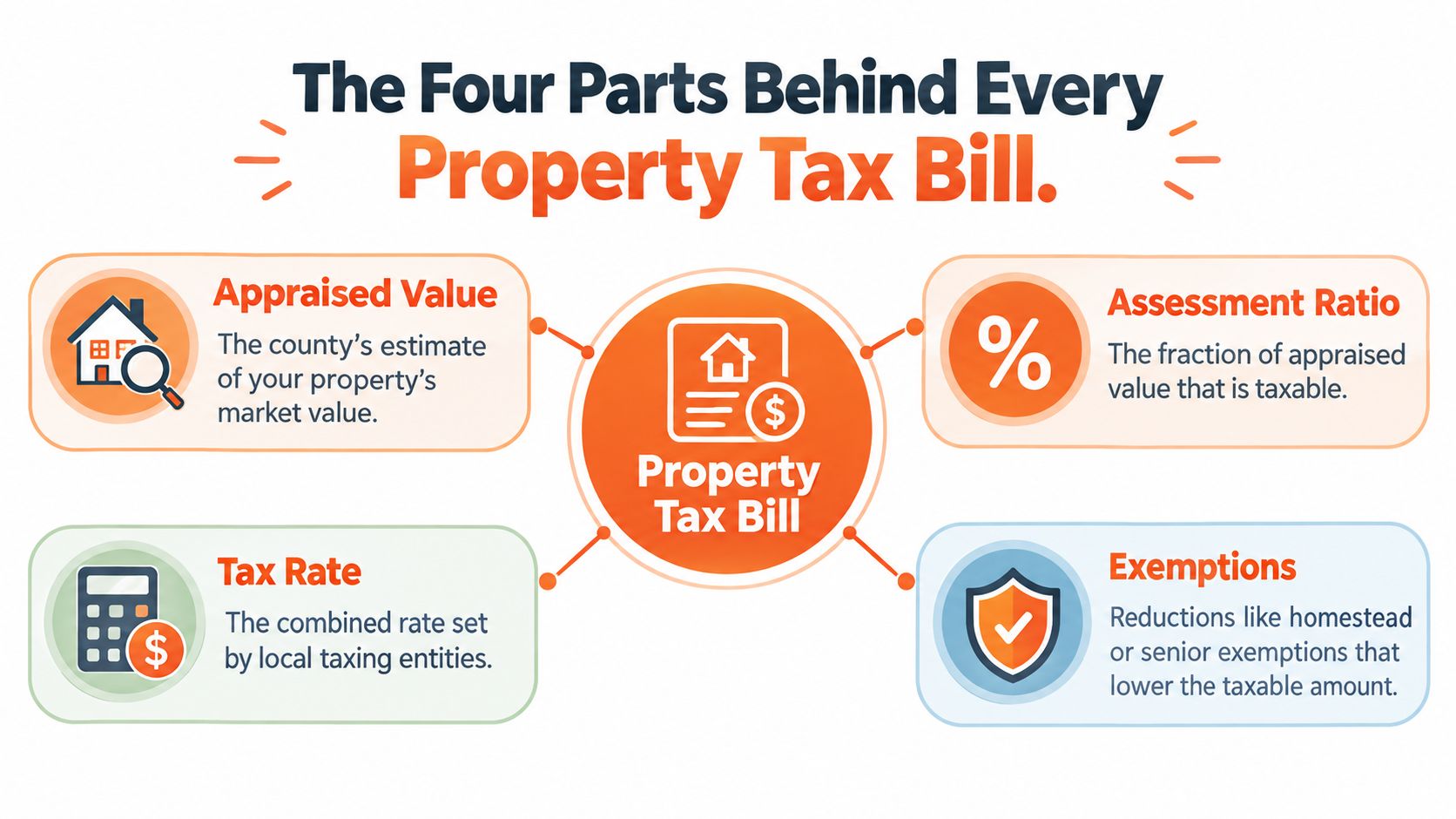
Market value is the price a property could reasonably command in the market, and the appraisal district estimates it from market evidence. Texas law generally requires property to be appraised at current market value and appraisal practices to be equal and uniform. The Texas Constitution also prohibits appraising a property above its fair cash market value, as explained by the Texas House Research Organization.
Next is appraised value, the district's official valuation for the property. It may differ from what you could sell the property for, and a successful protest can change it. Taxable value is what remains after exemptions and other adjustments come off that appraised figure. Finally, tax rate is set by each local taxing unit: school district, city, county, and special districts each levy their own. A rate cut lowers the bill even when taxable value stays flat.
Practical rule: Don't ask only, "Did my home value go down?" Ask which of these four numbers changed.
This distinction matters because homeowners often use "property value" to mean several different figures at once. The Texas property tax calculation guide shows how the values and rates combine into the final amount due. For broader context on what property taxes fund and how they're structured, the Allied Tax Advisors property tax guide is a useful reference.
Find the number that changed, and you've found the reason your bill went down.
When a Lower Appraised Value Drives the Reduction
A lower appraised value can reduce the bill when credible evidence shows the appraisal district's number is too high or unequal compared with similar properties. The evidence might include comparable sales, repair records, or operating data for an income-producing property. Texas appraisal districts determine property value as of January 1 each year, so a valuation correction applies to that annual cycle. A lower value this year doesn't guarantee the next appraisal will stay low.

The math makes the effect clear. If a property is assessed at $500,000 and the combined tax rate is 2%, the estimated tax before exemptions is $10,000. If comparable sales, repair documentation, or income-and-expense data support a revised value of $425,000, the same rate produces about $8,500, a $1,500, or 15%, reduction. The rate hasn't changed. The lower bill comes from correcting the valuation, as shown in the Texas Comptroller's property tax overview.
Evidence should fit the property
For a house, look for sales of similar homes near the relevant appraisal date. A sale from a different neighborhood or a home with substantially different condition may not support your case. If the property needs repairs, keep clear photos, contractor estimates, and invoices that show the issue and its cost.
Rental and commercial owners should organize income-and-expense records. A property that earns less than the appraisal assumes may warrant a closer valuation review. The point isn't to claim that the property is worth less without support. It's to connect the requested value to evidence the appraisal district can evaluate.
A protest is worth considering when the district's value exceeds market evidence or treats your property unequally compared with comparable properties. Don't rely on a general sense that the assessment feels high. Build the case around the property's condition, comparable transactions, and, where relevant, documented operating performance.
How Exemptions Remove Value From the Tax Bill
An exemption lowers the taxable value, not necessarily the home's market value. That's why a homeowner can receive a smaller bill even when comparable-sale prices remain steady. Texas allows partial exemptions that remove a percentage or fixed dollar amount from taxable value, and total exemptions that can exclude the entire value.
Texas's school-district residence homestead exemption is $140,000 under current law. Local taxing units may adopt an additional homestead exemption of up to 20% of appraised value. The actual savings depend on the separate tax rates and exemptions adopted by the school district, county, city, and special districts. The Texas Comptroller's exemption guidance explains the rules and application process.
Consider a $400,000 homestead with an illustrative combined rate of 2%. Without exemptions, the estimated tax is $8,000. Applying only the $140,000 school-district exemption leaves $260,000 taxable for that school-tax component, equivalent to $2,800 in annual tax reduction at that illustrative rate. An eligible local exemption could reduce the taxable amount further, but the actual bill depends on which taxing units have adopted one.
Common exemptions and their effect
| Exemption | Effect on Taxable Value | Typical Eligibility Trigger |
|---|---|---|
| Residence homestead | Removes the applicable exempt amount from taxable value | Owner qualifies for a residence homestead |
| Over-65 or disabled person | Provides additional relief where approved under applicable rules | Owner meets the relevant age or disability criteria |
| Disabled veteran | Reduces taxable value under applicable exemption rules | Veteran meets the qualifying disability requirements |
| Agricultural or timber appraisal | Values qualifying land based on productivity rather than ordinary market value | Land meets the applicable use and qualification rules |
| Other local exemptions | May remove a percentage or fixed amount, depending on local action | Taxing unit has authorized the exemption and owner qualifies |
Travis County offers a simple illustration: a home with a $100,000 market value and a $10,000 exemption is taxed on $90,000 rather than the full value. The county's property tax breaks guide explains how exemptions reduce the taxable base.
Most exemptions require an application to the county appraisal district, generally by May 1. Eligibility is determined by the chief appraiser, not by a tax preparer or consultant. Check your records for an exemption that was missed, denied, or not applied after your eligibility changed. For a closer look at the categories and application process, see this guide to Texas property tax exemptions.
Filing a Successful Protest or Appeal in Texas
Texas property owners can challenge an appraisal if the value is too high, unequal compared with similar properties, or if an exemption or special appraisal was denied. The usual deadline is May 15 or 30 days after the appraisal district delivers the notice of appraised value, whichever is later, according to the Texas Comptroller's protest guidance. Confirm the deadline on your notice and file on time.

Build the case before the hearing
A strong protest connects evidence to a specific claim. If you argue the value is too high, gather comparable sales and explain why they resemble your property. If condition is the issue, document the defects with photos, repair estimates, and invoices. For rentals or commercial buildings, prepare income-and-expense information that reflects the property's actual performance.
Organize the evidence so an appraiser or review board can follow it without guessing. Identify the valuation you're disputing, state the value you believe the evidence supports, and keep the documents that substantiate that position together. If the appraisal district denies a qualifying exemption or special appraisal, include records relevant to that eligibility question.
Keep the deadline separate from the evidence. A compelling case won't help if you miss the filing window.
INTELLI uses licensed property tax consultants and a data-first approach that draws on public and private data to prepare evidence and represent owners before appraisal districts. That's one option for owners who want professional help; you can also prepare and file a protest yourself. Ask any consultant what evidence they'll use, who will represent you, and what happens if the appraisal district doesn't agree.
The process may move from filing to discussion with the appraisal district and, if needed, a formal review. Keep copies of your notice, protest, evidence, and any decision. A reduction is most useful when you understand exactly what was changed and why.
The video below offers another way to review the protest process before deciding how to proceed.
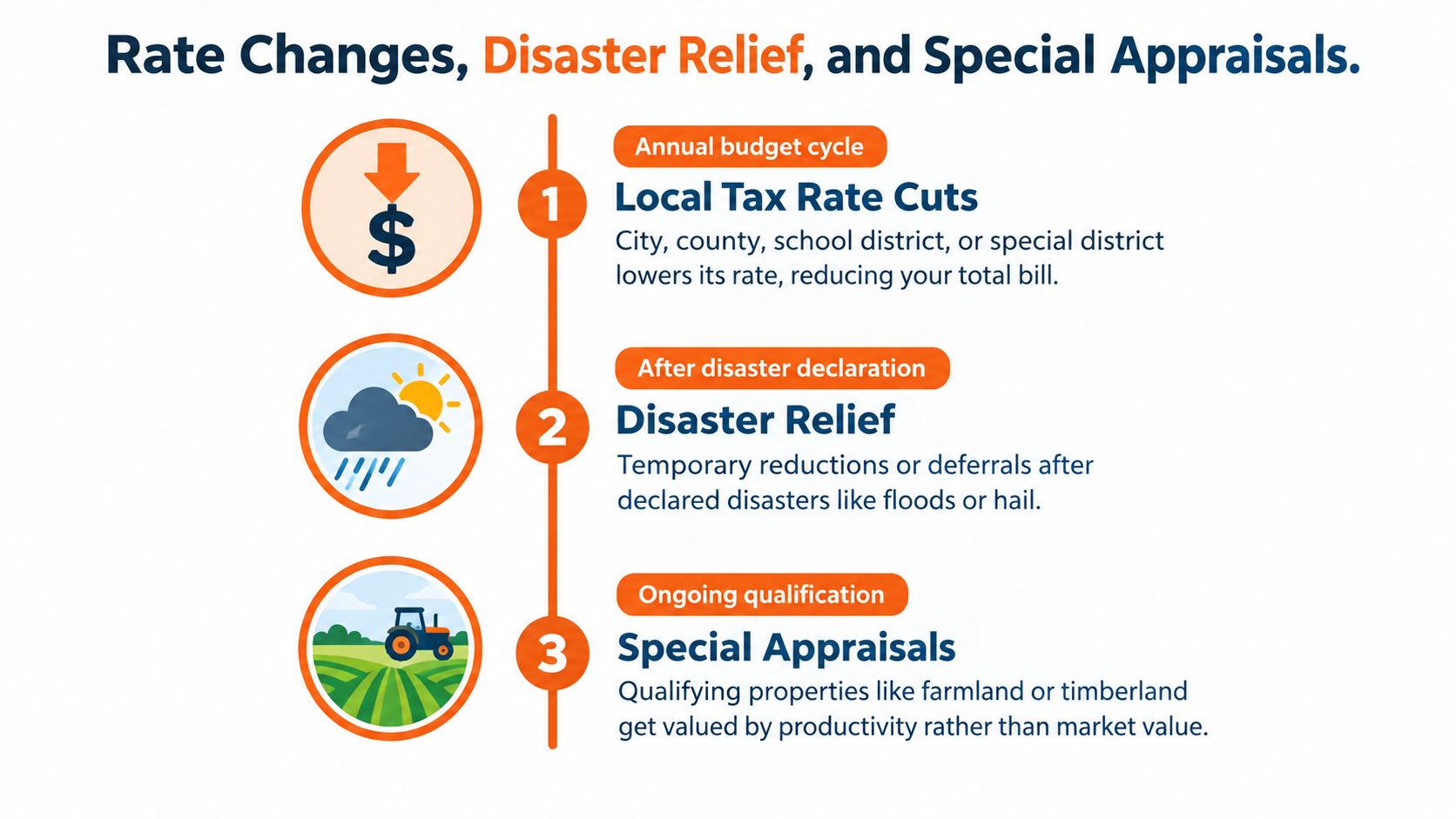
Rate Changes, Disaster Relief, and Special Appraisals
Say a property owner opens this year's statement and the total dropped, yet the building, the land, and the neighborhood market all look the same. The answer usually sits in one of the other three parts of the bill: the appraised value, the taxable value, or the rate each taxing unit applied. Rates and special appraisal categories move the total without any change to what the property would sell for.
Limits and relief can change the taxable amount
Local taxing units set their own rates every year, and a rate reduction lowers the bill even when the appraised value holds steady. The same applies to statutory limits on how fast a value can grow.
Texas has a 2026 circuit-breaker limitation for qualifying non-homestead real property valued at $5.32 million or less, described in the Texas Comptroller's property tax guidance. It caps annual appraised-value increases, though several special-appraisal categories are excluded. A landlord or commercial owner can see slower growth in the appraised value used for taxation without any drop in the property's market price.
Tax treatment differs between similar properties. Homestead exemptions, investor limitations, agricultural appraisal, disaster relief, and local rates don't apply uniformly. When a property sells, a prior owner's limitation or exemption may not transfer unchanged. Verify how the property will be treated under the new ownership and model the next appraisal cycle before projecting the bill.
Qualified properties with at least 15% damage may be eligible for temporary disaster-related exemptions, as described in the Texas Tax Code's disaster exemption provision. This relief addresses qualifying damage rather than a routine shift in neighborhood market prices. Ask the appraisal district what documentation and deadlines apply to the damaged property.
Special appraisal recognizes qualifying use
Agricultural or timber productivity appraisal lowers taxable value for land that qualifies because the appraisal reflects productivity instead of ordinary market value. It follows a different path from a standard protest based on comparable sales. Confirm the land meets the applicable requirements and that the special appraisal appears on the notice.
Each taxing unit adopts its rate through a public process, and the Texas truth-in-taxation guide explains how those rates enter the calculation. A lower rate multiplied against a capped or specially appraised value is where some of the largest reductions come from.
Reading Your Bill to Find Out What Actually Changed
The quickest way to answer “Why did my property taxes go down?” is to compare last year's appraisal notice and tax statement with this year's. Don't stop at the total due. Review the values, exemptions, and individual taxing-unit charges to find the specific change.
Compare the same lines year to year
- Market and appraised values: If the appraised value fell, check whether the district changed its valuation or accepted a protest. Compare the notice's market and appraised values rather than treating them as interchangeable.
- Exemptions and taxable value: If the appraised value is steady but taxable value fell, look for a new or increased exemption, special appraisal, or applicable limitation.
- Taxing-unit rates and amounts: If taxable value is steady but a unit's charge fell, compare that unit's current and prior rate. The change may come from the city, county, school district, or another taxing unit.
- Final bill: Check whether each charge is included in the total and whether the statement reflects the same property and taxing units as the prior year.
| Sign on the Notice | Most Likely Cause | Action to Take |
|---|---|---|
| Appraised value is lower | Valuation correction or appraisal change | Review the evidence and decision behind the value |
| Exemption amount increased | New or updated exemption | Confirm eligibility and keep the approval record |
| Taxable value fell while appraised value stayed similar | Exemption, special appraisal, or limitation | Ask the appraisal district which adjustment applies |
| A taxing unit's charge is lower | Rate or unit-level change | Compare that unit's rates and calculations |
| Property details are inaccurate | Possible clerical or record error | Request a correction and keep supporting documentation |
If the notice doesn't explain the change clearly, contact the county appraisal district or the taxing unit responsible for the charge. Ask which value, exemption, limitation, or rate changed. That answer is more useful than guessing from the total bill.
Turning One Lower Bill Into Recurring Savings
Treat a lower bill as a reason to review your records, not as proof that the work is finished. Texas appraisals happen annually, and eligibility or market evidence can change. A reduction may need to be confirmed or pursued again in a later cycle.
Keep a simple yearly routine:
- Confirm exemptions: Check your approval and file any required application by the applicable deadline.
- Review the appraisal notice: Compare market value, appraised value, taxable value, exemptions, and property details as soon as the notice arrives.
- Decide how to handle a protest: If the value appears unsupported or unequal, gather evidence and consider whether you want a licensed consultant to represent you.
- Ask about past overcharges: A tax recovery audit can review prior bills for clerical errors, incorrect property details, or missed exemptions and pursue any available refund.
INTELLI offers property-tax protests, exemption support, representation before county appraisal districts, and tax recovery audits. Its model is results-based: it only gets paid when taxes go down, so you can ask about the terms and whether your property is a fit before proceeding.
Review your appraisal notice and tax statement together, then get help identifying whether value, exemptions, or rates drove the change. Visit INTELLI to learn about its licensed property tax consultants, public- and private-data approach, and support with Texas protests and exemption reviews.