

You opened your Notice of Appraised Value, saw a number that looks higher than what you could sell for, and now you're trying to work out whether your bill will jump by the same amount. That's the most common Travis County property tax mistake I see. Your appraisal, your exemptions, and the rates set by each taxing unit move independently, and conflating them leads owners to ignore the one lever they can control.
Read your notice as a starting point, not a bill. Check the property characteristics, confirm every exemption you're entitled to, and calendar your protest deadline from the mailing date. If those three items are wrong or missing, you're volunteering to overpay.
How Travis County Property Tax Actually Works
Your bill comes from three separate dials. Turn one and the others don't automatically move. Get this model right and every number that follows makes sense.
The three dials on every bill
Taxable value is what remains after the Travis Central Appraisal District, or TCAD, values your property and exemptions are subtracted. Tax rates are set separately by each taxing unit that covers your parcel. Exemptions shrink the value those rates apply to, but only for the units that grant them.
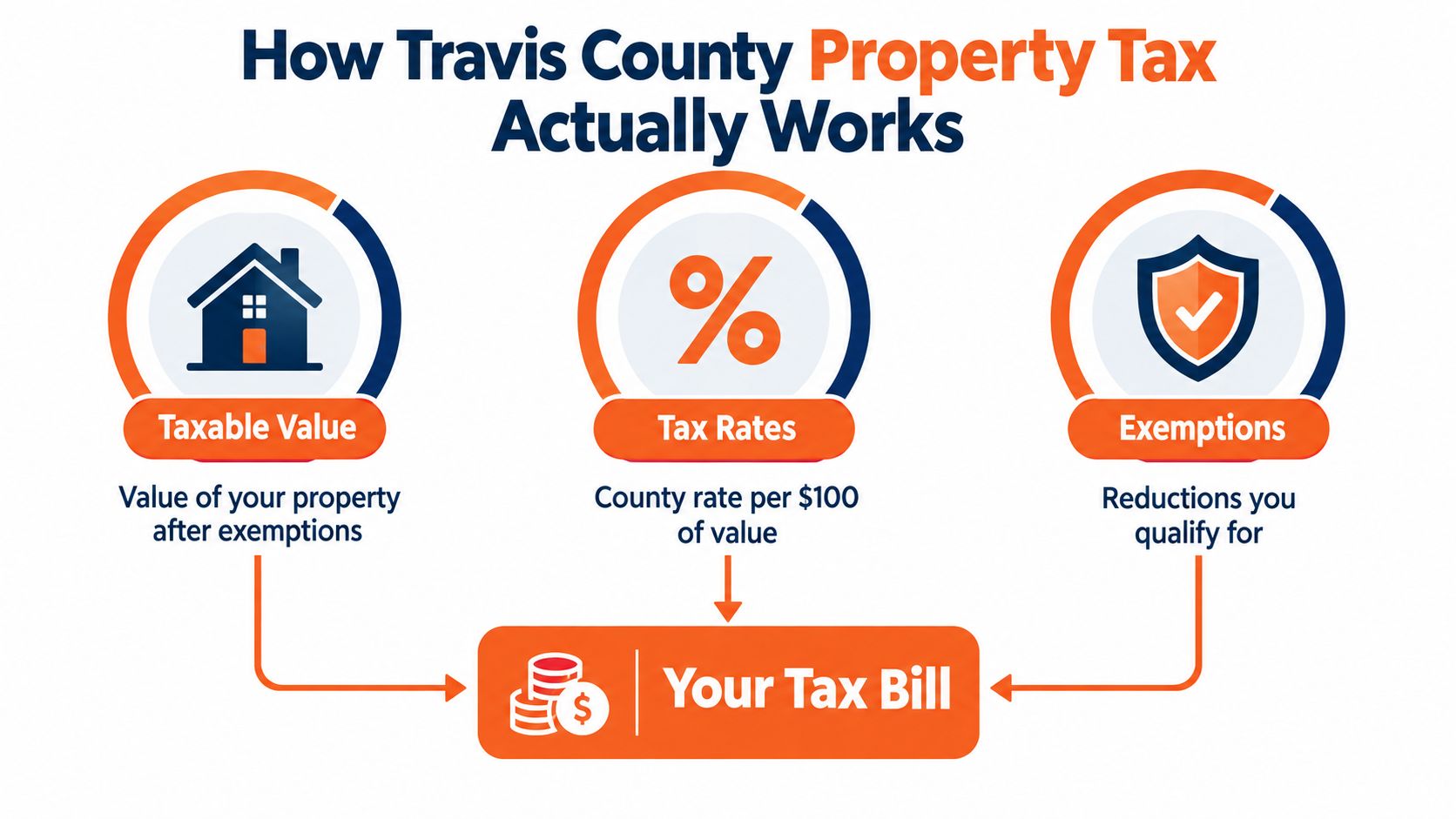
The line labeled Travis County on your statement is rarely the whole story. Depending on your address, the City of Austin, Austin ISD or another school district, Austin Community College, an emergency services district, and a municipal utility district can all tax the same TCAD value. That's why two homes with identical appraisals in different parts of the county can owe very different totals.
For tax year 2025, the county piece alone was $0.344445 per $100 of taxable value, split between $0.306204 for operations and $0.038241 for debt service, according to the county's FY 2025 Budget in Brief. Multiply your taxable value divided by 100 by that rate and you get only the county portion. Every other jurisdiction runs the same math with its own rate.
Practical rule: Never judge a protest by the county line alone. Add up every rate on your property first, because a value cut applies to the stack.
That stacking effect is where evidence quality matters. INTELLI uses licensed property tax consultants and employs a data first approach, using public and private data, to test whether TCAD's value, your recorded characteristics, and comparable properties line up. Whether you hire help or file yourself, insist on that same discipline. Don't argue that taxes feel high. Show, with data, that the value or the underlying property record is wrong.
Inside the Travis Central Appraisal District
TCAD doesn't set your tax rate and it doesn't collect your payment. Its job is mass appraisal, valuing hundreds of thousands of parcels so taxing units can divide their levies. Understanding the scale explains both why errors happen and why a focused protest can work.
What the 2025 roll tells you
TCAD reported 487,831 accounts with a combined market value of $458.49 billion on its 2025 roll, including 423,321 residential accounts at $249.83 billion and 25,758 commercial accounts at $184.16 billion, per the TCAD 2025 Annual Report. Business personal property made up the rest of the accounts described in that report. Residential parcels dominate by count. Commercial parcels carry a disproportionately large share of value.
That composition matters if you're a landlord or commercial owner. You're not a rounding error in the system, and your valuation method will differ from a single family homestead. Income, condition, and comparable commercial evidence carry weight that a simple neighborhood sales pitch won't.
The long view is just as instructive. The county's total roll has grown enormously over two decades, then flattened recently, with the 2025 total slightly below 2024. I'm not going to restate every historical figure here because your protest doesn't turn on county wide growth. It turns on whether your parcel is valued correctly and equitably compared with similar properties this year.
A mass appraisal system will miss deferred maintenance, functional problems, incorrect living area, and unequal treatment. Your job is to document the miss, not complain about the model.
Check your TCAD property record before you look at sales. Owners routinely find wrong square footage, wrong year built details, or condition assumptions that don't match the house. Fix the record first, then build valuation evidence around accurate characteristics. If the inputs are wrong, even a reasonable model produces the wrong answer, and that error flows into every taxing unit's bill.
Travis County Tax Rates and Recent Changes
Rates are adopted by elected bodies after TCAD certifies values. You can't protest a rate at your Appraisal Review Board hearing, but you need to read rates correctly so you don't misjudge what a value reduction is worth.
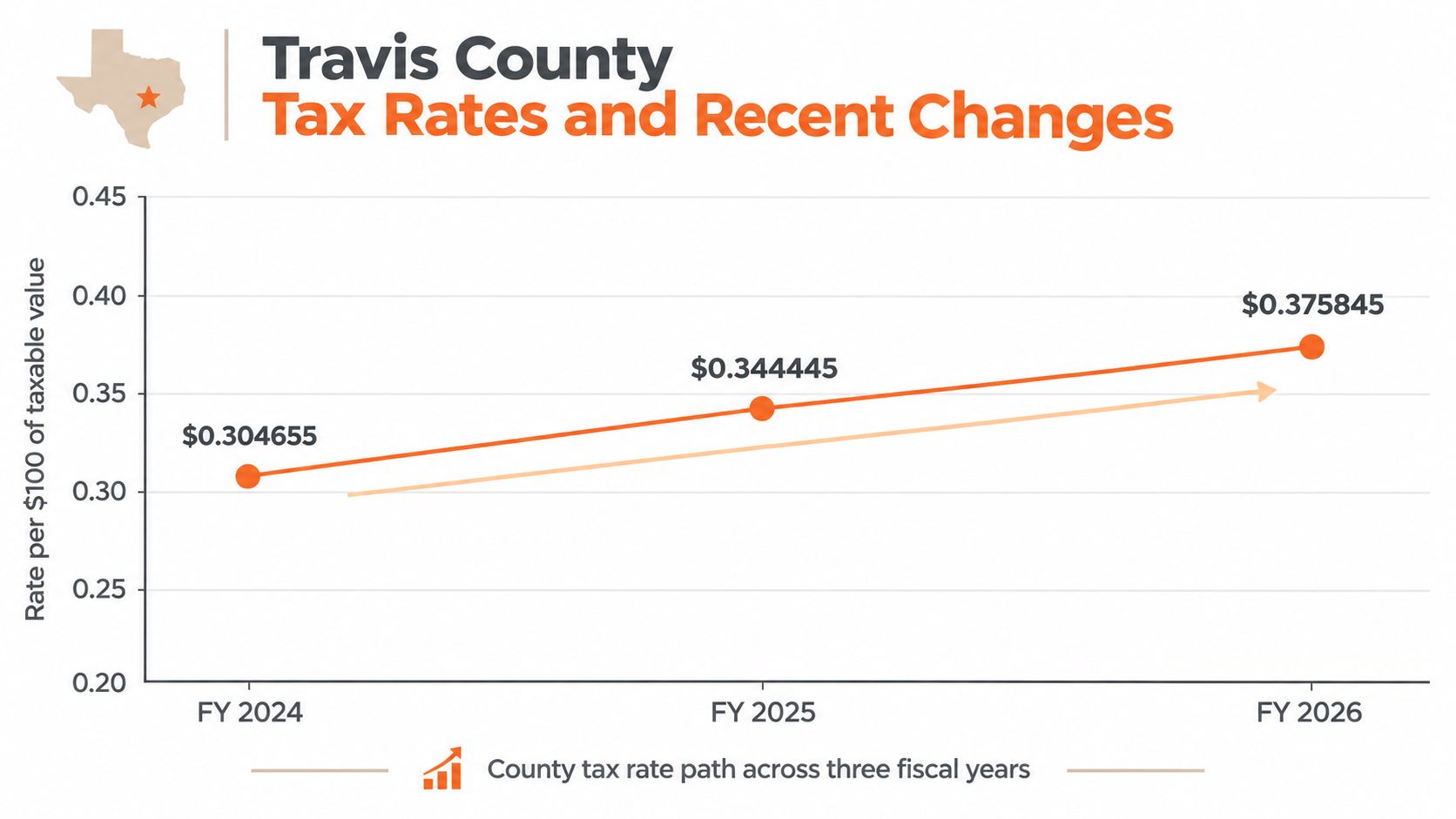
The county rate path shows why bills rose even for some owners whose values softened. Travis County's adopted rate moved from $0.304655 in FY 2024 to $0.375845 in FY 2026, and the FY 2026 step was a 9.12% increase made up of a $0.027620 rise in maintenance and operations and a $0.003780 rise in debt service, according to the Travis County taxpayer impact statement. That statement also illustrates diverging homeowner experiences, with average and median taxable homestead values moving in opposite directions.
How to read your own stack
- Start with the county rate: Identify the operations and debt service pieces separately so you know what you're funding.
- Add every other unit: Pull the city, school, college, and special district rates that apply to your parcel, not a county wide average.
- Use current local data: Review the breakdown in this guide to Austin area tax rates by jurisdiction before you estimate savings.
Don't annualize a single year's rate move into a permanent forecast. Rates reset each budget cycle, values reset each appraisal cycle, and exemptions can change when your status changes. Your controllable work each spring is value and exemptions. Your civic work on rates happens during budget hearings, which is a different calendar and a different room.
Exemptions That Cut Your Taxable Value
A $50,000 reduction in taxable value lowers the tax bill across every taxing unit that applies to the property, not just Travis County. Exemptions work alongside that reduction: they lower the taxable value used to calculate each applicable unit's share. Check exemptions before estimating savings from a protest, because the total bill reflects the value, the combined rates, and the exemptions on your account.
Travis County offers a 20% homestead exemption and an additional $143,220 exemption for qualifying homesteads owned by people age 65 or older or with disabilities. The Texas Comptroller explains the distinction between appraised value and tax rates in its valuing property guidance page. Confirm that eligible exemptions appear on your account before focusing on comparable sales.
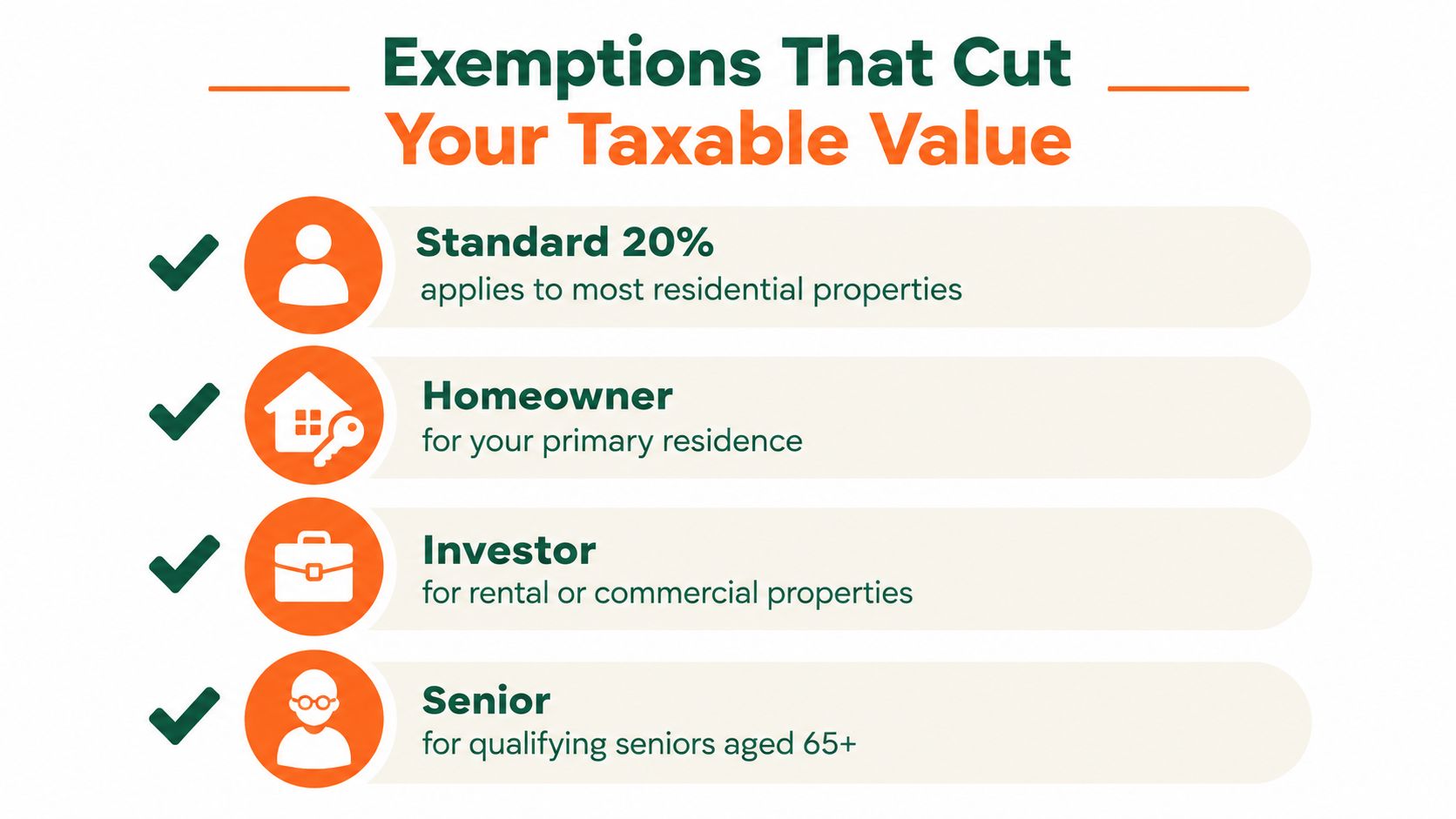
Start with the residence homestead. Make sure the property is your primary residence and the exemption is reflected for each applicable taxing unit. Owners age 65 or older and owners with disabilities should apply rather than assume the status is automatic, then confirm TCAD has recorded it. Disabled veterans should check eligibility and required documentation. Agricultural and historic properties follow special appraisal or designation rules, so confirm the requirements before applying.
Use this guide to Travis County property tax exemptions and filing requirements to identify the application that fits your property. Most exemption and special appraisal applications are due April 30. Missing that date can mean losing a year of savings.
Rental and commercial properties do not qualify for the homestead exemption. Still, check for incorrect coding and see whether the land may qualify for a special appraisal. Keep exemption questions distinct from a valuation protest: they affect different parts of the tax calculation, and mixing them in a hearing weakens the case.
Filing a TCAD Protest Step by Step
A strong protest starts with a timely filing, not a polished argument. Texas owners generally must file by May 15 or within 30 days after TCAD mails the Notice of Appraised Value, whichever is later, according to the Texas Comptroller protest and deadline guidance. The deadline runs from the mailing date, not when the notice arrives or gets opened. If it falls on a weekend or legal holiday, the deadline moves to the next business day.
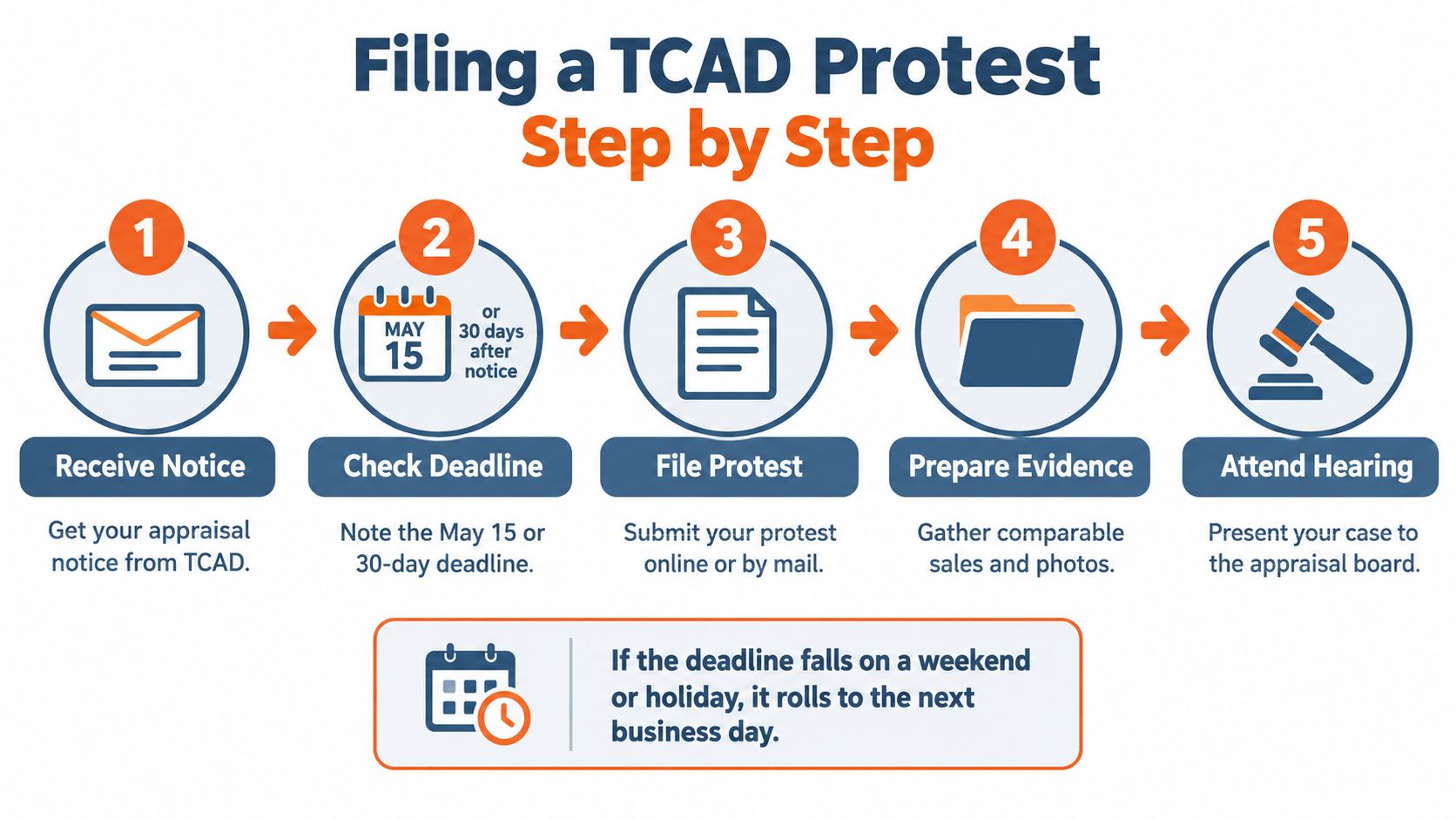
File through a channel TCAD accepts, such as online, by mail, or in person, and save proof of submission. State what you are disputing: the appraised value, unequal appraisal, or an incorrect property characteristic. Request an Appraisal Review Board hearing if needed. An informal conversation with TCAD does not, by itself, protect your right to an ARB hearing.
Once the filing is secure, build evidence around the specific issue. A focused comparable property analysis for your protest evidence is more useful than a pile of unadjusted sales. Account for differences in size, condition, location, and sale timing. If you are challenging condition, include photos and repair estimates.
The embedded walkthrough shows the filing sequence:
Late protests are not a fallback. TCAD says they are considered only in limited circumstances such as serious illness and generally must arrive before the Appraisal Review Board approves records in mid-July, according to its property tax system overview. Treat that exception as a last resort, not a filing strategy.
Why Appraising Down Is Almost Always Worth More Than Rate Cuts
A $50,000 reduction in taxable value can lower the tax charged by every taxing unit on a property, not just Travis County. That makes a well-supported appraisal protest a direct way to reduce the bill, while a rate cut depends on decisions by local officials.
On $500,000 of taxable value, the 2025 county portion would be about $1,722.23 before exemptions or other jurisdictions, using the $0.344445 rate in the county's 2025 tax rate notice. A value reduction is multiplied by the county rate and by the rates of the city, school district, and any special districts taxing the property. The county figure is only one part of the total bill.
Consider the three levers together. An official rate cut affects a bill only if the taxing unit adopts one, and another unit could raise its rate. A successful appraisal protest lowers the property's taxable base across the units that use it. An eligible exemption lowers taxable value before those rates are applied, so check for exemptions as carefully as you review the appraisal.
At an ARB hearing, focus on evidence for your property's value or appraisal equality. You cannot set local budgets there.
A protest is not automatically worthwhile every year. If TCAD's appraisal is defensible and comparable assessments support it, weak evidence is unlikely to help. Check the property record for errors, then build a case with credible comparable sales or equity evidence. Document condition problems with evidence that shows what the appraisal may have missed.
For commercial property, income and expense records can support a value challenge where appropriate. For rentals, compare market rent assumptions with actual performance. The calculation is the same across property types: a lower taxable value reduces each applicable tax component, while exemptions can lower the starting base further. Check both before deciding whether the county portion alone reflects the likely savings.
Worked Examples for Three Travis County Property Types
Abstract formulas don't tell you whether a protest is worth an afternoon. These illustrative profiles use a hypothetical $50,000 appraisal reduction and the FY 2025 county rate described earlier to isolate the county effect. Your total savings will be larger if other taxing units also tax the parcel, and smaller if an exemption or cap means the full market reduction doesn't flow into taxable value.
| Property Profile | Starting Taxable Value | After Reduction | Homestead/Over-65 Exemptions | Approximate County Tax Savings |
|---|---|---|---|---|
| Owner-occupied homestead, under 65 | $500,000 example | $450,000 | County homestead exemption already reflected in taxable value | About $172 on the county portion |
| Qualifying senior homestead | $500,000 example | $450,000 | Homestead plus additional age 65 exemption already reflected | About $172 on the county portion if taxable value falls by the full amount |
| Small rental property | $750,000 example | $700,000 | No homestead exemption | About $172 on the county portion |
How to read these results
The county savings look identical because the table isolates one variable, a $50,000 drop in taxable value, against one rate. That's the point. In real bills, the senior homestead starts from a lower taxable base because exemptions have already done substantial work, while the rental gets no homestead protection and feels the full appraisal. Add city, school, and special district rates and the same reduction produces a bigger total, by an amount that depends entirely on the property's jurisdiction stack.
Run your own version before filing. Take your proposed value reduction, divide by 100, and multiply by each rate on your statement. If the combined result is trivial and your evidence is thin, redirect your effort to exemptions and record corrections. If it's material, file and prepare properly.
Common Misconceptions About Travis County Property Tax
Myth 1: A lower appraisal cuts my bill by the same percentage. It doesn't. Rates can rise while values fall, exemptions interact with taxable value, and each taxing unit decides separately. Do the property level math instead of assuming a one to one result.
Myth 2: Exemptions appear automatically when I qualify. They generally require an application and TCAD coding. Verify yours on the property record every year, especially after a move, a death in the household, or a change in disability or veteran status.
Three more costly assumptions
- Paying means I accepted the value: Payment and protest operate on different calendars. Don't let a paid bill talk you out of a timely protest the following spring.
- Landlords and commercial owners can't protest effectively: They can, but they need evidence suited to the property type, not a homestead comparable sales packet.
- Missing May 15 ends everything forever: It usually ends that year's regular protest, subject to narrow late exceptions noted earlier. It doesn't remove next year's right, and it doesn't excuse skipping exemption deadlines.
Your action plan is short. Confirm exemptions by April 30, file a specific and documented protest by your May deadline if the evidence supports it, and estimate savings across your full rate stack before deciding how hard to push. That's how Travis County property tax stops being a surprise and becomes a managed annual cost.
If your TCAD value looks unsupported, your exemptions aren't coded correctly, or you don't want to build comparable evidence and attend a hearing alone, INTELLI can review your Travis County property, handle the protest and exemption deadlines, and represent you with licensed consultants using public and private data. Visit INTELLI to request a property review before your filing window closes, and pay only under its results based model when your taxes go down.