
Your homestead exemption has been approved, or your property-tax protest ended with a lower value. You've already paid the bill, so you're expecting money back. But the check hasn't arrived, and the account information doesn't tell you whether anyone is processing a refund.
When Homeowners Start Asking About Their Property Tax Refund Status
A mid-summer exemption approval can feel like the end of the process. You have the approval document, you know your taxable value should be lower, and you're ready to put the overpayment toward another household expense. The difficult part is figuring out what happened between that approval and the payment you're waiting for.
That's where a property tax refund status review needs to become more specific than asking whether your refund is pending. An approval, a corrected bill, an account credit, and an issued refund are different checkpoints. Keep them separate when you review your records or speak with the county.
An exemption approval is a useful starting document, but it isn't a payment confirmation.

Start with the event that created the overpayment
Texas refund tracking follows different paths depending on whether you received a corrected assessment, made an erroneous payment, or paid conditionally while a dispute remained unresolved. Don't assume that the same paperwork or starting date applies to every path.
Before contacting an office, write down what changed and what you're trying to confirm:
- An exemption or valuation changed. Look for the approval or final determination, followed by the corrected tax information.
- Something went wrong with the payment. Gather the payment receipt and any refund-application correspondence.
- You paid during a pending dispute. Establish whether the dispute has reached a final determination before looking for a refund payment.
Practical rule: Ask which processing step is incomplete, not just whether the refund is pending.
That question gives the employee something concrete to investigate. It also helps you avoid submitting another application when the missing step is a correction, or waiting for an automatic payment when the collector needs a claim.
The useful sequence is straightforward: identify the trigger, gather the records, check the responsible office, and escalate against the applicable timeline. Keep a written record of the answer at each stage so your next inquiry starts where the last one ended.
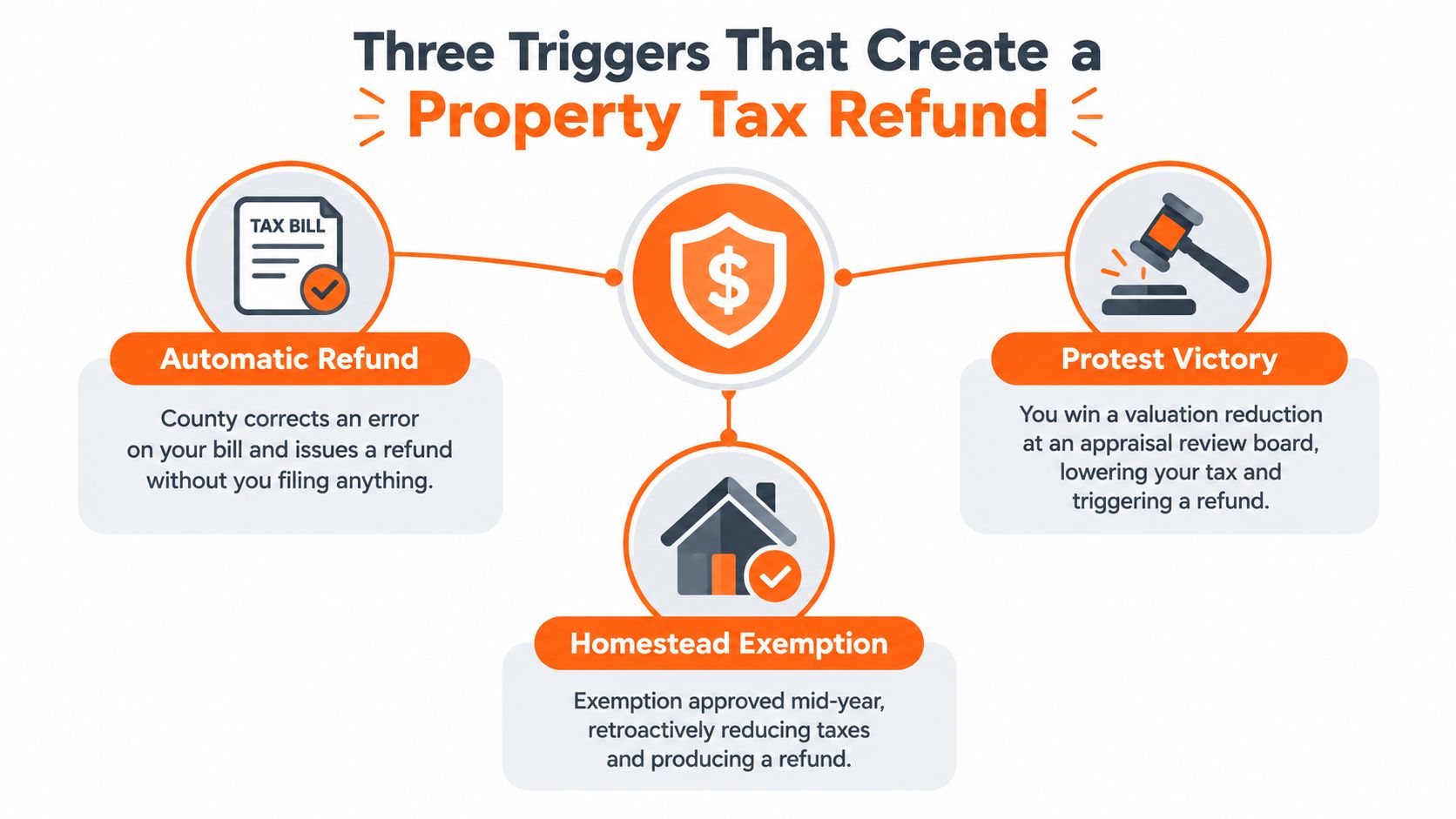
The Three Triggers That Create a Property Tax Refund
The refund trigger determines the tracking path. A lower property value and a payment mistake can both leave you with an apparent overpayment, but they don't necessarily require the same action.
The visual below highlights common correction events. A protest victory and a homestead approval can both feed into the corrected-tax-roll path rather than creating separate payment procedures.
Automatic refunds following a correction
Approved late homestead exemptions, valuation corrections, court-ordered appraisal changes, and voter-approved rate reductions can create automatic refunds after paid liability is reduced. Texas taxing units generally must issue the resulting overpayment within 60 days of correcting the tax roll; refunds of at least $20 are generally automatic, while smaller amounts typically require an application, according to the Texas Comptroller's property-tax refund guidance.
The threshold was reinforced by 2025 legislation effective September 1, 2025, for applicable liabilities arising on or after that date, under that same guidance. The important practical distinction is that an approval date isn't necessarily the tax-roll correction date.
Application-based and conditional-payment refunds
For an erroneous payment, ask the collector whether a refund application is required. Duplicate payments, incorrect check amounts, and ownership or remitter questions deserve particular attention because the office may need to establish who is entitled to receive the money.
A duplicate payment shouldn't be classified solely by its label. It may appear through a correction process, but you should confirm whether the collector requires an application for your particular account.
A conditional-payment refund follows a different sequence: the owner pays before delinquency while a protest, appeal, or challenge remains pending, and the collector applies the final liability after resolution. The amount available for repayment depends on that outcome.
- Correction path: Ask whether the corrected liability has reached the tax account.
- Application path: Ask whether the claim is complete and entitlement has been verified.
- Conditional-payment path: Ask whether the underlying dispute is finalized.
If you're also comparing refund terminology, the meaning of a rebate in tax provides useful context. For tracking purposes, however, focus on the event and the required procedure, not the word used in a letter.
Documents and Records You Need Before Checking Status
Prepare a compact account file before you call. The purpose isn't to send the county every document you own. It's to make the relationship between the original assessment, the correction, and the payment easy to follow.
Start with your property account number, property address, owner name, and relevant tax year. Then arrange the supporting documents in chronological order. A receipt without a matching tax year or an approval without its effective period can leave the employee unable to connect the records confidently.
This checklist illustrates the core documents to keep together.
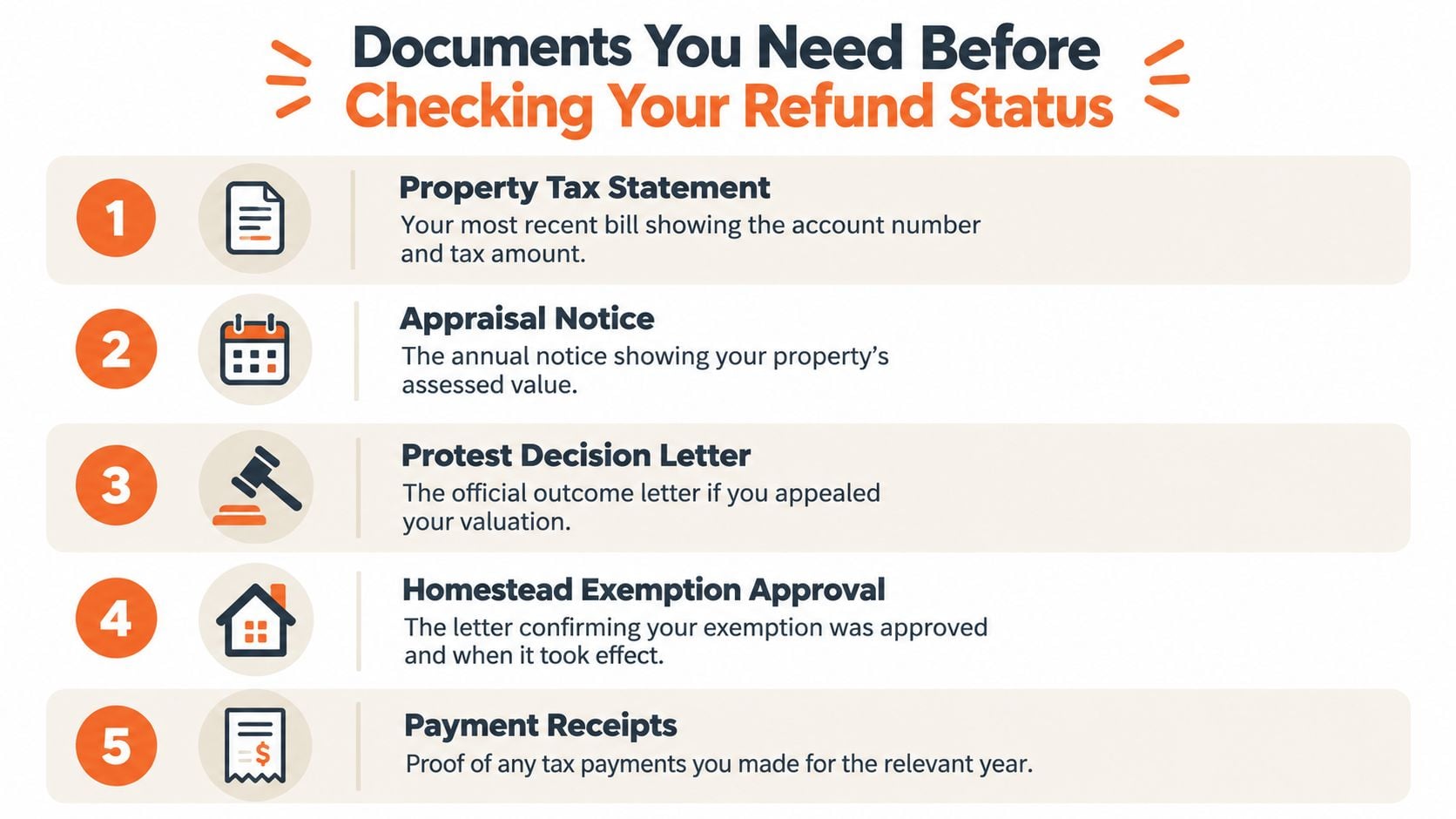
Build a file that answers the collector's questions
- Assessment records: Include the Notice of Appraised Value and original property-tax statement.
- Approval evidence: Save the protest decision, exemption approval, and submission confirmations.
- Corrected liability: Obtain the revised bill or corrected tax-roll information, not just the favorable decision.
- Payment evidence: Include receipts and applicable escrow statements showing the original remittance.
- Processing history: Keep refund applications, acknowledgments, and prior correspondence together.
The distinction between appraised value and taxable value matters when organizing the file. Don't substitute a valuation decision for the corrected tax information needed to explain the overpayment.
Use a separate worksheet for each taxing unit's corrected taxable value, original payment, refund principal, interest, and outstanding balance. That approach helps you test whether the account is fully resolved rather than treating a single payment as proof that everything is finished.
Send readable records, not a document dump
Use descriptive filenames and preserve the original documents. The guide to Texas property-tax records can help orient your record review.
If you need help preparing documents for transmission, PDFKing's practical PDF guide is a relevant resource. Confirm the receiving office's submission requirements first, and send only the records needed for the question you're asking.
County-Specific Paths for Checking Property Tax Refund Status
For a Travis County property, separate appraisal processing from tax payment processing. Start with Travis Central Appraisal District when you need to verify the valuation evidence or determination. Move to the tax collector when the question is whether a correction has produced a refund.
Have your account file open before you contact either office.
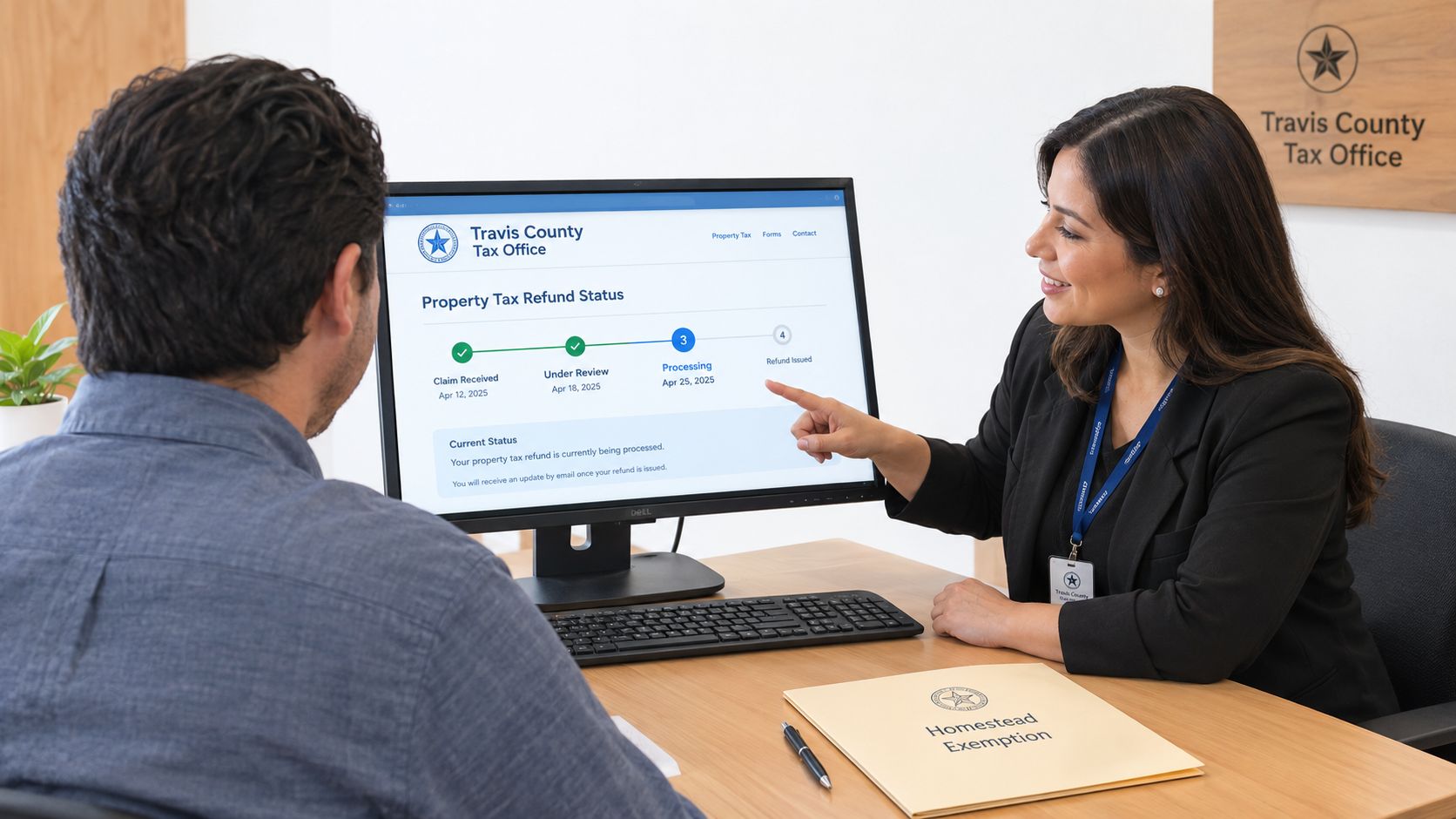
Verify the appraisal record first
Travis Central Appraisal District reports estimated evidence-processing times of about two hours through its online portal, compared with five business days for mail or in-person submissions, on its Get in Line Online guidance page. Those estimates concern evidence processing, not refund issuance.
The portal offers a practical advantage when you need to confirm that supporting documents are in the district's record before discussing the case. Mail or in-person delivery may suit your circumstances, but delivery itself isn't the same as acceptance into the record.
Ask focused questions:
- Evidence acceptance: Has the district processed the submitted comparable sales, photographs, measurements, and condition evidence?
- Final determination: Is the corrected value final, and can you obtain the supporting record?
- Correction information: What documentation confirms the tax-roll change?
Save the answers and confirmations. Don't rely on a verbal understanding that your value will be reduced when the collector needs the completed correction.
Ask the collector about the money
Once the valuation or exemption work is complete, payment-status questions belong with the tax collector, not the appraisal district. Ask whether the corrected liability is reflected on the account, whether an application is needed, and what remains before payment can be issued.
The video is an additional resource to view alongside your account review.
For other Texas counties, use the same division of responsibilities without assuming their portals or submission procedures match Travis County's. Verify the office responsible for your property and the accounts it handles. The Brazoria tax office guide is a county-specific starting point for owners there.
A portal confirmation tells you a document was processed. It doesn't tell you a refund was issued.
When calling, describe the exact stage: evidence submitted, determination received, correction posted, application accepted, or payment outstanding. That's more useful than asking an appraisal employee to locate a check.
Realistic Timelines and the 60-Day Rule
A refund timeline needs a documented starting event. Counting from the day you first expected savings can make a normal processing sequence look overdue, while failing to record the correction or application date can conceal a genuine delay.
The annual calendar matters too. Texas property taxes are generally due by January 31, and unpaid taxes generally become delinquent on February 1, according to the Texas Comptroller's property-tax payment guidance.
Property Tax Refund Timelines in Texas
| Refund Trigger | Typical Window | Key Status Checkpoint |
|---|---|---|
| Automatic correction refund | The correction-based window described earlier | Date the collector's tax roll was corrected |
| Application-based refund | Travis County states a correctly completed application is followed by a refund within 60 days, in its property-tax refund FAQ | Receipt of the correctly completed application |
| Conditional-payment refund | Follows resolution and application of the final tax liability | Final determination and corrected account |
Travis Central Appraisal District notes that bills are generally issued around October 1, and certain exemption applications require annual filing by April 30, including tax-abatement, historic and archeological, miscellaneous, low-income housing, and Freeport exemptions, in its previously linked guidance. Review the exemption filing history as well as payment records when investigating the account.
Escalate using the right date
Texas guidance states that refunds not paid by the 60th day can accrue 12 percent annual interest, an issue addressed in the Travis County refund guidance linked in the table. Ask the collector to explain whether interest applies to your refund and how it will appear separately from principal.
Don't treat interest as a guaranteed addition without confirming the applicable circumstances. Send a written inquiry identifying the starting event, its supporting document, and the unresolved payment.
Escalation checkpoint: Request the processing date and the reason for delay in writing before describing the refund as overdue.
Keep unrelated tax-refund research separate. For readers also investigating federal return messages, The Money Maniac explains tax topic 152. Don't use a federal refund explanation to calculate a Texas county property-tax refund deadline.
Why a Refund Status Stays Pending Longer Than Expected
Winning the protest isn't proof that every refund has been paid. A favorable determination establishes the valuation outcome, but your account review still needs the correction and payment records. Chasing a check before those records are complete can send you around the same loop repeatedly.
The most useful audit trail begins before the protest meeting. Preserve the evidence submission, confirmation of acceptance, final determination, correction record, payment receipt, and subsequent refund correspondence. The collector shouldn't have to reconstruct the appraisal dispute from your recollection.
Look for the missing handoff
A pending account deserves a narrower diagnosis than “the county is slow.”
- Evidence wasn't processed: Confirm acceptance before relying on material discussed during an informal meeting.
- The decision hasn't reached the account: Obtain the corrected tax information rather than forwarding only the protest result.
- One account remains unresolved: Review each taxing unit separately instead of assuming a payment covers every component.
- Entitlement is unclear: Ask whether ownership or remitter information is holding up the application.
For a rental portfolio or commercial property, keep these checks organized by property and tax year. Combining accounts in a single email without a clear reconciliation makes it harder to identify what remains outstanding.
A missed protest deadline requires a different review
The ordinary Texas protest deadline is generally May 15 or the 30th day after the appraisal notice is mailed, whichever is later, according to the Texas Comptroller's protest and appeal guidance. Missing that deadline can close the ordinary protest route.
Limited late-protest situations can still apply, including failure to receive a notice the appraisal district or appraisal review board was required to send. The owner generally must act before delinquency and avoid allowing the taxes to become delinquent under that guidance.
A conditional payment can preserve the payment side of an eligible pending dispute, but it doesn't revive a missed protest deadline by itself. Keep the remedy question separate from the refund question: first establish a valid correction path, then track any resulting repayment.
Practical Tips and Next Steps When Your Refund Is Delayed
Send a focused written status request when the expected processing window has passed. Include the account identifier, tax year, refund trigger, relevant correction or application date, and the document supporting that date. Ask for the specific unresolved step and the action needed to complete it.
Avoid sending the same broad complaint to both offices. Direct valuation-record questions to the appraisal district and payment-processing questions to the collector. If an employee says another office must act, ask which document or correction is missing so you can follow up precisely.
Make the next inquiry actionable
- Confirm the trigger: State whether you're tracking a correction, an application, or repayment after a conditional payment.
- Check every affected account: Request confirmation that the corrected liability is reflected for each taxing unit.
- Resolve document gaps: Supply missing payment, exemption, ownership, or remitter records.
- Request an explanation: Ask for the payment status and any applicable interest determination in writing.
If a real estate agent is helping assemble the property file, you can browse PDFWix realtor tools as an optional document resource. Follow the county's instructions for the actual submission.
Know when to bring in a consultant
A licensed consultant is worth considering when the correction trail is unclear, several properties are involved, or past overcharges may need review. Alongside handling the inquiry yourself, INTELLI is an option: its licensed property tax consultants employ a data-first approach using public and private data to check deadlines and supporting records, and can pursue past overcharges through a tax-recovery audit.
If you missed the ordinary protest deadline, request a remedy review rather than assuming every recovery route is closed. The limited exceptions and conditional-payment procedure described earlier depend on eligibility and timing, not on having paid too much.
Treat a stuck refund as a documentation or processing question to resolve before concluding that the money is lost. A complete file gives you a concrete basis for the next call.
INTELLI offers property-tax refund record reviews and tax-recovery audits to investigate eligible past overcharges. Visit INTELLI with your corrected bill, payment receipts, and refund correspondence to discuss the next step for your unresolved account.