
Many landowners get improved vs unimproved land exactly backward. They hear “improved” and assume it's always the better, cheaper, safer tax result, then they buy a tract or file a protest and learn the assessor is using a different rulebook entirely. In Texas, that shortcut can cost real money because valuation method, land use, utility access, and special appraisal status often matter more than whether a building sits on the parcel.
| Dimension | Improved Land | Unimproved Land |
|---|---|---|
| Physical condition | Has measurable site or structural improvements | Lacks buildings or significant site improvements |
| Texas valuation focus | Land value plus a separately supported improvement value | Land value analyzed on its own |
| Typical appraisal inputs | Structure details, depreciation, utilities, access, condition | Comparable land sales, land schedules, access, zoning, utility availability |
| Tax risk | Inflated improvement records can overstate value | Raw land can still be priced aggressively if development potential is assumed |
| Best challenge angle | Break apart the building component from land value | Attack land comparables, land schedule, and use assumptions |
The right question isn't “Is there a building?” It's “What is the assessor valuing, and under what legal category?” That's the lens I use in hearings, and it's the same lens INTELLI uses licensed property tax consultants and employs a data first approach, using public and private data when evaluating valuation, land-use, and exemption issues.
Why the Improved Versus Unimproved Shorthand Misleads Texas Owners
“Improved” does not automatically mean cheaper, safer, or easier to defend on a Texas tax roll. A vacant tract can carry a high taxable value because of access, utilities, development potential, or a land schedule. A parcel with a house can also have an overstated improvement component. The physical condition matters, but the valuation method and tax classification often matter more.
The label is not the same as the value
Older agricultural usage treated improved land as land regularly tilled or mowed, cleared or tilled pasture, fallow land, gardens, orchards, vineyards, nurseries, and land occupied by farm buildings. Unimproved land included brush, rough or stony ground, swamps, and other land that was neither improved nor forested. That history shows the term has long described use, not merely whether a roof sits on the parcel.
Modern land-use systems follow the same principle. Roads, utilities, entitlements, and site work can change how a tract functions and how buyers value it USDA Forest Service analysis. Texas appraisal districts then record those factors through acreage categories, access details, utility information, and measurable improvements. The result is a tax record that may not match the language used in a sales brochure.
In hearings, I see owners bring a listing sheet showing vacant land while the appraisal card shows road frontage, utilities, and a land schedule premium. The card controls the district's starting position. A parcel's classification can also shift over time, and the same tract may receive different treatment for market value, productivity value, and exemption purposes.
Read the appraisal card, not the brochure
Before buying or protesting, inspect the fields that support the district's value. Check the improvement description, utility access, road frontage, acreage by use category, and notes about site work or structures. These entries reveal what the district believes it is valuing.
For a plain-English comparison of raw and developed parcels, improved land options explained separates common land descriptions without treating every vacant tract alike. Texas owners should also compare the land's actual use with county requirements for agricultural treatment, including the criteria described in what qualifies as an agricultural exemption.
Practical rule: if the appraisal card says “unimproved,” keep reading. Check whether the district assigned a high land schedule, assumed strong development potential, or added a utility-based premium. Those entries can matter more than the label.
How Improved and Unimproved Land Are Defined and Classified
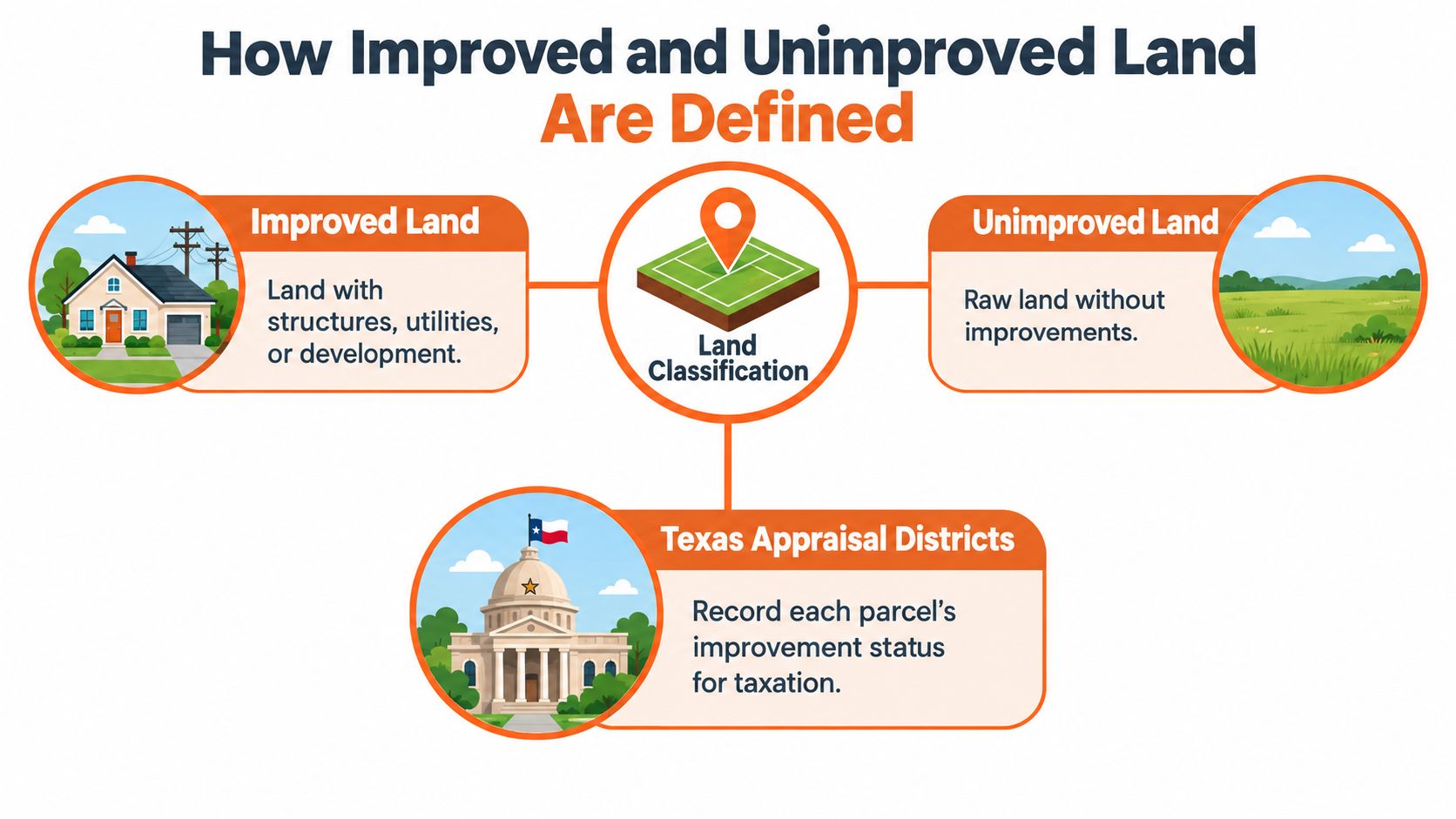
The buildings-or-no-buildings shortcut misleads Texas owners. A tract can lack a house yet carry measurable site work, utility access, or development-related value. A parcel with a structure can also lose value when that improvement becomes obsolete or unusable. Classification follows the land's condition, use, and recorded features, not the wording in a sales brochure.
Historically, “improved” land meant land made productive or actively maintained, while “unimproved” land included rough, swampy, brush-covered, or otherwise unused ground, as described in the U.S. Census agriculture bulletin. The historical distinction still helps explain modern property records, though Texas appraisal districts apply it through current use categories and measurable property characteristics.
What the district records
Texas appraisal districts record more than whether a building exists. They identify measurable improvements, their type, and the value they contribute beyond the site itself. A barn, driveway, utility connection, fencing, or substantial grading can move a parcel away from a raw-land profile.
Review the record for the use category, road access, utility status, acreage allocation, and improvement descriptions. Errors in those fields can place the tract in a higher valuation category, especially near expanding communities. For a plain-language comparison of raw and developed parcels, improved land options explained provides useful terminology.
Why classification changes over time
Land can move between categories as its condition and use change. Clearing may make a tract buildable. Agricultural acreage may face subdivision pressure. Demolition, deferred maintenance, or obsolete utilities may reduce the contribution of existing improvements.
The physical appearance is only part of the record. Owners considering agricultural treatment should review the county requirements in this guide to what qualifies as an agricultural exemption, then compare those requirements with the land's documented use.
Improved land contains measurable human work, such as structures, utilities, or substantial site preparation. Unimproved land lacks those features, yet it may still be developable, valuable, and expensive to own.
The classification describes the parcel. It does not prove that the tax value is fair.
Comparing How Texas Assessors Value Each Parcel Type
The “buildings or no buildings” test is too blunt for Texas property tax work. An unimproved tract can carry a higher tax burden than a built parcel when its location, development potential, or special appraisal status drives the record. Assessors value each acre according to its evidence and classification.
Land-only analysis versus stacked valuation
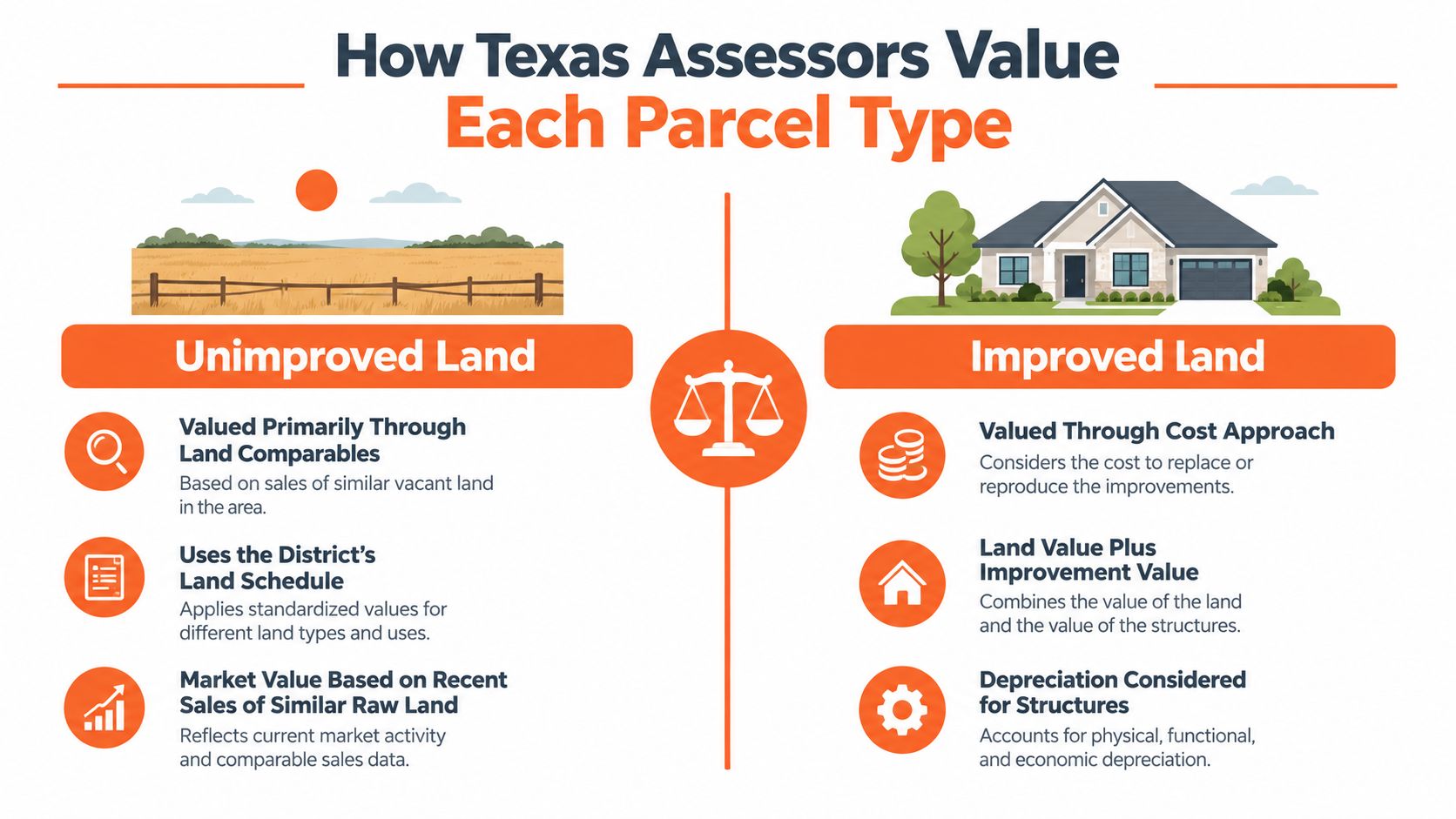
For unimproved land, the district typically examines sales of comparable raw parcels and adjusts for size, location, access, utilities, and other site characteristics. The land schedule then applies a price-per-acre or price-per-square-foot framework across a defined area. A vacant tract can still be expensive if nearby development supports a strong land schedule.
Improved property requires two related judgments: the value of the land and the value contributed by buildings or site work. Under Texas appraisal practice, the district may use the cost approach, estimating the replacement cost of a structure with equal utility, applying depreciation, and adding the result to land value Texas appraisal rule. The appraisal card must accurately identify dimensions, construction type, use, effective age, condition, and depreciation.
A parcel's physical appearance does not determine whether the stacked valuation is correct. The record must support each component.
What drives each side of the comparison
| Valuation point | Unimproved land | Improved property |
|---|---|---|
| Primary evidence | Land comparables | Cost support plus land comparables |
| Key district tool | Land schedule | Improvement schedule and cost approach |
| Sensitive data fields | Access, zoning, utility availability | Square footage, condition, age, depreciation |
| Common failure point | Bad comparable land sales | Overstated structure value or duplicated site work |
Check the improvement schedule line for paving and utilities against the site-work notes on the appraisal card. That comparison can reveal a driveway, hookup, or grading item recorded in both places. A rent roll does not fix a bad appraisal card.
Owners should challenge unsupported inputs, not merely argue that the total feels high. For an unimproved tract, start with comparable land sales and the district's adjustments. For an improved parcel, test every building measurement, condition rating, depreciation entry, and site-work charge. The valuation method explains the number, but the underlying entries determine whether it holds up.
Tax Treatment, Exemptions, and Productivity Value in Texas
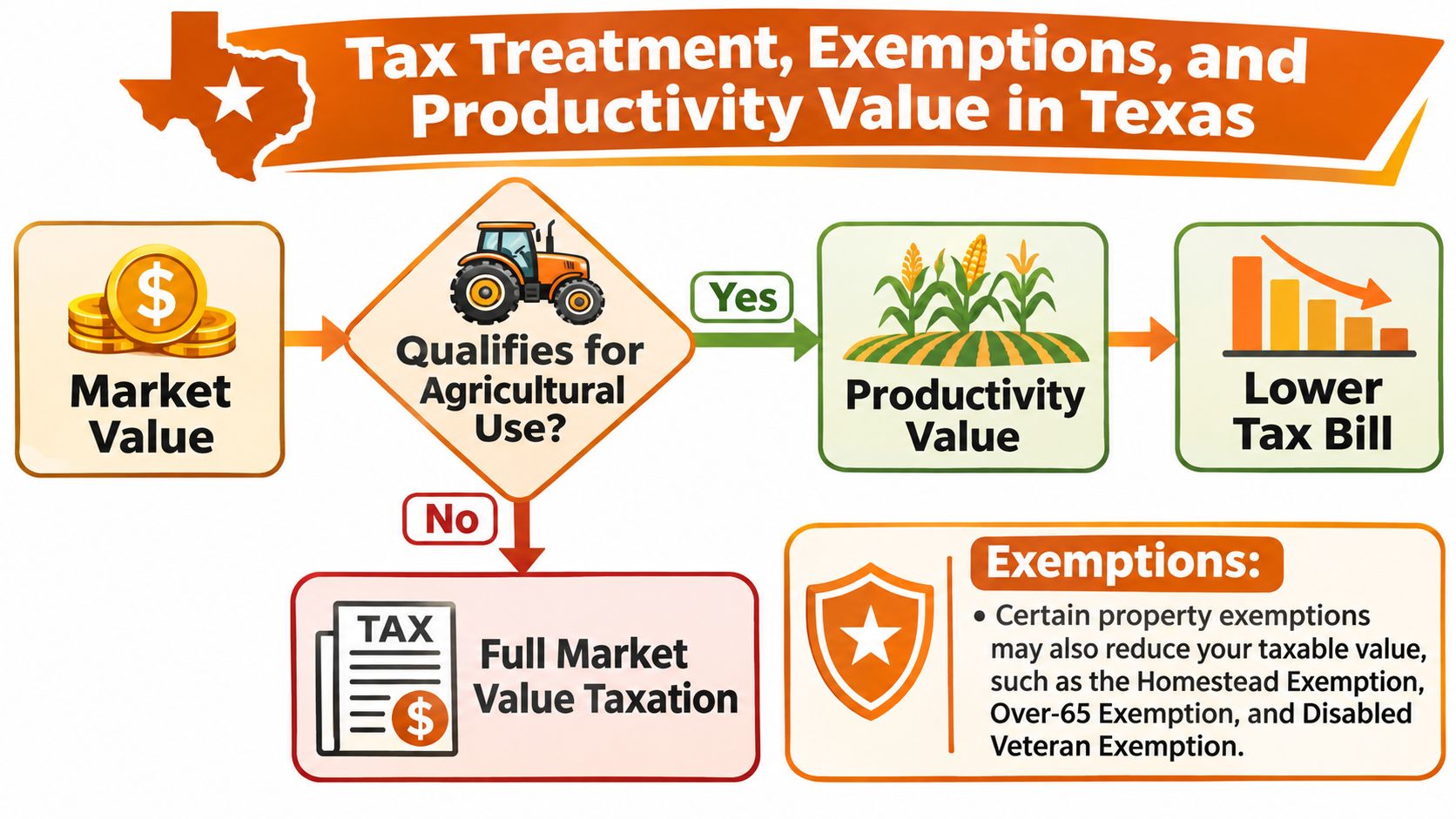
In Texas, “unimproved” does not tell you what the tax bill will be. A raw tract can carry a higher taxable value than a built property if its market value is strong and it does not qualify for a special appraisal. Conversely, qualifying agricultural or open-space land may receive a productivity value based on its income rather than its development price, as explained in the Texas Comptroller ag appraisal overview.
Productivity value is a land-income calculation
For 2026, the Texas Comptroller lists a 10.00% cap rate for agricultural or open-space land and a 7.77% cap rate for timberland Texas Comptroller cap rates. The appraisal district estimates typical net-to-land income, generally using a five-year average, then divides that income by the applicable cap rate.
For example, $120 of net-to-land income divided by a 10.00% cap rate produces a $1,200 productivity value per acre. That value is taxed instead of the tract's higher market price. The result can materially change the bill for land that appears vacant but meets the required agricultural or open-space use standard.
The special appraisal applies to land, not everything on it
Agricultural appraisal is a special appraisal, not a blanket property-tax exemption. It applies to qualifying land and its appurtenances, while residences and other structures remain subject to separate evaluation under the Texas Comptroller agricultural rules. A house on qualified acreage can therefore sit beside land assessed at productivity value while the house remains tied to market value.
Owners often make the costly mistake of treating agricultural status as protection for every improvement. It is not. A barn, residence, or other structure can add taxable value even when the surrounding acreage receives special treatment.
Qualification rules are procedural, not casual
The land must be currently and principally used for agriculture or timber, meet the local intensity standard, and satisfy the five-of-seven-years use test. Applications are generally filed after January 1 and no later than April 30. Miss the qualification requirements or filing deadline, and the district can assess the tract under its ordinary valuation rules.
Bottom line: judge the tax treatment by the parcel's classification, use history, and improvements, not by whether the land looks empty.
Landlords and investors can also review how taxes affect rental yields when comparing ownership costs with income. For a tract under agricultural review, INTELLI's guidance on current agricultural use value offers another reference point, but the local appraisal district's classification and records control the bill.
Real-World Scenarios Across Austin, Suburban Texas, and Rural Land
An Austin property can carry a higher taxable value because of a bad improvement record, even when the owner believes the dispute is about fairness. Check the district's measurements, effective age, condition, and finished site work. Compare each field with photos, permits, and sales of similar homes. A hearing officer can act on a documented error much faster than on a general complaint.
The practical question is not whether the parcel has a building. It is which valuation method the district applied and whether the evidence supports it.
A suburban investor may own a buildable lot near a development corridor. The tract can look unimproved while nearby sales support a high land schedule. Use comparable land sales to challenge that value. If the district overlooked weak access, limited utility availability, or another site constraint, document the limitation and connect it directly to the comparable analysis.
A rural tract presents a different problem. Acreage receiving productivity appraisal can sit beside a barn that is evaluated separately as an improvement. Agricultural treatment for the land does not automatically remove taxable value from structures. Review the land and improvement components independently before deciding what to protest.
Use this filing discipline:
- Verify the record first: Check acreage, use category, structure details, and missing exemption lines.
- Gather independent support: Bring land sales, photographs, utility records, agricultural-use proof, and evidence of depreciation.
- File on time: Agricultural applications are generally due after January 1 and no later than April 30.
- Match the argument to the parcel: Land-only disputes require land evidence. Improvement disputes require support for cost, condition, age, or recorded features.
Build the protest file the same way: district record on one side, photos, permits, land sales, and use proof on the other, matched line by line to the disputed fields. INTELLI's role is limited to helping organize that evidence; the hearing still turns on the accuracy and relevance of the records presented.
A raw tract is not automatically cheaper to own than a built property. In Texas, land schedules, special appraisal rules, exemptions, and separately assessed improvements can produce the opposite result. Compare the components of the bill, not the appearance of the property.
Filing a Property Tax Appeal When the Improvement Value Is Inflated
If the improvement value is wrong, protest it. Don't waste time arguing philosophy when the record has measurable errors. In Travis County and across Texas, the hearing is usually won by clean evidence, not by the loudest complaint.

What to check before you file
Start with the appraisal record. Confirm the structure dimensions, use, effective age, condition, and whether any finished site work, utility connections, or access features were counted correctly. If the district recorded a garage conversion as living area, or treated an old structure as newer than it is, that can move the number fast.
Then pull your support. Recent land sales help when the land component is too high. Repair estimates, photos, and contractor opinions help when the building is overstated. Agricultural-use records and exemption filings matter when the parcel sits inside a special appraisal lane.
The strongest protest files usually include:
- Correct property data: Wrong square footage, wrong improvement count, or wrong condition.
- Comparable support: Sales of similar land or similar improved properties.
- Depreciation evidence: Photos, age history, repair needs, or obsolescence.
- Exemption review: Homestead, Over-65, Disabled Person, Disabled Veteran, agricultural, or historic status that hasn't been applied.
Why representation matters
Software-only filings often lose because they submit a form without a case. Appraisal districts are used to that. They respond to evidence, not convenience. If you want the hearing to move, you need a file that attacks the district's assumptions line by line.
A hearing officer will listen to prepared comparables and corrected records. They won't rescue an owner who sent in a bare protest and hoped the system would do the rest.
If you need a format for the protest narrative itself, the property tax appeal letter resource gives a practical way to organize the claim before the hearing. That matters because a clean written record keeps the argument focused when the room gets rushed.
Which Path Fits Your Situation and When to Bring in a Consultant
If the error is a single data field, such as square footage or improvement count, file with corrected records. If the dispute involves productivity qualification, a land schedule, or depreciation, bring licensed representation before the protest deadline. That rule keeps a technical case from becoming a paperwork exercise.
Match the review to the property. Austin homeowners should confirm the appraisal card and exemption status. Suburban lot owners should test land comparables, utility assumptions, and access. Rural owners must separate productivity treatment from barns, houses, and other improvements. Commercial owners should scrutinize site work, access, and depreciation.
Senior owners and disabled veterans should check exemption status before arguing value. An unfiled exemption can leave money unclaimed. A raw tract can cost more to own than a built property when the valuation method or special appraisal treatment changes the tax result.
INTELLI handles protests, exemption work, and tax recovery audits on a no-recovery, no-fee basis. If the appraisal card or land classification looks wrong, start the review this week and compare it to your records.
If your Texas property tax bill feels off, identify the cause before guessing. INTELLI can review the appraisal card, test land classification, and challenge inflated improvement value with evidence assessors respect. Visit INTELLI to review its licensed consultant services.