

In Texas, an agricultural exemption is a special 1-d-1 appraisal based on agricultural productivity, not a blanket property tax exemption. The land generally must show agricultural or timber use for at least 5 of the preceding 7 years and satisfy both local intensity and principal-use tests.
The popular advice that “more acreage means an ag exemption” is wrong. A large tract used mainly for recreation can fail, while a smaller, well-documented operation may have a stronger case if it operates at the level accepted for that enterprise in its county. Texas appraisal districts evaluate what the land is doing, how consistently it's managed, and whether the owner can prove that use.
That distinction matters most around Austin and other urban-edge markets, where residential development value can far exceed agricultural productivity value. The lower valuation can be meaningful, but only when the land qualifies under the applicable standards and the evidence supports the application.
Why Acreage Alone Will Not Save Your Property Tax Bill
Buying rural land doesn't automatically create an agricultural valuation. Texas uses the 1-d-1 open-space appraisal to value qualifying land according to its agricultural productivity rather than its market value. The benefit generally applies to qualifying land and certain appurtenances, not a residence or every improvement on the property. The Texas Comptroller's overview of agricultural and timber appraisal explains why the common phrase “ag exemption” can mislead owners.
The county appraisal district asks a more demanding question than “How many acres do you own?” It asks whether the land is currently and principally devoted to agriculture, whether the operation reaches the locally accepted intensity level, and whether the required history exists. Occasional grazing, a few animals kept for personal enjoyment, weekend hunting, or attractive landscaping may show rural character without proving agricultural production.
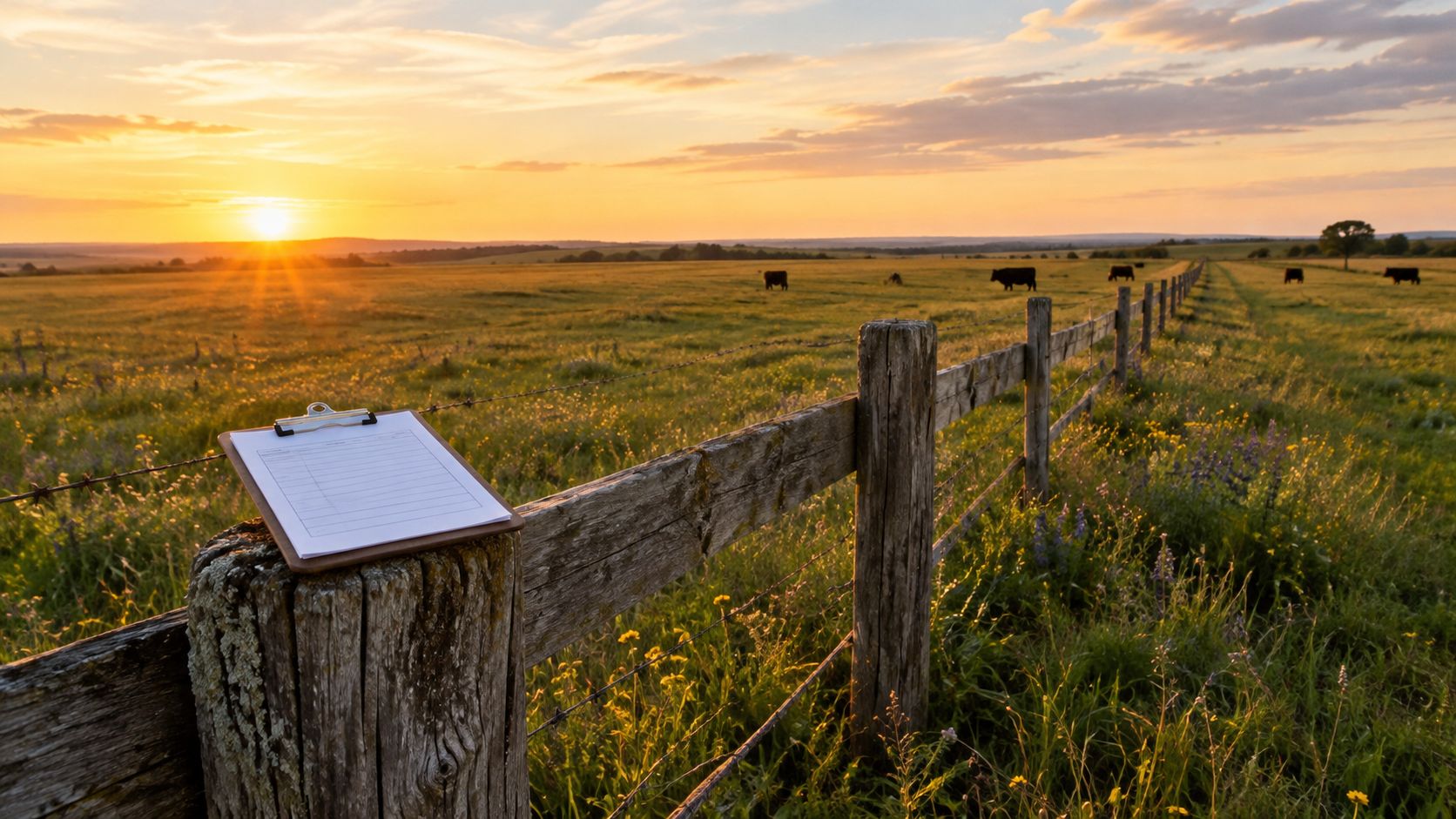
The real dividing line is evidence
A chief appraiser usually has to distinguish a working operation from land that merely looks suitable for one. That means records matter. A grazing lease, livestock inventory, stocking records, hay receipts, photographs, production documents, and a consistent management history can tell a much stronger story than a fence, barn, or pasture alone.
The same property can also change status over time. If the owner stops the qualifying use, converts the land to another principal use, or fails to maintain the evidence needed for review, the valuation can become vulnerable. An existing agricultural valuation isn't a permanent guarantee attached to the deed.
Practical rule: Treat the valuation as a continuing operating position, not as a label the property keeps simply because it was once approved.
For small farms and urban-edge parcels, the hardest question is often not whether an activity is technically agricultural. It's whether that activity is the principal use and meets the county's expectations. A handful of animals may be legitimate livestock, but the owner still needs to show that the operation is managed at the accepted local intensity.
INTELLI uses licensed property tax consultants and a data-first approach that combines public and private data. That approach can organize appraisal records, property characteristics, leases, receipts, inventories, and operating evidence against the applicable county standards. Owners researching whether their parcel's size and configuration support a defensible position can also review this explanation of how acreage is measured for property tax purposes.
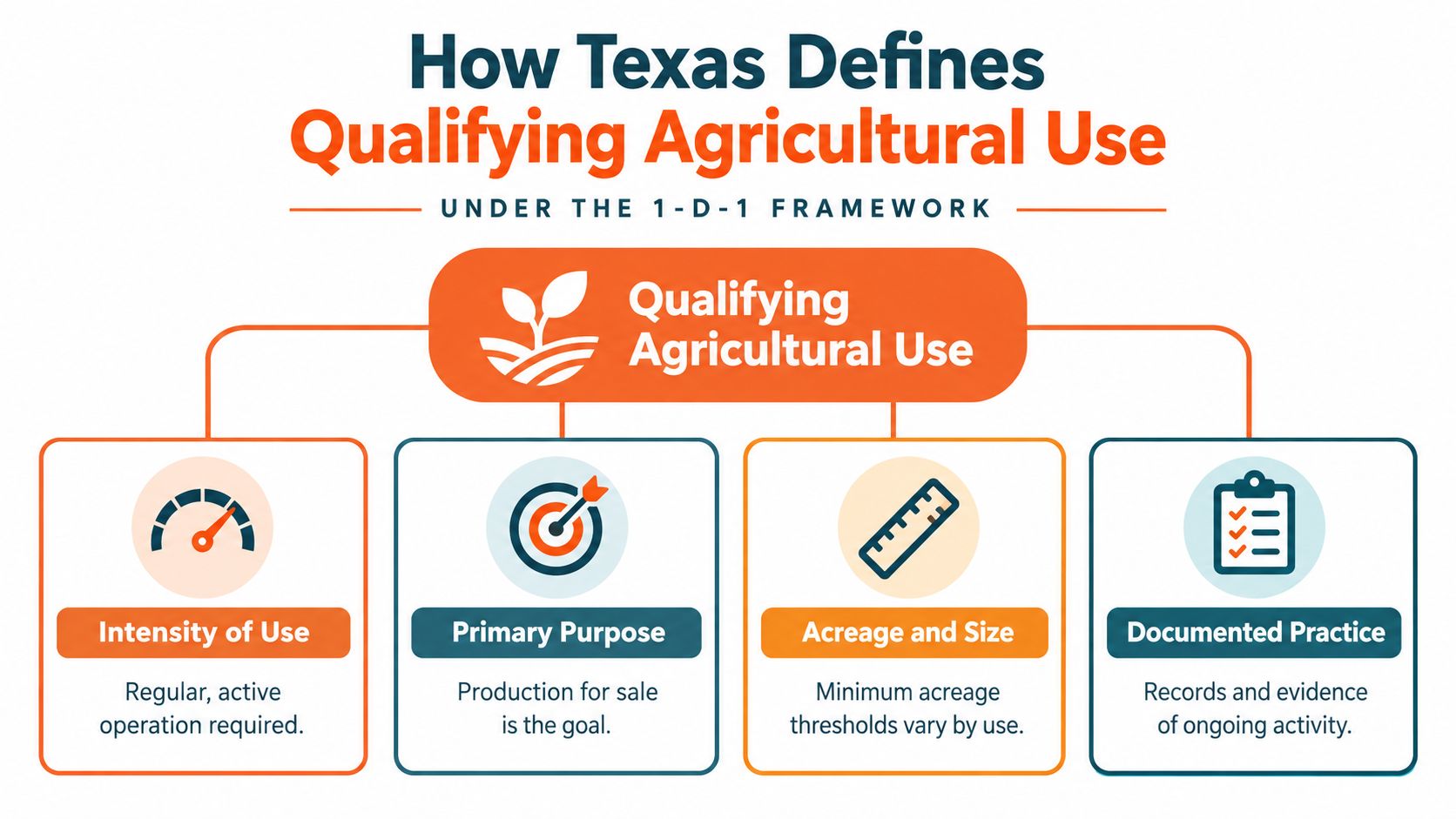
How Texas Defines Qualifying Agricultural Use
Texas' 1-d-1 framework is easier to understand when you stop treating the qualifying activity list as a checklist. Raising livestock, cultivating crops, producing hay, managing timber, operating an orchard, or conducting qualifying wildlife management can all be relevant, but the activity must fit the land and satisfy the appraisal district's standards.
The state framework applies four core tests. The appraisal must concern the land and qualifying appurtenances rather than ordinary improvements, the land must be currently and principally devoted to agricultural use, the operation must meet the degree of intensity generally accepted in the local area, and the property must satisfy the historical-use requirement. Texas generally requires agricultural or timber use for at least 5 of the preceding 7 years. The Comptroller's property tax publication describes these 1-d-1 requirements.
Why the USDA benchmark helps, but doesn't decide the tax case
The U.S. Department of Agriculture defines a farm as a place where at least $1,000 of agricultural products were produced and sold, or normally would have been sold, during the relevant year, with government payments included in sales. The USDA definition doesn't prescribe a minimum acreage, so it illustrates an important principle: productive use matters more than tract size. The USDA explanation of the farm definition also makes clear that this is a statistical and federal-program benchmark, not a universal property-tax rule.
A Texas county can impose more specific requirements, including stocking levels, management practices, production records, leases, or a required use history. An owner therefore shouldn't assume that meeting the USDA benchmark automatically earns a Texas appraisal.
Signals that support a bona fide operation
Appraisers commonly look for evidence that connects the land to actual management:
- Production evidence: Crop activity, hay production, livestock records, receipts, or sales documents show that the land is producing something rather than sitting idle.
- Operating control: A lease or written agreement can identify who manages the land, what activity occurs, and how the operation is maintained.
- Physical proof: Dated photographs, pasture conditions, fencing, water facilities, livestock, crops, and other site evidence can support the written record.
- Continuity: Records covering the relevant period are more persuasive than a single recent invoice or a last-minute improvement before filing.
The productive-capacity test is also why market value alone doesn't control the appraisal. Agricultural value reflects the land's capacity and income potential from qualifying use, not what a buyer might pay for a home site or future development.
For owners evaluating technology used in agricultural production, equipment and field-management resources can provide useful operational context. For example, Xag P150 Max for Australian farms offers background on farm technology in another agricultural setting, although equipment by itself doesn't establish Texas appraisal eligibility.
A practical explanation of the valuation concept is available in INTELLI's guide to current agricultural use value. The central question remains local: does the operation demonstrate the use and intensity the relevant appraisal district accepts?
The Four Eligibility Tests That Determine Your Valuation
Owning acreage does not make land agriculturally qualified. Texas owners should test eligibility in a fixed order because passing one requirement cannot repair a failure in another. Productive pasture may lack the required history, while a long-used parcel may fail if its present operation falls below Travis County's intensity standard.
First, identify the property being appraised
The 1-d-1 benefit is a special valuation for qualifying land, not usually a blanket exemption covering the house, detached garage, commercial building, or other ordinary improvements. Fences and certain appurtenances may receive different treatment when they support the agricultural use, but the land analysis must remain separate from improvement value.
That distinction affects tax planning. An owner may expect the entire account to fall to an agricultural value, even though the appraisal treatment focuses primarily on qualifying land. Review the account by land and improvement components before estimating the potential effect.
Second, prove current and principal agricultural use
The land must support agriculture now, and agriculture must be its principal use. A barn, pond, and grazing animals do not settle the question if the property functions mainly as a residence, hunting tract, or future homesite.
The evidence should answer three practical questions:
- What activity occurs on the land?
- Who manages it, and under what arrangement?
- Why is that activity the property's principal use rather than a secondary amenity?
Leases, livestock inventories, grazing records, crop records, receipts, photographs, and management plans can tie the application to ongoing operations. A personal statement may provide context, but it rarely replaces operating evidence.
Third, meet the local degree of intensity
Intensity is a common failure point for small-acreage applications. The appraisal district compares the operation with what it generally accepts for the same enterprise in that locality. A few animals may suit one property and fall short on another because land type, use category, pasture condition, and county standards differ.
Travis County offers a concrete test that statewide summaries often skip. For certain agricultural uses, the county identifies a minimum grazing requirement of four animal units. Qualifying categories can include crop production, livestock or exotic-animal production, horticulture, beekeeping, and certain cover-crop or government-program acreage. Travis Central Appraisal District's agricultural FAQs illustrate how a statewide rule becomes a county-level review.
A strong application names the agricultural activity and documents it at the level the county recognizes as normal for that land and enterprise.
Fourth, establish the historical-use period
Texas generally requires agricultural or timber use for 5 of the preceding 7 years. Current activity is only part of the case. Owners should investigate the property's prior use, preserve available records, and determine whether a previous owner's operation matches the current claim.
A recent purchase does not automatically erase the property's history, but it can create a documentation problem. Buyers should review appraisal records, prior applications, leases, land-use evidence, and county correspondence before relying on an existing valuation.
Applications are generally filed on Form 50-129 with the county appraisal district before May 1 for the requested tax year. Travis County's practical filing window closes April 30, so owners should begin assembling evidence well before the deadline.
Wildlife Management And Other Nontraditional Agricultural Uses
Wildlife management is a documented land-management operation, not a tax label for unused acreage. The property generally must already qualify for open-space appraisal, and wildlife management must become its primary use. Hunting access, habitat preservation, or occasional improvements alone usually do not establish eligibility.
A conversion in Travis County requires a new 1-d-1 application and a five-year Texas Parks and Wildlife Department wildlife-management plan. The owner must also submit an annual report describing the prior year's activities by the last day of February. These requirements make the paper trail part of the operation, not an afterthought.
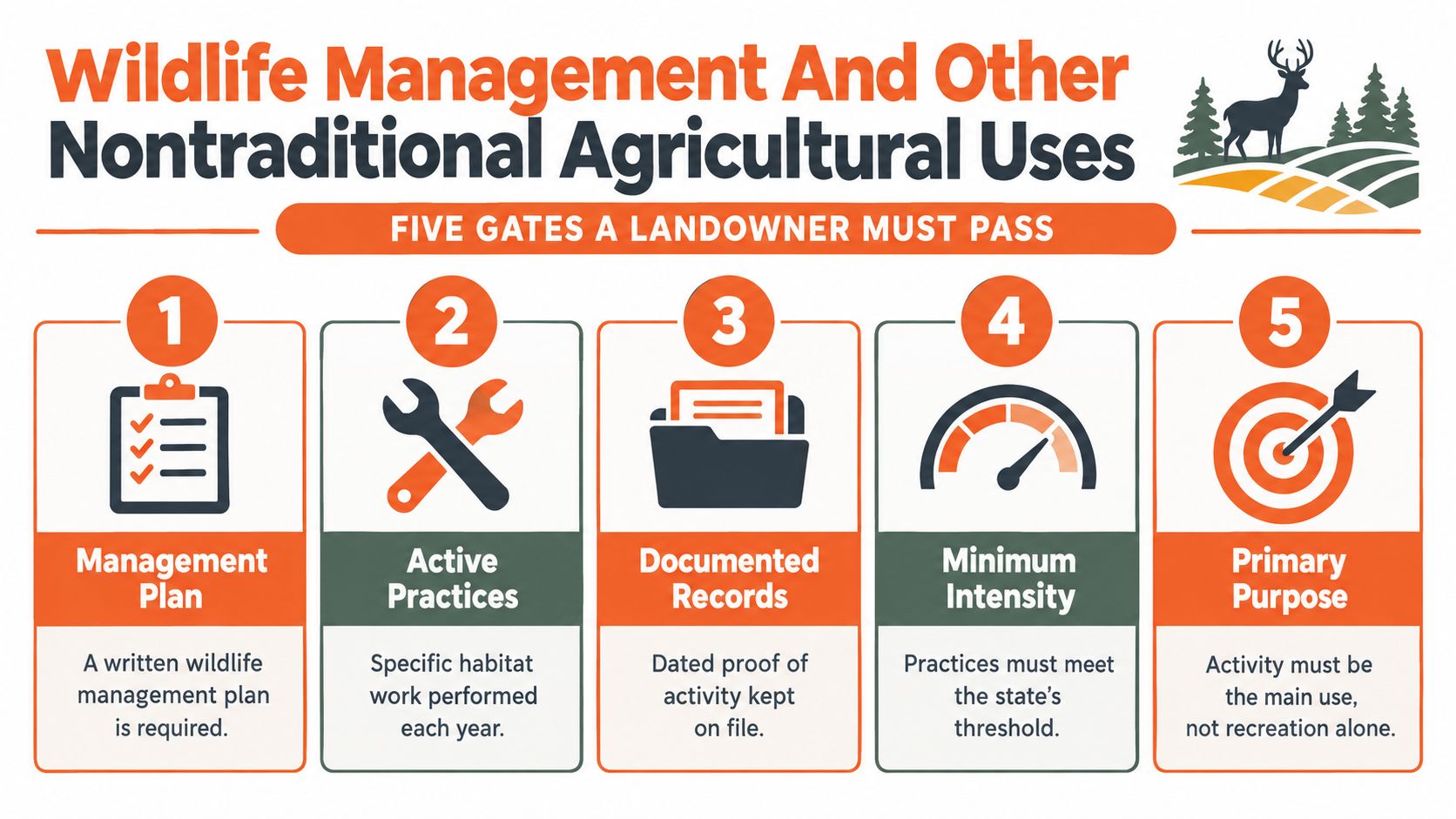
Wildlife management requires planned work
The written plan should identify the property's wildlife objectives, the target species or habitat needs, and the practices used to produce measurable improvements. The owner generally must carry out at least three qualifying practices, selected from the following categories:
- Habitat management: Improve or maintain vegetation and habitat conditions.
- Erosion management: Reduce soil loss and protect productive land.
- Predator management: Control predators in support of the wildlife objective.
- Water management: Maintain or improve water sources.
- Supplemental food: Provide food when the plan supports that practice.
- Shelter management: Create or preserve suitable cover.
- Census management: Track wildlife populations and management results.
The plan supplies the framework. Dated photographs, maps, invoices, receipts, field notes, and annual reports show that the work occurred. Records should identify locations, dates, and the practice performed. A plan prepared for an application but not followed later creates a credibility problem during review.
1-d and 1-d-1 are not interchangeable
The stricter 1-d appraisal requires agriculture to be the owner's primary occupation and source of income, treats the activity as a profit-seeking business venture, and uses a three-year agricultural-use history. The 1-d-1 framework does not require agriculture to be the owner's primary occupation or income source. It does require current principal use, local intensity, and agricultural use for 5 of the preceding 7 years. The Comptroller's comparison of 1-d and 1-d-1 appraisal explains the distinction.
That distinction matters for homeowners, investors, and landlords. A legitimate wildlife-management operation can support 1-d-1 valuation without being the owner's livelihood. Personal enjoyment of the property, however, does not replace the plan, qualifying practices, annual reporting, or documented principal use.
Travis County Operating Standards And Filing Deadlines
Owning acreage does not establish agricultural valuation in Travis County. The appraisal district examines how the property operates, whether agriculture is the principal use, and whether the activity reaches the county's local intensity standard. Fences, open space, and a rural setting do not prove that test.
For grazing operations, the district evaluates factors such as pasture condition, water access, livestock management, leases, inventories, and production records. The same acreage can receive different treatment depending on how consistently the owner uses and documents it. A grazing lease, dated records, and evidence of active management give the district something concrete to evaluate.
Local documentation matters as much as the application itself. Owners should be ready to identify the acreage in use, explain the operating arrangement, and provide records that connect expenses, livestock, crops, or management work to the land. A lease should show the parties, property, term, and agricultural purpose. Photographs and maps should be dated and location-specific rather than generic pictures of the ranch.
Wildlife applications require the same operational discipline. A written plan should identify the practices performed, while annual reports and supporting records should show that those practices occurred. Hunting access alone does not establish wildlife management. The file needs evidence of an ongoing program that matches the approved plan and local requirements. Detailed approval and denial patterns appear in the following case examples.
Deadlines require separate planning
A new 1-d-1 application is generally due before May 1. Travis County's filing window runs from January 1 through April 30, making April 30 the practical final day for that county's regular filing period. Wildlife reports covering the prior year's work are due by the last day of February.
These dates serve different purposes. The application requests the valuation, while the wildlife report documents continuing management. Missing either deadline can affect the requested tax year or weaken an otherwise supportable file.
Owners should assemble leases, maps, photographs, invoices, inventories, and management records before filing opens. Confirm the correct form, review the parcel details, and retain proof of submission. The Travis County property tax exemption guidance from INTELLI provides a practical overview of the local process and explains how property records and operating evidence relate to county requirements.
Real Cases That Show Approval Versus Denial Patterns
Owning acreage does not preserve an agricultural valuation after the property's use changes. These representative cases show how a parcel can qualify in one year, lose its valuation later, or face denial when a new owner cannot document the operation behind the prior approval.
A parcel converted from grazing to residential use
A landowner previously grazed cattle across the tract, then fenced a smaller area for horses, expanded residential improvements, and left the remaining pasture largely unmanaged. The property still appeared rural, and the owner still held acreage, but the dominant use had changed.
The county's review would focus on current agricultural activity, not the property's former operation. Old leases, earlier photographs, or a prior approval may explain the parcel's history, but they do not prove that the present use meets Travis County's intensity expectations. A valuation can be vulnerable when agricultural activity becomes incidental to residential or recreational use.
The practical lesson is to document changes as they occur. Keep updated maps, livestock or crop records, receipts, photographs, and notes showing which areas remain in production. If the operation has contracted, the records should make that change clear rather than leaving the appraisal district to infer that the former use continues.
A buyer who inherited the seller's history
A buyer may purchase land with an existing agricultural valuation and assume the tax treatment follows automatically. The buyer then discovers that the former owner's lease ended, livestock left the property, or management practices stopped before closing.
The prior owner's records can support the property's history, but they cannot establish the buyer's continuing use. The new owner needs current documentation tied to the present operation, including any new lease, inventory, invoices, maps, and photographs. Gaps between owners matter, particularly when the land is vacant or being prepared for a different use.
A mixed-use tract with weak boundaries
Another difficult case involves a property where one portion supports agricultural activity while the rest contains a residence, event area, storage, or other nonagricultural improvements. Broad statements that the entire tract is used for agriculture create problems when the records do not identify the productive area or explain the treatment of the improvements.
A defensible file separates those uses. It identifies the land in production, describes the activity performed there, and matches the records to the acreage claimed. The appraisal district can then evaluate actual use instead of relying on acreage alone.
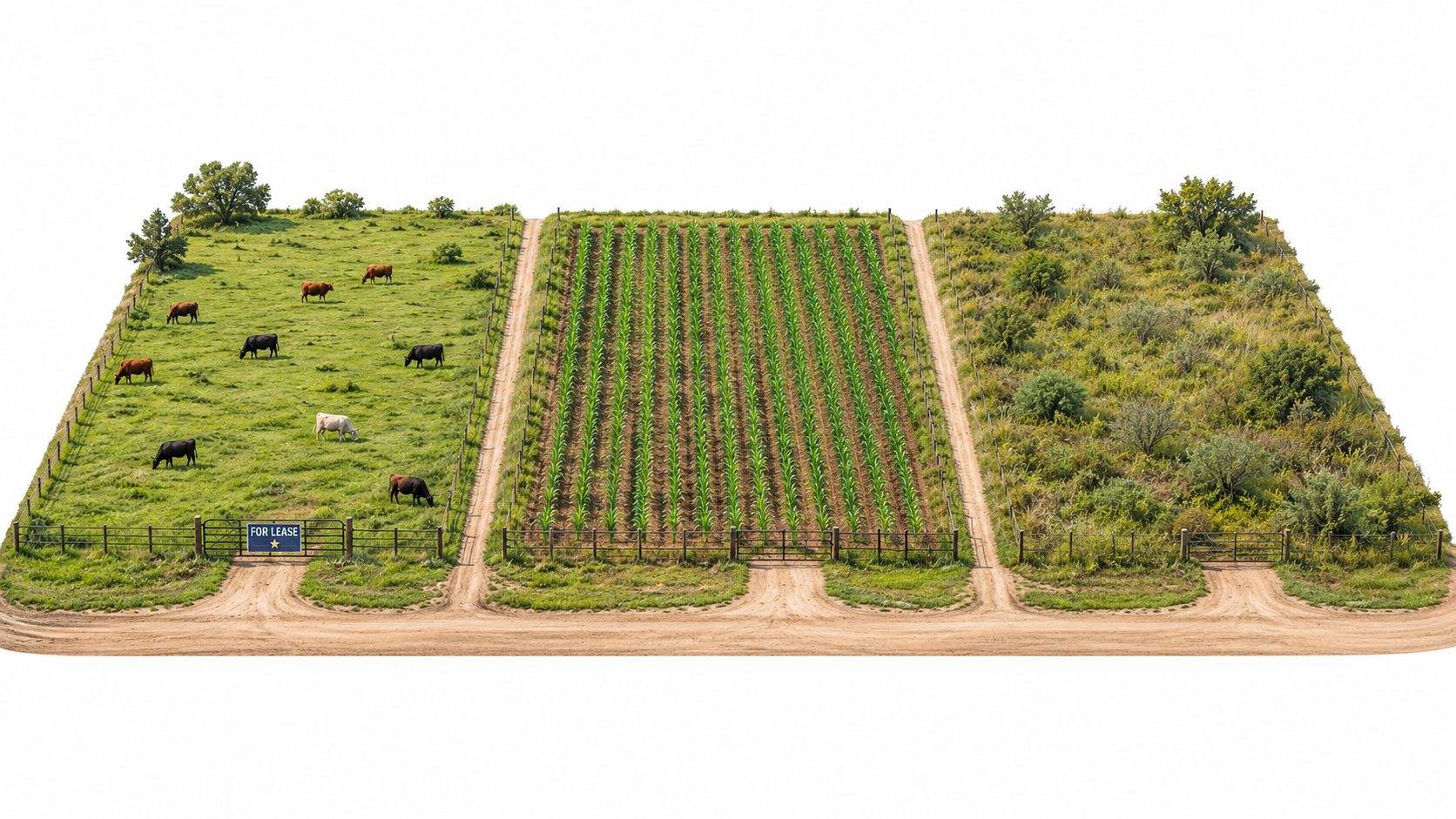
Use the filing window discussed in the Travis County section, and submit an evidence package built around the property's current use and local intensity standard.
Don't rely on acreage, inherited tax treatment, or a generic checklist. If you need help identifying gaps, INTELLI can review the land use, county requirements, and supporting records, then help organize an application strategy.