

A Travis County homeowner opens the annual notice of appraised value and sees a number that doesn't resemble the price a neighbor recently paid. The first reaction is usually frustration, followed by a rushed search for comparable sales. But the notice creates more than one decision. You can accept the value, file an exemption, protest the appraisal, or pursue several of these paths at the same time.
That distinction matters because property tax management isn't one task. A protest challenges the appraisal record, while an exemption reduces taxable value if you qualify. A recovery audit looks backward for missed benefits or incorrect property data. Each path has its own evidence, deadline, and likely outcome.
Texas makes timing especially important. Most owners need to monitor the exemption deadline around May 1 and the protest deadline around May 15, while remembering that the exact legal trigger can depend on when the appraisal district mails the notice. The practical details below reflect how these decisions work in Austin and Travis County, where a well-organized file usually matters more than a general objection that the bill feels too high.
When the Notice of Appraised Value Arrives
The notice is not the tax bill. It reports the appraisal district's proposed value and gives you an opportunity to check the property record before local taxing units calculate the final liability. Look for the appraised value, property description, exemptions shown, and the mailing date. A wrong square-footage figure, missing exemption, or incorrect property characteristic can matter as much as the headline value.
Suppose your neighbor sold a similar home for less than your proposed value. That doesn't automatically prove the district is wrong. The properties may differ in condition, lot size, additions, effective age, or timing. Your first job is to identify which fact is wrong and whether it belongs in an exemption filing, a valuation protest, or both.
Practical rule: Treat the notice as a deadline document, not as background mail.
Texas has no single statewide property-tax administration office that resolves every owner's issue. Local appraisal districts maintain records, while counties, cities, school districts, and special districts impose their own levies. The OECD's discussion of property-tax revenue and local administration notes that property-tax revenue exceeded 10% of total tax revenue in the United States in 2020, while assessment rules, exemptions, and appeals vary by jurisdiction.
Three decisions to make quickly
- Accept the value: Reasonable when the record appears accurate and the evidence doesn't support a lower figure.
- File or correct exemptions: Necessary when a qualifying homestead, age-based, disability, veteran, agricultural, or historic status is missing or incomplete.
- Protest the appraisal: Appropriate when the value, property characteristics, or level of assessment is inaccurate.
A missed exemption filing can leave taxable value higher for the year. A missed protest window can eliminate the normal opportunity to challenge that year's appraisal. The notice of appraised value guidance from INTELLI can help owners understand what to review before choosing a path.
How Assessed Value Becomes a Tax Bill
Property-tax calculations become easier once you separate the terms. Appraised value is the value the appraisal district estimates. Assessed value is the figure used after applicable tax-code adjustments. Taxable value is what remains after exemptions. The bill results when taxable value is multiplied by the combined rates imposed by the relevant taxing units.
Texas generally assesses taxable property in proportion to appraised value unless an authorized exemption applies. The Texas Comptroller also conducts a ratio study of each appraisal district at least every two years under Tax Code Section 5.10, as described in its property-tax exemption guidance.
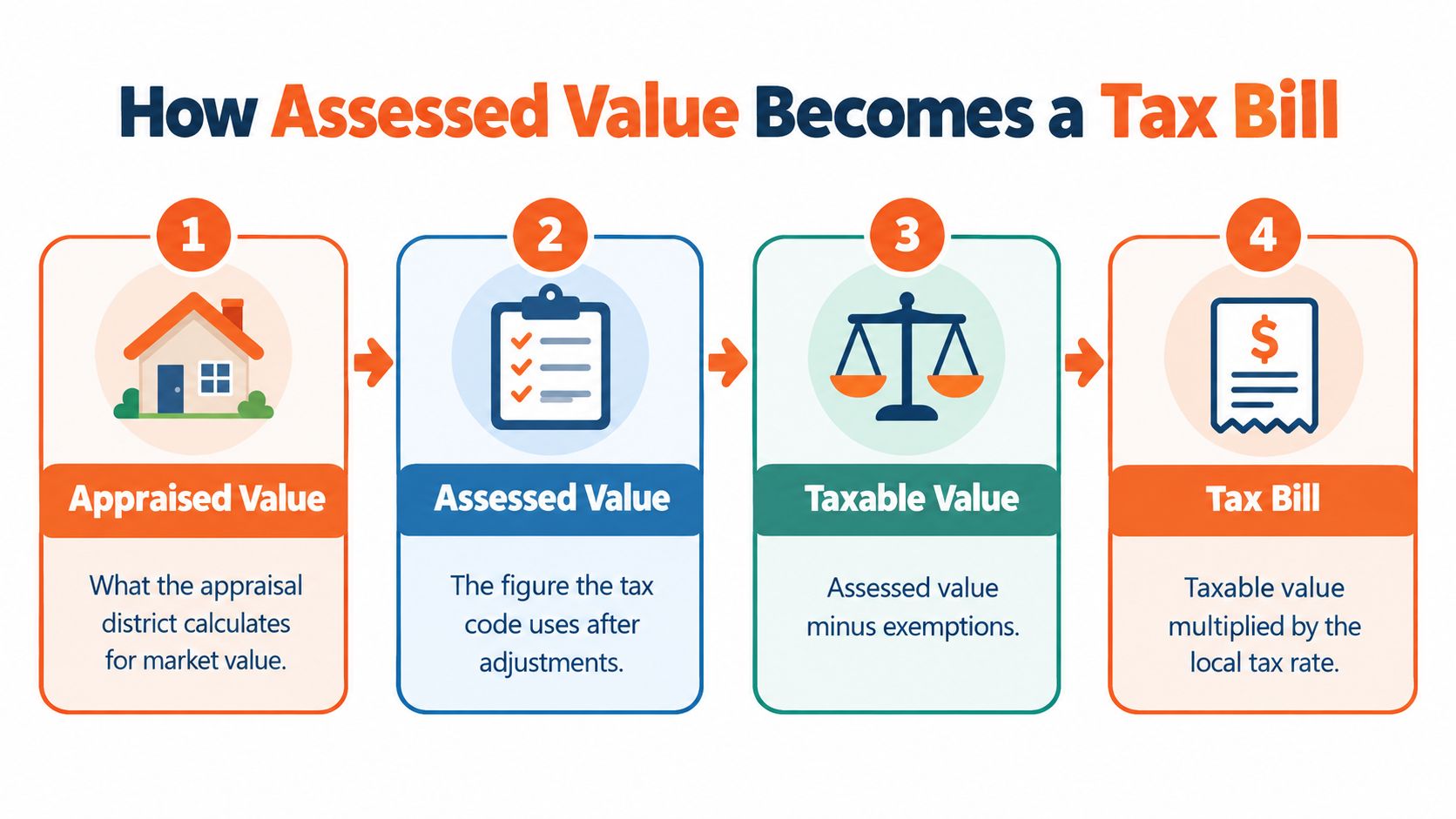
Follow the calculation in order
Consider a hypothetical Austin home with an appraised value of $450,000, an 80% assessment ratio, a $140,000 school-district homestead exemption, and a 2.5% combined local rate. The figures are an illustration of the mechanics, not a prediction of any owner's bill.
- Appraised value: $450,000.
- Assessed value: $450,000 multiplied by 80%, producing $360,000.
- Taxable value: $360,000 less the $140,000 exemption, producing $220,000.
- Illustrative tax: $220,000 multiplied by 2.5%, producing $5,500.
The key point is that the exemption applies after the assessed-value step in this simplified example. A lower appraised value and a larger exemption both reduce the base, but they do so through different legal mechanisms.
The combined rate also isn't one universal Austin rate. Travis County, the City of Austin, Austin ISD, and special districts can each impose taxes. For a fuller explanation of the calculation, see how property taxes are calculated in Texas.
The number that deserves the closest attention is taxable value, not market value by itself.
Exemptions That Quietly Lower Every Year
A protest changes the appraisal record if you establish that the district's position is wrong. An exemption works differently. It removes an authorized amount or category from taxable value while the owner continues to qualify, so exemption administration deserves its own annual control process.
A qualifying Texas residence homestead generally requires an application filed with the county appraisal district by April 30. Texas school districts must provide an additional $60,000 homestead exemption for qualifying owners age 65 or older or disabled under Tax Code Section 11.13(c), according to the Texas Comptroller's homestead guidance.

Match the exemption to the owner
- Residence homestead: Helps an owner who uses the property as a principal residence and satisfies the application requirements.
- Age 65 or older or disabled: Adds the school-district exemption described above. A taxing unit may also adopt a local-option homestead exemption of at least $3,000, subject to that unit's rules.
- Disabled veteran: Relief depends on the service-connected disability rating. Texas rules range from a $5,000 exemption for a 10–29% rating to a complete residence-homestead exemption for qualifying veterans with a 100% rating or individual unemployability, as described in Comptroller disabled-veteran guidance.
- Agricultural or historic treatment: These categories can be valuable for qualifying land or properties, but they require proof of use, status, and continuing eligibility. They aren't substitutes for a homestead filing.
The effect on the bill depends on which taxing units recognize the exemption and their applicable rates. An owner shouldn't assume that a reduction in taxable value produces the same dollar result across every property or district.
INTELLI uses licensed property tax consultants and a data-first approach, using public and private data, to identify applicable exemptions and manage applications, supporting documents, and deadlines. Its Texas homestead exemption resource provides another starting point for owners checking eligibility.
The Protest Path: From Notice to ARB Hearing
A Travis County owner who waits for the tax bill has already missed the best opening. Texas property owners generally must file by May 15 or within 30 days after the appraisal district mails the notice of appraised value, whichever is later. The mailing date starts the 30-day period, not the day the owner opens the envelope, according to the Texas Comptroller's protest guidance.
File with Form 50-132 or the appraisal district's accepted electronic system. State the grounds precisely. Excessive market value, unequal appraisal, incorrect square footage, omitted damage, and other district actions require different evidence.
Build the evidence before the deadline
A workable protest file ties each conclusion to a document:
- Comparable sales: Choose properties similar in location, size, condition, and features. Adjust for meaningful differences rather than attaching every nearby sale.
- Condition evidence: Use photographs, repair invoices, and estimates when deferred maintenance affects value.
- Record corrections: Support errors in living area, amenities, land characteristics, or classification with relevant records.
- Unequal-appraisal material: Include comparable assessment records and, when appropriate, median-level-of-appraisal calculations.
The Comptroller lists photographs, repair records, sales documentation, comparable-property evidence, and median-level calculations as relevant support. A repair bill does not automatically equal a dollar-for-dollar value reduction. Explain how the condition changes what a buyer would pay.
Travis Central Appraisal District's online process has allowed owners to upload evidence, review district evidence, receive settlement offers, and participate in meetings or hearings. A settlement may avoid a formal hearing, but evaluate the offer against your documented position. Continuing may improve the result, yet it also requires time and carries uncertainty.

If informal review does not resolve the dispute, prepare for the Appraisal Review Board. Owners or authorized representatives may present evidence, examine witnesses, and participate in person, by telephone, videoconference, or written affidavit. Put the key conclusion, supporting documents, and requested value in an order a hearing officer can follow quickly.
Market Value Versus Equal and Uniform
A homeowner in Travis County can lose a protest by proving the wrong point. Market value and equal and uniform are separate arguments, although the same property may support both.
A market-value protest argues that the appraisal district's estimate exceeds a supportable value. Build the case around adjusted comparable sales, condition, sale timing, location, size, and deferred maintenance. This approach fits a situation where the district's figure exceeds what similar properties sold for after meaningful differences are accounted for.
Equal-and-uniform analysis asks whether the subject property is assessed above the representative level applied to comparable properties. It can help when the subject's value appears reasonable by itself, but similar properties receive more favorable treatment. Comparable assessment records and median-level-of-appraisal calculations then become the focus.
| Theory | Argument | Best Evidence | Best When |
|---|---|---|---|
| Market value | The subject's indicated value exceeds its supportable value. | Adjusted sales, photographs, repair records, and condition analysis. | The proposed value is high relative to comparable transactions. |
| Equal and uniform | The subject is assessed above the representative level for similar properties. | Comparable assessment records and median-level-of-appraisal calculations. | The subject is treated less favorably than comparable properties. |
Comptroller guidance on unequal appraisal evidence recognizes comparable-property evidence and median-level calculations as relevant support. Choose the theory that the records can prove, not the one that sounds more familiar.
A market-value argument asks, “What is this property worth?” An equal-and-uniform argument asks, “How is this property assessed compared with its peers?”
Keep the evidence organized around one question at a time. A property may have a defensible market value and still raise an unequal-appraisal issue. A strong sales comparison may also resolve the dispute without a separate equal-and-uniform analysis. The requested value should match the theory and the documents supporting it.
Tax Recovery Audits and Past Refunds
A current-year protest addresses the present appraisal. A tax recovery audit examines earlier records for errors that may have increased liability, such as incorrect square footage, a wrong land-use classification, or an exemption that was never applied. It turns property tax management into a recurring review rather than an annual reaction to one notice.
Start with a property-level file containing closing documents, prior appraisal notices, tax statements, exemption applications, denial letters, and records of changes to the building or its use. Compare the property description across years. A small record error can persist if nobody checks the underlying data.

What happens when an issue appears
The reviewer identifies a potential overcharge, checks the legal route for correction, and gathers documents that establish ownership, eligibility, value, or property characteristics. The responsible appraisal district or tax collector may need to review the record, depending on the nature of the issue. Refunds aren't automatic just because an owner discovers an old discrepancy.
A no-recovery, no-fee arrangement changes the cost trade-off. The owner doesn't pay a fee unless a refund is secured, but the engagement still requires accurate records and a realistic assessment of whether the issue can be corrected.
Some exemption rules create special lookback opportunities. For certain Section 11.22 applications, including the 100% disabled-veteran exemption, an eligible veteran, surviving spouse, or child may file up to five years after the delinquency date for the property's taxes despite the standard April 30 deadline, according to the Comptroller's disabled-veteran FAQ. That exception is specific, so owners shouldn't apply it broadly to every missed exemption.
Signs You Should Hire a Professional
Professional help makes the most sense when the potential benefit, complexity, or procedural risk exceeds the value of handling the matter alone. A single straightforward homestead filing may not require representation. A portfolio with several Travis County parcels presents a different workload because every property needs its own record review, exemption analysis, and deadline control.
Commercial property owners also face a more technical valuation exercise. Income-producing properties can require operating records, rent information, expense support, and a defensible explanation of how market conditions affect value. A generic appeal statement rarely addresses those issues.
Consider representation when
- You manage multiple parcels: A consultant can maintain separate evidence files and prevent one property's deadline or exemption from being confused with another's.
- The property is unusual: Unique construction, extensive deferred maintenance, mixed use, or specialized improvements can be difficult for mass appraisal to capture accurately.
- The hearing is approaching: An Appraisal Review Board presentation requires a clear theory, exhibits, and answers to questions. Preparation becomes more valuable once informal settlement hasn't resolved the dispute.
- You missed a deadline: A professional can determine whether another legal route remains available, although no representative can promise that a late protest will be accepted.
- The property is commercial: The evidence burden and financial impact can justify a contingency arrangement even when a homeowner would reasonably proceed alone.
INTELLI uses licensed property tax consultants and a data-first approach that combines public and private data. Its model is risk-free and results-based, with no upfront cost, and the company reports average reductions around 15%. That figure is a company claim, not a guaranteed outcome for an individual property, so owners should review the engagement terms and the evidence strategy before signing.
The useful comparison isn't software versus a person in the abstract. It's automated record collection versus local judgment about which comparables fit, which theory is defensible, and how to present the file at the hearing.
A 90-Day Action Plan and Common Questions
Start with the records already in your possession. During the first part of the next 90 days, retrieve the latest notice of appraised value, confirm the mailing date, inspect the property description, and list every exemption currently shown. Compare the district's information with closing documents, floor plans, repair records, and prior notices.
Next, separate the work into two files. One should contain exemption applications, ownership and occupancy records, age or disability documents, veteran-rating material, and filing confirmations. The other should contain the protest form, comparable sales, photographs, repair estimates, property-record corrections, and any district evidence.
| Action | Date | Where It Is Filed | What Happens If Missed |
|---|---|---|---|
| Residence homestead or most exemption applications | Generally by April 30 | County appraisal district | The exemption may not be applied for the year, unless a specific exception or late-filing rule applies. |
| Protest of appraised value or other appraisal action | May 15 or 30 days after mailing, whichever is later | Appraisal district or accepted electronic process | The ordinary protest opportunity may be lost. |
| Appeal of an exemption denial or modification | Follow the written notice and stated ARB process | Appraisal Review Board | The owner may lose the opportunity to challenge the exemption decision. |
If an appraisal district denies or modifies an exemption, it must notify the owner in writing within five days and explain how to protest that decision before the Appraisal Review Board, according to Texas Comptroller guidance on exemption decisions. Keep that notice because it controls the next procedural step.
Questions owners ask
Can the appraisal district retaliate after a protest? A protest challenges the record through a statutory process. The practical objective is to present accurate evidence, not to avoid a review that the law permits.
Will a successful protest affect a refinance appraisal? A property-tax appraisal and a lender's valuation serve different purposes. A lower tax appraisal doesn't automatically determine what a lender or buyer will conclude about market value.
How long will an ARB hearing take? The duration depends on the evidence, the issue, and the board's process. Prepare a concise presentation with an indexed file, because clarity matters more than filling the available time.
The four control points are straightforward: monitor the appraised value, file every applicable exemption, protest when the value or treatment is wrong, and audit prior years for recoverable errors. INTELLI uses licensed property tax consultants and a data-first approach using public and private data to manage valuation reviews, exemption filings, protests, and recovery audits for Texas owners.
INTELLI reviews Texas property records, identifies valuation and exemption opportunities, prepares evidence, and supports owners through the appraisal process using licensed property tax consultants and public and private data. Visit INTELLI to start a property review before the next filing deadline.