

You open your property tax notice and see a higher appraised value than last year. The homestead exemption is already on the account, so the result feels wrong. The common assumption is that the exemption should erase the increase or cut the final bill by a fixed percentage. Texas property tax doesn't work that way. The exemption changes taxable value, and each taxing unit applies its own rules and rate.
A useful homestead exemption calculator can still answer an important planning question: how might an approved exemption change the value used to calculate taxes? It can't replace the appraisal district's eligibility decision, current tax rates, or the official appraisal record. The difference between those two functions is where most online estimates become unreliable.
What a Homestead Exemption Calculator Actually Does
A homeowner receives a higher appraisal notice, enters the property's value into a calculator, and expects one clean answer. Instead, the calculator should separate the value shown by the appraisal district from the value each taxing unit will ultimately tax. It should also identify whether the owner qualifies for the exemption and whether the estimate assumes approval, unchanged rates, or both.
A homestead exemption calculator serves as an estimate of how an eligible primary-residence exemption changes taxable value, not a direct guarantee of the final tax bill. In Texas, eligibility generally requires owning and occupying the property as a principal residence on January 1 of the tax year. The application goes to the local appraisal district, not the tax collector, as confirmed by Travis County's general homestead exemption guidance.

The estimate is not the bill
Suppose your property qualifies and the calculator applies an exemption to the school-district taxable value. That result still doesn't tell you the exact annual bill because county, city, hospital, community college, and other taxing units may calculate their portions differently. Their rates can also change independently.
A calculator can therefore show estimated taxable value and estimated savings by jurisdiction. It shouldn't present one statewide percentage as though it applies to the entire bill. The official appraisal district determines eligibility, records the approved exemption, and issues the appraisal information that taxing units use.
The same discipline applies when you compare other transaction costs. Someone buying or selling property may also need to calculate land transfer taxes, but that tool addresses a different charge and shouldn't be confused with recurring Texas property taxes.
What to enter before trusting the result
A credible tool needs more than a ZIP code. At minimum, gather:
- Appraised value: Use the appraisal district's value, not an informal estimate of market price.
- County and school district: These determine which taxing units and rates belong in the model.
- Exemption category: General residence homestead, age 65 or disabled, or another qualifying category.
- Tax rates: Apply the rate for each relevant taxing unit rather than a blended statewide assumption.
- Application status: Treat an unapproved result as a projection, even when the owner appears eligible.
Homeowners who want the legal framework behind the benefit can review what a homestead exemption is in Texas and why it matters. The practical rule is simple: use the calculator to plan, then verify the result against the appraisal district record.
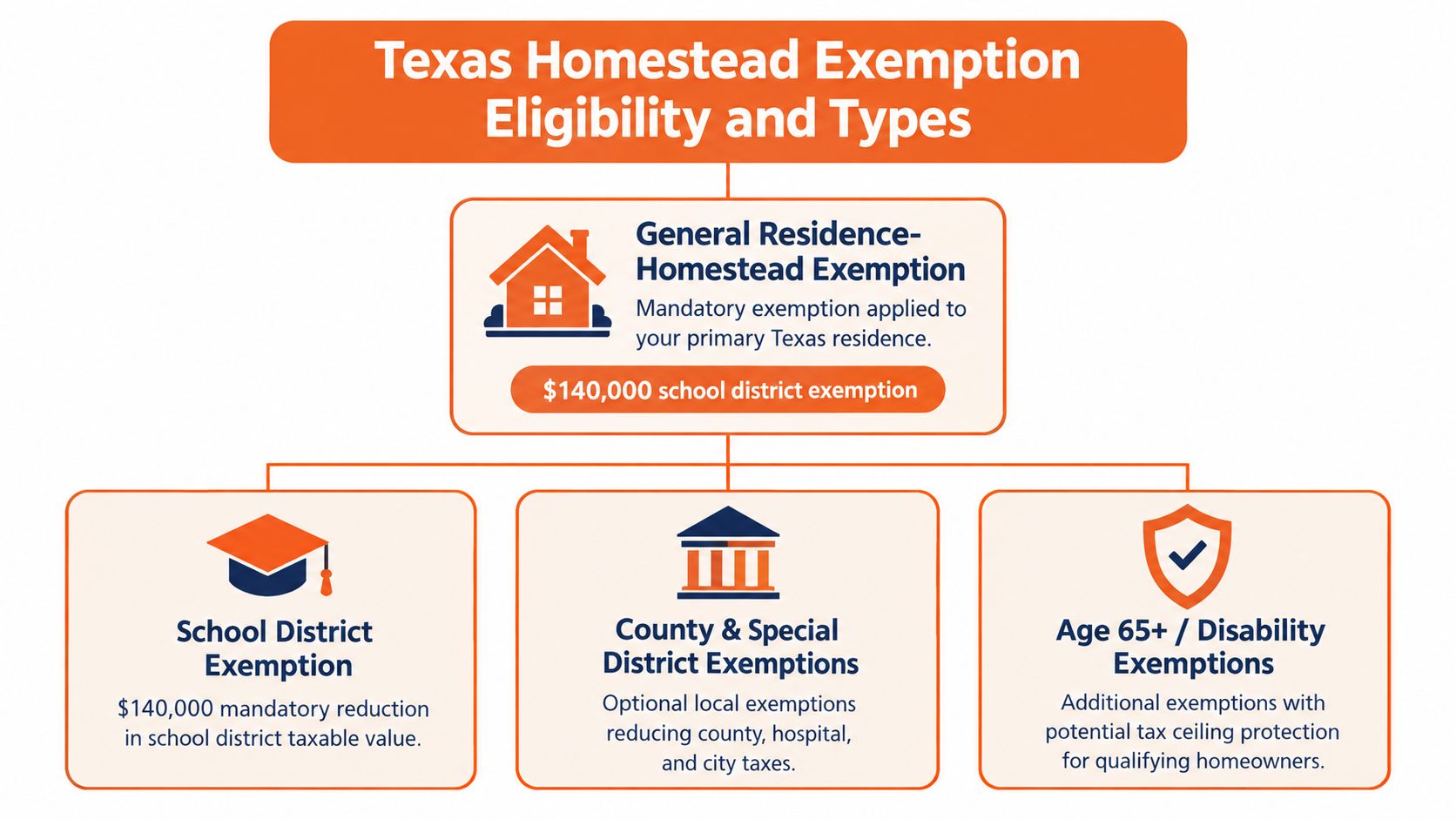
Texas Homestead Exemption Eligibility and Types
The first question isn't “How much will I save?” It's “Which exemption can this property legally receive?” For the 2026 Texas tax year, school districts must provide a $140,000 general residence-homestead exemption under the Texas Comptroller's materials. A qualifying homeowner who is at least 65 or disabled receives an additional $60,000 school-district exemption, creating a potential $200,000 reduction in school-taxable value (Texas Comptroller).
That reduction applies to the value used for school-district taxation. It isn't a universal credit against every property tax charge. County, city, and special-district treatment can differ, so the same home may show different taxable-value results across its taxing units.
General residence homestead eligibility
The owner must hold an ownership interest and use the property as a principal residence. The January 1 occupancy requirement matters because eligibility is tied to the tax year, not just to the date a deed was recorded.
Travis County confirms that the general homestead application is free and that the property must be the owner's primary residence. The application is filed with the appraisal district. A tax collector may receive and collect the resulting bill, but that office doesn't decide whether the homestead exemption applies.
A calculator should flag situations that need closer review:
- One principal residence: A homeowner generally can't claim competing homestead residences.
- Ownership structure: Individual ownership and residence use must align with the applicable rules.
- Property use: Rental, commercial, agricultural business, and mixed-use arrangements may require a different analysis.
- Life changes: A purchase, move, inheritance, or conversion from rental use can affect the qualifying year.
Mandatory and local benefits
The school-district exemption is the statewide foundation, but local taxing units may adopt additional residence-homestead relief. Texas allows a local-option exemption of up to 20% of appraised value, with a minimum of $5,000, when the relevant taxing unit adopts it (Texas Comptroller exemption guidance).
That local option isn't automatic everywhere, and it doesn't turn the whole tax bill into one statewide calculation. A homeowner should identify the county, school district, municipality, and special districts attached to the property before relying on the output. Owners evaluating a sale or off-market offer may also need a separate resource for Texas cash home buyers, because a transaction decision and an exemption estimate involve different financial questions.
How to Calculate Your Homestead Exemption Savings
The dependable method follows the tax bill's structure. Start with eligibility, calculate the taxable value for each taxing unit, apply that unit's rate, and add the results. Don't begin by subtracting a percentage from the final bill.
Step 1, verify the owner and property
Confirm that the owner holds an ownership interest and uses the home as a principal residence. Check the January 1 status for the tax year and look for another homestead claim, entity ownership, rental use, or mixed use that could change eligibility.
Then record the property's appraised value. This is the appraisal district's valuation input. It isn't the same thing as taxable value, which reflects the exemptions and other adjustments applied before a taxing unit calculates its charge.
Step 2, separate the taxing units
List each jurisdiction on the appraisal record. At a minimum, that may include the school district and county, with municipal and special districts added when applicable.
| Calculation layer | What to record | Why it matters |
|---|---|---|
| Appraisal | Appraised value | Establishes the starting value |
| School district | Approved school exemption | Applies the mandatory school benefit |
| Local jurisdictions | Adopted county, city, or special-district exemptions | These benefits vary by taxing unit |
| Tax calculation | Resulting taxable value and unit rate | Produces the unit's estimated charge |
For a $300,000 home receiving the $140,000 school exemption, the school district taxes the property as though its value were $160,000 (Texas Comptroller). That does not mean the county or city automatically uses $160,000.
Step 3, apply exemptions before rates
Apply the school-district exemption to the school-district value. Then apply any locally authorized county, city, or special-district exemption to the relevant unit. A local-option exemption may be up to 20% of appraised value, but the percentage-based exemption can't be less than $5,000 under the Comptroller's rules.
Only after those deductions should the calculator multiply each remaining taxable value by its taxing-unit rate. The total estimated bill is the sum of those separate results. The estimated savings is the difference between the modeled bill with the approved exemptions and the modeled bill without them, using the same rates and valuation assumptions.
Practical rule: An exemption reduces taxable value. It isn't a direct percentage discount on the final property tax bill.
Because rates and jurisdiction boundaries matter, homeowners should understand how to calculate a property tax rate before accepting a blended estimate. A calculator that hides the inputs may look easier, but it makes errors harder to find.
The Residence Homestead Appraisal Cap and How It Changes Your Bill
The exemption and the appraisal cap solve different problems. The exemption lowers taxable value through an approved statutory or local benefit. The cap limits how quickly the appraised value of a qualifying homestead can rise under specified conditions. A reliable calculator should show both scenarios separately rather than treating the cap as another exemption.
For a qualifying homestead that received the exemption in the preceding and current year, the annual appraised-value increase is generally limited to the lesser of market value or the prior appraised value plus 10% of that value and the market value of new improvements (Texas Comptroller valuation guidance).
Model the capped value first
The calculator should collect:
- Prior-year appraised value
- Current market value
- Market value of documented new improvements
- Current exemption status
- The applicable taxing-unit rates
It then calculates the capped appraised value before applying the exemptions and rates. That order matters because the exemption applies to the resulting taxable-value base, not to the home's market value in the abstract.
The cap doesn't apply immediately after every purchase, and it doesn't apply to every property type. It applies to property granted the residence-homestead exemption under the qualifying conditions. A new improvement can also affect the calculation.
Why the cap doesn't freeze the bill
Even with a capped appraisal value, the final bill can change. Taxing units may change their rates, a new jurisdiction may apply, or improvements may increase the value used in the calculation. The cap also doesn't prevent the appraisal district from determining market value as of January 1 using sales-comparison, income, or cost approaches.
A homeowner should therefore compare three lines rather than one:
- Market value, the appraisal district's estimate of the property's market worth.
- Capped appraised value, when the homestead cap applies.
- Taxable value by taxing unit, after each exemption is applied.
That distinction is central to any discussion of Texas property tax relief. A cap can moderate valuation growth, while an exemption changes the taxable base. Neither guarantees an unchanged bill.
Why Most Calculators Miss the Real Variables
Many online calculators ask for a home value and return a savings figure. That approach is attractive because it's fast, but it omits the variables that determine whether the estimate resembles the actual account.
The $140,000 school-district exemption is only one layer. A local-option exemption may be available from a county, city, or other taxing unit, but its adoption and application are local. The property's county, school district, municipal jurisdiction, and special districts can therefore matter more than the market value alone.
The property isn't taxed by one statewide rate
A statewide percentage applied to the total bill assumes every jurisdiction grants the same exemption and uses the same rate. Texas taxing units don't operate that way. The calculator should show the school-district result separately from the county, city, and special-district results.
A single number also hides the assumptions that produced it. Did the tool assume the application was approved? Did it include the local option? Did it apply the residence cap? Did it treat the property as entirely owner occupied?
Ownership and use can change the answer
Eligibility requires individual ownership, principal-residence use, and no competing homestead claim. Travis County's general homestead guidance excludes corporations and properties used for commercial or agricultural business. A rental owner who enters the property into a personal-residence calculator may receive a polished answer that doesn't apply to the property.
A fast estimate is useful only when its assumptions are visible.
The strongest calculator output should identify each taxing unit, list each exemption layer, flag mixed-use or entity-owned property, and distinguish an estimate from an approved appraisal record. It should also direct the homeowner to the responsible appraisal district for verification.
How INTELLI's Data-First Approach Improves Your Estimate
The most difficult calculator questions involve dates, not arithmetic. A recently purchased homeowner may apply immediately and have the exemption applied to the year in which the owner qualifies, while Travis Central Appraisal District says processing can take up to 90 days (Travis CAD homestead guidance).

A calculator that ignores purchase and occupancy dates may estimate the right deduction for the wrong year. It should also account for prior homestead status, retroactive eligibility, filing deadlines, and changes in the law. Travis CAD identifies a 2026 treatment for a residence homestead completely destroyed by fire: the exemption can be prorated for the remaining portion of the tax year, but supporting documentation must be filed within 180 days of the fire.
That kind of event illustrates why precision isn't only about adding more decimal places. The tool must know which legal version applies, whether the owner occupied the property on January 1, and whether a sale, move, inheritance, vacancy, or disaster changed the property's status. Texas materials describe the $140,000 school-district exemption and 2025 legislation affecting residence-homestead administration, so an older calculator can produce an outdated result.
INTELLI uses licensed property tax consultants and employs a data-first approach that combines public and private data to evaluate appraisal evidence, identify overlooked exemptions, and support property tax challenges, as described in its property tax consultant service. That work complements, rather than replaces, the statutory eligibility decision made by the appraisal district.
The practical workflow is to use a calculator for an initial scenario, verify the property's official record, and then investigate valuation evidence or missed exemptions when the numbers still look wrong. The right tool doesn't promise certainty where the facts are unsettled. It shows the assumptions, dates, taxing units, and next action clearly.
INTELLI offers a property tax review that examines your appraisal record, potential homestead exemptions, and property-specific evidence. If your calculator estimate doesn't match the official account, visit INTELLI to review your options with its licensed property tax consultants.