

You open the spring appraisal notice expecting a routine update and find a value higher than anticipated. The number on the notice feels like a tax bill, but it isn't. It is the starting point for calculating taxes, and property tax breaks can change the amount that local taxing units use in that calculation.
Texas homeowners often focus on the headline exemption amount and overlook the more important question: How much will this reduce my actual bill? The answer depends on the exemption, the taxing unit, the local rate, the property's use, and whether the owner still qualifies.
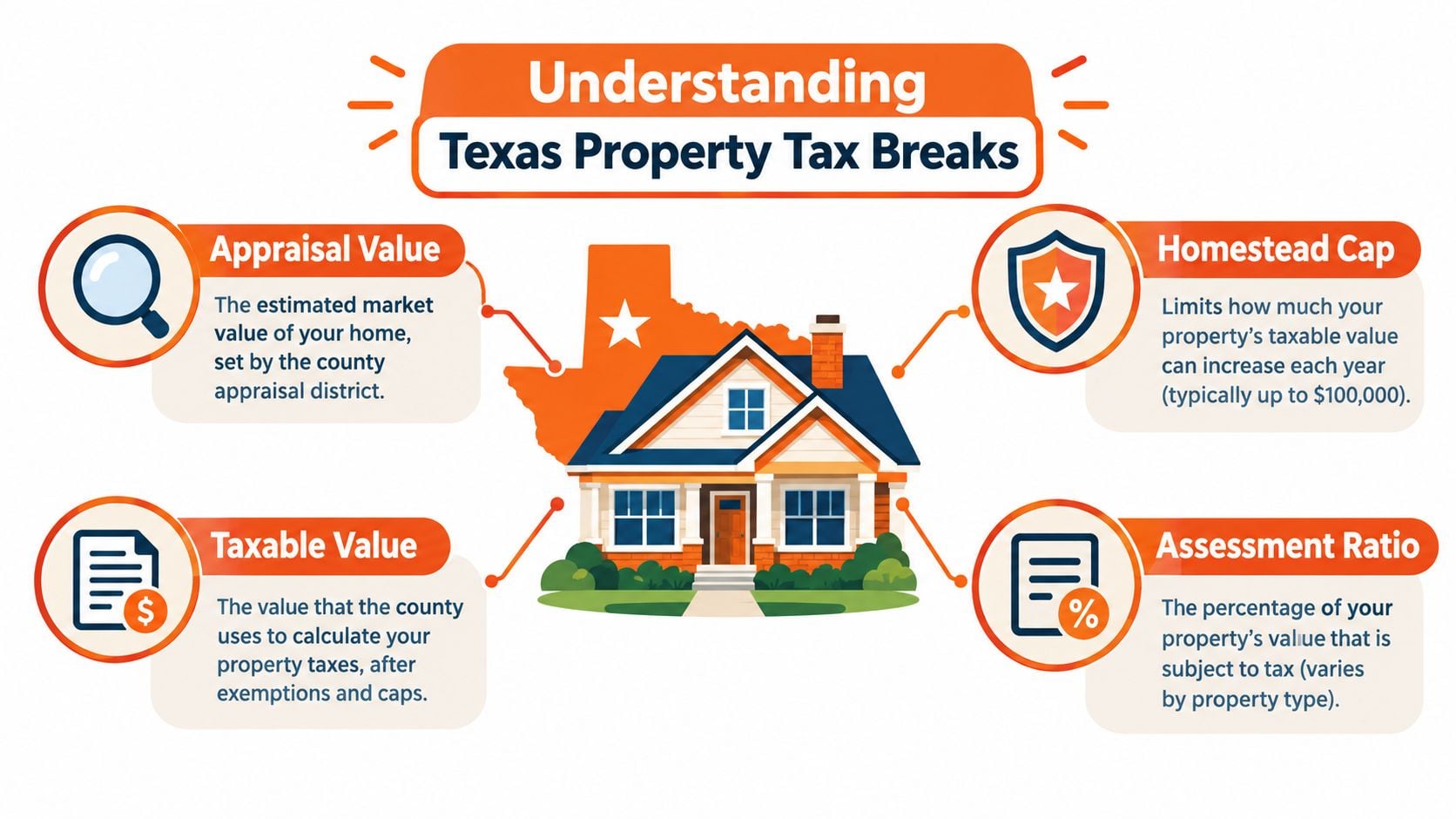
Understanding Texas Property Tax Breaks
A Texas homeowner can look at an appraisal notice, see a large exemption amount, and assume the tax bill will fall by that same amount. That is where confusion starts. A property tax break usually lowers the value that a taxing unit can tax. The actual dollars saved depend on which taxing unit applies the break and what rate that unit uses.
The core formula is simple:
Taxable value × local tax rate = tax attributable to that taxing unit
The hard part is that Texas does not apply one statewide property-tax rule to every part of the bill. Cities, counties, school districts, and special districts can use different rates, and some local governments offer exemptions that others do not. The Texas Comptroller's explanation of property-tax exemptions describes this local structure and the school-district homestead exemption.
The headline amount is not the final saving
Under Tax Code Section 11.13(b), every Texas school district must provide a $140,000 exemption from the appraised value of a qualifying residence homestead for school-district taxation. If a home is appraised at $400,000, its school-taxable value would be $260,000 before the school tax rate is applied, as the Texas Comptroller explains in its published exemption guidance.
That $140,000 exemption is a reduction in taxable value. It is not a $140,000 cut in the bill. A good way to read it is to treat the exemption like a coupon applied before checkout. The discount matters, but the final amount still depends on the price tag, here, the local tax rate.
This is also where Texas gets unusually local. A homeowner may receive the mandatory school-district homestead exemption but see a different result from the county or city portion because those units may handle local-option exemptions differently. Two homes with the same appraised value can end up with different total savings for that reason alone.
Practical rule: Treat an exemption amount as a reduction in taxable value, not as a promised reduction in your tax bill.
Eligibility is another place owners get tripped up. A qualifying residence homestead exemption generally applies to the owner's principal residence, not automatically to a rental or investment property. That distinction matters even more later in the process, because some forms of relief reduce current taxes while others only postpone payment and can create consequences when the owner sells, transfers, or leaves the home.
Major Exemptions Homeowners Qualify For
A homeowner can look at the word exemption on a Texas form and assume every tax bill will drop the same way. It rarely works that cleanly. Eligibility depends on the property, the owner, and which taxing units are on the bill, so the first question is who qualifies, and the second is where the savings apply.
Start with the property's status. A residence homestead applies to a qualifying principal residence, not every property an owner happens to hold. The statewide school-district homestead exemption is mandatory for an eligible homestead, while local percentage exemptions depend on whether a city, county, or special district adopted them. If you need a plain-language walkthrough of the basics, this homestead exemption guide for Texas homeowners is a useful starting point.
Then look at the owner's status. The main categories are:
- Residence homestead: Available for a qualifying principal residence. This is the starting point for many homeowners, but it does not automatically carry over to rental or investment property.
- Age 65 or disability: A qualifying homeowner who is at least 65 or disabled receives an additional mandatory school-district exemption of $60,000, according to the Texas Comptroller's guidance. The point that often gets missed is what that number means. It reduces taxable value for school taxes. It does not mean the bill falls by $60,000.
- Disabled veteran status: Texas disabled-veteran exemptions vary by statutory category and disability qualification. One Comptroller example provides a $12,000 assessed-value exemption for a veteran who is at least 65 with at least a 10% disability rating, is totally blind in one or both eyes, or has lost use of one or more limbs. Other categories can remove part or all of a qualifying property's value, with the amount tied to the disability rating. Details and application rules appear in the Comptroller's disabled-veteran FAQ.
- Agricultural, wildlife-management, and historic designations: These can change how eligible property is valued, but they follow their own use, documentation, and statutory rules. They are not automatic substitutes for a homestead exemption.
Texas also has a local-option layer, which is where homeowners often overestimate savings. The school-district homestead exemption is statewide for a qualifying residence. Cities, counties, and some special districts may also adopt a local-option residence-homestead exemption of up to 20% of appraised value, subject to statutory minimums. For tax year 2026, the local option cannot be less than $5,000, per the same Comptroller exemption guidance cited above.
That means the headline exemption amount and the actual dollar savings can drift apart. One taxing unit may offer local relief while another does not. Each participating unit also applies its own rate. A higher exemption can still be partly offset by a rising appraisal, a changed local rate, or the property's use.
The safest habit is to read the bill line by line. County, city, school, and special-district calculations do not always move together, so actual savings come from matching the right exemption to the right taxing unit, not from assuming one large number applies everywhere.
Exemptions vs Deferrals vs Abatements
These terms describe different financial outcomes, and confusing them can create an unpleasant surprise when a homeowner sells or moves.
An exemption reduces the taxable value used by an eligible taxing unit. The benefit applies while the owner and property meet the requirements. It isn't a loan, and it doesn't create a balance that the homeowner later repays just because the exemption was used.
A deferral works differently. It delays payment, which can protect cash flow for an eligible senior, disabled homeowner, or another qualifying owner. But the unpaid amount becomes a liability rather than disappearing. Under the Travis County tax office's guidance, deferred property taxes generally become due, along with 5% annual interest, within 180 days after the owner sells the home, moves, or otherwise stops qualifying.
An abatement is usually a temporary agreement or statutory reduction connected to a particular property, project, or period. It doesn't function like a permanent homestead exemption, and its terms determine what happens when the agreement ends or the property's circumstances change.
Why the exit event matters
Suppose a homeowner uses a deferral to keep monthly expenses manageable. That may be a sensible cash-flow decision, but the owner should record the liability and plan for the event that ends eligibility. A sale, move, or change in qualification can convert a manageable delay into a settlement obligation for the owner or estate.
Missing the repayment window can trigger substantially higher penalties and interest, so heirs and family members handling an estate shouldn't assume that the benefit follows the property. The benefit may depend on the former owner's status and occupancy, while the liability may need attention during the sale or inheritance process.
| Relief type | What changes now | What to check later |
|---|---|---|
| Exemption | Taxable value is reduced | Confirm continued eligibility and filing status |
| Deferral | Payment is postponed | Track the balance, interest, and ending event |
| Abatement | Taxes are reduced for defined terms | Review the agreement and expiration conditions |
A lower current bill isn't always the same as a lower lifetime cost.
Before choosing a deferral, ask who will receive notices, how the balance is recorded, what happens after a move, and how an estate should handle repayment. Texas property tax deferral guidance can serve as a starting point, but homeowners should confirm the terms with the relevant appraisal district or tax office.
Filing Deadlines and Protest Procedures
Filing and protesting are separate actions. An exemption application asks the appraisal district to recognize an eligibility-based reduction. A protest challenges the district's valuation or another appraisal matter.
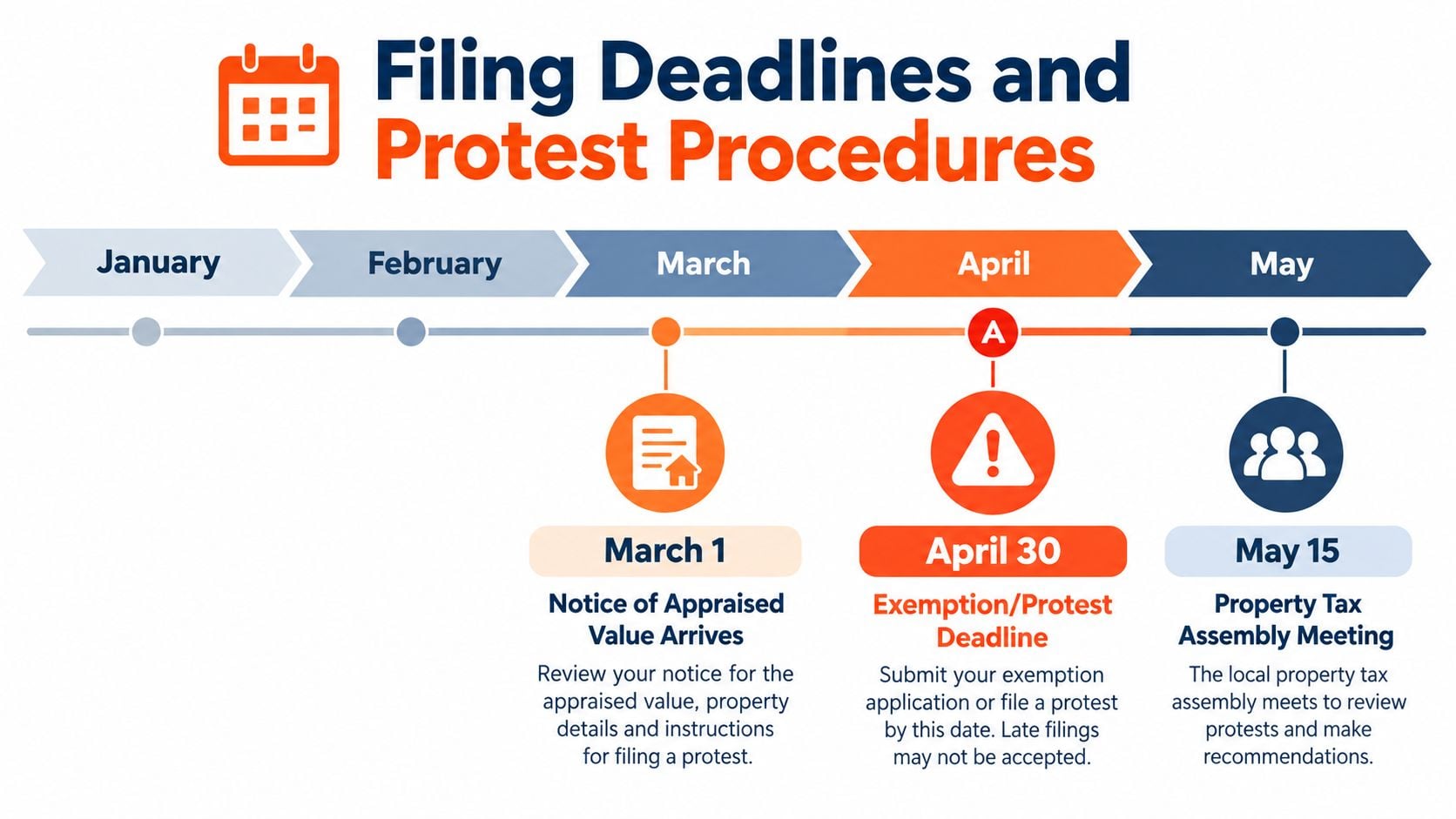
Most Texas property-tax exemption and special-appraisal applications are generally due by April 30, according to the Texas Comptroller's property-tax newsletter. Important exceptions exist. An age-65-or-older homeowner may generally file a residence-homestead application up to two years after becoming eligible, while a disabled veteran may generally file a qualifying application up to five years after the taxes become delinquent. Documentation and eligibility rules still apply.
A practical filing sequence
- Confirm the property and owner status. Check whether the home is the owner's principal residence and identify any age, disability, veteran, agricultural, or historic qualification.
- File with the correct appraisal district. Most applications go to the county appraisal district, not the tax collector.
- Keep proof of submission. Save the application, supporting documents, delivery confirmation, and any response.
- Review the appraisal notice. Don't assume an exemption application corrects an inflated valuation.
- Calendar the protest deadline. For most Texas appraisal protests, the deadline is May 15 or the 30th day after the appraisal district delivers the notice of appraised value, whichever date is later, as stated by the Texas Comptroller.
Build an evidence-based protest
A protest isn't merely a request for discretionary relief. It is a valuation challenge presented to the county Appraisal Review Board. The Comptroller's appraisal protest procedures identify useful evidence such as:
- Property photographs: Show deferred maintenance, damage, access problems, or condition issues.
- Comparable sales: Explain why selected properties are comparable and why their sale prices support a different value.
- Closing documents: Use transaction records when they illuminate the property's market evidence.
- Repair estimates and engineering reports: Connect physical defects to the property's value.
- Surveys, blueprints, and property details: Correct inaccurate descriptions or characteristics.
- Unequal-appraisal evidence: Compare the property's appraisal with comparable properties and relevant median-level-of-appraisal information.
Before the hearing, the owner may request the appraisal district's evidence. A persuasive case reconciles condition, physical characteristics, transaction data, and comparable selection. A broad claim that the market is weak won't carry the same weight as property-specific evidence.
Why Professional Help Makes a Difference
The hardest part of Texas property tax work isn't identifying one headline exemption. It's matching the right benefit to the right parcel, taxing unit, owner status, evidence set, and deadline. A homeowner may have a valid homestead claim and still need a separate valuation protest. An investor may need a portfolio review rather than a residence exemption. A veteran may need documentation tied to a specific statutory category.
Professional support can be useful when the facts are complicated or the cost of a missed filing is high. A consultant can help organize appraisal records, inspect comparable selection, identify inconsistencies, prepare evidence, and manage communications with the appraisal district. The owner still makes the underlying decisions, but the process becomes less dependent on memory and guesswork.
The value of a data-first review
INTELLI uses licensed property tax consultants and employs a data-first approach using public and private data to help identify applicable exemptions and filing issues. That approach can bring together public appraisal information with property characteristics, transaction records, condition evidence, and documentation supplied by the owner.
The purpose isn't to promise a particular result. It's to make the case traceable. A strong review should answer which value is being challenged, which taxing units are affected, what evidence supports the position, and whether the owner has a separate exemption or filing issue.
Good representation connects the paperwork to the parcel, the parcel to the evidence, and the evidence to the deadline.
Homeowners who manage rentals, commercial buildings, historic properties, or multiple parcels may also want broader administrative support. Property managers looking beyond tax matters can browse financial management options for related property and financial administration needs.
A homeowner can also file independently, especially when the property and documentation are straightforward. Professional representation becomes more relevant when the owner lacks time, struggles to compare appraisal records, has missed a deadline, or needs help presenting a multi-part valuation argument. INTELLI's property tax reduction services address exemption reviews, valuation challenges, and representation within that broader process.
Real Examples of Tax Savings and Recovery
A homeowner can look at a large exemption on paper and still wonder why the tax bill did not fall by that same amount. The missing step is the tax rate. Start with a qualifying homestead appraised at $400,000. For school taxes, the taxable value drops to $260,000 before the rate is applied. If the school tax rate were $1.00 per $100 of taxable value, that $140,000 reduction would translate into about $1,400 in school-tax savings for the year. The exemption changes the amount being taxed. The rate determines the dollars.
The same step-by-step approach helps with the mandatory $60,000 school-district exemption for an owner who qualifies by age or disability. At that same sample rate of $1.00 per $100, a $60,000 reduction in taxable value would save about $600 on the school portion. The actual total bill can still vary because other taxing units may have different rates, and some local exemptions depend on whether a city, county, or special district has chosen to offer them.
That local-option piece is where Texas often gets confusing. Two houses with similar values can produce different bills because the tax bill is built from several layers, more like stacking separate receipts than reading one price tag. One taxing unit may apply an exemption. Another may not. A headline exemption amount only tells you how much value is removed from the calculation. It does not tell you the final savings until each applicable rate is applied.
Comparing the main outcomes
| Situation | Immediate effect | What the owner should measure |
|---|---|---|
| Homestead exemption | Reduces taxable value for school taxes and any participating local units | The dollar change after each relevant tax rate is applied |
| Senior or disability exemption | Adds another school-taxable-value reduction for a qualifying owner | The added school-tax savings, plus any local treatment |
| Successful appraisal protest | Lowers the value used to calculate taxes | Whether the revised value changes multiple taxing-unit bills |
| Deferral | Postpones payment instead of cutting the tax itself | The deferred balance, interest, and what happens when eligibility ends |
Past-year review can also produce recovery, but the route matters. An owner may find a missed exemption, an incorrect property characteristic, or an appraisal record that overstated the property. Deferrals need extra care because they solve a cash-flow problem first and can create an exit problem later when the balance comes due with interest. Ask for a parcel-level explanation that shows the original calculation, the corrected calculation, and the effect on each taxing unit.
INTELLI uses licensed property tax consultants and a data-first review of public and private data to help homeowners, investors, and businesses identify exemptions, prepare valuation evidence, and address filing issues. Visit INTELLI to review your property tax position and determine whether a homestead claim, exemption review, or appraisal protest is the appropriate next step.