

You're sitting at the kitchen table in Austin with a Travis Central Appraisal District notice in front of you. The value doesn't match the number on Zillow, the price in your purchase contract, or the amount your mortgage servicer paid last year. That's normal, because Texas property taxes aren't based on one number or one rate.
The practical question behind “how are property taxes calculated in Texas” is simpler than the paperwork makes it appear: which value survives the appraisal process, which exemptions reduce it, and which local rates apply afterward? In Travis County, exemptions and a well-supported protest often matter more to a homeowner's bill than trying to predict a rate change.
Why a Texas Property Tax Bill Feels So Confusing
A Texas tax bill combines several values that sound interchangeable but aren't. Market value is the likely price in an arm's-length sale. Appraised value is the appraisal district's estimate of that market value. Assessed value, in a homestead context, reflects the value after the applicable limitation is applied. Taxable value is what remains after exemptions and excluded value are removed.
The bill then applies rates adopted by several taxing units. A residence may be subject to school district, county, city, community college, healthcare, utility, or other special-district charges. Texas property taxes therefore begin with the appraisal roll or an estimate of taxable value, then use local truth-in-taxation procedures to establish the no-new-revenue and voter-approval rates. Texas Comptroller guidance on truth-in-taxation calculations explains how the local formula works.
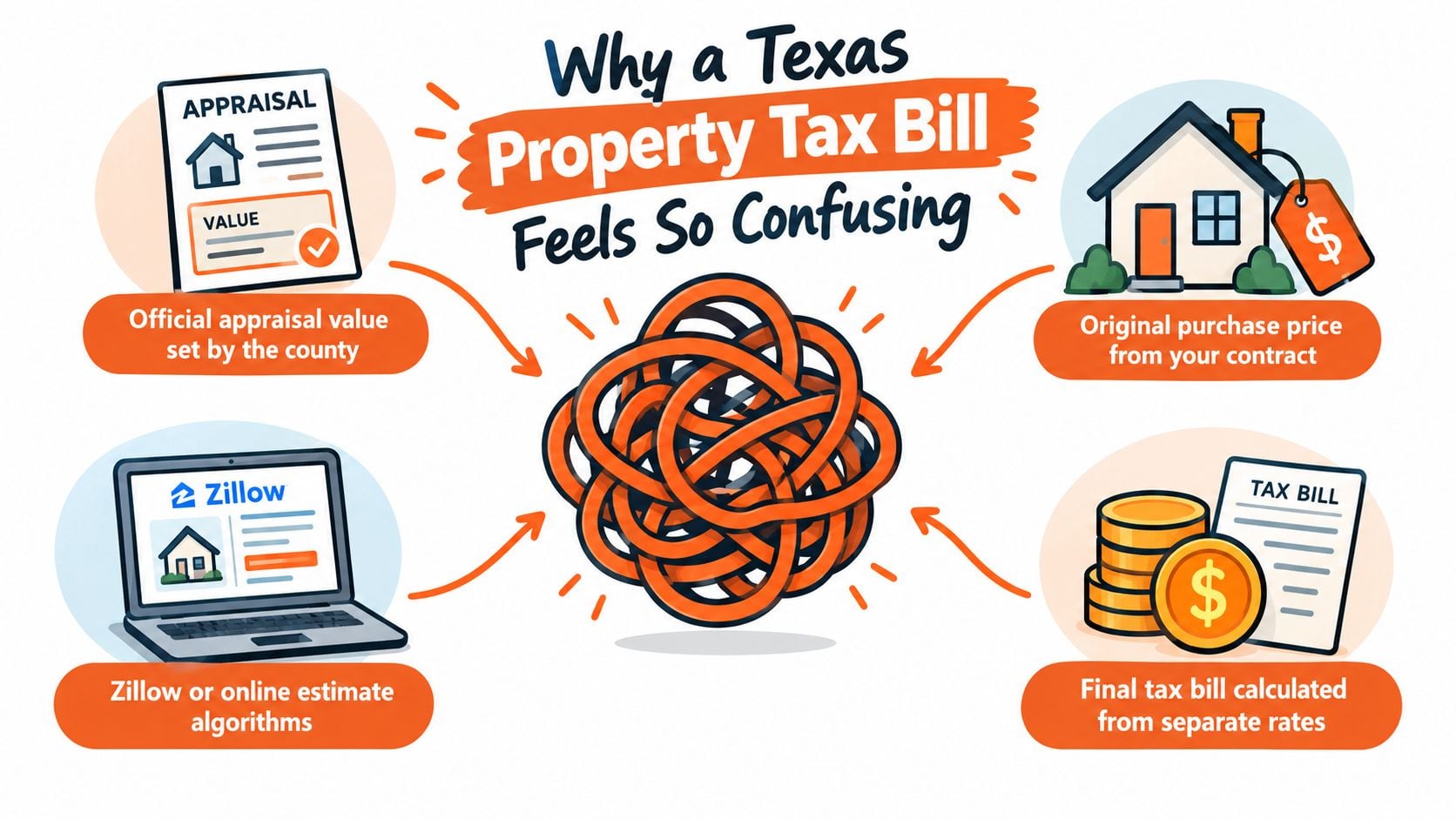
The numbers on your notice serve different purposes
The purchase contract can show what one buyer paid at one point in time. Zillow or another online estimate can provide a useful market reference, but it isn't the county's official appraisal record. TCAD's value is the figure used in the government's calculation, and the final bill depends on the taxable value and the combined rates for the property's taxing units.
That's why the familiar shortcut, assessed value multiplied by rate, hides the most important decisions. The rate is only one input. A homestead cap can limit the value increase, exemptions can remove value from taxation, and a protest can challenge the appraisal itself.
Practical rule: Start with the official notice and exemption record, not an online estimate. The question is which official value is being taxed and why.
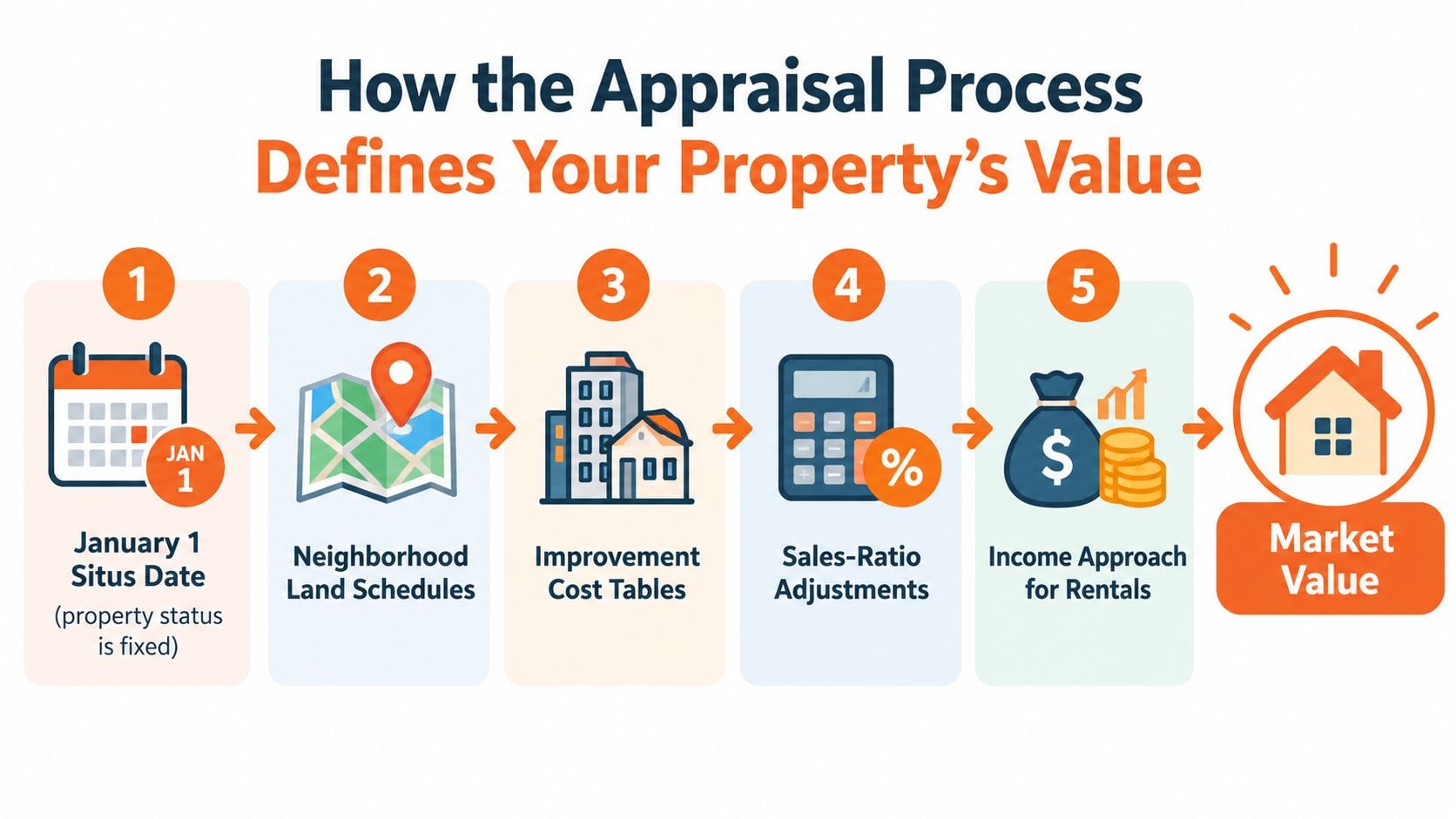
How the Appraisal Process Defines Your Property's Value
A Travis County appraisal begins with the property's status on January 1, the situs date for that tax year. TCAD generally uses mass appraisal, grouping comparable properties and applying neighborhood land schedules, improvement cost tables, and sales data to calibrate its models. The district is estimating market value across many properties, not negotiating a separate figure with each owner.
For rental property, the income approach may also matter because earning capacity helps inform value. Homeowners do not need to rebuild TCAD's model. They do need to check the inputs that can change the result, including a recent sale, inferior condition, deferred maintenance, incorrect square footage, or a flawed property description. Those details usually make stronger protest evidence than a general claim that the value feels too high.
The four-value chain
- Market value: The price the property could reasonably command in an arm's-length transaction.
- Appraised value: The appraisal district's statutory estimate of market value.
- Assessed value: The appraised value after a limitation, such as a qualified residence homestead cap, is applied.
- Taxable value: The assessed value after eligible exemptions and exclusions are deducted.
These labels are not interchangeable. The rate applies later, after the district determines which value remains taxable. That distinction explains why exemptions and caps can change a bill more than a small rate movement.
The Notice of Appraised Value gives the owner the proposed appraisal and starts the protest process. In Austin practice, notices commonly arrive in spring. The filing deadline is generally May 15 or the 30th day after the appraisal district delivers the notice, whichever is later. Keep the notice and exemption record together before deciding what to challenge.
For a broader explanation, Homebase appraisal guidance outlines appraisal methods that can help with unusual or income-producing property. What a property tax assessment means and how it impacts your tax bill also clarifies how the assessed figure reaches the bill.
The Homestead Cap and Why It Changes Your Tax Base
The homestead cap is one of the most misunderstood parts of the calculation. For a qualified Texas residence homestead, the annual increase in appraised value is limited to 10% plus the value of new improvements. The limitation begins on January 1 of the tax year after the owner first qualifies for the homestead exemption. Texas homestead cap guidance explains how the limitation compares the previous year's appraised value with the current market value.
The cap limits the taxable appraisal value. It doesn't cap the final tax bill, because local rates and exemptions can still change. The value may also reset after a sale, which is why a buyer can receive a substantially different taxable value from the seller's even when the property itself hasn't changed.
A simplified cap example
Suppose the prior capped value was $535,714, and the current market value rose by 12% to $600,000. Applying the 10% annual limitation produces a capped value of $589,285.40, before accounting for new improvements. The difference between market value and capped value is $10,714.60, not a permanent exemption. It is value outside the current cap calculation, and the limitation can change after ownership transfers.
| Year | Market Value | Capped Value | Deferred Gap |
|---|---|---|---|
| Prior year | $535,714 | $535,714 | $0 |
| Current year | $600,000 | $589,285.40 | $10,714.60 |
The exact mechanics matter. The capped value is generally the lesser of current market value or the prior year's appraised value plus the permitted annual increase and new improvements, as summarized in this Texas homestead cap explanation.
The cap is especially valuable when market value rises faster than the permitted increase. But it isn't a reason to skip a protest. If the district's market value is wrong, that inflated figure can affect future calculations, and a sale can remove the prior owner's limitation.
Exemptions That Cut Your Taxable Value in Texas
Exemptions often create the largest swing in a homeowner's bill because they reduce the value to which local rates apply. Texas now provides a $140,000 school-district homestead exemption statewide, and a taxing unit may adopt a local-option residence homestead exemption of up to 20%. The Texas Comptroller's exemption guidance explains which exemptions are authorized and how partial exemptions remove a percentage or fixed amount from taxation.
A homeowner should review each taxing unit separately. The school-district exemption doesn't automatically mean the same deduction applies to county, city, or special-district taxes. Some exemptions apply broadly, while others are limited by the governing statute or local adoption.
Common exemptions and their practical reach
| Exemption | Who Qualifies | Taxing Units That Apply | Typical Impact on Taxable Value |
|---|---|---|---|
| Residence homestead | Owner occupying the property as a principal residence | Depends on the exemption and taxing unit | Removes an eligible fixed amount or local percentage |
| Over-65 | Qualifying older homeowner | Often includes school-tax protections and other authorized benefits | Reduces taxable value and may support a tax ceiling |
| Disabled person | Qualifying homeowner with a disability | Applies according to the governing exemption | Reduces taxable value and may support a tax ceiling |
| Disabled veteran | Veteran meeting statutory disability requirements | Depends on the exemption category | Tiered reduction, from $5,000 to $12,000, with a full exemption at 100% disability |
| Agricultural or timber productivity | Land used and managed for qualifying agricultural or timber purposes | Applies to qualifying land value | Replaces ordinary market valuation with productivity-based treatment |
| Historic designation | Property meeting applicable historic-site requirements | Depends on the legal designation and local rules | May create a partial or specialized exemption |
The standard residence homestead treatment, the school-district exemption, and the local-option reduction can work together, but they don't all apply in the same way. Over-65 and disabled-person provisions can also create a tax ceiling on the homestead, which means later rate changes may not affect the school-tax obligation in the ordinary manner, although improvements and other circumstances can matter.
Filing errors are common. A homestead exemption generally cannot be claimed on a rental property, and filing timing affects when savings begin. Owners should also check whether a surviving-spouse rule or portability provision applies rather than assuming a new application is unnecessary. The appraisal district's exemption record is as important as the valuation record.
Local Tax Rates and How They Stack Across Districts
After the appraisal district establishes the relevant taxable value, separate taxing units apply their own ad valorem rates. A Texas property can carry a school-district rate, county rate, city rate, community-college rate, and special-district rates. In the Austin area, special districts can include healthcare entities such as Travis County Healthcare District, doing business as Central Health, as well as municipal utility districts where applicable.
The rates are added together and commonly expressed per $100 of taxable value. For example, a rate of $1.0669 per $100 is converted to 0.010669 for multiplication against taxable value, as shown in this Texas tax-rate calculation example.
What the rate labels mean
The no-new-revenue rate is designed to produce the same total revenue from properties on the current roll, subject to the statutory calculation. The voter-approval rate is the rate a taxing unit can generally adopt before voter approval is required under the applicable rules. Texas truth-in-taxation procedures require taxing units to publish information and hold the required process before adopting rates.
A property owner shouldn't treat the published rate as the first or only variable. Rates can differ sharply between adjacent properties because city limits, school boundaries, MUD participation, and other taxing-unit boundaries differ. Annexation, bond obligations, and local elections can also affect the adopted rate.
The adopted rate appears after the taxing units complete their annual process, often after appraisal protests have changed the certified roll. For a plain-language explanation of rate mechanics, see what a mill rate means.
Use the rate to estimate the bill, but use the taxable value to find the biggest homeowner lever. A lower taxable base reduces every rate applied to that base.
A Sample Travis County Property Tax Calculation
The following illustration shows the order of operations requested by many Austin homeowners. It uses a 2024 market value of $625,000, a 10% homestead cap, a $140,000 school homestead exemption, a 20% local-option reduction, and a composite rate of roughly $2.20 per $100. These are illustrative figures, not a statement of the actual rate for a particular Austin address.
The cap produces a capped value of $560,000 in this example. Subtracting the school exemption leaves $420,000. Applying the local-option reduction to that remaining amount produces a taxable value near $336,000.
| Step | Calculation | Value | Running Bill |
|---|---|---|---|
| Market value | Starting market value | $625,000 | Not yet calculated |
| Homestead cap | Capped appraisal value used in example | $560,000 | Not yet calculated |
| School exemption | $560,000 minus $140,000 | $420,000 | Not yet calculated |
| Local-option reduction | $420,000 reduced by 20% | $336,000 | Not yet calculated |
| Composite rate | $2.20 per $100, applied to taxable value | $336,000 taxable value | Near $7,400 |
| Estimated bill | $336,000 multiplied by 0.022 | $336,000 taxable value | Near $7,400 |
The arithmetic demonstrates why the taxable base deserves attention. A rate of roughly $2.20 per $100 applied to approximately $336,000 creates an annual bill near $7,400, while the same property without the listed exemptions would produce a substantially larger estimate, roughly $13,750, under the same illustrative rate. The comparison isolates the effect of exemptions and the cap, rather than suggesting that every Travis County property carries that rate or receives those exact reductions.
Several details can change the result. A local-option exemption may apply differently by taxing unit, a special district may add its own rate, and an improvement can affect the capped value. The official tax statement, exemption record, and adopted rates control the actual liability.
Filing a Protest and Key Austin Deadlines to Know
A protest begins with the Notice of Appraised Value from TCAD. Review the property description, market value, homestead status, exemption record, and deadline printed on the notice. The statutory timing trigger is generally May 15 or the 30th day after the notice is delivered, whichever is later. Confirm the applicable date under the Texas Comptroller protest deadline rules.
Build the file before submitting
A strong protest connects the value you request to specific evidence. Gather:
- Comparable sales: Choose properties similar in location, size, age, condition, and features.
- Condition evidence: Provide dated photographs, contractor estimates, and repair records for defects the district's model may overlook.
- Record corrections: Identify errors in square footage, year built, quality grade, lot details, additions, or other physical characteristics.
- Exemption documentation: Check that homestead, senior, disability, veteran, or land-use status appears correctly.
Owners can generally file through the TCAD online portal, use available electronic tools, or submit a written protest. The filing must identify the property and grounds clearly and arrive on time. Strong valuation evidence cannot fix a missed deadline.
The Appraisal Review Board may offer an informal conference before the formal hearing. At the formal hearing, present the evidence, answer the district's position, and request the value you believe is correct. Organize the presentation around that requested value, then explain the strongest comparable sales or condition evidence. Use weaker points only as supporting context.
After an ARB decision, review the order promptly. Correction procedures, additional evidence, or judicial review may be available, depending on the issue and procedural posture. A homeowner who disagrees with the result can explore review through Travis County district court, but litigation requires attention to deadlines, pleadings, evidence, and cost.
For Austin-specific filing context, review the Austin Texas property tax protest process. The district may not correct a missed exemption or inaccurate property characteristic automatically, so compare the appraisal record with your documents before filing.
Key Takeaways and When to Bring in a Specialist
The calculation becomes manageable once the values are separated. Market value is the starting question, the homestead cap limits qualifying annual growth, exemptions reduce the taxable base, and local rates convert that base into the final bill. A protest should attack the evidence behind the appraisal, not object to the amount of the tax bill.
The highest-property tax checks are practical:
- Challenge market value with comparable evidence. A well-matched sale is usually more useful than a general complaint about affordability.
- Verify every exemption. Check the homestead record and review eligibility for senior, disabled-person, disabled-veteran, agricultural, timber, or historic treatment.
- Track the cap after a purchase. A buyer may not receive the seller's prior limitation, so the first post-purchase notice deserves close review.
- Audit the taxing units. Confirm that the property is assigned to the correct school, city, county, and special districts.
- File on time. The deadline is procedural, and late evidence can't always cure a late protest.
DIY filing works well for a straightforward house with obvious comparable sales and a clean exemption record. A licensed Texas property tax consultant can analyze valuation evidence, prepare the protest, and represent the owner before the appraisal district. A protest attorney becomes more relevant when the matter involves complex legal issues, a difficult ARB record, or judicial review. Fee structures vary, so ask whether the engagement is contingent, fixed-fee, hourly, or results-based before signing.
Professional help is particularly useful for higher-value properties, complex land-use exemptions, recent purchases with limited comparable sales, multi-unit properties, commercial assets, and cases moving beyond the ARB. INTELLI uses licensed property tax consultants and employs a data-first approach using public and private data, combining valuation analysis with evidence preparation and representation.
My recommendation for Travis County homeowners is direct. Review the appraisal annually, protest when the evidence supports a lower value, and treat exemptions as a core part of the calculation rather than a filing footnote. If your property involves multiple taxing units, unusual improvements, commercial use, or a post-ARB dispute, bring in a licensed, data-first specialist before the deadline closes.
INTELLI reviews Texas property valuations, identifies support for a protest, helps address eligible exemptions, and represents owners through the appraisal process. Visit INTELLI to request a property tax review and determine what evidence and filing strategy fit your Austin or Travis County property.