

The Notice of Appraised Value arrives, and the number doesn't resemble what your Travis County home, rental, or commercial property would command in a real transaction. Maybe the appraisal record still shows a dated kitchen as remodeled, uses a questionable comparable, or treats a specialized building like a standard asset. Your first instinct may be to object to the tax bill, but the productive move is to challenge the valuation, the equity of the appraisal, the property record, or the exemption status with evidence.
A successful Travis County property tax appeal isn't built on frustration. It rests on the right deadline, the right legal ground, and a concise packet that answers how TCAD reached its value. The strongest owners also know when a market-value argument isn't the best tool, when unequal appraisal creates a stronger position, and why an exemption review should happen before deciding how much value remains worth disputing.
Why Your Travis County Valuation Feels Too High
Notice day usually starts with a quick search of the TCAD property record. You compare the figure with your purchase price, recent neighborhood sales, or the rent your property produces. Then you find the problem: the district's record may describe the property broadly enough to miss condition, functional limitations, deferred maintenance, or a use that doesn't support the assigned value.
TCAD estimates value for the tax roll and assists owners with protests. That estimate may be reasonable in broad terms while still being wrong for a particular parcel. Automated models and mass appraisal systems can overshoot when they don't fully account for a remodeled home that was marketed as original, an older structure with expensive repairs, or a commercial property whose income doesn't support the district's assumptions.
Three values that owners confuse
Market value is the property's probable price in an open-market transaction. Appraised value is the value TCAD places on the property for appraisal purposes. Taxable value is the amount left after applicable exemptions and other adjustments.
Those numbers can move differently. A protest generally addresses the appraisal record and value, while an exemption reduces taxable value independently. Travis County materials distinguish properties under protest from certified taxable values, which means a timely dispute can affect the tax roll before the dispute is finally resolved, as explained in the county's guidance on appraised-value protests.
Practical rule: Don't start by asking whether your taxes feel excessive. Start by asking which part of the record is wrong and which evidence can prove it.
When equity beats a lower-value opinion
A market-value protest says the property's assigned value exceeds what the property would have sold for on the relevant valuation date. An unequal-appraisal protest says similar properties are being appraised at lower levels, even if the district's general market model appears defensible.
That distinction matters for a remodeled home, rental, or commercial asset when nearby properties with similar characteristics carry lower appraisal-to-market ratios. A lower opinion of value based on one sale may be easy for the district to dismiss. A carefully selected group of comparable properties, adjusted for meaningful differences and presented as a ratio comparison, can show that the owner is carrying more than a fair share of the tax burden.
For owners still learning how property taxes work across different property types, Global's property tax guide provides useful general context. It shouldn't replace a Travis County evidence review, but it can clarify the distinction between valuation and tax treatment.
A quick decision before you file
Check the notice date, property description, square footage, condition, land details, and exemption status. Then ask whether you have credible sales, income records, repair documentation, or comparable appraisal ratios. If at least one material issue exists, filing is usually the sensible choice because the protest preserves your opportunity to present the evidence.
INTELLI uses licensed property tax consultants and employs a data first approach using public and private data to organize valuation evidence, identify record problems, and manage the appeal process. The same discipline applies whether you handle the protest yourself or hire representation: identify the defect before building the argument.
Filing Deadlines and Protest Options That Protect You
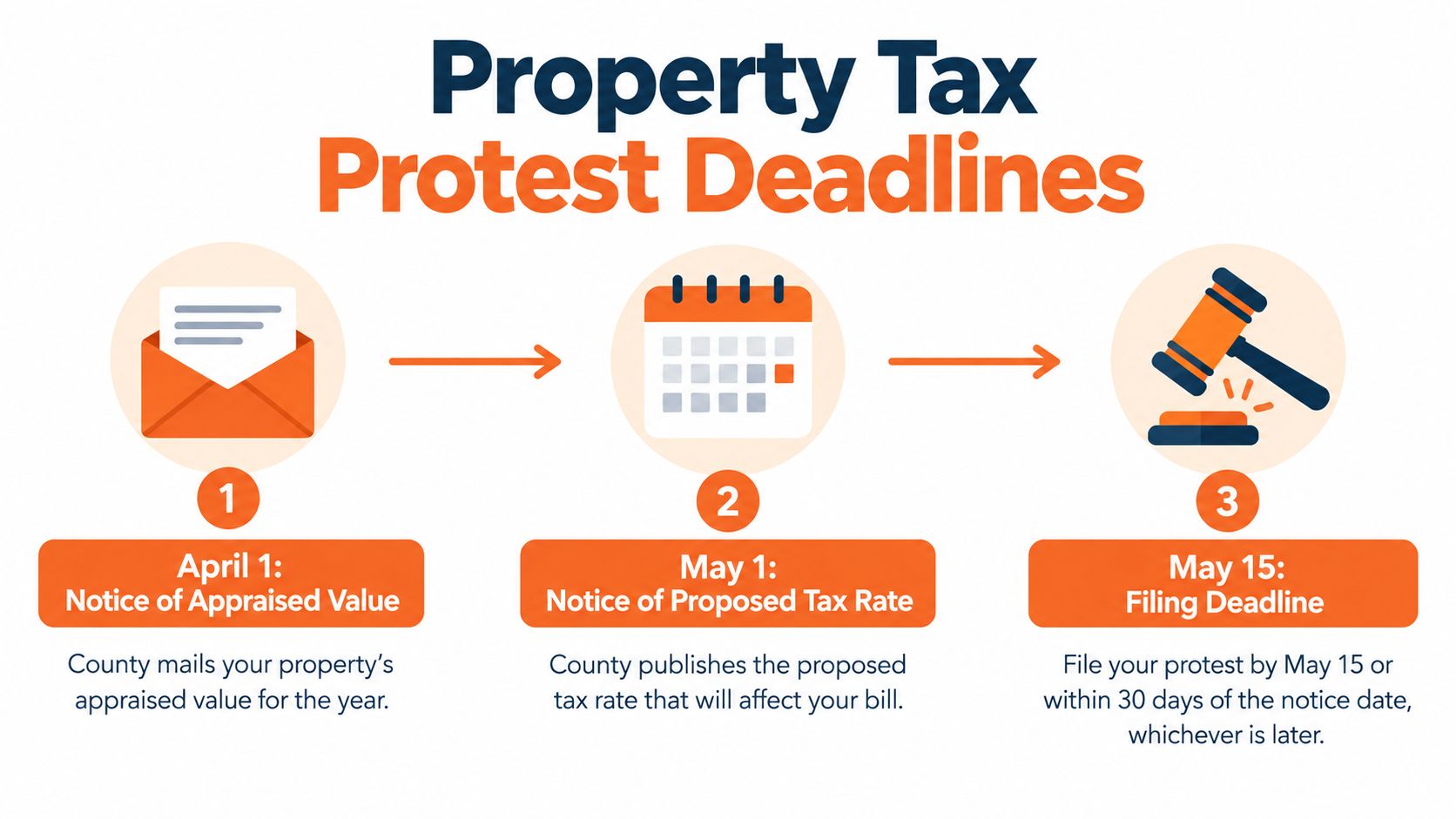
A good argument filed late may never reach the merits. In Travis County, an owner generally must submit a written protest to the Appraisal Review Board by May 15 or within 30 days after the appraisal district mails the Notice of Appraised Value, whichever date is later. The Texas Comptroller describes this statewide rule in its property-tax protest guidance.
Residence homestead notices generally must be sent by April 1, while notices for other properties generally must be sent by May 1, or as soon as practical afterward. Those notice expectations matter because the mailing date can control the filing window. Don't assume the calendar date alone settles your deadline.
Use a deadline-first checklist
- Locate the notice date. Save the Notice of Appraised Value and record when TCAD mailed it. Calculate both possible deadlines, then use the later date.
- Choose every applicable ground. Common grounds include excessive appraised or market value, unequal appraisal, incorrect property records, and certain exemption or agricultural-appraisal issues.
- File through a reliable channel. TCAD permits electronic submission through its public portal, mail, or hand delivery. Keep the submitted form, uploaded documents, delivery proof, and confirmation.
- Submit a defensible initial protest. You don't need a finished courtroom brief on the first filing, but you do need to preserve the grounds and meet the deadline.
- Calendar the next contact. TCAD generally offers an informal discussion with an appraiser before a formal ARB hearing. Watch the portal and your mail for notices and evidence access.
The online portal is convenient, but convenience isn't proof. Save a confirmation screen or downloadable receipt. For mail, retain delivery evidence. For hand delivery, keep a stamped copy. A protest that cannot be shown to have been filed with the ARB, or delivered to the postal service or a private carrier, by the deadline can be treated as late.
Late filing is a narrow safety valve
The ARB may accept a late protest for good cause, but the board decides whether the explanation qualifies. A late filing isn't available after the ARB approves the year's appraisal records. Waiting for a better packet can therefore create more risk than filing a timely protest and supplementing the evidence later.
INTELLI's Travis County property tax protest service uses licensed property tax consultants and a data-first process combining public and private data to help organize evidence and manage deadline-sensitive filings. Whether you use a consultant or file independently, the operational objective is the same: submit on time, select the correct grounds, and preserve confirmation.
Choosing Between Market Value and Unequal Appraisal
The argument should follow the evidence, not the owner's preferred theory. A recent arm's-length sale may support a market-value challenge, but it doesn't automatically prove that the district treated the property unfairly. Conversely, a group of lower-valued neighbors may show inequity without proving the owner's property is worth less than the assigned market value.
TCAD permits owners to submit a protest and supporting evidence through its online portal, by mail, or by hand delivery, as described in its protest filing information. The filing channel protects the right to be heard. The analysis determines whether the hearing officer has a reason to reduce value.
Lead with market value when the property is mismeasured
Use comparable sales when you can identify transactions that resemble the subject in location, size, age, condition, quality, and timing. The comparison becomes persuasive only after you explain the differences. A sale across a major road, a property with a substantially different finish level, or a transaction involving unusual concessions may not be useful merely because it appears nearby.
For a house, document condition with photographs, contractor estimates, permits, and a clear explanation of how each defect affects buyer demand. For a rental, connect the market evidence to actual income and expenses. For commercial property, match the approach to its highest-and-best-use profile rather than presenting residential sales for a multifamily asset or retail comparables for an office building.
Choose unequal appraisal when the tax burden is the stronger problem
Unequal appraisal becomes attractive when the district's market model may be broadly supportable but comparable properties are assessed at lower levels. Build a ratio comparison rather than a list of addresses. For each comparable, show the appraisal value, a credible market indicator where available, and adjustments for size, age, condition, location, quality, and relevant exemptions.
The comparison must be fair. Don't mix a renovated central-city property with an older suburban property because the values look lower. Don't treat an exemption as proof that the underlying appraisal is lower. Separate physical characteristics from tax treatment, then explain whether the ratio difference remains after reasonable adjustments.
A practical selection matrix
| Situation | Best argument | Why it works |
|---|---|---|
| Recent comparable sales are below the assigned value and closely resemble the property | Market value | The evidence directly challenges what the property could command in an open-market transaction |
| Similar properties carry lower adjusted appraisal ratios | Unequal appraisal | The evidence focuses on equal and uniform taxation rather than only on a sale price |
| The record shows incorrect size, condition, use, acreage, or improvements | Record correction plus market value | Fixing the factual input can change the model and supports the resulting value |
| A rental's income and expenses don't support the assigned value | Income-based market value | Actual operating performance tests the assumptions behind the income approach |
| A remodeled home has a poor sales match but many comparable properties are assessed lower | Run both arguments | Sales may establish a value range while adjusted ratios show inequity |
| A specialized commercial asset has unusual obsolescence | Cost and income analysis | Replacement cost alone may overstate what the market supports |
A weak comparable is worse than no comparable. If you can't explain why the property competes with the subject, remove it.
The veto list
Reject sales that involve a different use, a materially different quality level, unusual financing, a renovation that the subject lacks, or a location with a different buyer pool. For unequal appraisal, reject properties whose lower taxable value comes mainly from an exemption or a different legal limitation. For commercial work, don't mix retail, multifamily, industrial, office, and hospitality evidence without explaining the economic differences.
A strong protest can present market value and unequal appraisal in parallel. The two arguments answer different questions, and a well-organized packet lets the ARB evaluate both without forcing the owner to choose a theory that the evidence doesn't support.
Building Evidence That Holds Up at a Hearing
The evidence packet should let an appraiser or ARB panel understand the conclusion without reconstructing your research. Start with the property identification number, notice, property record, and a one-page summary. State the requested value or correction, identify the legal ground, and point to the pages that prove it.
Build the residential file around condition and comparability
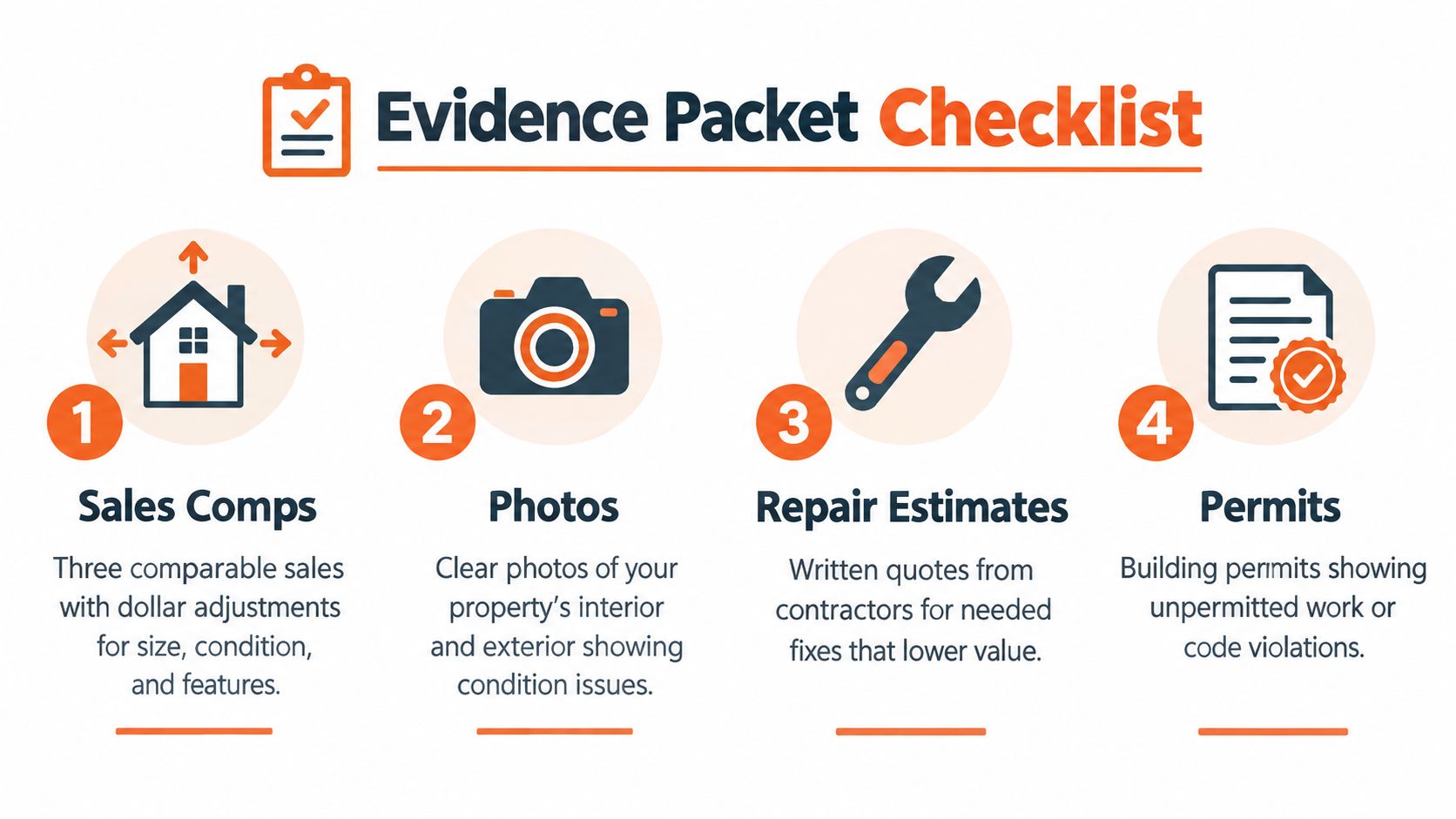
A residential packet works best when it combines an adjusted sales grid with visual proof. List the sale date, location, size, age, condition, quality, and relevant features for each comparable. Then make explicit dollar or percentage adjustments supported by the differences you can document, rather than declaring that one property is "better."
Photos should show the issue clearly, not merely establish that the owner dislikes the finishes. Pair water damage, foundation concerns, outdated systems, or incomplete work with written repair estimates. If the record includes improvements or permits that don't match the property, identify the specific entry and provide the correction.
Make income evidence traceable
For an income-producing property, build a transparent income-and-expense schedule that reconciles effective gross income, vacancy and collection loss, operating expenses, and a supportable capitalization rate, then show how each assumption changes indicated value. The Texas Comptroller's ARB guidance on valuation approaches supports matching the evidence to the applicable appraisal method.
Don't submit a rent roll without explaining collection history, concessions, occupancy, or unusual income. Don't state a cap rate without market support. A reviewer should be able to follow the calculation from revenue to net operating income to indicated value and test the result by changing a reasonable assumption.
For commercial properties, add leases, operating statements, expense detail, photographs, and evidence of functional or external obsolescence where relevant. Under the cost approach, separate land value from improvement value. Replacement cost doesn't equal market value when the building has design limitations, excess capacity, or external conditions that reduce buyer demand.
Keep public and private data organized
Public data may establish sales, ownership, parcel details, and appraisal history. Private data can supply leases, invoices, repair estimates, operating statements, photographs, and transaction context. INTELLI uses licensed property tax consultants and a data first approach that combines public and private data to assemble the record around the property's actual characteristics.
A useful packet has an index, numbered pages, a valuation summary, evidence by argument, and a short response to likely TCAD objections. INTELLI's comparable property analysis resource is relevant when the central task is screening and adjusting comparable properties rather than collecting an unfiltered list.
Prepare for the district's evidence
TCAD makes the district's evidence packet available online for the formal hearing using the property identification number and PIN from the appraisal notice. Pull it as soon as access becomes available. Look for incorrect characteristics, unsupported adjustments, outlier sales, mismatched property types, and defects that appear in the district's model but not in your own file.
Bring five sets of evidence to an in-person formal hearing, as TCAD instructs. Upload the same organized version when the hearing format permits it. Avoid double-counting one defect in multiple adjustments. A foundation problem shouldn't also be treated as a general condition adjustment, a repair-cost deduction, and a lower-quality adjustment unless the evidence proves separate effects.
What Happens at Informal Review and ARB Hearings
The informal discussion is often the first opportunity to see how the district views your evidence. An appraiser may explain the model, identify the sales used, or point out a record detail that needs correction. Treat that conversation as a focused valuation meeting, not a negotiation over what the tax bill should feel like.

Open with a precise statement: “The property record overstates condition and the adjusted comparable evidence supports a lower value.” Then show the page, explain the adjustment, and ask whether the appraiser agrees with the factual correction. Avoid spending the meeting on neighborhood growth, tax rates, or personal finances. Those points don't prove the assigned value is wrong.
Choose the hearing format that fits the evidence
The Travis Appraisal Review Board can hear an unresolved protest in person, by written affidavit or unsworn declaration, by telephone conference call, or by videoconference. The owner presents evidence and arguments, while the appraisal district presents its evidence for questioning by the ARB panel. TCAD says the formal hearing notice is mailed at least 15 days before the scheduled hearing, and the district packet can be accessed online using the property identification number and PIN from the notice, as described in its ARB hearing guidance.
A written affidavit can work for a clean record correction or a tightly documented valuation dispute. An in-person or video hearing may work better when the district packet contains complicated adjustments or when the owner needs to answer questions. Telephone hearings can be efficient, but they make page references and verbal organization especially important.
The following video can help owners understand the kind of preparation required before appearing:
Attendance is substantive, not ceremonial
TCAD may dismiss a protest if the owner doesn't appear in person, through a valid affidavit, through an authorized agent, or through a pre-scheduled telephone hearing. At an in-person formal hearing, bring the required evidence sets and keep your presentation short enough for the panel to follow.
If you miss the scheduled hearing, you may ask the ARB chair to reopen it by sending a letter within four days of the scheduled hearing and explaining the good-cause reason for the absence. Don't rely on that remedy. Confirm the hearing date, test the technology, and arrange authorization paperwork before the appointment.
ARB hearings typically occur from May through July. INTELLI uses licensed property tax consultants and employs a data first approach using public and private data to prepare the presentation for the applicable hearing format. If the ARB decision remains unfavorable, Texas law permits an appeal to district court in the county where the property is located. That step requires a separate evaluation of cost, timing, evidence, and legal strategy.
Exemptions Representation and Keeping Savings Year After Year
A valuation reduction isn't the only way to lower the taxable amount. The practical sequence is to verify ownership and eligibility, apply for the relevant exemption through TCAD, confirm that it appears on the account, and then protest any remaining value that still exceeds the evidence.
That sequence matters for homestead owners, seniors, disabled homeowners, disabled veterans, agricultural operators, and properties with other specialized treatment. Travis County states that TCAD grants exemptions, not the county tax office. An omitted exemption won't necessarily be corrected merely because the owner files a valuation protest.
Compare the available paths
DIY costs less in professional fees, but the owner supplies the research, deadline control, evidence design, hearing preparation, and follow-up. It's a sensible choice when the issue is a clear record error or a small, well-documented residential dispute.
An authorized agent can handle filing and representation, which helps when the owner lacks time or doesn't want to appear. The trade-off is that the owner still needs to provide accurate property facts, financial records, and exemption documentation.
INTELLI uses licensed property tax consultants and employs a data first approach using public and private data to review valuation evidence, support protests, and identify applicable exemptions. Its Travis County property tax exemption resource is a starting point for owners comparing exemption issues with valuation issues.
Check eligibility before chasing a reduction
School districts must provide an additional $60,000 residence homestead exemption to qualifying homeowners who are age 65 or older or disabled, according to the Texas Comptroller's exemption guidance. The age-based exemption requires the owner to be at least 65, hold an interest in the property, and occupy it as a principal residence.
Disabled-veteran relief depends on the disability rating issued by the U.S. Department of Veterans Affairs or the applicable military branch and can cover part or all of the property's value. For some owners, correcting exemption status will matter more than negotiating a modest appraisal reduction.
Keep the next cycle on your calendar. Review the record when the notice arrives, confirm exemptions and ownership details, preserve updated repair or income evidence, and file before the applicable deadline. A protest can address this year's valuation, but disciplined annual review protects the gains that survive the hearing.
INTELLI offers Travis County property owners licensed property tax consultants, public and private data analysis, deadline-sensitive filing support, and representation for valuation, unequal-appraisal, and exemption issues. Visit INTELLI to review your property and start a practical assessment of the evidence before the filing window closes.