
An appraisal notice from the Travis Central Appraisal District shows up in the mail, and the number looks wrong. Before you touch a single form, split the problem in two. A valuation protest and an exemption application are separate processes, each with its own deadline, and filing one does nothing to protect the other.
Treat the stack as a coordinated deadline-and-evidence problem. TCAD sets the appraised value and administers protests and exemptions for Travis County property, including Austin. The taxing units set rates, and the county tax office bills and collects. A protest asks the Appraisal Review Board (ARB) to review a disputed value. Winning can lower the figure used in your tax calculation, while rates and billing stay exactly where they are.

Read the notice of appraised value before you pick a form. Check the property description, the appraised figures, your exemption status, and the mailing date. That mailing date starts the protest clock, which means a notice sitting unopened in a stack of mail is already costing you days. The Comptroller requires the appraisal notice to include protest instructions, informal-conference information, and taxpayer-remedy materials. Keep all of it.
Your first real decision is the fork: challenge the value, claim an exemption, or pursue both. Get that routing right early and the rest of the deadlines fall into place.
The Form Stack Most Owners Miss
A Texas property tax reduction form isn't one universal application. Each document has a specific job, and the quickest way to lose time is to assume that one filing covers everything.
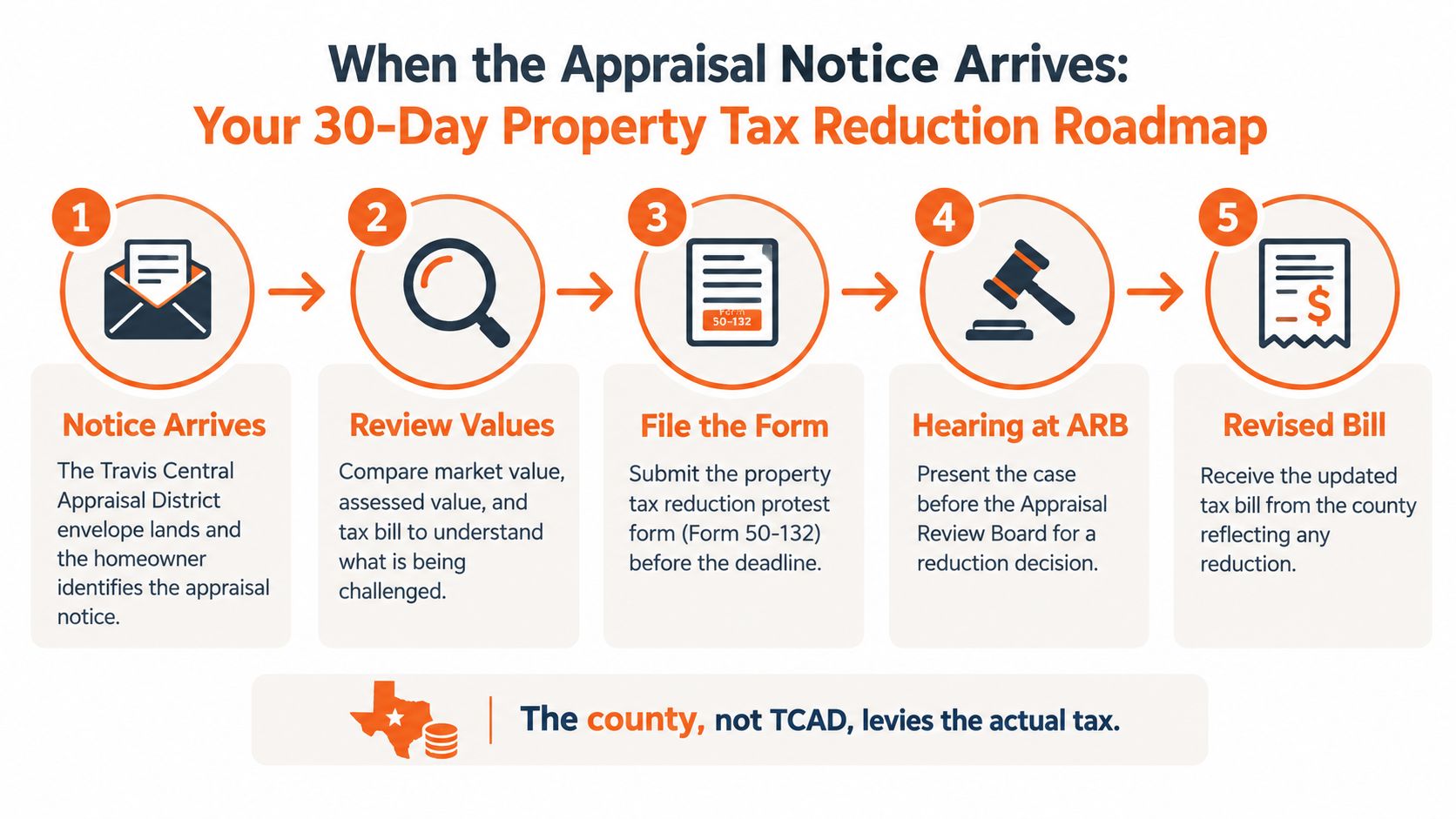
The keystone for a valuation challenge is Form 50-132, the Property Owner's Notice of Protest. It lets an owner or appointed agent dispute excessive appraised value, unequal appraisal, incorrect property records, or a failure to apply an exemption before the county ARB. File it with the appraisal district in the county where the property is taxable. The Texas Comptroller's property-tax forms page provides the official form and related materials.
Use Form 50-162 if you're appointing an agent to handle property-tax matters. That appointment is separate from the protest itself. The Comptroller describes the required protest instructions, form, informal-conference information, and taxpayer-remedy materials that accompany an appraisal notice in its notice requirements.
Exemption applications serve a different purpose. Common forms include 50-114 for a residence homestead, 50-114-A for related homestead affidavits, 50-122 for historic or archaeological site exemptions, and 50-113 for the Freeport exemption. A same-day hearing request is another distinct form. A late-protest request isn't a substitute for filing on time; the ARB must determine whether there's good cause to hear a late case.
Match the paperwork to the problem:
- Appraised value or record dispute: File Form 50-132.
- Representation: Complete Form 50-162.
- Exemption eligibility: Apply using the relevant exemption form.
- Hearing logistics: Use the applicable hearing request form.
- Late protest: Ask the ARB to consider the reason for the late filing.
Keep the protest and exemption tracks separate in your calendar. They can both affect the eventual tax bill, but neither filing replaces the other.
Filling Out Form 50-132 Without Sabotaging Yourself
Form 50-132 opens your case; the evidence decides it. Fill out the form so the ARB can identify the property, understand what you dispute, and see the remedy you want. As noted above, the notice itself must include protest instructions and informal-conference information, so read it before you touch the form.
Work through the form in order
Start with owner and property information. Copy the details straight from the appraisal notice and check them against your records. If the record shows a wrong characteristic, flag it as a record error on its own. A clean property description keeps the ARB focused on your numbers instead of your paperwork.
Then pick the protest grounds your evidence supports. Market value says the appraisal exceeds what the property's condition and market evidence justify. Unequal appraisal says your property is assessed higher than a defensible set of comparable properties. Check both only if you can argue both. Owners who mark every box hoping something sticks usually walk into the hearing with nothing organized.
The opinion-of-value field trips up more filers than any other line. Enter a considered number or leave it alone. If you write in a value, be ready to show how you reached it when the ARB asks. A dramatic lowball figure with no support costs you credibility before you say a word.

If you're completing the form electronically, FaxZen's fillable PDF guide covers ways to work with PDF fields. Review the finished form before filing: property identification, selected grounds, contact details, and any agent appointment. Austin-area owners file with TCAD for Travis County accounts, so confirm the form goes to the correct appraisal district.
One caution on attachments. Submit organized evidence, not a document dump, and remember the form's job ends at making your dispute legible. Credibility comes from what you bring to the hearing.
Building the Evidence Package That Survives the Hearing
At the ARB, evidence carries the argument. Pick the valuation theory that fits your property and build the record around it. Market-value evidence might include recent sales, listings, closing statements, photographs of condition issues, repair estimates, and documentation of property-specific obsolescence. Unequal-appraisal evidence should use a defensible sample of comparable properties and calculate a median level of appraisal.
A comparable isn't useful just because it's nearby. You need to account for meaningful differences in size, condition, location, age, and improvements. The comparable-property analysis guidance can help you think about what makes comparisons relevant. A generic neighborhood list, with no explanation of adjustments, gives the ARB little reason to accept your conclusion.

Organize documents for the hearing
Put the clearest evidence first. A practical binder or digital file can include:
- A short case summary: State whether you're challenging market value, unequal appraisal, a record error, or more than one issue.
- Comparable-property analysis: Identify each property and explain adjustments for relevant differences.
- Condition evidence: Include dated photographs, repair estimates, and records that show the issue affects value.
- Transaction documents: Add relevant sales, listings, or closing materials that support your position.
- A requested value and explanation: Make sure your stated position follows from the evidence rather than standing alone.
Don't wait until the hearing to think about delivery. Both sides must exchange documentary and electronic materials intended for use before or immediately after the hearing begins. For affidavit or remote hearings, deliver evidence before the hearing. The Comptroller's protest guidance explains the evidence process and the owner's opportunity to present evidence, examine witnesses, and state an opinion of value.
Practical rule: If you can't explain why a comparable is comparable, don't make it the centerpiece of your case.
Exemptions Worth Real Money and How to File Each
An exemption changes taxable value under the applicable rules; a protest challenges an appraisal decision. Treat them as separate tracks, and check eligibility with the appraisal district where the property is located. The chief appraiser decides whether an owner qualifies, not the protest representative.
| Exemption | What to check | Filing point |
|---|---|---|
| Residence homestead | You generally need an ownership interest and must occupy the property as your principal residence. Confirm the property and ownership records, and provide supporting documentation if requested. | Apply to the appraisal district for the county where the property is located. |
| Over-65 | Check eligibility and submit the documentation requested by the district. Qualifying homeowners who are 65 or older receive an additional $60,000 school-district residence-homestead exemption under Tax Code Section 11.13(c). Cities, counties, and other districts may offer additional local-option amounts. | Apply to the county appraisal district. |
| Disabled Person | Confirm eligibility and gather supporting records. Qualifying disabled homeowners also receive the school-district exemption described above. | Apply to the county appraisal district. |
| Disabled Veteran | Relief is tied to the service-connected disability rating. A qualifying 100% disability rating can result in a total residence-homestead exemption under applicable rules. Gather VA disability documentation and confirm which exemption applies to the property. | Apply to the appraisal district for the county where the property is located. |
The Comptroller's exemption guidance explains the school-district exemption and related rules. For application details and supporting records, review this guide to Texas property-tax exemptions.
Don't assume an exemption transferred when you bought the property. Reconcile the deed, occupancy, exemption history, and any disability documentation with the appraisal district's records. For agricultural or historic eligibility, verify the property's use and the applicable requirements rather than assuming personal status alone qualifies it.
Deadlines, Filing Paths, and TCAD Versus Travis County
Build one calendar for exemptions and another for protests. Most Texas exemption and special-appraisal applications must be filed by April 30, including Form 50-114 for a residence homestead, Form 50-122 for historic or archaeological sites, Form 50-113 for Freeport, and partial disabled-veteran exemptions across property types. The Comptroller lists the forms and deadline in its April property-tax update.
The usual protest deadline is midnight on May 15, or 30 days after the appraisal district mails the notice of appraised value, whichever is later. If the deadline falls on a weekend or legal holiday, it moves to the next business day. Some late protests may be heard if the ARB finds good cause, but don't plan around an exception. If a district or ARB should have sent a required notice but didn't, a special filing window may apply, generally extending to the day before taxes become delinquent, usually February 1, or the applicable statutory limit.
Send the filing to the right place
TCAD handles property values, exemption approvals, and protests for properties in its jurisdiction. The Travis County Tax Office handles tax billing and payment functions. Sending a protest to the tax office instead of TCAD can waste calendar time; sending an exemption application to the wrong appraisal district can delay review.
Use the filing method listed in the notice or confirmed by TCAD. Owners may file through an available appraisal-district portal, by mail, or by delivery to the appraisal district. If you appoint a representative, use Form 50-162 and confirm the agent has the information needed to meet the filing deadline. Keep a copy and proof of submission.
This video provides another walkthrough of the protest process:
Common Mistakes and How to Recover From Them
The most expensive mistake is treating paperwork as proof. A low opinion of value doesn't establish that the appraisal is wrong. If you've already filed, build the evidence package around the reason for protest, check the hearing instructions, and prepare to explain how each document supports your position.
Fix the problem you actually have
- You missed the protest deadline: Contact the appraisal district and ask about the process for requesting a late hearing. The ARB may allow one for good cause, but approval isn't automatic. Certain offshore workers and full-time military members may have additional relief.
- You filed for an exemption but didn't protest value: Don't assume the exemption filing opened a valuation case. Check whether the protest deadline remains open and file a separate protest if you're challenging the appraisal.
- You protested but never applied for an exemption: A protest doesn't replace an exemption application. Contact the appraisal district about the exemption process and any available remedy for a missed filing.
- Your comparable properties are generic: Explain adjustments for size, condition, location, age, and improvements, or replace the comparisons with better-supported evidence.
- You skipped the informal conference: Review the notice and district instructions, and attend if an opportunity is available. Keep your position and evidence consistent with what you present at the ARB.
- You sent the filing to the wrong office: Redirect it to the appraisal district immediately and verify receipt. A filing sent to the tax office can cost time, even though the office handles billing rather than appraisal protests.
Texas guidance says a protest can be submitted as a written notice identifying the owner, property, and disputed decision; it doesn't have to use the appraisal district's official form. But a protest can't cure a missed exemption deadline, and an exemption application can't preserve a protest right. The Comptroller explains these distinctions in its property-tax protest and remedy guidance.
Decide whether to file yourself
A straightforward homestead and one disputed appraisal on your primary residence can be manageable as a DIY filing if you can organize credible evidence and meet the deadlines. Multi-form cases, commercial properties, rental portfolios, agricultural or historic designations, and disability-related exemptions involve more coordination. Don't choose DIY because the first form looks short.
INTELLI uses licensed property tax consultants and a data-first approach that combines public and private data to review valuation and property-record issues, prepare evidence, and handle representation and exemption applications. Ask any representative what they'll file, what evidence they'll use, which deadlines they'll track, and how fees work before appointing them.
Choose DIY when the dispute is narrow and your evidence is organized. Hand it off when several properties, forms, or eligibility questions need to be managed together.
If you're unsure whether your next move is an exemption application, a valuation protest, or both, gather your appraisal notice and property records before the deadline gets close. INTELLI helps Texas owners review valuations, prepare protests, and manage exemption filings; visit INTELLI to discuss the right approach for your property.