

You closed three weeks ago. The boxes aren't unpacked, the builder's punch list isn't finished, and the first notice from the appraisal district already looks wrong. It values more house than existed on New Year's Day, or it ignores the exemption you thought you had. That's property tax for new construction in Texas. The bill doesn't start at closing, completion, or move-in. It starts with what stood on your lot on January 1.
Why New Construction Tax Bills Catch Texas Owners Off Guard
An Austin buyer I see every spring closes on a new build, budgets from the builder's tax estimate, then gets a notice built on a different house at a different point in time. The builder estimated from the lot, a prior year's rate, or a finished value that sounded tidy at the sales office. The appraisal district doesn't care about that estimate. It cares about market value on January 1.
Under Texas Tax Code Section 23.01 and the Comptroller's valuation guidance, taxable property is generally appraised at market value as of January 1. Williamson Central Appraisal District applies that snapshot by valuing construction according to its percentage complete on January 1. Your closing date doesn't reset that clock.
You Can Owe Tax on an Unfinished House
Texas splits the roll into two pieces. Total market value equals land market value plus improvement market value. The land was taxable before the slab was poured. Once framing, roofing, and other work are in place, the partially built improvement adds value too.
That split explains the shock in both directions. A house that was only framed on January 1 shouldn't be valued as finished, even if you moved in by March. A house finished in December can carry a full improvement value for the coming year, even if you haven't spent a night in it.
- Builder estimate: A sales tool, not an appraisal. Don't escrow your expectations around it.
- Land value: Taxable from the start and shown separately on the district record.
- Improvement value: Tied to physical progress on January 1, not to your final walkthrough.
- County record: The document that controls your bill until you correct it.
Same House, Different County, Different Result
Texas appraisal districts are county-level political subdivisions. Each district appraises property inside its boundaries, sets its own evidence habits within state law, and works with local taxing units that set their own rates. Move the same plan across a county line and you'll get a different record card, different comparable sales, and often a different tax outcome.
Don't ask when the tax starts. Ask what existed on January 1, how the district split land from improvements, and whether you can prove it.
That question drives everything else. If you can't document the house as it stood on that date, you're arguing from memory against a district that works from permits, aerials, and cost schedules.
The January 1 Valuation Rule for New Construction
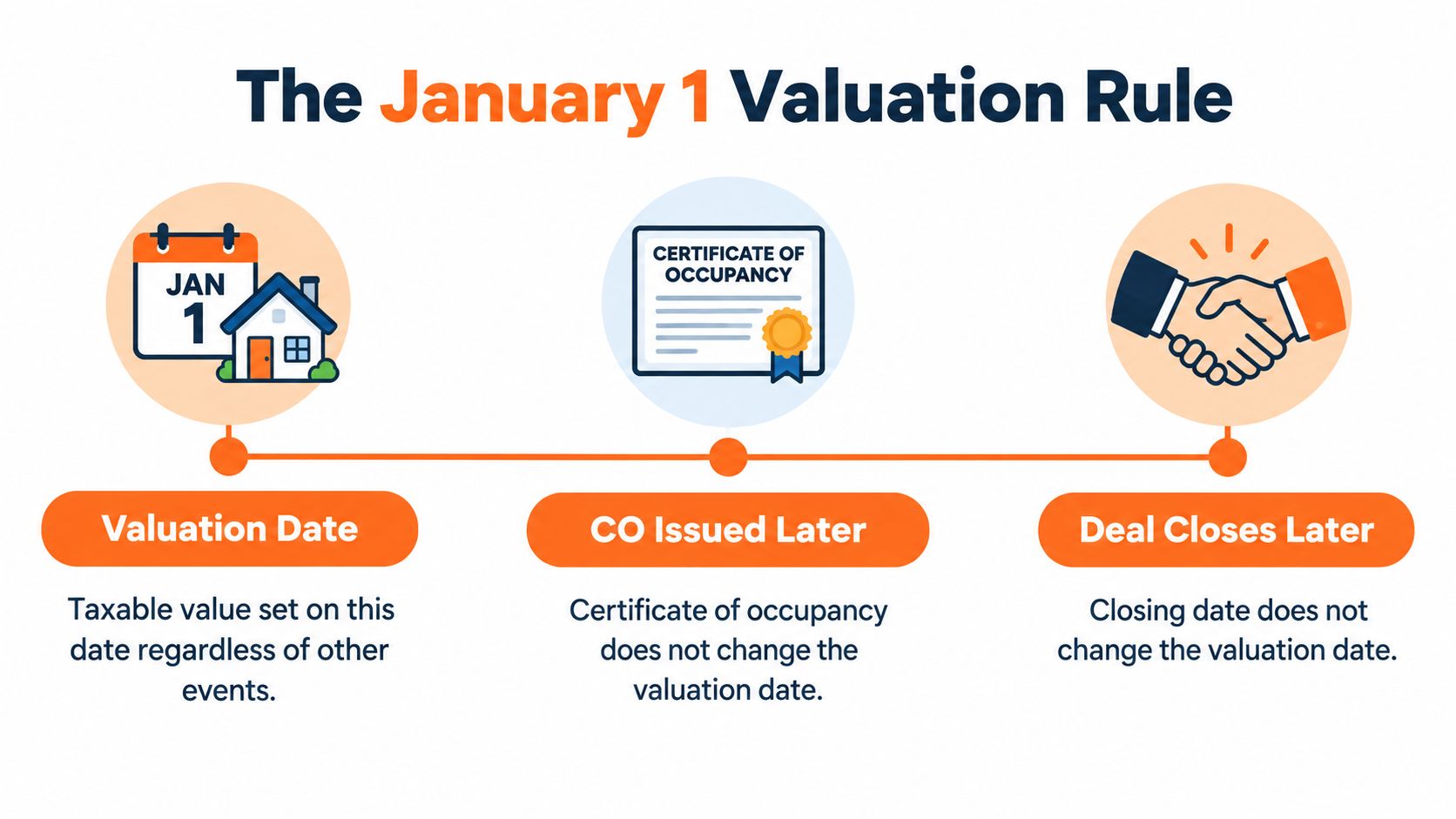
The rule is blunt. January 1 is the valuation date. Closing later, getting a certificate of occupancy later, or installing the last fixtures later doesn't change the taxable value for that year. Work completed after January 1 generally belongs to a later assessment cycle.
This timeline shows why owners who focus on closing miss the date that matters.
A Worked Example With Two Neighbors
Take two similar homes on the same Austin street. For example, House A is 70 percent complete on January 1 and finished in March. House B is complete and ready for occupancy before January 1.
House A should carry land value plus an improvement value reflecting that incomplete stage for the year. House B carries land plus the full improvement. By summer both houses look identical from the curb, but their first-year appraisals shouldn't match.
Now reverse the mistake I see most often. The district's field work or permit data shows House A as complete. The owner pays tax on cabinets, flooring, and systems that weren't in place on January 1. That's not a rounding error. That's a percentage-complete error, and it's correctable with dated evidence.
Why Your Purchase Price Doesn't Control the First Year
You may have paid for a finished home months after January 1. The district is valuing what existed on January 1. If the structure was incomplete, the improvement value for that year shouldn't automatically equal the price of the finished product.
California works differently, and the contrast helps Texas owners moving here. Under California guidance on new construction questions, new construction becomes assessable when the property or a distinct portion becomes available for use, with a supplemental step after completion. Texas owners shouldn't import that logic. Your fight here is about the January 1 snapshot.
Document the Slab, Not the Story
Build your timeline while the work is happening. Memories fade and builders move crews.
- Dated photos: Shoot the exterior and major interior systems around year end, with metadata intact.
- Permits and inspections: Keep approvals and failed or pending inspections that prove unfinished stages.
- Contractor logs and draws: Save draw requests showing work billed and work remaining.
- Certificate of occupancy: Keep it, but don't treat it as the valuation date.
Practical rule: If it wasn't built on January 1, don't let the district tax it as if it was, and don't expect the district to take your word for it.
How Appraisers Turn Cost Into Taxable Value
For new builds, districts lean on the cost approach because comparable sales and stabilized income data are often thin. The appraiser values the land as though vacant, estimates replacement or reproduction cost new for the improvements, then subtracts physical, functional, and economic depreciation. You'll see it expressed as RCNLD plus land.
That method is described in New York's uniform assessment standards for valuation, and it's the logic Texas owners need to understand before they argue. If you don't know how the district built the number, you can't take it apart.
Where a New Build Gets Overvalued
Depreciation on a brand-new property may be minimal. That puts pressure on four assumptions: land allocation, current construction cost benchmarks, entrepreneurial profit, and functional utility. Get one wrong and the improvement value climbs fast.
Start by checking the district's split against what improvement value means on a Texas record. Then test the cost side. Builders and owners who track line items in tools such as Exayard construction estimating software have a cleaner record to compare against the district's schedule than owners working from a single contract total.
Contract price is evidence. It isn't automatic market value. California assessment guidance makes the same caution in its own system: reported costs should be checked against typical costs for comparable current construction, because cost doesn't invariably equal current value. Atypical upgrades, financing-driven premiums, change orders, and builder profit can push cost above what a buyer would pay for the finished property on January 1.
Separate Real Property From Personal Property
Don't let removable items ride inside the improvement value without scrutiny. Appliances, equipment, and other removable personal property raise a different classification question than the structure affixed to the land. Commercial owners need to be especially careful with equipment and specialized build-out items.
Keep the file that lets you make that separation:
- Itemized contracts: Show structure, site work, and removable items as separate lines where possible.
- Change orders: Prove upgrades that were cancelled, substituted, or added after January 1.
- Plans and specifications: Tie the district's square footage and quality grade to what was built.
- Permits and site costs: Document site improvements separately from the building.
- Unusual expenses: Flag non-market costs that shouldn't be treated as typical construction cost.
If your design has functional problems, say so with evidence. Awkward layout, excess specialized space, or a feature the market won't pay for can support functional obsolescence that a simple cost schedule misses. Don't just claim the house cost less. Show why cost overstates market value.
Qualifying for Homestead and Other Texas Exemptions
Exemptions are where new-build owners lose money. They assume the builder, title company, or lender filed something. Nobody files your homestead for you. You own that deadline.
Williamson Central Appraisal District states that a qualifying newly built residence purchased after January 1, 2022 may receive a prorated homestead exemption, as explained in WCAD guidance for newly built residences. Read the next part carefully. The homestead cap adjustment applies only after the exemption has been on the property for one full year.
The Cap Trap in Your First Two Years
You can have an exemption and still have limited protection against a sharp jump in taxable improvement value. That's the counterintuitive part nobody models at closing. Your first year may reflect a partial build, your next year reflects the completed home, and the cap may not yet be doing the work you expected.
Build a date-specific worksheet before you budget:
- Land value on January 1: Pull it from the district record.
- Percentage-complete improvement value: Match it to your construction evidence.
- Prorated exemption eligibility: Confirm it for the purchase year.
- First full exemption year: Mark when the exemption has been in place for a full year.
- Cap impact year: Identify when the cap affects the bill.
For the broader rules, use the Texas property tax exemptions guide for homeowners and confirm qualification with your district. If the new build is a second home rather than your principal residence, don't assume homestead treatment. A second home tax deductions guide can help you separate income tax questions from Texas appraisal exemptions, which are not the same thing.
Texas Property Tax Exemptions for New Construction
| Exemption | Applies to New Construction | Key Trigger | Typical Deadline |
|---|---|---|---|
| Homestead | Yes, for a qualifying principal residence | Ownership and residence qualification, with proration possible for qualifying post January 1, 2022 purchases | File promptly with the appraisal district for the tax year |
| Over-65 | Yes, once the owner and residence qualify | Age and homestead qualification | File for the tax year under district and statutory deadlines |
| Disabled Person | Yes, once qualification is established | Disability qualification and homestead status | File for the tax year with required documentation |
| Disabled Veteran | Yes, with the most generous relief tied to a 100 percent service-connected rating | Service-connected disability documentation | File for the tax year and keep rating records current |
| Agricultural | Possibly, depending on land use | Qualifying agricultural use of the land | Confirm use and filing requirements with the district |
| Historic Preservation | Possibly, depending on designation and local rules | Qualifying historic status and approvals | Confirm designation and local filing dates early |
Texas requires exemption qualification to be determined for the tax year under statutory deadlines, a point reflected in the Comptroller overview of Texas property tax exemptions. Miss the date and you can lose a year of savings even if you qualified in substance. INTELLI uses licensed property tax consultants and a data first approach, using public and private data, to confirm eligibility and file on time. Whether you hire help or not, calendar the filing the day you close.
County Nuances in Austin and the Rest of Texas
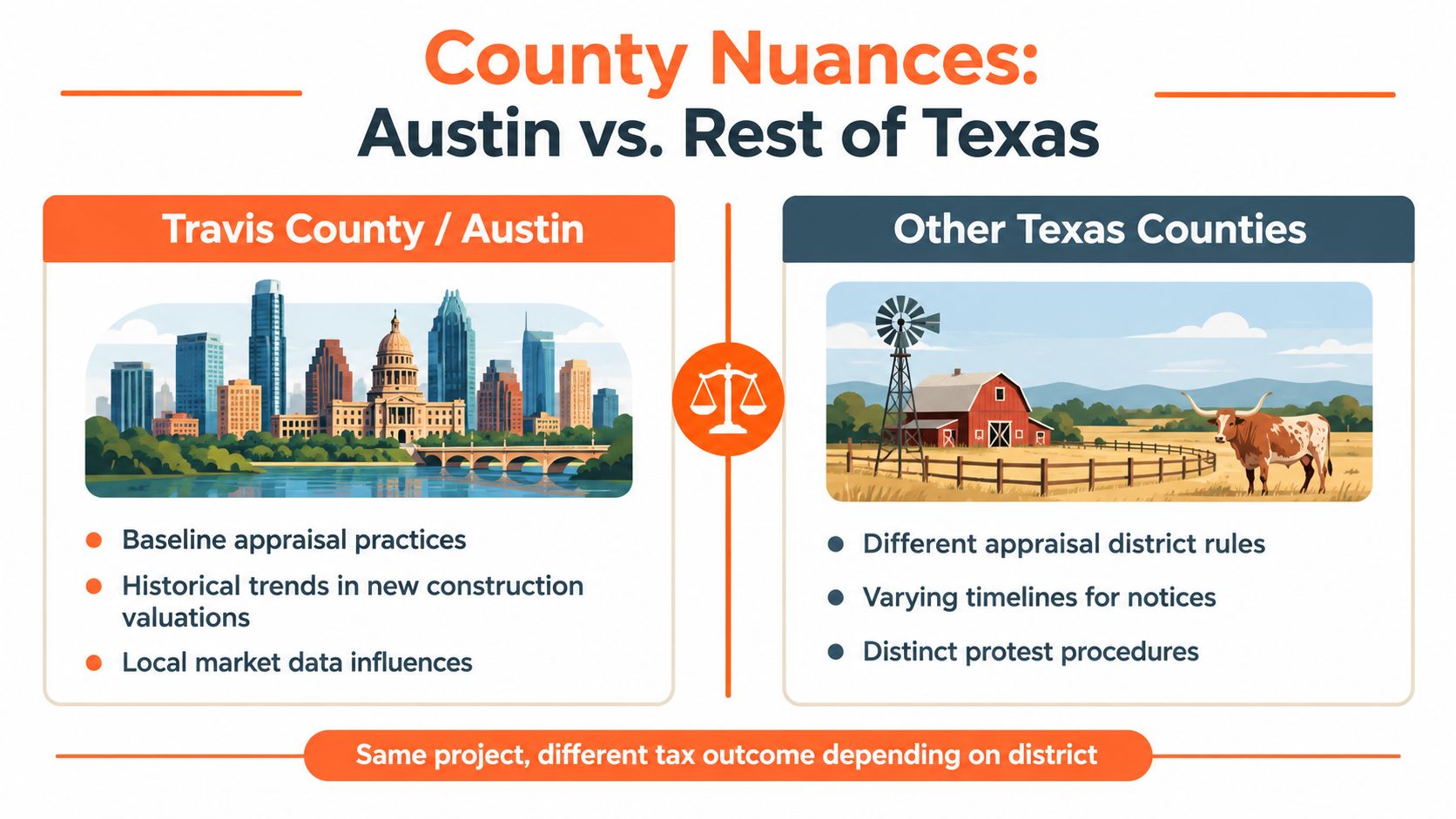
State law sets the frame. County practice decides how your file feels. Appraisal districts determine value within their county boundaries, and taxing units inside those boundaries set rates that turn value into a bill.
The comparison below captures the point owners miss when they move a project across Central Texas.
Travis County as the Baseline
In Austin and Travis County, expect active market modeling, neighborhood-level commentary, and close attention to new construction in fast-changing areas. TCAD will split land and improvements, and you need to verify both. A correct total built from a wrong land allocation can still hurt you in later years.
Travis County also layers multiple taxing units over the same parcel. Your appraisal is one number, but your bill reflects the combined effect of the jurisdictions taxing that property. Don't compare a friend's bill across town without comparing taxing units.
How Neighboring and Large Counties Differ
Williamson County is the new-build corridor many Austin buyers land in. WCAD's prorated homestead and percentage-complete guidance matters there in practical terms, especially for production builders closing homes throughout the year. Verify the district's completion percentage against your builder timeline.
Harris County brings a dense mix of overlapping municipal and special districts. The valuation fight and the rate burden can both be more complex, so owners need to identify every taxing unit on the parcel before they judge the bill.
Dallas County has its own exemption administration patterns across its taxing units. Owners relocating from Austin shouldn't assume the same local option treatment or the same informal review experience.
- Confirm your district: Search by parcel or address in the county where the property sits, not where you get mail.
- Pull the record card: Check land value, improvement value, square footage, quality, and year built.
- Check new improvement status: Confirm whether the district treats the project as new to the roll.
- Verify exemptions by taxing unit: Don't assume one approval answers every local question.
The state's tax rate worksheet defines a new improvement as a building, structure, fixture, or fence erected on or affixed to land that wasn't included on the prior year's appraisal roll, as set out in Comptroller Form 50-856 for tax rate calculations. New additions may qualify when the district can determine their value. That definition matters for garages, expansions, and separate structures, not just whole houses.
Building Your Protest Evidence Package
A good protest isn't a complaint that taxes are high. It's a dated file showing the district valued the wrong property on January 1. For property tax for new construction, evidence selection is the whole game.
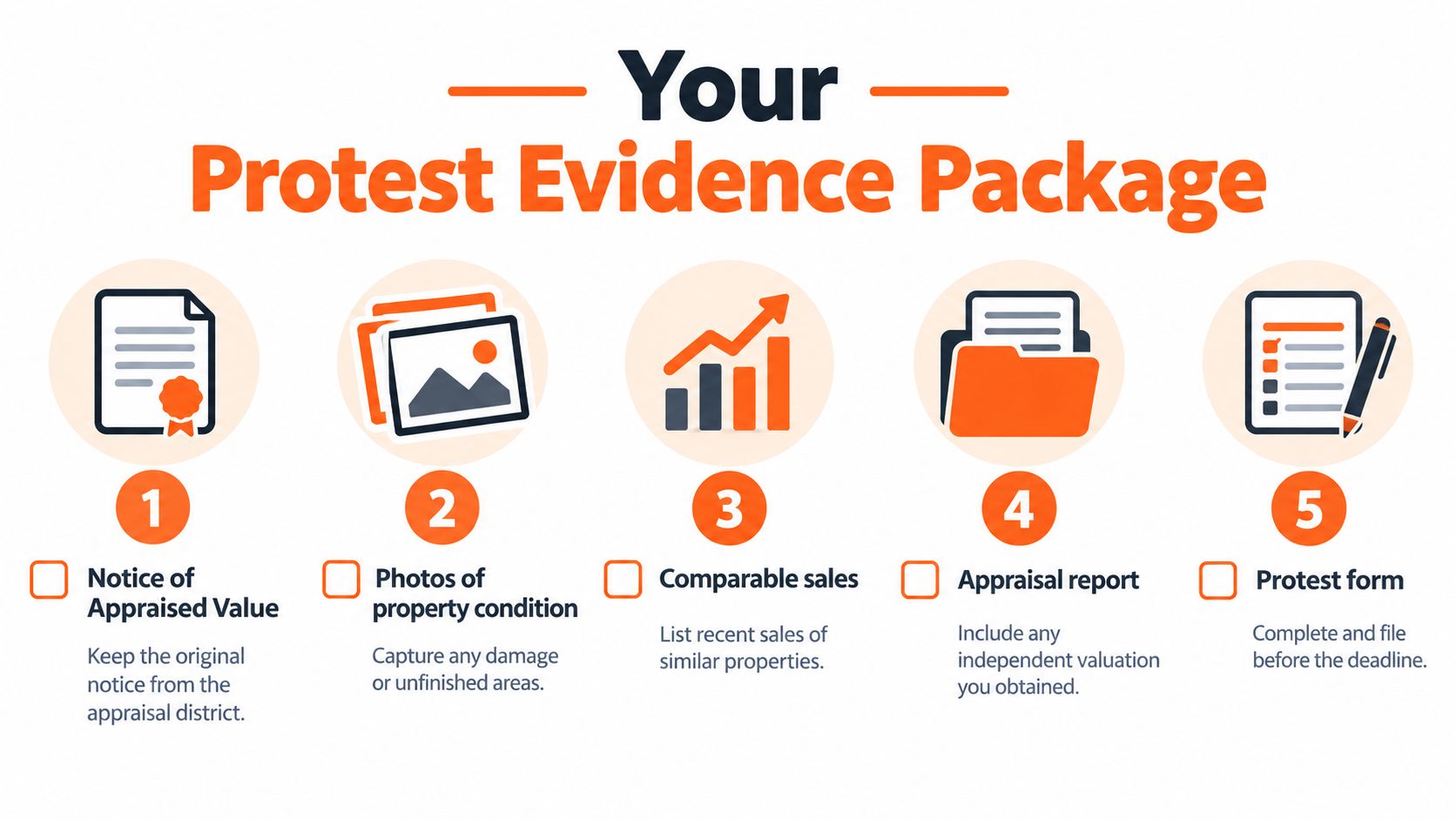
Use this checklist to build the package before you talk to an appraiser.
Start With the District Record
Keep the notice of appraised value and pull the full record. Circle every factual error: completion status, living area, quality grade, land size, and improvement description. If you're unsure what appraisal information becomes part of the public record and what doesn't, this appraisal public record explained resource helps you set expectations before you request records.
Then reconcile the record to January 1. If the district assumed a finished interior and your photos show studs, that's your lead exhibit. Put the district page and your dated photo side by side.
Choose Evidence That Isolates January 1 Value
Not every document helps. Pick the evidence that answers the district's method.
- Percentage-complete proof: Dated photos, inspection records, draw schedules, and contractor logs showing stage on January 1.
- Comparable sales: Sales dated as close to January 1 as possible, adjusted for size, quality, and completion.
- Cost records: Itemized invoices and contracts that reconcile to, or contradict, the district improvement figure.
- Plans and permits: Documents proving what was approved, changed, or not yet built.
- Income or rent data: For investment and commercial property, evidence that tests whether cost overstates market value.
- Obsolescence evidence: Specific functional or economic problems, not general complaints about design taste.
For comparable selection, follow a disciplined comparable property analysis approach for Texas protests. Bad comps hurt credibility. A finished resale across town doesn't prove the value of your incomplete build on January 1 without adjustments you can defend.
Bring the appraiser a cleaner January 1 story than the one in the district file. Dates, photos, and reconciled costs beat outrage every time.
Keep exemption claims separate from value protests. You may need both in the same year, but they ask different questions and carry different proof. INTELLI uses licensed property tax consultants and a data first approach, using public and private data, to test those classifications and identify support for an accurate valuation. If you file yourself, label each exhibit so the reviewer doesn't have to guess what it proves.
Deadlines, Decisions, and When to Bring in Help
Your calendar should run from the notice, not from the tax bill. By the time the bill arrives, the value fight is usually over. Watch for the notice of appraised value in spring, then act.
This planning image belongs on your desk next to the construction file, not in a drawer after closing.

The Decision Points That Matter
The typical protest deadline is May 15 or 30 days after the notice, whichever applies to your situation, with ARB hearings through summer and judicial appeal deadlines later. Confirm the exact date on your notice. Don't rely on a neighbor's deadline.
Handle it yourself when the error is simple and documented. A wrong completion percentage with clear dated photos is a clean owner filing. A square footage error with plans in hand is also manageable.
Bring in help when the district anchors value to your builder contract price, when the property is commercial, when you hold multiple rentals, or when land allocation and obsolescence drive the dispute. Those cases require market evidence and hearing discipline, not just a form.
This short video walks through the planning mindset you need before deadlines compress your options.
Run This List Before You File
- Record pulled: Land and improvement values verified against plans.
- January 1 proof ready: Photos, inspections, draws, and occupancy records dated.
- Exemption filed: Homestead and any other qualifying exemption confirmed for the tax year.
- Evidence matched to method: Cost, sales, or income proof chosen for the district's approach.
- Deadline calendared: Protest date taken from your notice, with a buffer.
INTELLI uses licensed property tax consultants and a data first approach using public and private data to examine completion status, assessed-value components, and applicable statutory exclusions for new construction. That work also includes identifying overcharges, filing protests, and pursuing past-year recovery on a no-recovery no-fee basis where it applies. If your file is thin, fix the evidence first. Nobody wins a January 1 case with a July memory.
If your new build was valued as finished before it was, or your exemption and cap timing don't match what you were told at closing, get the record reviewed before the protest window closes. INTELLI's licensed consultants use public and private data to test completion status, land and improvement splits, and exemption eligibility, then build the evidence package for your county. Visit INTELLI to start with your notice and construction timeline in hand.