

You're looking at this year's Texas appraisal notice and one number seems to have moved far more than the others. The land value barely changed, but the improvement value jumped. You may be wondering whether that line represents your entire property, only your house, or something else entirely.
The answer matters because an incorrect improvement value can affect the taxable value used by local taxing units. A wrong square-foot measurement, an outdated condition rating, or a feature that doesn't belong on your record can keep increasing the assessed figure until you challenge it. This guide explains what is improvement value, how Texas appraisal districts calculate it, and what evidence can support an improvement-focused protest.
Why That One Line on Your Appraisal Notice Matters
A homeowner in Travis County opens this year's notice beside last year's copy. The land line has changed little, but the improvement line is noticeably higher. The house hasn't gained a new room, the garage is unchanged, and the roof is showing more wear, not less. That mismatch deserves attention before the protest deadline arrives.
Texas appraisal notices commonly separate the property into land value and improvement value. You may also see a market or appraised value, exemptions, and a homestead cap adjustment. Harris, Travis, and Collin County notices can look different, but the practical question is the same: does the improvement figure accurately describe the structures and permanent features attached to the land?
The improvement amount can represent the house, attached garage, driveway, pool, patio cover, shed, and other site enhancements. The land is valued separately. Because property-tax systems generally use annual assessed values rather than the final sale price, tracking each line from year to year gives you a clearer way to identify a change that needs proof. Public assessment records often preserve multiple years of assessed-value history, which can help you compare the district's treatment over time. Learn how to read a notice of appraised value before deciding whether the increase is justified.
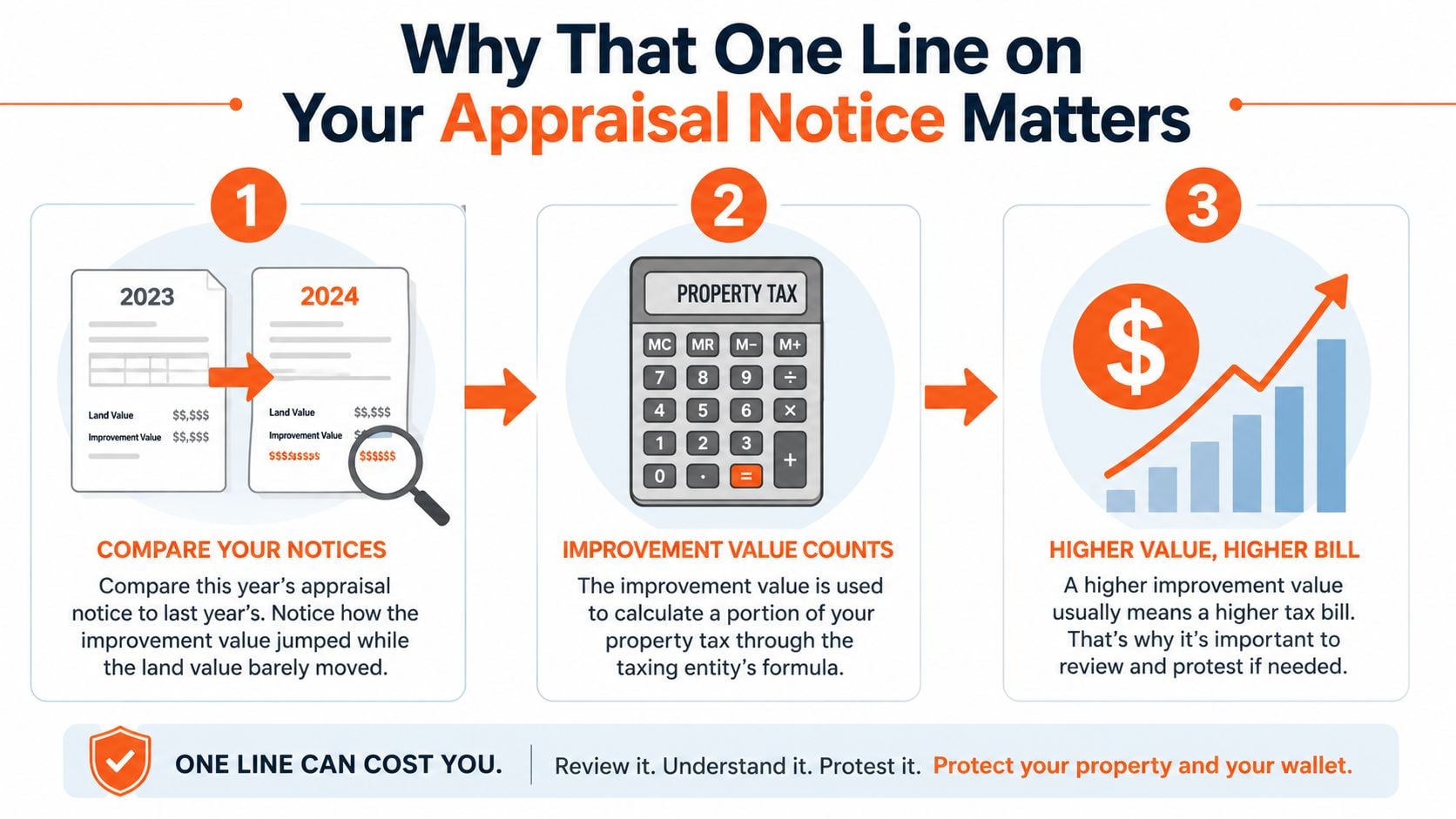
Find the change before it becomes a bill
A higher improvement value can affect the amount used by school, county, city, and other taxing units. The district doesn't need to have made a dramatic mistake for the result to matter. A modest square-footage overstatement or an incorrect quality classification can feed into the cost calculation and remain on the record until corrected.
Start with three comparisons:
- Improvement line: Compare this year's figure with the prior year's figure.
- Property description: Check living area, stories, foundation, garage, bathrooms, pools, sheds, and additions.
- Cap and exemption entries: Confirm that the homestead treatment and other applicable adjustments appear correctly.
Practical rule: Protest the specific fact that's wrong, not only the final tax amount. The appraisal district can respond more effectively to a measured square-foot error, an incorrect feature, or an unsupported condition rating.
Defining Improvement Value in Property Tax Terms
Improvement value is the assessed worth of the human-made assets attached to a parcel, separate from the land itself. The land value reflects the site as land. The improvement side generally covers the dwelling and permanent additions, such as a garage, covered porch, in-law addition, driveway, pool, or outbuilding.
A simple formula captures the relationship:
Total property value minus land value equals improvement value.
One published example uses a total capital value of $800,000 and a land value of $500,000, leaving an improvement value of $300,000, or 37.5% of total capital value. The example is useful because it shows that the improvement line can represent a substantial part of a developed property's value. See the improvement value definition and example.
Replacement cost minus depreciation
Texas appraisal districts commonly use a cost approach for buildings. They estimate the cost to replace a structure with one offering equal utility, then subtract depreciation for age, condition, and obsolescence before adding the resulting improvement figure to the land value. The Texas Comptroller describes the cost approach.
A car analogy makes the calculation easier to remember. Replacement cost new is similar to the price of replacing your vehicle with a comparable new model. Depreciation is the reduction for the years of use, physical wear, outdated design, and other limitations. The resulting trade-in-style figure isn't the cost of a new vehicle, and the improvement value isn't automatically the cost of constructing a brand-new house.
Land and improvements also behave differently. Land may gain value because of location, access, scarcity, or nearby development. Buildings and other structures generally lose value as they age unless remodeling, maintenance, or market conditions offset that decline. That distinction matters during a protest because you may need to challenge the structure's condition or replacement-cost inputs even when the land value appears reasonable.
For homeowners considering storm-related upgrades, documentation can also clarify what was added and when. Resources on toughened glass for storms may help you understand a specific building feature, but the appraisal question remains whether the district has accurately recorded and valued it. You can also review what a property tax assessment means before comparing the notice with your property records.
How Appraisal Districts Calculate the Improvement Side
The district's improvement figure usually begins with physical facts, not the amount you paid for the property. An appraiser or appraisal record may identify the building's size, construction type, quality, features, and condition, then apply a valuation model that estimates replacement cost and removes depreciation.
The three stages of the calculation
First, the district measures and classifies the improvements. The record may distinguish conditioned living space from unconditioned areas, identify the number of stories, and record features such as a slab or pier-and-beam foundation, central air, plumbing fixtures, fireplaces, attached garages, and patio covers.
Second, it applies replacement-cost inputs. Cost schedules can vary with construction class, quality, design, and features. Brick veneer, a larger garage, additional bathrooms, or other recorded characteristics may increase the replacement-cost estimate. The district is attempting to estimate what it would cost to replace a structure with comparable utility, not copying a recent contractor invoice.
Third, it subtracts depreciation. Physical depreciation reflects age and wear. Functional obsolescence can reflect an outdated or less useful design. Economic influences may affect the property's contribution to value. The final improvement figure is therefore sensitive to both the original cost estimate and the deductions applied afterward.
The most productive review compares the district's record with the actual property. Storage sheds, above-ground pools, and partially finished rooms can be recorded inconsistently. A district may also treat a covered area as conditioned space or include a feature that was removed years earlier.
Inputs that deserve a close review
| Cost Driver | Typical Adjustment | Effect on Improvement Value |
|---|---|---|
| Conditioned area | Measured separately from unfinished or unconditioned space | An overstatement can raise the structure's replacement-cost estimate |
| Construction quality | Class or quality rating applied to the building | An overly high rating can make the model assume more expensive construction |
| Foundation | Slab, pier-and-beam, or another recorded type | The selected foundation type can change the cost input |
| Attached features | Garage, fireplace, bathrooms, patio cover, and central air | Missing or duplicated features can distort the improvement figure |
| Age and condition | Physical depreciation based on the record and inspection | Understated depreciation can leave an older property overvalued |
| Functional or economic factors | Adjustments for usefulness or external influences | Failure to recognize limitations can make the final figure too high |
The homestead cap adds another layer. Texas law limits annual increases for a residence homestead to the lesser of market value or the prior year's appraised value plus 10% plus the market value of new improvements, as explained by the Texas Comptroller's property valuation guidance. A higher improvement value in an earlier year can therefore affect the starting point used for later capped calculations.
Example Calculations and Tax Bill Impacts
Numeric examples can clarify the mechanics, but they can't predict your actual bill. Texas property taxes depend on the taxing units, exemptions, appraised value, and local rates. The examples below use only the requested property values and show how an improvement change can be isolated from the rest of the parcel.
Scenario one, a homesteaded home
Assume a homesteaded home has a total value of $350,000, with an improvement value rising from $260,000 to $285,000. The land value is treated as the remaining $90,000 in the first year and $65,000 in the second year for this simplified illustration, so the total remains constant while the allocation between land and improvements changes.
The improvement increase is $25,000. If the prior appraised value used for the homestead calculation were $350,000, the capped amount before new improvements would be the prior value plus 10%, or $385,000, subject to the statutory formula and market-value limit. The actual notice can produce a different result because the cap applies to appraised value and new improvements, not to the improvement line by itself. Review the Texas cap formula from the Comptroller.
At an illustrative effective rate range of 2.1% to 2.4%, a $25,000 value difference corresponds to approximately $525 to $600 in annual tax exposure if the entire amount reaches the taxable base. A homestead cap may limit the immediate increase, but an inflated prior-year figure can still affect future calculations.
Scenario two, an investor-owned duplex
Now assume an investor-owned duplex has a total value of $500,000 and the same proportional improvement increase. An improvement value of $370,370 would rise to approximately $405,957, while the land allocation would change from approximately $129,630 to $94,043 in this simplified comparison.
Because the property is investor-owned rather than a residence homestead, the owner doesn't receive the residence homestead cap treatment described above. A value increase that reaches the taxable base can therefore create a larger immediate bill. At an effective rate range of 2.1% to 2.4%, the resulting annual difference on a $35,587 improvement increase would be approximately $747 to $854.
| Item | Homesteaded Home ($350K) | Investor Duplex ($500K) |
|---|---|---|
| Starting total value | $350,000 | $500,000 |
| Starting improvement value | $260,000 | Approximately $370,370 |
| Illustrative ending improvement value | $285,000 | Approximately $405,957 |
| Improvement increase | $25,000 | Approximately $35,587 |
| Homestead cap treatment | May limit the immediate increase under the statutory formula | Residence homestead cap doesn't apply |
| Illustrative tax exposure | Approximately $525 to $600 | Approximately $747 to $854 |
The lesson is narrower than “every improvement increase becomes a tax bill increase.” The result depends on how the district applies the cap, exemptions, and taxable value. The practical step is to identify whether the disputed amount reflects a real new improvement, a corrected record, or an error that should be removed.
Common Appraisal Errors That Inflate Improvement Value
Improvement disputes often begin with a record that looks plausible at first glance. The district may have the correct street address and a reasonable land value, yet one inaccurate physical input can push the structure's calculated value above what the property supports.
A frequent problem is incorrect square footage. MLS records, builder plans, appraisal sketches, and district measurements may not classify enclosed areas in the same way. A garage, porch, attic, bonus room, or partially finished space can be counted incorrectly. Compare the district's sketch with blueprints and measured plans rather than relying on the total shown on a listing.
Grade and quality classifications create another source of error. A property assigned a higher construction quality may receive more expensive replacement-cost inputs even when its materials, workmanship, or finish level don't support that rating. The owner should ask which characteristics led to the classification and identify specific differences between the record and the structure.
Four errors worth checking first
- Square-footage mistake: A conditioned area may include a garage, unfinished room, porch, or other space that should be classified separately.
- Quality overstatement: The record may assign a grade that doesn't match the materials, finish, or workmanship.
- Condition understatement: The district may not reflect roof age, deferred maintenance, water damage, foundation concerns, or other physical limitations.
- Duplicate or phantom improvement: A removed shed, old pool, demolished addition, or feature recorded twice can remain in the account.
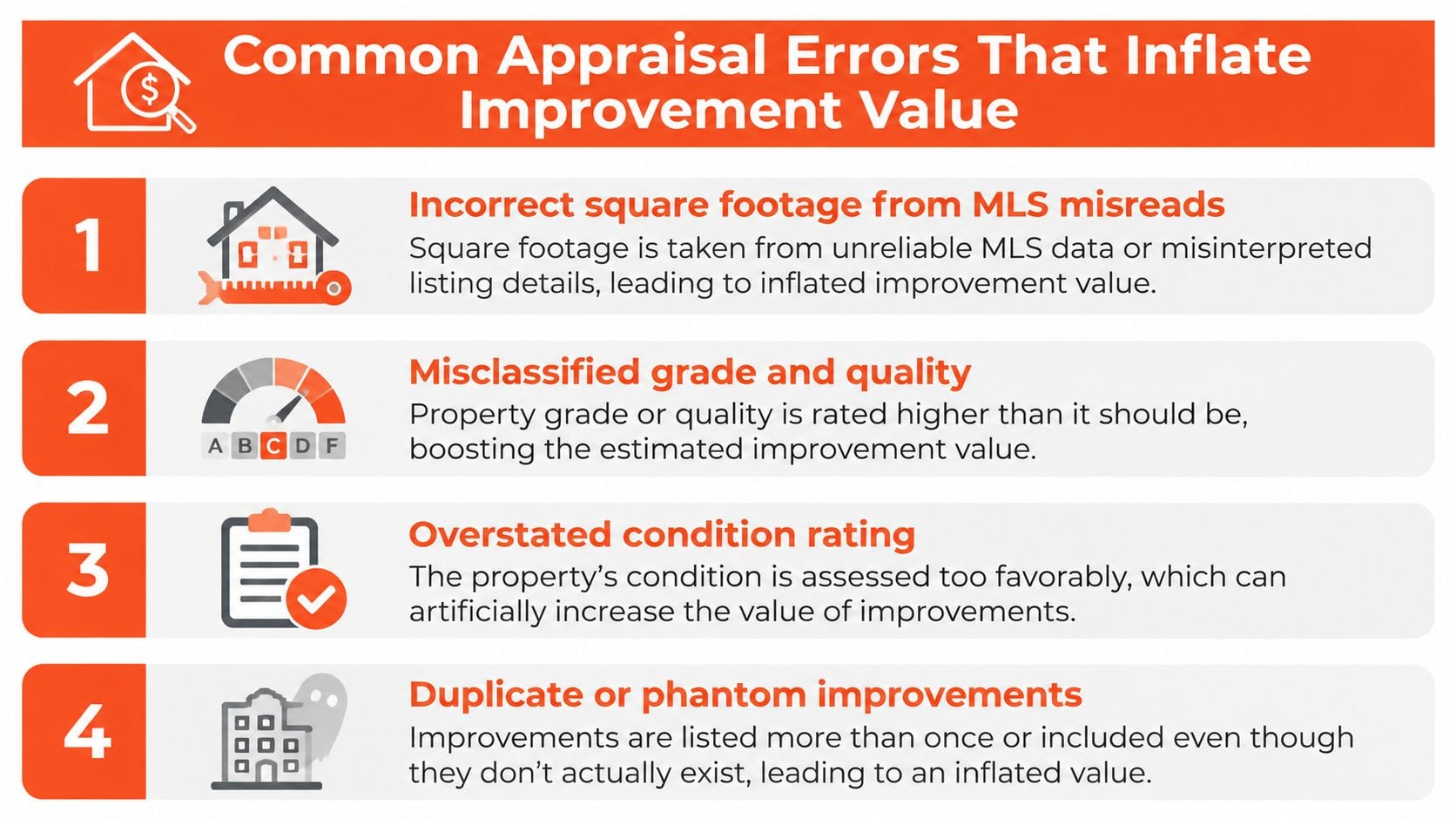
Errors can compound because the district's model may use several inputs together. An overstated area combined with a high quality rating and too little depreciation can produce a final improvement value that no single input appears to explain.
Evidence that makes the objection concrete
Gather documents that let the appraiser verify the disputed fact:
- Building records: Original blueprints, builder specifications, permits, and closing documents.
- Condition proof: Dated photographs, inspection reports, and contractor estimates describing repair needs.
- Independent valuation: A licensed appraisal report that separates land and improvements where possible.
- Market evidence: Comparable sales with similar size, age, condition, and construction characteristics.
- Timeline records: Proof showing when an addition was completed, removed, or only partially constructed.
The following video can provide additional context for reviewing an appraisal and preparing a property-tax discussion.
Challenging Improvement Valuations in Texas
A Texas protest starts with the deadline, not the argument. Property owners generally must file by May 15 or within 30 days after the appraisal district mails the notice of appraised value, whichever is later, and the Comptroller says the deadline is tied to the mailing date rather than the delivery date. Read the Texas protest deadline guidance.
Follow the timeline
- Review the notice. Locate the land, improvement, market, appraised, exemption, and cap entries.
- File on time. Use May 15 or the 30-day-after-mailing rule, whichever gives you the later deadline.
- Request an informal review. Many districts allow a phone or online discussion with an appraiser. Bring a focused correction and supporting documents.
- Attend the formal ARB hearing. If the informal process doesn't resolve the issue, present the evidence to the Appraisal Review Board.
- Consider further appeal. Texas procedures can provide a path to district court or arbitration after the ARB decision, subject to applicable requirements and deadlines.
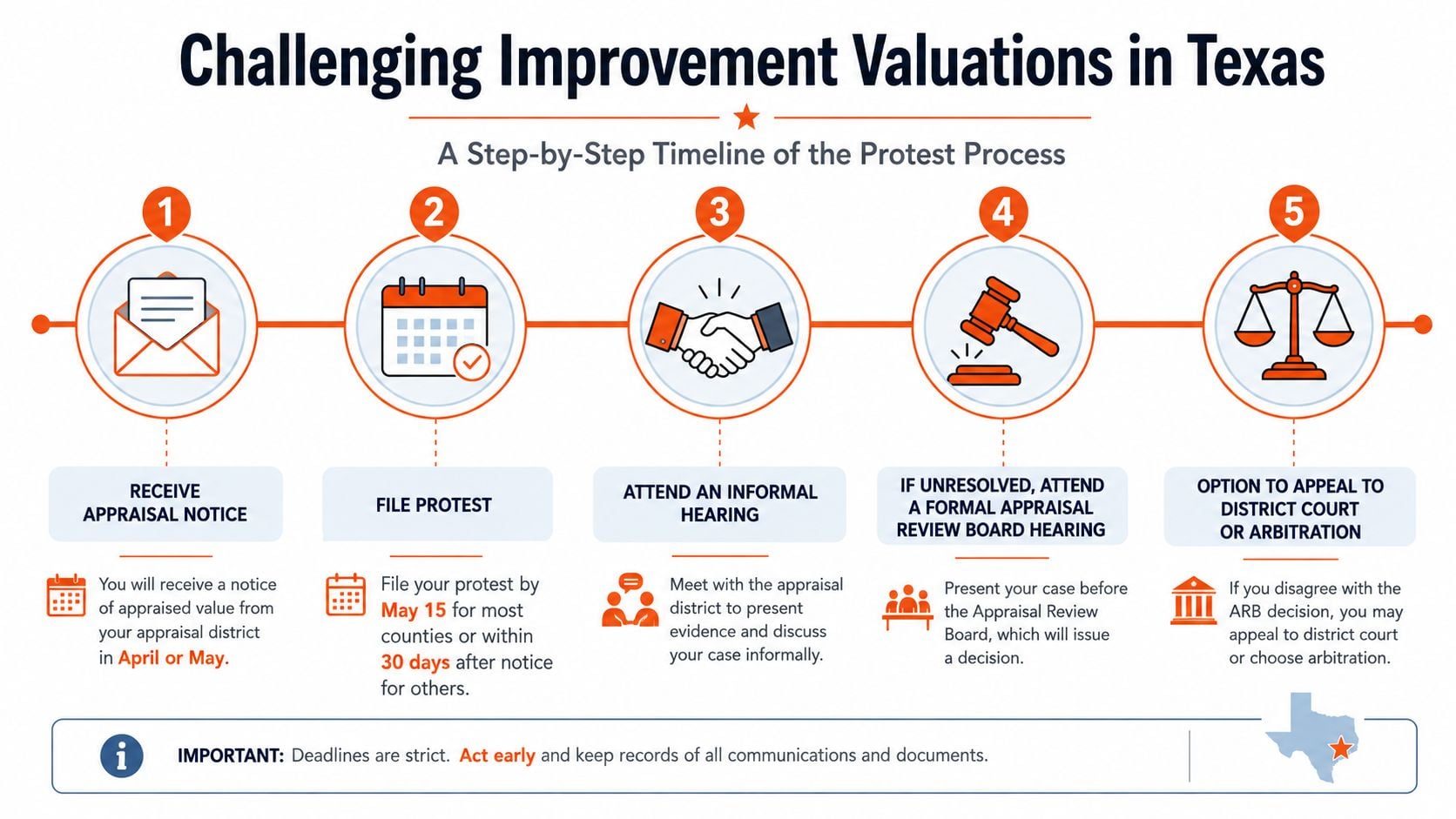
A strong evidence package answers a narrow question: why is the improvement figure too high? Include a corrected square-foot measurement, comparable sales that support a lower improvement contribution, a licensed appraisal report, contractor documentation about condition, and records showing that the district over-graded or duplicated a feature. A statement that “the taxes are too high” doesn't establish which improvement input is wrong.
For a practical walkthrough of the broader process, use this guide to protest property taxes in Texas. Local districts can publish their own hearing instructions, forms, and scheduling details, so confirm the procedure with the appraisal district handling your account.
Why Licensed Local Consultants Make a Difference
Improvement-value protests are local disputes. The relevant appraisal district uses its own property records, cost schedules, classification practices, and comparable-selection methods. A generic letter or software prompt may identify that the value changed, but it usually won't explain which local input caused the change or how to prove the correction.
A licensed Texas property tax consultant can examine the account at a more technical level. That includes checking the district's building sketch, reviewing depreciation and condition ratings, comparing the property with locally relevant records, and preparing an argument that addresses the appraisal method rather than only the final number.
Where local experience helps
- County-specific methods: Consultants understand how local appraisal districts apply cost schedules, classifications, and hearing procedures.
- Data access: Public and private data can help compare permits, property characteristics, sales, and neighborhood evidence.
- Feature review: A consultant may catch an outbuilding, pool, finished garage, or addition that the record describes incorrectly.
- Cap analysis: The timing of a new improvement can affect the homestead calculation, so the consultant can separate a legitimate addition from a broader unsupported increase.
- Hearing preparation: A clear evidence package gives the appraiser or ARB a direct path to verify the requested correction.

INTELLI uses licensed property tax consultants and employs a data-first approach that combines public and private data. That model is relevant when the dispute depends on a measurement, classification, depreciation input, or local comparison rather than a general claim that the property should be worth less.
A homeowner can still file independently, and some straightforward errors are easy to document. The decision turns on complexity, time, property type, and the strength of the available records. For a rental portfolio or a property with several structures, a consultant's local review may reduce the risk of overlooking a connected exemption or improvement issue.
Key Takeaways and Next Steps for Texas Property Owners
Improvement value is not the land value. It's the assessed contribution of the structures and permanent site features built on the parcel, generally estimated through replacement cost and reduced for depreciation. The district calculates that side separately so owners can review the physical assets independently from the underlying site.
Start with the notice in front of you. Record the improvement value, compare it with the prior year, and inspect the district's description of square footage, stories, foundation, garage, rooms, pools, sheds, and additions. Then compare the improvement cost basis with similar properties and collect permits, photographs, plans, closing records, appraisal reports, and contractor estimates that support a correction.
Your next steps should run on two tracks:
- Current-year protest: File by May 15 or within 30 days after the notice was mailed, whichever is later. Confirm the applicable deadline with your county appraisal district.
- Exemption review: Check whether your homestead exemption and any other applicable exemption are properly reflected. For Texas residence homesteads, the school district exemption increased to $100,000 for 2023, while later 2026 guidance references a $140,000 homestead exemption and an April 30 application deadline. Review the published Texas deadline guidance.
- Past-year review: Ask about a prior-year recovery audit if inflated improvement assessments may have caused overpayment. INTELLI's published materials describe reviewing prior assessments and pursuing eligible recoveries, including a review period of up to three years.
The homestead exemption and improvement challenge address different parts of the tax problem. Correcting the improvement record can reduce the assessed basis, while confirming exemptions can reduce the taxable amount separately. Review both before accepting the notice.
Your best evidence is specific: show the district what it recorded, what the property actually contains, and which document proves the difference.
INTELLI reviews improvement values, exemptions, and prior assessments using licensed property tax consultants and public and private data. Visit INTELLI to request a property review and discuss a current-year protest or a prior-year recovery audit.