

A cost recovery fee is a charge used by a government agency or contracted firm to recoup documented administrative costs for delivering a specific service. In Texas property tax matters, county appraisal districts and private tax firms can use the same label for very different charges, so the name alone doesn't tell you what will be deducted from your refund.
You may encounter the term after a homestead exemption correction, a successful protest, or a tax recovery audit. The appraisal district may process a corrected value or exemption, the tax office may issue money back, and a private consultant may invoice separately under the terms of an engagement agreement. The result is a familiar frustration: the gross savings sounds substantial, but the check or deposit is smaller.
The practical question isn't merely what is a cost recovery fee. It's who is charging it, what authority supports it, what work it covers, and whether it comes out before or after your tax savings reach you.
The Moment a Fee Line Appears on Your Tax File
The confusion usually starts with a document, not a definition. A Texas property owner opens a refund check from a county tax office, reads a protest settlement letter, or reviews a tax firm's engagement agreement and sees an unfamiliar line marked “administrative,” “processing,” or “cost recovery.”
That line can appear after a homestead exemption refund processed through the county appraisal district, after a tax recovery audit firm delivers a recovery report, or inside a protest contingency engagement that lists a separate administrative charge. The same words can describe different financial arrangements.
In plain English, a cost recovery fee is intended to reimburse documented administrative work connected to a defined service. That can include handling an application, reviewing records, maintaining a file, processing a correction, or monitoring a regulatory matter. It isn't automatically a profit markup, and it isn't automatically a commission based on the amount you save.
Start with the identity of the biller
Before disputing a fee, identify who placed it on the document.
- County or government charge: The appraisal district or another public office is applying a charge under its governing authority or published procedure.
- Private-firm charge: A consultant, recovery-audit company, or protest firm is invoicing under a contract you signed.
- Tax-office adjustment: The refund calculation may reflect an administrative deduction before the payment is issued.
Those categories matter because a county's authority comes from law and public administration, while a private firm's authority comes from its agreement with you. A private company can't turn a contingency fee into a government fee by using the phrase “cost recovery.”
Ask four questions immediately
Look for the gross refund, each deduction, the party receiving the deduction, and the method used to calculate it. If the engagement says the firm receives a percentage of recovered savings, that isn't the same thing as a county charge for processing a correction.
Practical rule: Don't evaluate a fee by its label. Evaluate the payer, the legal or contractual basis, and the work the charge supposedly reimburses.
A smaller refund isn't necessarily evidence of an improper deduction. It is evidence that you need the accounting trail. Request the original calculation, the fee schedule or contract clause, and the final net amount deposited.
How Government Frameworks Define a Cost Recovery Fee
Government finance frameworks use cost recovery as a formal allocation mechanism. Australia's Department of Finance defines a cost recovery fee as a charge collected from a specific individual or organization to recover the efficient costs of a government good, service, or regulation delivered directly to that party. The same policy distinguishes a fee from a levy, because a fee is connected to a service delivered to an identifiable party, while a levy applies more broadly to a group such as an industry sector. Australia's government cost recovery policy
New Zealand treasury guidance describes the same basic principle as charging a party for the costs of producing a good, service, or activity over a reasonable period. That framework shows why the term appears in licensing, permitting, regulatory processing, and service delivery. It isn't just casual business language.
The cost may extend beyond the visible transaction
A cost-based fee can account for more than the person who touches your file at the front counter. Government guidance can include direct administrative work and indirect expenses associated with delivering or overseeing the service. A Victorian cost recovery framework identifies cost categories such as salaries, office costs, supplies, professional services, travel, and training, while emphasizing that the charge should be tied to the reasonable or estimated cost of the activity. Victoria's cost recovery guidelines
That distinction answers a common question: can a cost recovery fee exceed the visible service cost? In some systems, yes. The recoverable amount may reflect the full efficient cost of processing and monitoring the service, rather than only the obvious front-end action.
A Texas property tax example requires caution. If a county appraisal district processes a homestead or over-65 exemption correction that leads to a refund, the public office's handling of the file and the tax office's payment process are separate from a private firm's compensation. Whether a county may deduct a particular amount depends on the applicable authority and local procedure. Don't assume that a government framework from another jurisdiction automatically authorizes a Texas deduction.
Cost recovery isn't a blank check
A legitimate cost recovery structure isn't designed to maximize revenue. It should connect the charge to an identifiable service and a reasonable cost basis. That is why schedules need review when processing time, workload, or overhead changes.
A private company operates under a different rule. It may set a contingency percentage, a fixed processing fee, or a hybrid charge if the contract clearly permits it. Calling that invoice a cost recovery fee doesn't give the firm public-sector authority. The contract controls the private charge, while statute and public procedure control the government charge.
County Appraisal Districts Versus Private Tax Firms
Texas property owners usually encounter two separate fee environments. Confusing them makes a refund statement harder to audit and can lead owners to challenge the wrong party.
| Question | County appraisal district or public office | Private tax firm or recovery auditor |
|---|---|---|
| Who charges it | A government office involved in appraisal, exemption, correction, or refund administration | A consultant, protest firm, or audit company |
| Why it appears | To cover an authorized administrative service or handling activity | To compensate the firm under an engagement agreement |
| Where authority comes from | Statute, regulation, public policy, or a published local schedule | The signed contract and applicable professional rules |
| How it may be calculated | A stated administrative amount or cost-based charge | A percentage of savings, a flat amount, or a hybrid |
| What to request | The governing authority, schedule, and calculation | The fee clause, methodology, recovery definition, and invoice |
The county side is public administration. An appraisal district processes appraisal records and exemptions, while a tax office handles collection and refunds. A charge tied to those functions should be traceable to the relevant authority or published procedure. If the document doesn't identify the basis, ask the office to explain it in writing.
The private side is commercial contracting. A recovery-audit company may identify an overpayment, prepare evidence, communicate with the appraisal district, and charge according to the result. A protest firm may earn compensation only when the assessed value falls, but the agreement can still contain separate administrative or processing language.
Read the agreement before the savings appear
The most useful distinction is not the word “fee.” It is whether the charge is government-imposed or contract-imposed.
A private firm should disclose whether its percentage applies to gross savings, refunded taxes, or another defined amount. It should also explain whether the firm can invoice a fee when the protest fails, when the county rejects the exemption, or when a refund is unavailable. A line described as “cost recovery” may be reasonable, but undefined language gives you no reliable way to test it.
The same refund can carry a public administrative deduction and a private contractual fee. Treat them as separate ledger entries.
Keep the county notice, appraisal district correspondence, tax-office calculation, engagement agreement, and private invoice together. The paperwork should show who charged what, when, and why.
What These Fees Cost and How They Are Calculated
A fee line on a Texas property tax file needs a defined base, a stated service, and a clear payer. County appraisal districts do not use one statewide cost-recovery schedule, so a charge in one local process may not apply elsewhere. The amount must come from the applicable county procedure, notice, or contract.
Do not accept a precise figure merely because a consultant or website calls it typical. A private firm may charge a flat case-opening amount, a percentage of recovered savings, or both. The written agreement should identify the calculation and explain when the charge becomes payable. For a practical discussion of Texas protest expenses and engagement economics, review INTELLI's Texas property tax protest cost guide.
Follow the calculation trail
Request a worksheet that separates the work and the money attached to it:
- Administrative labor: Identify file review, application preparation, correction processing, or refund reconciliation.
- Document handling: Separate mailing, copying, scanning, and records-management expenses from professional fees.
- Data and system work: Show database corrections, public-record retrieval, or permitted third-party lookups.
- Success compensation: State whether the firm receives a percentage of the recovered amount and define “recovered.”
- Pass-through charges: Identify amounts paid to another entity rather than retained by the consultant.
This review does not reject every fee. It distinguishes documented reimbursement from a percentage-based business charge. A government cost-recovery framework can include direct and indirect efficient costs, as described in the BLM's 2025 administrative and monitoring cost guidance. That federal guidance does not authorize a Texas county charge. It does show why the visible administrative action may not equal the full cost base used for a government calculation.
Timing affects the accounting
A mid-year protest may first produce a corrected appraisal record and then require a separate tax-office refund process. The county may finish its accounting before releasing money, while the private firm's agreement may trigger payment at an earlier stage.
Check whether the fee is due when the appraisal district issues a corrected value, when the tax office releases funds, or when the owner receives the refund. Those events can produce different amounts and different cash-flow consequences.
If the worksheet is missing, pause the review. You cannot determine whether the charge is proportionate, authorized, or contractually valid until you know the base amount and the work assigned to it. On the final refund accounting, list any county-imposed deduction separately from the private firm's contract charge. A similar label does not make them the same fee.
How a Cost Recovery Fee Eats Into a Tax Recovery Audit
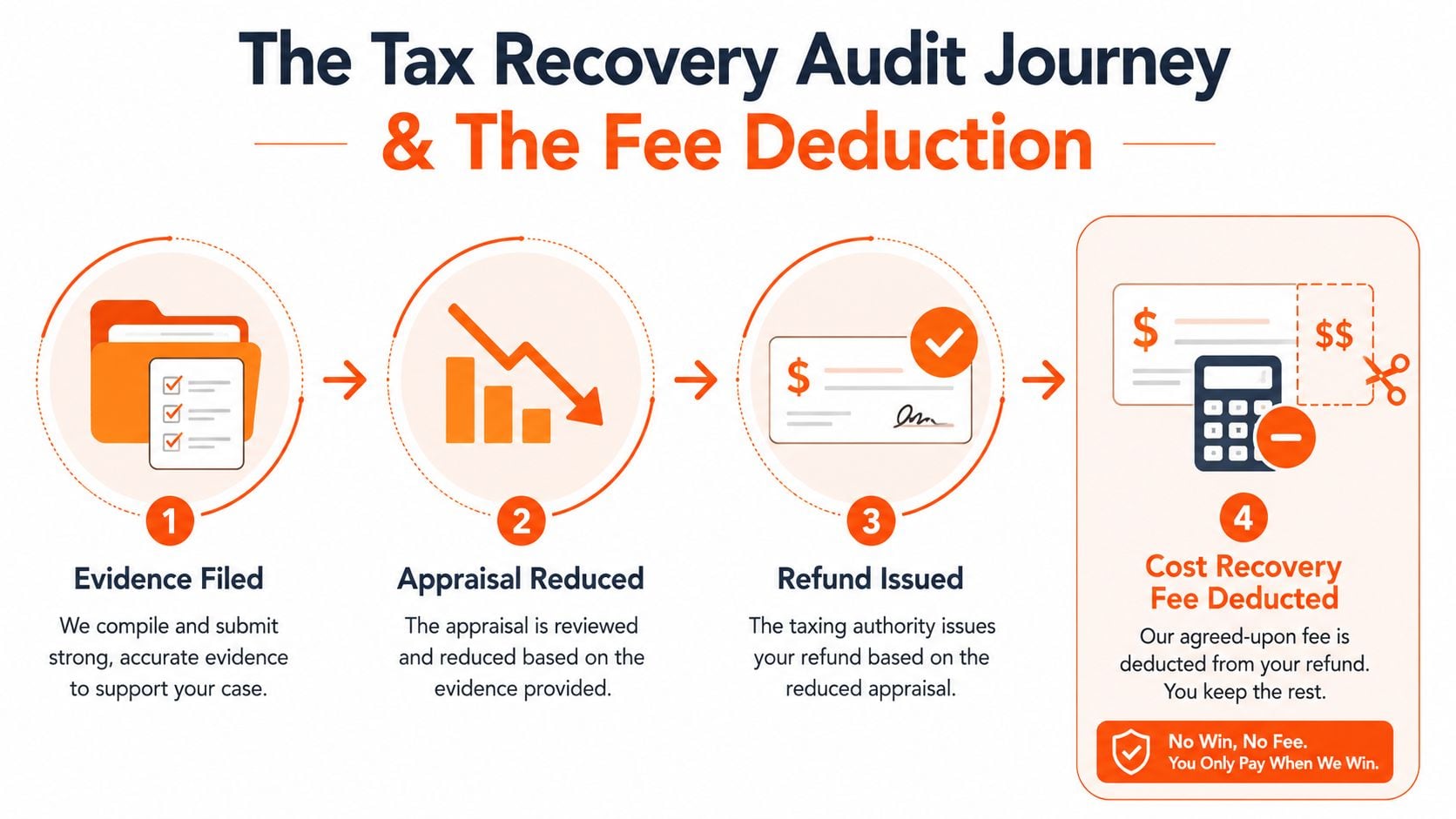
A commercial parcel can show a lower taxable value and still deliver less cash than the owner expects. The audit firm reviews the tax history, submits evidence, the appraisal district lowers the value, and the tax office calculates the refund. The final accounting then shows which amounts were deducted before payment.
Consider a parcel whose assessed value falls from $480,000 to $420,000. At a 2.8% local tax rate, the annual tax difference is approximately $1,680, assuming the rate applies evenly and no other tax components change. These figures explain the accounting, not a promised result.
A private firm charging a 25% to 35% contingency share would retain $420 at the lower rate or $588 at the higher rate. The owner would have a gross balance of $1,260 or $1,092, respectively. If an authorized county administrative handling charge of $150 also applies, the approximate amounts reaching the owner become $1,110 or $942.
Two deductions can have two different explanations
Both deductions reduce the amount that reaches the owner, but they come from different sources. The county charge should have an administrative basis and supporting calculation. The private firm's contingency or processing charge comes from the engagement agreement. A property owner should keep those lines separate on the refund statement.
For multi-year work, the distinction affects the net recovery even more. Texas rules can allow a late residence homestead application up to two years after the delinquency date under Tax Code Section 11.431, as described in the statutory late-filing provision. Corrected years may increase the gross refund, while percentage fees apply across the recovered amount.
Owners evaluating a rental or commercial portfolio should also distinguish property-tax recovery from other tax studies. VerticalRent's cost segregation overview covers a separate tax-planning process. It does not replace a property-tax recovery audit or explain county refund accounting.
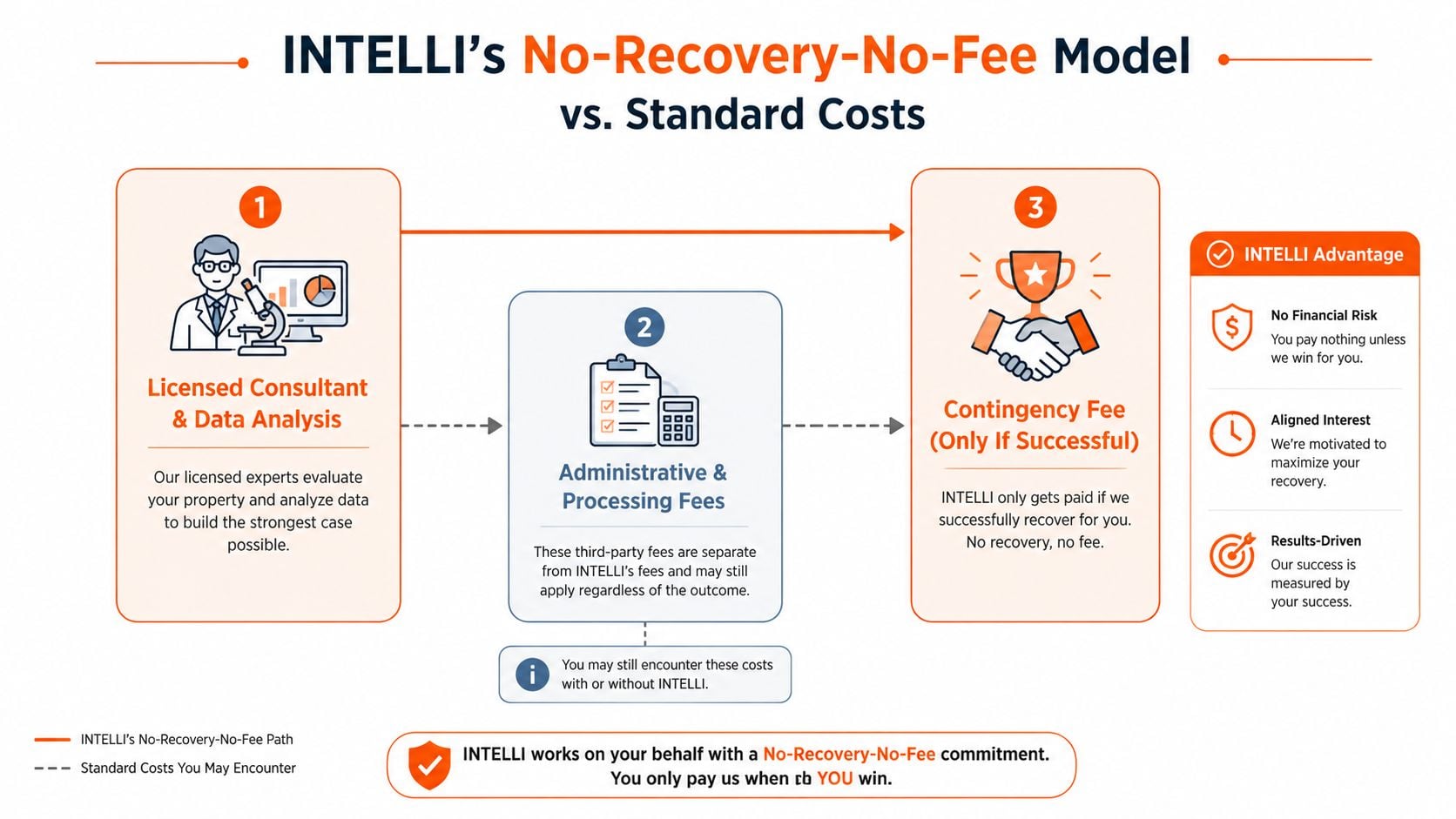
A recovery audit contractor may structure compensation around the result. Under a no-recovery-no-fee arrangement, the owner still reviews any government pass-through charge, while the private consultant receives no compensation when the audit produces no actual recovery.
Spotting, Disputing, and Tracking Cost Recovery Fees
A fee line can change the amount on your refund check. Before authorizing a protest or audit, read the engagement letter and any county statement. An undefined “administrative cost recovery” charge, a percentage with no stated base, or a fee due after a zero-recovery result requires written clarification.
Request these details before signing:
- Itemized worksheet: Have the firm identify labor, documents, data, and pass-through charges separately.
- Authority or contract basis: For a government charge, request the statutory or administrative authority. For a private invoice, identify the exact contract paragraph.
- Calculation method: Confirm any percentage, flat amount, minimum, maximum, and definition of recovered savings.
- Failure treatment: Ask what happens if the protest fails, an exemption is denied, or no refund is issued.
- Payment timing: Confirm whether the charge comes out of the refund, is billed separately, or becomes due after you receive the money.
Texas filing deadlines can determine whether a recovery is available. The Texas Comptroller states that the general exemption-application deadline is before May 1. County instructions may identify April 30 as the practical cutoff, so review the Texas Comptroller's exemption guidance with the applicable county instructions.
Build one audit trail
Use one spreadsheet row for every parcel. Include:
- County and appraisal district
- Parcel number
- Tax year
- Protest, exemption, or audit type
- Gross reduction or refund
- Government deductions
- Private-firm fees
- Net deposit
- Payment date
- Supporting document location
For an exemption claim, verify the governing rule rather than relying on a sales email. Texas law provides a late residence homestead filing window of two years after the delinquency date under Section 11.431. That deadline does not determine every exemption or refund process. The Compass+'s expense monitoring guide offers a useful framework for tracking money owed and money spent, while the property file still needs Texas-specific records.
If a bill says only “cost recovery,” send a written dispute or clarification request. Ask the biller to identify who imposed the charge, the authority or contract supporting it, the calculation base, and the amount deducted from your refund. Keep the response with the closing statement and deposit record, so the gross recovery and the money you received can be reconciled later.
Why INTELLI's No-Recovery-No-Fee Model Matters Here
The fee question becomes clearer when the refund is separated into layers.
Layer one is the county. An appraisal district or tax office may retain authority to apply a documented administrative charge connected to its process. A consultant can't promise that every public deduction will disappear, because the consultant doesn't control county accounting.
Layer two is the private firm. Traditional contingency arrangements can take 25% to 40% of gross savings, depending on the agreement and service. That private percentage is separate from any county charge, and the contract should disclose whether it applies before or after public deductions.
Layer three is the consultant's risk model. INTELLI uses licensed property tax consultants and employs a data-first approach, using public and private data. Its no-recovery-no-fee model makes the firm's compensation contingent on an actual recovery, while the owner still reviews any county or third-party charge that the firm can't control.
Transparency matters more than the label
A transparent engagement should show the expected service, the fee trigger, the calculation base, and the treatment of public charges. A useful pricing policy should let an owner compare gross savings with the actual net result. Cloudvara's pricing transparency guide offers broader context for evaluating whether a vendor explains charges clearly.
Reviewing a proposed audit through INTELLI's property tax audit service means focusing on the records behind the recovery, not just the headline amount. The model doesn't eliminate county or third-party charges, and it doesn't guarantee a refund. It does avoid adding a private fee when no recovery occurs.
The practical comparison is simple. With an upfront or failure-based charge, the owner carries more downside before knowing whether the file supports recovery. With no recovery, no fee, the consultant's compensation is tied to the result, while the owner remains responsible for understanding any independent public charge.
Your Texas Owner's Quick Reference Checklist
A refund can look favorable until the deductions are identified. Use this checklist before signing an engagement agreement or authorizing payment:
- Verify licensing: Confirm that the consultant is licensed through the Texas Department of Licensing and Regulation.
- Separate fee types: Require a written schedule distinguishing the firm's contingency percentage from pass-through administrative or processing charges.
- Identify the county deduction: Ask whether the appraisal district or tax office may deduct a documented cost recovery fee before disbursing funds.
- Read the notice deadline: Verify the specific protest deadline printed on the Notice of Appraised Value and in the county's instructions. Do not rely on a generic calendar.
- Request the evidence packet: Obtain the comparable sales, valuation analysis, and appraisal district data used in the filing.
- Confirm refund timing: Ask when payment should issue after the appraisal review, settlement, or applicable order.
- Check insurance: Confirm that the firm carries professional liability coverage and ask what the policy covers.
- Track the net result: Record the gross refund, each deduction, the final deposit, and the documents supporting every amount.
Keep exemption requirements separate from protest deadlines. As noted earlier, the Comptroller's guidance is a useful starting point, but the notice and county instructions control the action you must take on that property.
A fee should be clearer after these questions, not harder to explain. If the firm will not identify the calculation base, the payment recipient, or what happens after a failed protest, ask for a revised agreement before signing.
INTELLI helps Texas homeowners, investors, and businesses pursue property tax protests, exemption filings, and recovery audits through licensed consultants and reviews of public and private data. Visit INTELLI to request an assessment of your property tax file and evaluate whether a no-recovery-no-fee engagement fits your situation.