

You open your appraisal notice in Round Rock and see a value that jumped sharply, even though you haven't remodeled, added a room, or changed the property. The number feels disconnected from your home because the notice doesn't show the full reasoning behind it.
That reasoning is property valuation methodology, the set of procedures used to estimate market value. In Texas, understanding the method behind the number helps you identify the evidence that matters, meet the protest deadline, and explain to the appraisal review board why the district's conclusion may not reflect your property's actual condition or market position.
Why Property Valuation Methodology Matters to Texas Owners
A homeowner in Texas may receive an appraisal notice showing a value that seems out of step with the property's condition. The answer is rarely found in the final number alone. A county appraisal district reaches that figure by selecting data about sales, land, improvements, condition, income, and depreciation, then applying a valuation method to interpret it.
That method matters because the appraisal district's market value forms the starting point for the property tax calculation. A higher value can raise the tax burden even if the owner's income, mortgage payment, and home condition remain unchanged. The notice may look simple, but it represents a chain of choices about which properties, costs, rents, and adjustments the district considered.
Practical rule: Don't argue only that the value feels high. Identify the method, find the incorrect input, and connect it to specific evidence.
The three questions to ask first
Begin by asking:
- Which approach applies? The district may rely mainly on sales comparison, cost, or income analysis.
- What property facts did it use? Check living area, lot size, age, quality, condition, improvements, and classification against your records.
- Does the result match market behavior? The estimate should fit what comparable buyers and sellers supported, rather than reflect an unsupported assignment.
These three approaches are recognized in professional valuation practice. RICS explains the three valuation approaches and their role in appraisal practice describes how sales comparison, cost, and income analysis serve different valuation purposes. For a Texas homeowner, the practical value is knowing what evidence can test each one.
A flawed comparable sale can weaken a sales comparison analysis. A wrong measurement, construction cost, or depreciation assumption can affect a cost analysis. Unsupported rent, operating expenses, or capitalization assumptions can undermine an income analysis. The relevant evidence might include photographs, repair estimates, floor plans, measured areas, deed records, or documentation showing that a selected comparable differs materially from your property.
Understanding what a Texas property tax assessment means provides context for reviewing an assessment before examining the district's supporting evidence. At a hearing, the strongest explanation follows a clear chain: identify the approach, show which input is inaccurate or poorly matched, and explain how correcting it changes the conclusion.
The Three Core Valuation Approaches Explained
Each valuation approach answers a different question about market value. The sales comparison approach tests what similar properties sell for, the cost approach tests what the improvements would cost to replace, and the income approach tests what the property's expected earnings support. Texas county appraisal districts select and apply these methods according to the property type and available evidence.
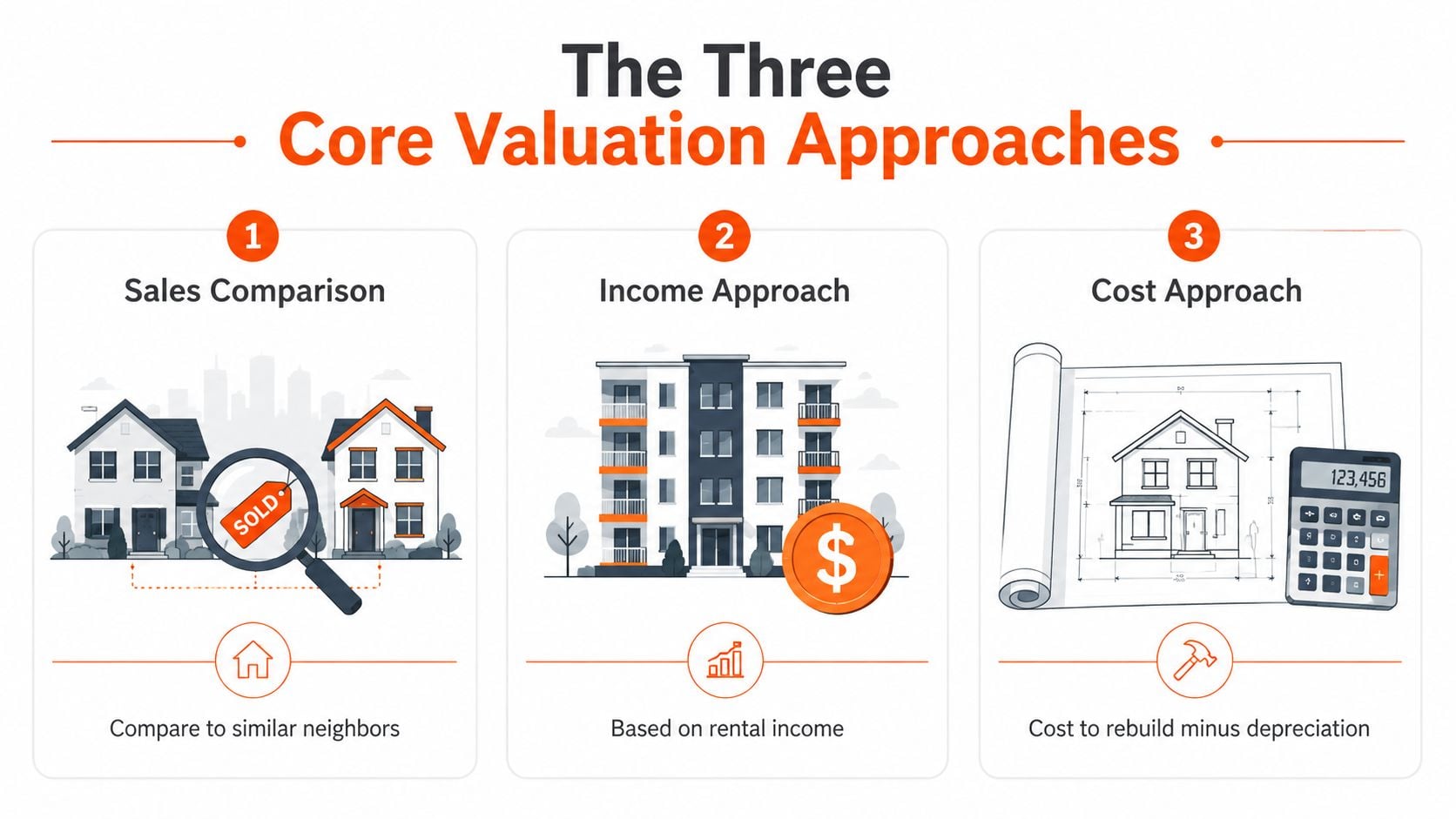
Sales comparison approach
What would similar properties sell for in the same competitive market?
This approach resembles reviewing nearby sales before listing a home. The appraiser selects comparable properties, or “comps,” then adjusts their sale prices for meaningful differences. A larger lot, updated kitchen, greater living area, newer roof, or superior location can make one sale a poor match unless the analysis accounts for that difference.
Suppose three nearby homes sold recently. One has a smaller lot, another has an updated kitchen, and the third has less living area but a newer roof. The appraiser adjusts each sale to estimate what it might have sold for with the subject property's characteristics. The conclusion depends on the quality and comparability of the sales, along with the adjustments, not on the number of sales.
At an appraisal review board hearing, useful evidence can include photographs, floor plans, measured areas, and records showing that a selected comparable differs materially from your home. Owners seeking a broader explanation can review this guide on how to price your Fresno property correctly. The market differs, but the discipline remains the same: compare similar properties and explain material differences.
Cost approach
What would it cost to replace the improvements, after accounting for depreciation, plus the land value?
The cost approach separates land from buildings. It estimates the current cost to replace a structure with similar utility, subtracts depreciation, and adds the land's estimated value. Districts may give this method greater weight for newer construction, unusual properties, or special-use facilities where comparable sales provide limited guidance.
Depreciation includes more than visible wear. Physical deterioration, outdated design, functional limitations, and outside influences can reduce an improvement's usefulness and market appeal. At a hearing, a homeowner can challenge the result with corrected measurements, photographs, repair estimates, construction details, or evidence of functional problems. A replacement-cost estimate without realistic depreciation can overstate value.
Income approach
What would a reasonable investor pay for the property's expected income?
The income approach is most relevant to apartments, retail centers, offices, and other income-producing properties. The analysis starts with potential rent, considers vacancy and collection loss, subtracts operating expenses, and capitalizes the resulting income into an indication of value.
A property with strong rent but substantial expenses may be worth less than its gross income suggests. A capitalization rate that fails to reflect risk, location, condition, and available market alternatives can also distort the conclusion. Texas owners managing commercial assets can review this guide to commercial property appraisal, then compare the district's rent, expense, and capitalization assumptions with actual records.
Residential property usually relies most heavily on sales comparison, commercial property often depends more on income analysis, and special-use property may require the cost approach. The appropriate method is the one that best reflects how buyers and sellers judge that type of property.
How Mass Appraisal Works Behind the Scenes
A Texas county appraisal district may value thousands of parcels in the same cycle. Mass appraisal handles that workload by valuing groups of similar properties as of a specific date, using shared data, standardized procedures, valuation models, and statistical tests. The result should be consistent across neighborhoods and property types, while still reflecting each parcel's actual characteristics.
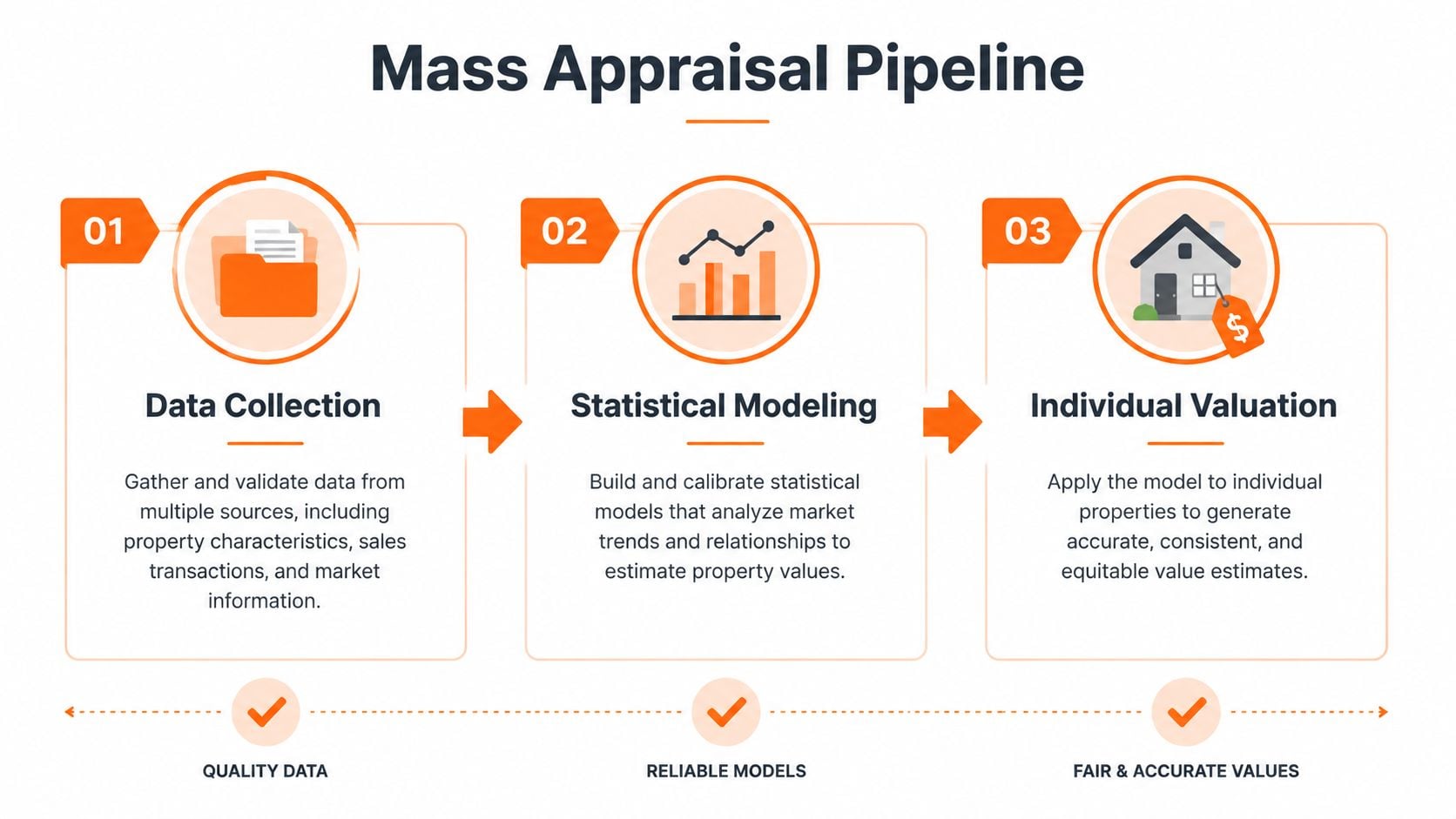
The appraisal pipeline
The first stage is data collection. District staff compile sale records, land characteristics, building measurements, improvement details, neighborhood information, and property classifications. If your record lists too much living area, an oversized lot, or the wrong property class, every later calculation rests on a faulty starting point.
The district then develops models that connect property features with observed sales. Regression and other statistical methods can identify how characteristics such as location, size, age, or condition relate to market prices. The model applies those relationships to groups of similar parcels and produces an indicated value for each property.
A final stage includes individual review and performance testing. A model may produce reasonable results for a neighborhood while still misvaluing one house because its record contains an incorrect measurement or classification. Consistency across a group does not verify the facts recorded for your parcel.
That distinction matters at a Texas appraisal review board hearing. Evidence that corrects your property record can disrupt the model's result, even when the district's broader statistics appear acceptable. A survey, appraisal sketch, photographs, repair documentation, or proof of a different classification can focus the discussion on your parcel.
How ratio studies test performance
A ratio study compares assessed value with market value by dividing one by the other. It tests whether a mass appraisal system tends to value properties too high or too low and whether results are reasonably uniform among different property groups.
Washington appraisal reports use sales-ratio analysis to evaluate accuracy and uniformity. IAAO-based standards expect the overall appraisal level for a jurisdiction to fall within 10% of market value, while the price-related differential, or PRD, is expected to remain between 0.98 and 1.03. The Washington ratio study report explains these performance measures.
Those measures address the system as a whole. They can show whether lower-priced and higher-priced properties receive consistent treatment, but they cannot determine whether your lot size, condition grade, or comparable properties are wrong.
IAAO guidance also calls for valuation procedures and models to be documented and reproducible. If the district reruns a model with unchanged data, the process should produce the same result. At a hearing, ask which property data and adjustments produced your value, and whether another professional could follow the same steps. IAAO guidance addresses reproducible mass appraisal models.
Data Inputs and Adjustments That Drive Each Method
A county appraisal district's conclusion depends on the property facts and adjustments behind its model. An incorrect sale date, site measurement, depreciation factor, or income assumption can shift the result even when the formula itself is applied correctly. Texas owners can understand the method by tracing each input to the final value.
| Valuation Approach | Primary Inputs | Key Adjustments | Common Ripple Effect |
|---|---|---|---|
| Sales comparison | Verified sales, location, lot size, living area, age, condition | Differences in physical features, sale timing, location, and transaction terms | A superior comp may push the subject value too high |
| Cost | Land value, replacement cost, construction quality, age, condition | Physical deterioration, functional limitations, external influences | Inadequate depreciation can overstate improvement value |
| Income | Rent, vacancy, expenses, net operating income, capitalization rate | Lease terms, operating performance, risk, market conditions | An unsupported rate can shift the indicated value materially |
Sales data needs context
A nearby sale is not automatically a useful comparable. The district should evaluate similar utility, condition, location, site size, and market appeal. Sale timing also matters. A transaction from an earlier market period may need a time adjustment before it supports a current valuation.
Suppose a district compares a renovated home on a larger lot with an older property that has deferred maintenance. The comparison may raise the subject's indicated value without reflecting its actual market position. At a hearing, listing photographs, inspection reports, repair records, closing documents, and carefully selected competing sales can test that conclusion. A detailed comparable property analysis helps organize the differences and show which adjustments require review.
Cost and income inputs create different problems
The cost approach starts with land value and the cost to replace the improvements, then accounts for construction quality, age, condition, and other forms of depreciation. The district must use property characteristics that support classification and valuation, while cost and depreciation data require adjustment to local conditions. IAAO's mass appraisal standard discusses data collection, cost inputs, depreciation, and model validation.
A cost challenge should therefore focus on evidence such as inaccurate living area, incorrect quality or condition coding, omitted deterioration, functional limitations, or outside influences affecting the property. A repair estimate or clear property documentation can connect the physical condition to the requested adjustment.
Rental property uses a different set of pressure points. An incorrect rent schedule can overstate gross income. Missing expenses can overstate net operating income, while a capitalization rate that does not fit the property's risk and market position can magnify the final value.
Consider a home whose record shows too much living area, whose selected sale is superior, and whose visible deferred maintenance is missing from the model. Each error may look modest alone. Together, they can produce a notice that does not represent the home's market position. Separate each input, identify the supporting record, and show how the correction affects the method.
Challenging a Valuation at the Appraisal Review Board
A homeowner opens the notice of appraised value and sees a figure that does not match the property's condition or the recent market evidence. The productive response is not to challenge every line at once. First identify which valuation approach drove the result. Then present evidence that tests the assumptions behind that approach.
In most cases, Texas property owners have until May 15 or 30 days after the appraisal district mails the notice of appraised value, whichever is later, to file a protest with the appraisal review board. The Comptroller explains that the deadline follows the mailing date rather than the delivery date. A late hearing may be granted only for good cause. The Texas Comptroller explains property tax protest deadlines.
Match the evidence to the method
For a sales comparison valuation, review the district's selected comparable properties one by one. A sale with a substantially larger site, extensive renovations, or a different location may not represent the subject property well. Bring verified closing data, photographs, repair records, and a clear explanation of the needed adjustments. The point is not that a neighbor pays less. The point is that the selected sales differ in characteristics that affect market value.
A cost-based protest needs physical evidence. An independent appraisal, contractor estimate, permit, construction record, or inspection report can show whether the district's replacement cost and depreciation assumptions fit the actual improvements. A documented condition problem matters because the cost approach is meant to reflect the value of the improvements as they exist, not an average building in the same area.
Income-producing property calls for financial records. Review the rent roll, vacancy assumptions, expense statements, lease terms, and capitalization rate. Show how one disputed assumption changes the indicated value. A panel can evaluate a calculation more readily when the packet connects the original input, the corrected input, and the resulting difference.
Texas appraisal notices must explain how to protest, state when and where ARB hearings begin, and describe the availability and purpose of an informal conference before the protest hearing. The Comptroller describes the required notice information and valuation procedures.
Give the panel a traceable argument. Identify the district's input, provide the supporting evidence, and calculate the requested change.
A signed contract, settlement statement, appraiser certification, contractor estimate, inspection report, or rent documentation may support the case, depending on the method. Organize the packet so the ARB can move from the disputed fact to the requested value without guessing what each document proves.
Review this overview of the protest process before preparing the hearing presentation:
Common Valuation Errors and Red Flags to Watch For
A homeowner may find the problem by comparing the district's record with the property itself. A wrong lot dimension, missing repair, or outdated comparable can affect the final value even when the valuation model is mathematically consistent. In Texas county appraisal districts, the practical question is whether the property's recorded facts and assigned assumptions fit the evidence.
Data problems owners can verify
Check the property record against the deed, survey, appraisal documents, permits, inspection reports, and photographs. Look for these warning signs:
- Stale comparable sales: Sales from another market period appear without a clear timing adjustment.
- Incorrect lot size: The record shows a larger or more valuable site than the parcel contains.
- Wrong living area: Unconditioned space, an enclosure, or another area is treated as equivalent living area.
- Misclassified property type: The property is placed in the wrong class, quality category, neighborhood, or use.
- Unrecognized condition issues: The model treats the property like an average home despite documented deferred maintenance or functional limitations.
A sudden increase without matching permits or physical improvements warrants a closer review. Market movement may explain part of the change, but the district should still identify the record changes, model inputs, or adjustments supporting it.
Method problems need deeper testing
The evidence that challenges a valuation depends on the approach behind it. For sales comparison, test whether the selected sales match the property in location, time, size, condition, and use. For cost, examine replacement cost, depreciation, and whether an improvement has been counted twice. For income, compare the capitalization rate, rents, vacancy assumptions, expenses, leases, and tenant or location differences.
Uniform cap-rate assumptions can misstate income properties with different leases, expenses, tenant profiles, locations, or physical conditions. Cost models can overstate value when depreciation is understated or improvements are double-counted. Sales models can create unequal results when one adjustment pattern is applied across unlike streets and subdivisions.
MSCI's 2025 analysis shows why timing rules matter in changing markets. It excludes valuations made within three months of sale, then adjusts the last uninfluenced valuation for segment-level capital growth. The analysis reported a weighted average absolute deviation of 7.6% in 2025, compared with 9.1% in 2024 and a 10-year average of 9.5%. It also reported that 8 of 13 market segments improved year over year, showing that model performance can differ substantially by segment. The MSCI analysis provides its valuation timing and segment methodology.
Data quality can limit any mass appraisal system. Limited transactions, fragmented records, and informal land systems make reliable comparisons harder, while developed markets may have extensive transaction databases and digital registries. Research on mass appraisal data challenges compares these information environments.
Software can locate possible comparables, but it cannot decide whether they fit. At a hearing, property-specific evidence should show which fact or assumption is wrong and how that error affects the indicated value.
Turning Methodology Into Savings With the Right Partner
A strong protest works backward from the appraisal district's conclusion. Begin with the proposed value, determine which approach appears to support it, trace the data and adjustments, then collect evidence tied to the property itself. That sequence keeps the argument focused on a specific valuation error rather than an unsupported request for a lower number.
Build evidence around the actual method
For a sales comparison challenge, assemble verified closing information, photographs, inspection findings, repair invoices, and records documenting differences in size, condition, location, and site characteristics. For a cost challenge, collect permits, construction documents, contractor estimates, and evidence of physical or functional depreciation. For an income challenge, prepare rent rolls, leases, operating statements, expense records, and market support for the selected capitalization rate.
Match every document to a hearing argument. A repair invoice supports a condition adjustment. A survey tests the recorded site size. A signed closing statement helps establish what the property sold for under the relevant circumstances. The document matters because it addresses an input used by the district, not because it shows that the owner disagrees.
Presentation should follow the same method-based structure. Explain the district's evidence, identify the assumption that does not fit, and show the property-specific record that corrects it. An owner does not need to recreate a countywide model. The owner does need a clear, reproducible explanation of why the selected sales, cost inputs, or income assumptions do not represent the property.
A homeowner might pair a comparable-sales analysis with a cost-approach depreciation review. The sales analysis questions whether the market evidence matches the property. The depreciation review shows why the improvements should not be valued as newer or better maintained than they are. Together, these documents address separate parts of the district's reasoning.
INTELLI uses licensed property tax consultants and employs a data-first approach, using public and private data. Its service reviews appraisal methodology, prepares evidence packets, and represents property owners before county appraisal districts. A structured review can also address exemptions and deadlines where applicable. The starting point remains the same: identify the valuation error and prove it with property-specific evidence.
Gather the appraisal notice, property record, recent sales information, and condition documentation before the protest deadline. A qualified reviewer can then determine which approach drove the result and whether its supporting data withstands scrutiny.
If your Texas appraisal notice does not reflect your property's actual market position, visit INTELLI to connect with a team that reviews the methodology, uses public and private data, and builds a documented protest case with licensed property tax consultants. Get the property record reviewed early so the evidence matches the valuation argument before the ARB deadline.