

You open your Austin appraisal notice at the kitchen table, see a higher value, and pull up the exemption application. The checkboxes look straightforward until you realize that owning the home, retiring, and having a VA disability rating could each change the answer. You don't need a longer list of tax breaks. You need to know which benefits belong on your property and whether they appear on your account.
Start With the Question on Your Tax Bill
What tax exemption should I claim? For a Texas homeowner, my answer is to investigate every exemption you qualify for, then determine which benefits work together. Don't choose a single checkbox just because its label sounds most relevant.
Start with the property record and the taxing units on your bill, not a statewide savings estimate. An Austin mailing address isn't enough to calculate your result. Your school district, county, city, and other applicable taxing units need separate attention.
Build a household-specific decision path
Before comparing exemptions, put these facts on paper:
- Ownership and use: Identify who owns the property and whether it's the owner's principal residence.
- Personal eligibility: Record age, legal disability status, and any VA disability determination.
- Property history: Note purchases, moves, inheritances, and changes in occupancy.
- Existing benefits: Compare approved exemptions with what you believe you applied for.
The mistake I'd address first is under-claiming: filing for the basic homeowner benefit and never checking whether another qualifying benefit belongs alongside it. But stacking doesn't mean every exemption is interchangeable or that every additional application produces additional savings.
Old guidance creates another trap. Texas increased the school-district exemption for older or disabled homeowners from $10,000 to $60,000 beginning with the 2025 property-tax year, so an article using the former figure can materially understate the benefit (Texas legislative analysis).
Practical rule: Match the exemption to your household, the property, and the tax year before estimating savings.
If you own outside Texas too, keep those reviews separate. Resources such as Broward tax insights from BatchData can provide a starting point for another market, but don't transfer another jurisdiction's assumptions to your Travis County filing.
The Homestead Exemption That Most Texans Start With
If you own and live in the home, the residence homestead exemption is your first filing. It's the base layer of the stack. Every other Texas exemption in this article assumes this one is already approved.
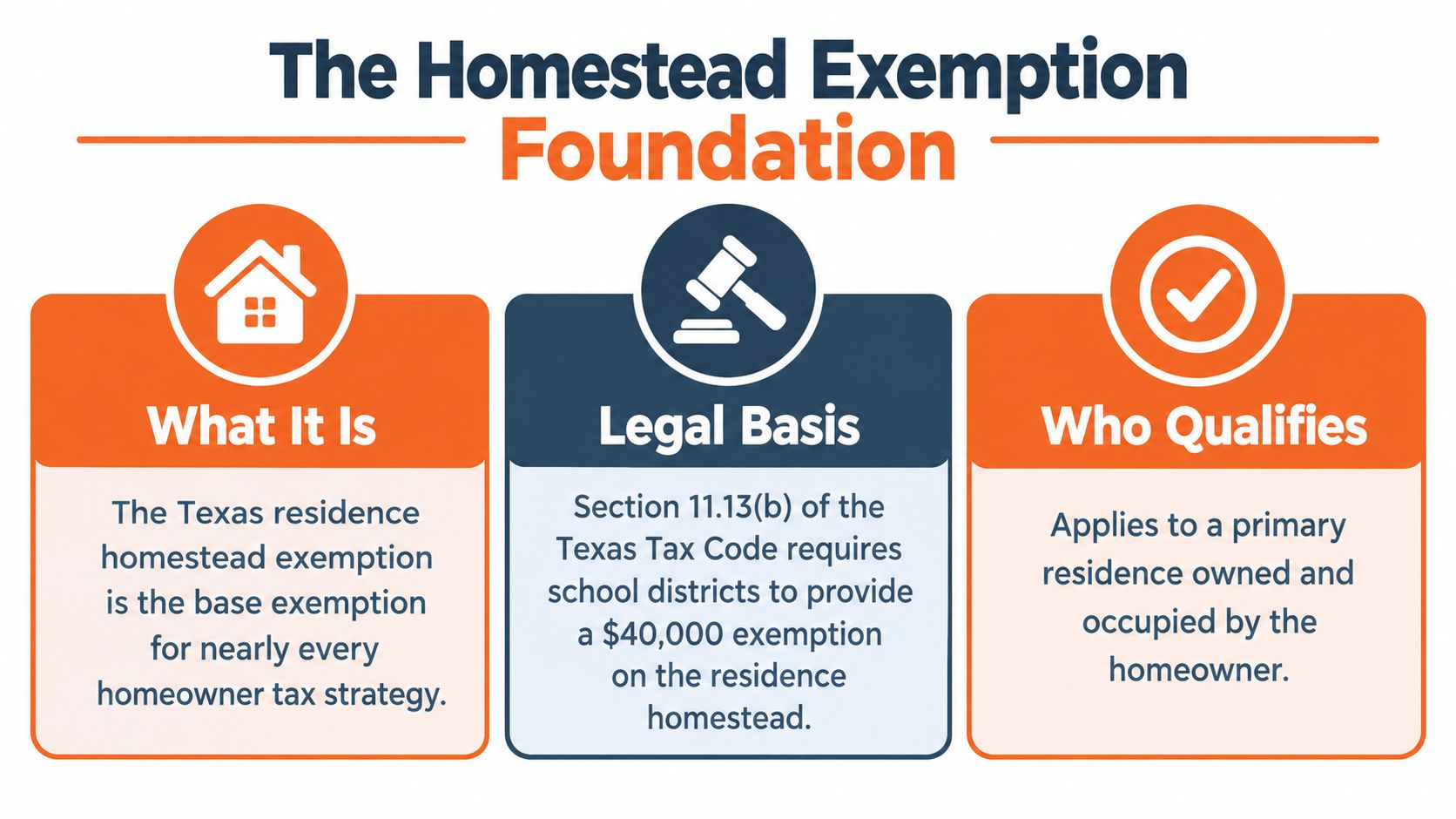
Under Texas Tax Code Section 11.13(b), an eligible residence homestead receives a $140,000 school-district exemption, and local taxing units may adopt an optional homestead exemption of up to 20% of appraised value (Texas Comptroller property-tax exemption guidance).
That reduction lowers taxable value on the school-district line of your bill. Your city, county, and special-district amounts sit on separate lines, each governed by whatever optional exemption that particular unit adopted. Nothing about a school benefit touches them.
Who Qualifies for the Standard Homestead Exemption
| Requirement | What it means | Common edge case |
|---|---|---|
| Ownership interest | You must have a qualifying ownership interest in the home | An inheritance or ownership transfer needs careful documentation |
| Principal residence | You occupy the property as your main home | A rental or second home generally doesn't qualify |
| Qualifying dates | Ownership and occupancy dates matter to the application | A midyear purchase needs review rather than an assumed full-year result |
| Supporting records | Your application must establish eligibility | Conflicting ownership or address information needs attention |
The Comptroller's homeowner exemption guidance treats ownership and principal-residence occupancy as the two core tests. Check your status on January 1. A midyear purchase, move, or inheritance still deserves its own review, because a January snapshot doesn't settle a household that changed in June.
This is also the one exemption I'd file without help. The form asks for the same ownership and occupancy facts already sitting in your deed paperwork, and a consultant adds nothing there.
The graphic below shows the structure of the exemption; the current school-district amount is $140,000.
For an Austin homeowner, I'd compare the school-district taxable value before and after the exemption, then inspect every other taxing-unit line separately. Don't multiply the school exemption by your combined tax rate. That applies a school-specific benefit to taxes it never touches, which is how homeowners end up with inflated savings estimates.
Pull the actual school rate printed on your own bill before you run any math. A statewide average will lie to you.
The Over-65 and Disability Exemptions Most Filers Miss
Retirement isn't the eligibility test. Age or qualifying disability is. If your application history consists of a homestead filing from when you bought the house, review it again when your circumstances change.
Older homeowners and legally disabled homeowners can receive an additional school-district exemption alongside the general residence homestead benefit. Taxing units may also adopt a local exemption of at least $3,000, but the local benefit is optional, not something every taxing unit must offer (Comptroller homestead exemption guide).
That distinction matters when someone promises a statewide savings total. A benefit approved by one taxing unit doesn't establish the same benefit for all the others.

Compare the qualifying facts, not just the labels
| Household situation | What to review | What not to assume |
|---|---|---|
| Homeowner reaches the qualifying age during the year | Eligibility date and applicable tax year | That eligibility must wait until the following year |
| Homeowner has a legal disability | Accepted supporting documentation | That every disability determination automatically qualifies |
| Homeowner qualifies by age and disability | How the categories interact | That similar benefits automatically double |
| Surviving spouse remains in the home | Whether benefits can continue under the spouse's circumstances | That continuation requires no review |
| Homeowner moves | Eligibility at the replacement residence | That the prior property's account settings transfer unchanged |
The Comptroller's guidance also makes clear that an older or disabled homeowner needn't have owned the home on January 1 to qualify for the additional school exemption. That's why purchase and inheritance dates deserve attention rather than a quick rejection.
For a surviving spouse or someone moving between homes, I'd get the appraisal district's written explanation of what continues, what requires an application, and which tax year it affects. Don't surrender a potential benefit because the transaction happened midyear. Equally, don't assume the previous approval settles the new property's eligibility.
Disabled Veteran Exemptions and the 100% Homestead Rule
Read the VA determination before choosing the property-tax application. A partial disabled-veteran exemption and a total residence-homestead exemption aren't different sizes of the same benefit.
A qualifying 100%-disabled veteran, or a veteran rated individually unemployable, may receive an exemption covering the residence homestead's total appraised value. Lesser disability ratings provide partial exemptions that can apply to other property, as described in the Comptroller's homestead guide cited above.
Match the benefit to the property
| Veteran's circumstances | Filing direction | Property distinction |
|---|---|---|
| Qualifies for the total homestead exemption | Investigate the full residence-homestead benefit | The benefit is tied to the qualifying principal residence |
| Has a lesser qualifying disability rating | Review the applicable partial exemption | Eligible property needn't always be the homestead |
| Owns a home and additional property | Compare eligibility property by property | Don't assume the largest exemption can move to a rental |
| Has both age-related and veteran eligibility | Review the complete combination | More approved labels don't necessarily mean more savings |
For a qualifying veteran whose homestead value is already fully exempt, an additional exemption can't reduce that same taxable value further. The useful question becomes whether another property or an earlier eligible year needs review.
The strongest filing isn't the application with the most boxes checked. It's the application that matches the VA determination and the correct property.
Gather your VA rating or award letter, documentation of any individual-unemployability determination, ownership records, and principal-residence evidence. Ask the Travis County Appraisal District to confirm the current application and supporting-document requirements rather than assuming a benefits card is enough.
Treat donated-home situations as a separate eligibility review. Don't apply an unsourced donation-based dollar amount or assume receiving a donated home establishes the same entitlement as a VA disability determination.
The disabled-veteran property-tax exemption guide is a useful starting point for organizing that review. My recommendation is straightforward: file a clear, well-documented claim yourself if the category is obvious, but get help when ratings, effective dates, multiple properties, or surviving-spouse circumstances overlap.
Other Exemptions Investors and Rural Owners Should Check
A rental property isn't a failed homestead application. It needs a different review. Start with the property's actual use instead of trying to extend your personal residence benefit to an investment.
Texas recognizes agricultural productivity valuation, historic-site benefits, and exemptions involving solar or wind-powered energy devices. Each has its own application and documentation requirements under the Comptroller's special-use guidance cited earlier.
Other Texas Exemptions at a Glance
| Exemption | Best fit | Key requirement |
|---|---|---|
| Agricultural productivity valuation | Owners of potentially qualifying agricultural land | Establish qualifying use and supporting history |
| Historic-site benefit | Owners of designated historic property | Confirm designation and applicable local treatment |
| Solar or wind-powered energy device exemption | Owners with qualifying energy equipment | Document the device and the applicable exemption |
| Charitable or religious property review | Organizations evaluating property-tax status | Verify the specific ownership-and-use requirements before claiming |
Agricultural productivity valuation isn't the same as subtracting a homeowner exemption. The review concerns qualifying productivity-based treatment rather than accepting market value and deducting a standard amount. Don't assume a rural address, acreage, or occasional activity establishes eligibility.
If agricultural treatment looks relevant, use this Texas agricultural exemption application guide to organize your questions and records.
For an older Austin building, distinguish architectural age from recognized historic status. For energy equipment, distinguish buying a device from documenting the property-tax treatment that applies to it. For charitable or religious ownership, request a category-specific review rather than treating nonprofit status as a universal property-tax exemption.
- Ask about effective dates: If approval starts during the year, have the district explain whether and how proration applies.
- Separate the properties: A benefit on your home doesn't settle eligibility for your commercial building or land.
- Document actual use: Keep records that support the claimed category, not just the owner's description.
I'd prioritize benefits supported by existing records before spending money trying to qualify for a designation solely for tax savings.
Three Travis County Scenarios That Show the Actual Savings
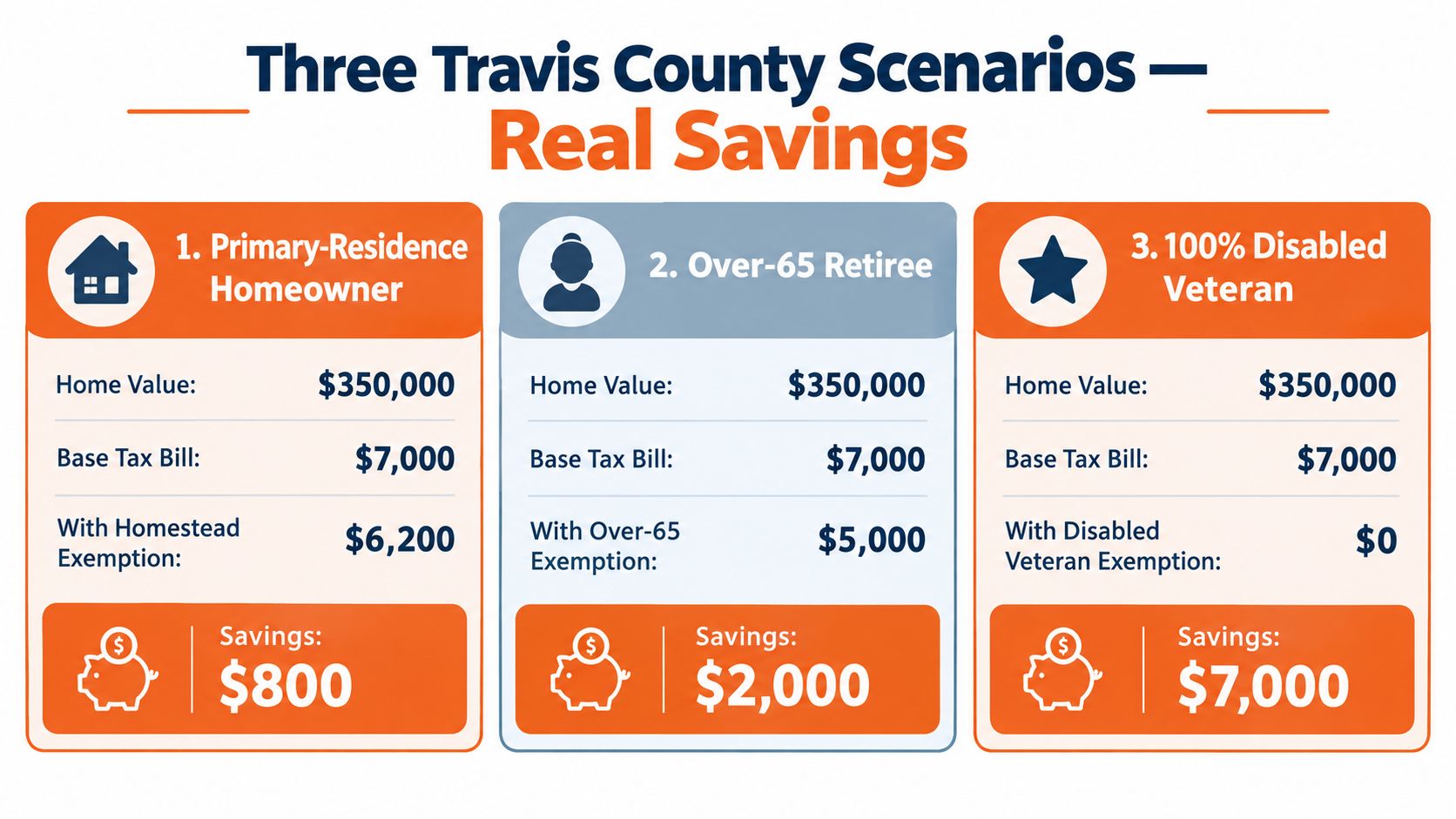
Three Austin-area households can walk into the appraisal district with the same question and leave with very different bills. These are illustrative households, not client case studies or current Travis County tax quotes. The comparison uses a hypothetical 1% school-tax rate, and the exemption amounts follow the residence-homestead figures covered earlier in this article.
Treat the following graphic as a comparison aid, not a verified bill estimate. Its sample totals can't substitute for your property's taxing units, approved exemptions, and applicable rates.
Compare under-claiming with the complete filing
| Illustrative household | Under-claimed position | Complete eligible filing |
|---|---|---|
| Primary-residence homeowner | No residence homestead exemption | General homestead benefit |
| Older homeowner | General homestead benefit only | General benefit plus qualifying age-related benefit |
| Qualifying fully disabled veteran | General homestead benefit only | Total residence-homestead exemption |
For the primary-residence homeowner, the $140,000 school-tax exemption reduction multiplied by the hypothetical 1% rate produces $1,400 in school-tax savings, before other benefits or limitations. That follows the example methodology noted earlier.
For the older homeowner, stacking the qualifying age-related exemption adds another $60,000 reduction, worth $600 at that same hypothetical rate. That's the dollar difference between stopping at the general exemption and filing everything the household qualifies for. I see this one missed constantly, because the general homestead gets filed at purchase and nobody revisits the account when the owner turns 65.
For the qualifying veteran, the comparison works differently. The total exemption removes the qualifying residence homestead's appraised value from taxation entirely, so the added savings depend on whatever taxable value remained after the incomplete filing.
City-tax savings and the total bill require the actual account. I wouldn't quote either from a statewide example.
The short walkthrough below shows how to read the school-district line on a Travis County bill before you estimate your own savings.
Deadlines, Late Filing, and the Travis County Paperwork
File a complete application, then verify the result. Choosing the right exemption won't help if the appraisal district never receives the supporting documents or the approved benefit doesn't reach the account.
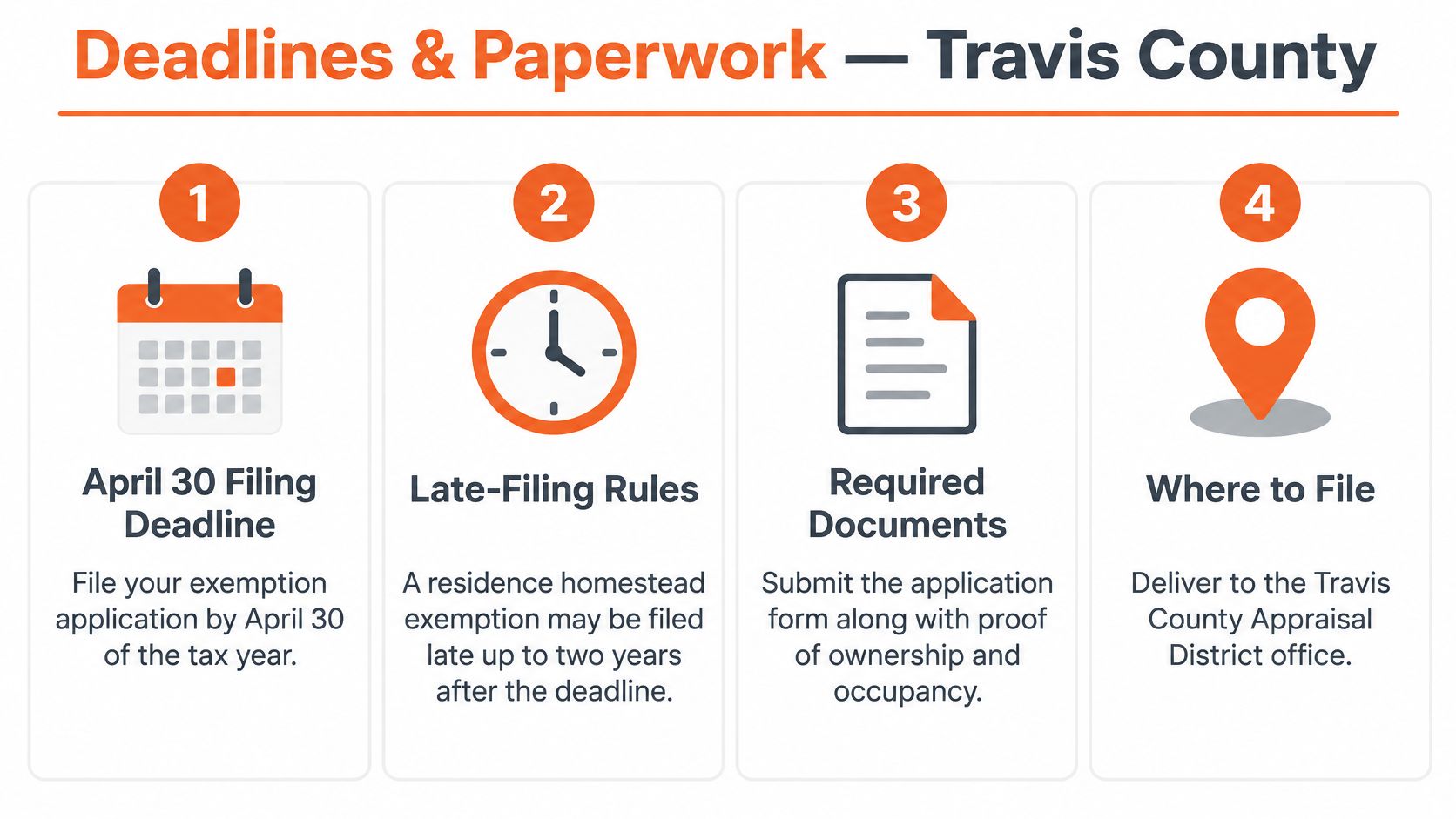
The standard application deadline is generally April 30 of the tax year, with residence-homestead applications and supporting documentation filed with the appraisal district in each county where the property is located (Comptroller exemption filing guidance).
Use this checklist to organize the submission, then confirm the deadline that applies to your specific claim.
Late filing requires a calendar, not a guess
The Comptroller describes different recovery windows: residence-homestead claims may qualify for late filing up to two years under the relevant deadline or delinquency rule; disabled-veteran applications may generally qualify up to five years after delinquency; and an age-related claim may have a window up to two years after the homeowner became 65 (Comptroller exemption and late-filing overview).
Those are separate rules, not interchangeable extensions. Record the qualification date, tax year, normal deadline, and delinquency date before deciding that a prior-year claim is lost.
Prepare the following:
- Correct application: Obtain the current residence-homestead or applicable veteran application from the appraisal district.
- Ownership and occupancy evidence: Assemble records supporting your ownership interest and principal-residence use.
- Category-specific proof: Include requested age, disability, or VA documentation.
- Submission record: Retain the completed application, attachments, delivery confirmation, and district correspondence.
Don't rely on an old form number or a generic online document checklist. Ask Travis County Appraisal District which current form and evidence your category requires.
Before closing the file: Check the approved category, effective year, property account, and resulting taxable values. Submission confirmation isn't approval.
Putting It Together and When to Call a Licensed Consultant
File yourself when the facts are straightforward. If ownership is clear, the home is your principal residence, the documentation matches, and there's no prior-year issue, professional help may add little to a routine application.
Bring in a licensed consultant when the problem is interpretation or recovery rather than form completion. I'd draw that line at overlapping eligibility, multiple properties, disputed qualification dates, surviving-spouse questions, or a late-filing window that needs careful calculation.
Use a final filing check
- Eligibility matches evidence: Each claimed category has supporting records.
- Property selection is correct: Benefits are assigned to an eligible property.
- Dates are documented: Qualification, ownership, occupancy, and filing dates are consistent.
- Local treatment is checked: Optional benefits are reviewed by taxing unit.
- Approval is verified: The property account reflects the district's decision.
For complicated claims, this explanation of why a licensed local property-tax consultant still matters can help you decide what work to delegate. Ask who reviews eligibility, who files the application, and who checks the outcome.
A recovery audit should compare earlier bills with the household's eligibility history. Its purpose is to identify a supportable missed exemption and determine whether an adjustment or refund remains available, not to assume the county owes money.
Before engaging anyone, request a written scope covering the properties, tax years, applications, recovery work, and fees. No-recovery, no-fee terms should be explicit, including what counts as a recovery and whether current-year work is priced separately.
The right answer isn't merely the exemption with the largest headline amount. It's the complete, documented set of benefits that reduces your actual bill without claiming anything your facts don't support.
INTELLI uses licensed property tax consultants and employs a data-first approach, using public and private data to identify applicable exemptions, support accurate filings, and pursue eligible retroactive savings. Visit INTELLI to request a review of your Travis County exemption history and discuss no-recovery, no-fee recovery-audit services before another filing opportunity passes.