

You've already paid the tax bill on your Texas rental, either directly or through mortgage escrow. Then a corrected appraisal arrives, you spot another payment on the county account, or the tax statement no longer matches what your lender sent. You want the excess back, not another explanation of how to deduct property taxes.
A rental property tax refund starts with identifying what went wrong. An excessive payment, an inflated appraisal, and a mistake on Schedule E require different remedies. My advice is simple: identify the legal route before you submit paperwork, and don't let an old refund review distract you from preserving this year's protest rights.
When a Rental Property Tax Refund Is Real
Suppose your mortgage servicer paid the rental's tax bill before an appraisal correction reduced the liability. The original payment may have been accurate when sent, but the corrected account now shows that you paid more than legally required. That's a potential recovery, not merely a complaint about an expensive assessment.
Under Texas Tax Code §31.11, a refund application generally must be submitted within three years after the payment date, or the taxpayer waives the refund right. The application can use the Comptroller's prescribed form or a written request containing enough information for the collector and auditor to verify the overpayment, according to the Texas Comptroller's property-tax refund guidance.
Separate excess payment from excessive value
A refund returns money paid in error or above the amount legally due. A belief that the county overvalued your rental doesn't, by itself, establish an overpayment. You still need the appropriate valuation challenge or correction to change the liability.
When a successful appeal or correction lowers liability after payment, the owner generally doesn't need a separate refund application for the resulting difference. Ask whether the corrected liability has reached the collector's account before assuming another application is necessary.
Practical rule: A lower opinion of market value isn't a refund claim. A documented difference between taxes paid and taxes legally due can be.
Rentals make reconciliation harder because the money and records may sit with different people:
- Escrow payments: Your servicer's disbursement record shows what it sent. Match that against the collector's payment history.
- Ownership changes: Keep evidence showing who owned the property and who made the payment.
- Multiple taxing units: Identify the liability and payment associated with each unit rather than treating the annual total as a single unexplained charge.
- Recurring bills: Keep each tax year separate so a correction doesn't get matched against the wrong payment.
Know what a collector's notice means
Under the Comptroller guidance cited above, an overpayment of $5 or more requires written notice and a refund application form. In a county with a population of at least 2.5 million, a single-unit refund exceeding $5,000 requires county-level approval. Those review requirements matter when setting expectations, but they don't replace evidence of the error.
For broader context, Stewart Accounting Services explains how to recover tax you have overpaid. That resource concerns the UK, so don't borrow its filing rules for a Texas claim.
Keep your local recovery file separate from your rental-property tax-filing records. They may share supporting documents, but the immediate question here is whether the county received money it wasn't legally entitled to retain.
Choosing Protest Correction or Refund
File a timely protest when your live dispute is the appraisal. Don't deliberately miss that opportunity because you expect a refund strategy to be easier later. A refund request isn't a substitute for winning the underlying valuation issue.
Texas generally sets the appraisal protest deadline at May 15 or 30 days after delivery of the appraisal notice, whichever is later. Later correction motions exist only for specified situations, as explained in the Comptroller's appraisal protest and correction guidance.
Which Texas Recovery Route Fits a Rental
| Route | Typical timing | Fits a rental when | Limit to watch |
|---|---|---|---|
| Annual appraisal protest | During the notice's protest window | You dispute the current appraisal and can present supporting evidence | Paying the bill or requesting a refund doesn't preserve protest rights |
| Correction motion | After the ordinary protest window, where legally available | The facts meet a specified correction ground | Property classification and prior protest history can restrict eligibility |
| Property-tax refund | After an erroneous or excessive payment | Payment records and legal liability establish an overpayment | A refund request doesn't independently lower an appraisal |
| Federal income-tax correction | Through the applicable federal correction procedure | Rental income, expenses, or depreciation were reported incorrectly | The county collector can't correct your income-tax return |
Choose the route based on the tax year, property classification, payment history, and prior proceedings. Don't start with whichever form looks easiest to download. A well-organized packet still fails if it asks the wrong authority for relief it can't provide.
Don't borrow homestead rules for an ordinary rental
The commonly discussed one-fourth over-appraisal threshold applies to residence homesteads, while the one-third rule applies to non-residence homesteads, under the Comptroller guidance cited above. An ordinary rental doesn't qualify for those correction provisions because its market value fell.
The same guidance flags another restriction: the appraisal roll can't be corrected through the relevant motion if the property was already subject to a protest for that tax year. Check the protest record before paying someone to prepare a correction request.
- Still inside the protest window: Preserve the valuation challenge instead of waiting for a hypothetical recovery.
- Past the deadline: Identify a specific correction ground before assuming the appraisal can be reopened.
- Liability already reduced: Focus on the collector's account and the excess payment.
- Already protested: Have the prior proceeding reviewed before choosing a later motion.
Recent legislation also changes the payment-recovery mechanics. For liabilities arising on or after September 1, 2025, SB 850 allows, but doesn't require, an application for refunds of at least $20, and requires refunds or tax-year application of erroneous or excessive payments of $20 or more under specified conditions, as described in the same Comptroller guidance.
For a Travis County landlord, keep the appraisal review board proceeding separate from the collector's payment account. The right question isn't merely whether money might be recoverable. It's which procedure remains available for this property and this year.
How to File a Texas Refund Claim
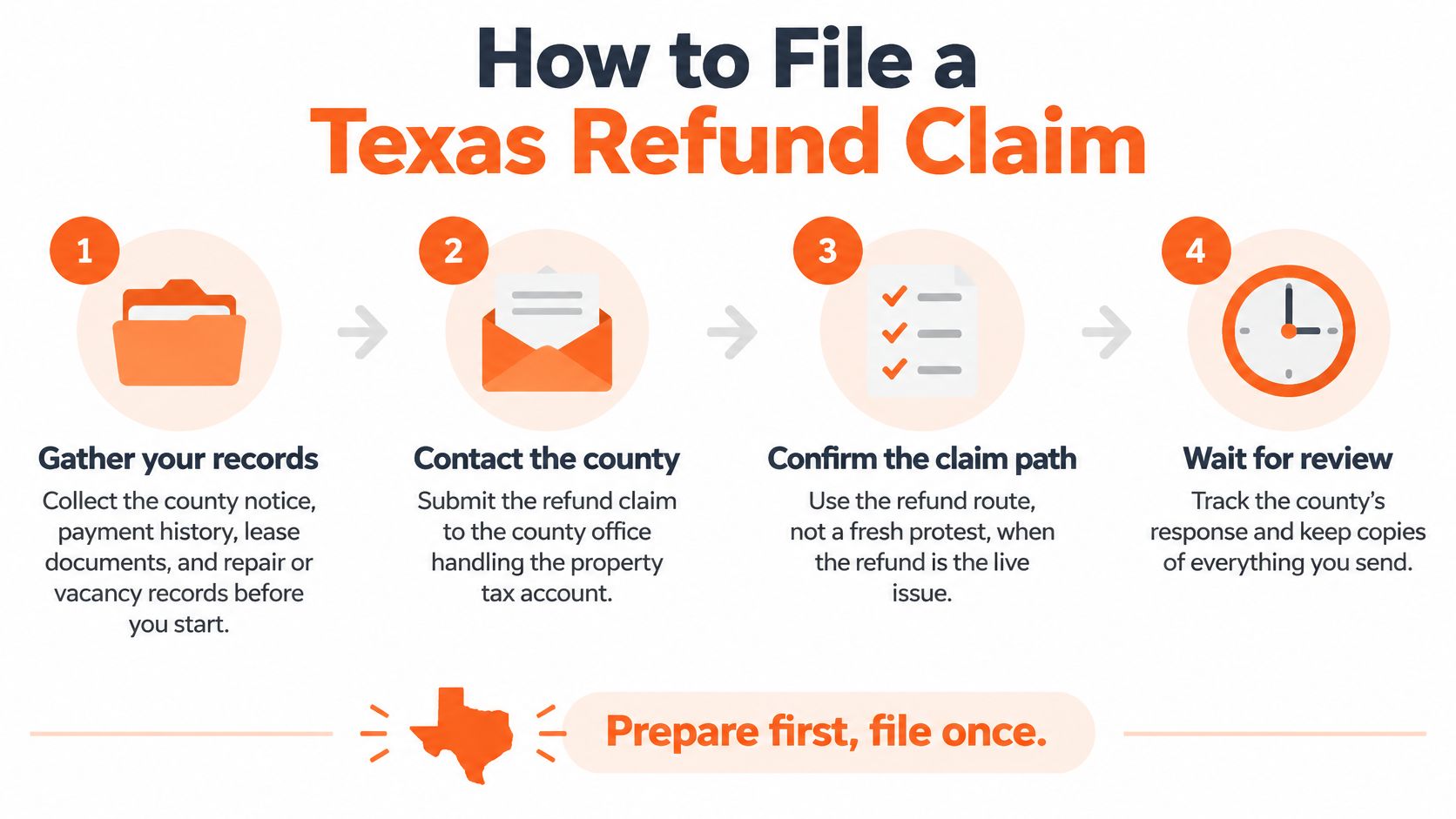
Start with the account history, not a letter saying the taxes seem too high. The collector and auditor need enough evidence to verify the overpayment. Your submission should let them trace the payment, the correct liability, and the reason for the difference without guessing.
Build a packet that proves the difference
Consider an Austin-area duplex paid through mortgage escrow, followed by an appraisal correction. This is an illustration of the paperwork, not a reported client result. The lender's escrow statement establishes the disbursement, while the county payment history establishes how the collector posted it.
The correction document establishes why the liability changed. Ownership records connect the claimant to the property, and the tax statements help reconcile the affected taxing units. Keep those documents together rather than sending a revised appraisal without evidence of payment.
- Payment evidence: Include county receipts, payment history, and relevant escrow disbursement records.
- Liability evidence: Attach the correction, appeal result, or other document supporting the legally due amount.
- Property identification: Use the account identifier and property details shown on the tax statement.
- Ownership evidence: Include documents needed to explain ownership changes or the claimant's connection to the payment.
- A reconciliation: State what was paid, what was due, and why the difference should be returned.
Lease documents, repair records, and vacancy information may help explain a valuation issue. They don't replace proof that an excessive payment occurred. Submit evidence that answers the collector's actual question.
Send the request to the right office
Use the prescribed refund form or a sufficiently detailed written request, as described earlier. For a reduction that should generate a refund without a separate application, ask the tax office to confirm receipt of the corrected liability and the recovery's status.
In Travis County, the protest generally goes to the appraisal review board by May 15 or 30 days after the appraisal district mails the notice of appraised value, whichever is later, according to the Travis Appraisal Review Board's formal hearing procedures. That deadline is distinct from the payment-based refund application window discussed earlier.
Send valuation evidence to the authority handling the appraisal issue. Send payment-recovery evidence to the office handling the tax account.
After submission, ask whether the packet is correct and complete, whether another approval is required, and whether the office needs additional ownership or payment evidence. Keep a copy of everything sent and a written record of responses.
For your broader bookkeeping workflow, Bookkeeping and Accounting of Florida Inc.’s real estate tax planning insights provide a separate planning resource. Use Texas authorities, not another state's general guidance, to determine the local claim procedure.
Refund Timing Interest and Portfolio Math
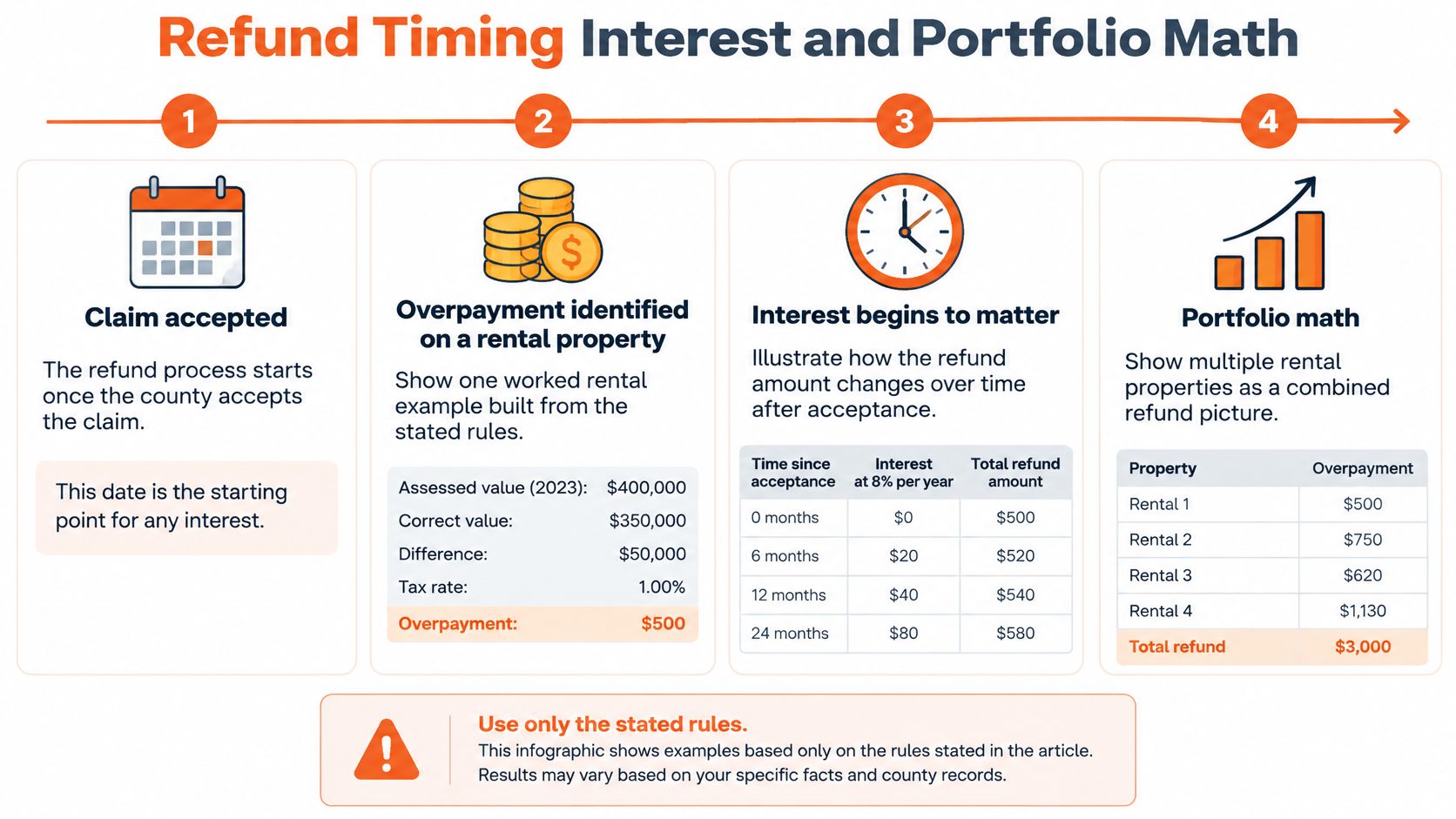
Treat an accepted claim as a receivable to track, not cash you can already spend. The collector and any required reviewing authorities must confirm the error before processing the refund from available collections or appropriated refund funds.
For a correct and complete application, Travis County says a refund is generally sent within 60 days. Its property-tax payment and refund FAQ also addresses the recovery process and related payment questions.
Work from the parcel to the portfolio
Take a rental with a verified overpayment and a complete application. Your starting calculation is tax paid minus tax legally due. Then determine whether the recovery will be issued as cash or applied elsewhere under the applicable rules.
Now suppose you also own another rental with delinquent taxes. Under specified ownership conditions, Texas law permits a taxing unit to apply an overpayment against delinquent taxes on another property rather than issue cash directly. A recovery can therefore improve your overall tax position without producing the deposit you expected.
| Portfolio entry | What to record |
|---|---|
| Paid amount | The payment actually posted to the account |
| Legally due amount | The supported liability after the applicable correction |
| Recovery form | Cash refund, permitted delinquency offset, or applicable tax credit |
| Review status | Missing documents, pending approval, or confirmed processing |
| Interest question | The legal basis and deadline governing that particular refund |
Don't stop the review at the parcel showing a credit. Reconcile the other properties held under the relevant ownership, and ask the collector to explain any proposed application of the money. Otherwise, you may mistake an offset for a missing refund.
Interest depends on the legal basis
Interest isn't a universal bonus for a slow claim. Texas materials identify 12% annual interest for refunds tied to a final binding-arbitration determination when the collector misses the applicable 60-day deadline, as addressed in the Travis County materials cited above. Don't apply that rule automatically to every duplicate-payment or correction claim.
Cash-flow check: Record the expected recovery and its form separately from your operating cash balance.
For escrow-paid properties, compare the collector's recovery record with the servicer's account activity. Don't assume the refund will appear in the same reporting period as the original tax disbursement.
Use a property-tax refund status review to organize follow-up questions, but keep the county's actual account record as your evidence. The practical objective is to know what you're owed, where it's being applied, and what remains unresolved.
Pitfalls That Sink a Landlord Refund
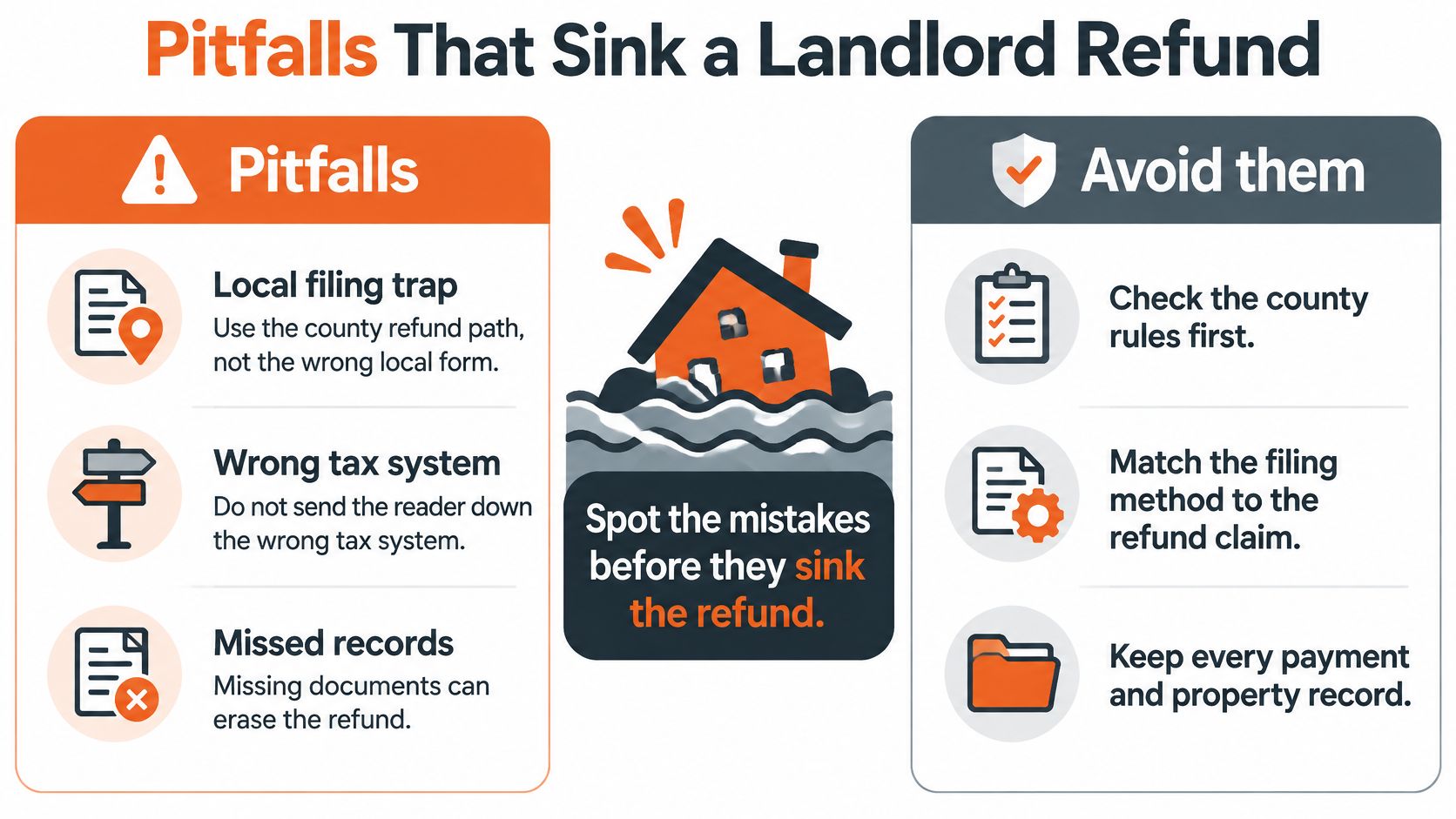
The homestead-threshold shortcut is a poor starting point for an ordinary rental. So is treating a missing Schedule E deduction as proof that the county owes you money. Those mistakes send landlords into the wrong procedure before anyone checks the records.
The local checks are straightforward: confirm the property classification, inspect prior protest history, preserve the payment-based filing window, and review other parcels before expecting cash. Don't pay for a correction motion without first establishing that the motion is legally available.
Keep the federal correction separate
A federal rental-tax refund generally comes from correcting an income-tax return, not reclaiming the underlying local payment. Use IRS Publication 527 as the technical checklist for rental income, expenses, depreciation, and reporting.
Reconstruct each affected year's Schedule E before deciding that an amended return will produce a refund. That reconstruction needs the following:
- Income and expenses: Gross rents and deductible operating expenses, supported by the books.
- Use allocation: The rental-use portion relevant to the reported amounts.
- Depreciation inputs: Basis, placed-in-service date, recovery period, and depreciation previously claimed or allowable.
- Loss treatment: Passive-activity limitations and carryovers that affect whether a correction changes current tax.
- Return context: Filing status and applicable state effects when comparing corrected and original liability.
Residential rental buildings generally use MACRS straight-line depreciation over 27.5 years, while land isn't depreciable, under Publication 527 cited above. Keep depreciation calculations separate from deductible repairs and capital improvements. Don't assume every property-related expense belongs in the same category.
Omitted depreciation isn't harmless
Basis generally must be reduced by depreciation that was allowable, even if you never claimed it. That can increase taxable gain and create depreciation-recapture exposure when you sell. Leaving the deduction off a return doesn't necessarily preserve your basis.
For an incorrect depreciation amount, Form 1040-X may be available, while some accounting-method corrections require a different procedure, as explained in Publication 527. Have the preparer identify the proper correction method before submitting an amended return.
For day-to-day organization, ThriveXDNA's practical steps for rental property management offer a broader management resource. Keep the tax evidence specific: payment receipts for county recovery, and income, expense, and depreciation records for federal corrections.
The decision rule is clear. County payment error, county recovery process. Federal reporting error, federal correction process. A landlord can have both problems, but resolving one doesn't automatically resolve the other.
When to Use a No-Fee Recovery Audit
Handle an obvious duplicate payment yourself if the account history is clear and you can document the claim. There's little value in making a simple reconciliation more complicated than necessary. The hiring decision changes when ownership records, escrow disbursements, appraisal corrections, and past bills no longer line up cleanly.
A portfolio review is different from asking whether a rental's current market value looks high. Someone needs to connect historical payments to the property's legal status, appraisal records, exemptions, and available recovery procedures. That's evidence work, not a generic estimate of possible savings.

Match the help to the record problem
INTELLI uses licensed property tax consultants and employs a data-first approach using public and private data. Its stated recovery-audit process reviews prior payments for clerical errors, inaccurate property details, and missed exemptions, while its valuation analysis compares appraisal records with relevant market evidence, according to its property-tax consultant service description.
Compare that option with your own capacity. If you can identify the payment error, establish the correct liability, and follow the collector's requests, a direct filing may be sensible. If the records require reconstruction across properties and ownership changes, outside review deserves consideration.
- Choose direct filing when the overpayment is apparent and the supporting documents are readily available.
- Consider a recovery audit when historical records conflict or you can't identify which procedure fits.
- Use federal tax help separately when the potential recovery depends on Schedule E, depreciation, or an accounting-method correction.
- Read the engagement terms before hiring, including what counts as recovery and how offsets or credits affect compensation.
A no-recovery, no-fee property-tax audit can align the engagement with an actual reduction rather than a speculative estimate. Confirm the written terms, including the fee trigger, rather than relying on the label alone.
Keep current-year work on the calendar
The firm also handles current-year valuation protests and exemption work, including homestead, over-65, disabled person, disabled veteran, agricultural, and historic designations. Those are eligibility-specific services, not a promise that a rental qualifies for an owner-occupant exemption.
Don't let historical recovery work replace current-year planning. Ask whoever reviews the old bills to identify any live protest issue separately, so you can decide what to pursue without confusing the procedures.
This week, gather the historical tax statements and proof of payment for every rental, organized by payment date. Flag ownership changes and any year already protested, then either submit the supported request or arrange a recovery review before the oldest eligible payment falls outside the filing window.
INTELLI offers property-tax recovery audits to identify documented past overpayments, alongside current-year valuation and exemption services. Pull three years of tax statements and payment records for each rental, note prior protests, and visit INTELLI to start a review before the payment-based refund deadline expires.