

A real estate tax bill is your property's taxable value multiplied by the combined rates of every local taxing unit that levies on it. That's why the total can rise even when a rate falls, because a higher taxable value or a lost exemption can more than offset a lower rate.
You might be holding that bill right now, wondering how the number got so big when you didn't add a room, buy anything new, or vote for a tax increase. You're not missing a simple explanation. The statement packs several decisions by different governments into one total, and it doesn't clearly separate appraised value, taxable value, and the amount owed. Once you pull those pieces apart, the bill gets much easier to check, pay, and, when the value is wrong, challenge.
What a Real Estate Tax Bill Really Is
You open the annual statement expecting one charge from one government. Instead, you see a long list of units, several different values for the same house, and a total that doesn't seem to match any single rate you read about in the news. That confusion is normal, and it starts with a common misunderstanding. Your real estate tax bill isn't a price tag on your home, and it isn't the same thing as your appraised value.
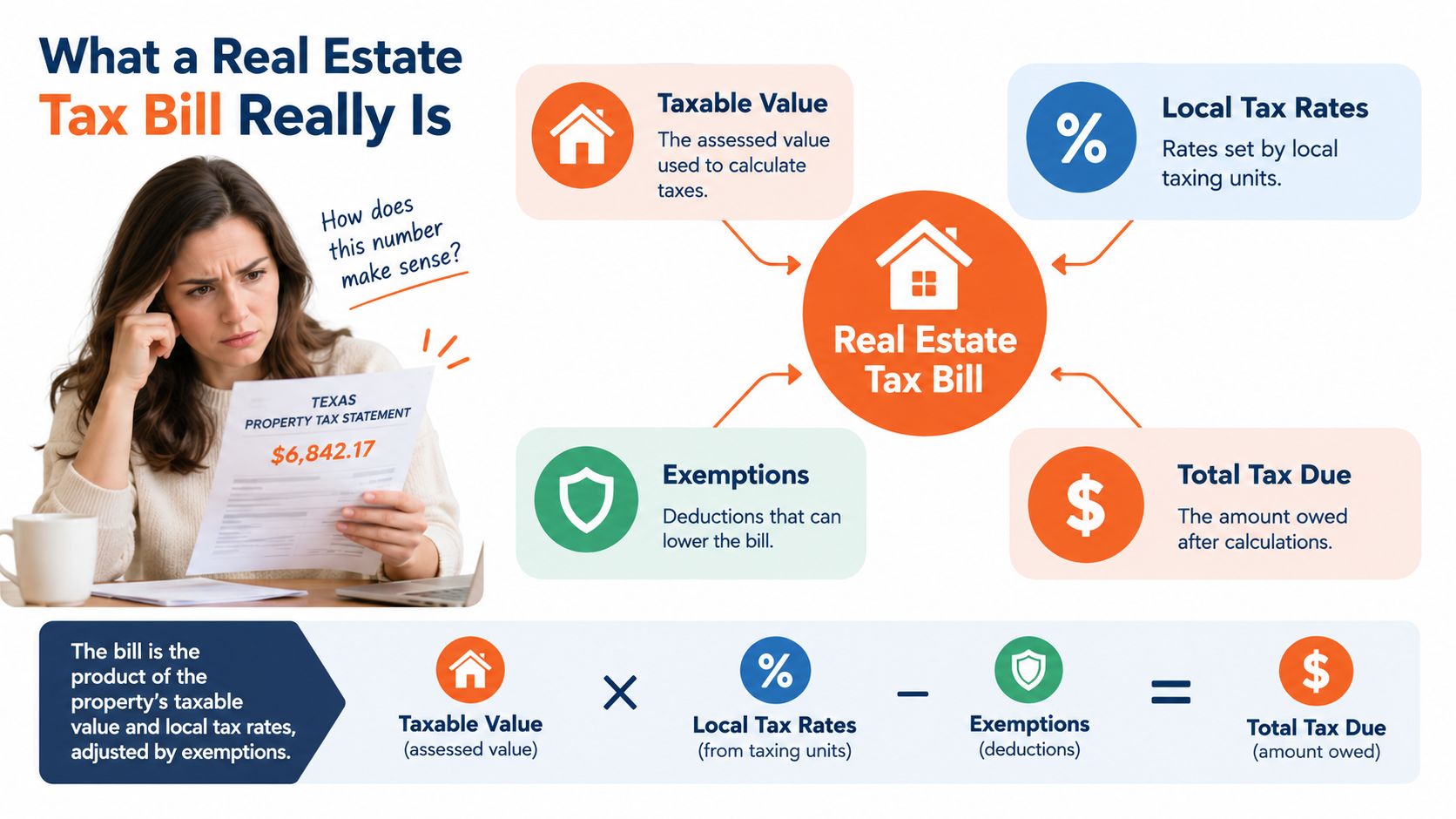
The bill is the result of a calculation. A real estate tax bill is the product of a property's taxable value and the combined rates imposed by multiple local taxing units, such as counties, cities, school districts, and special districts. Each unit levies on the same parcel, so one property can produce several lines on one statement.
Two Decisions Behind One Total
Think of the bill as two separate decisions meeting on paper. First, the appraisal district decides what your property is worth and what portion of that value is taxable after exemptions and limitations. Second, each taxing unit decides its rate. If either side changes, your total changes.
That's why a headline about a lower rate doesn't guarantee a lower bill. An increase in assessed value, the expiration of an exemption, or a change in taxable value can offset a lower rate. You have to check both sides, not just the rate.
Practical rule: Never judge a bill by the rate alone. Check the taxable value first, then check every rate applied to it.
What the Lines on Your Statement Mean
- Market value: The appraisal district's estimate of what the property would sell for
- Appraised value: The value used after any legal limit, such as a homestead cap, is applied
- Exemptions: Amounts subtracted for qualifying owners, which lower taxable value
- Taxable value: The amount that remains for a specific taxing unit after exemptions
- Tax rate: The rate adopted by that unit, applied to its taxable value
- Total tax due: The sum of the separate charges from all units
In Texas, appraisal districts report market values, taxable values, and tax rates to the state Comptroller through the Electronic Appraisal Roll Submission system. The Comptroller publishes annual rate and levy information, but reported levies don't represent actual tax collections. That distinction matters because a levy is a calculated charge across a jurisdiction, not proof of what was ultimately collected from owners.
Texas also uses ratio studies to measure how closely assessed values correspond to market values and whether appraisals are uniform across property categories. In the 2024 statewide ratio study, the overall median assessment ratio was 1.00, meaning the reported appraisal level was approximately 100% of the relevant market value benchmark, as described in the Comptroller publication linked above. A statewide median doesn't prove your individual appraisal is correct. It tells you the system aims at market value, and your job is to check whether your property was treated accurately within it.
How Assessed Value Tax Rates and Exemptions Set Your Bill
Start with three levers. Value sets the base, exemptions shrink that base for qualifying owners, and rates turn what remains into dollars owed. If you mix up the first two levers, the third one will never make sense.
Market value is the appraisal district's opinion of value. Appraised value may be lower than market value when a legal limitation applies. Taxable value goes one step further. It's appraised value minus exemptions that apply for a particular taxing unit, and it's the number multiplied by the rate.
The Homestead Cap Most Owners Misread
Many Texas homeowners believe the homestead cap means their home's value can't rise by more than a set amount. That's not how it works. Under Texas Tax Code Chapter 23 and the residence homestead limitation, a qualifying homestead's annual appraised value increase is generally limited to the lesser of current market value or prior year appraised value plus 10% of that prior value and the market value of new improvements. The district must maintain both market value and the capped appraised value.
Read that carefully, because two surprises hide inside it. First, market value itself isn't capped, so it can jump sharply on your notice even while the capped value moves more slowly. Second, remodeling, additions, or other qualifying improvements can raise the capped value above the ordinary 10% growth limit, because new improvement value is added separately under the same Texas statute linked above.
Timing trips people up too. The cap applies only after the property qualifies for the homestead exemption and takes effect on January 1 of the following tax year, and the limitation ends when neither the owner nor a qualifying spouse or surviving spouse continues to qualify, according to that statute. If you bought recently, don't assume the seller's capped value automatically protects you in the same way or on the same schedule.
Which Lever Can You Actually Move
- Value: Contestable through a protest with evidence about market value or unequal appraisal
- Exemptions: Fixable by filing a correct application and proving you qualify
- Rates: Set by elected bodies through their adoption process, not changed by your individual protest
A protest argues value. It doesn't rewrite a tax rate that a city, county, or school district has already adopted.
Run a three question self check on any bill. Is the homestead exemption active, and does the statement show both market and capped values. Did new improvements add value on top of ordinary growth. Does each taxing unit use the taxable value that follows from its own exemptions. If any answer looks wrong, you've found the specific place to investigate instead of arguing with the total at the bottom.
Reading a Sample Tax Bill Line by Line
Put the formula on a real statement and it stops feeling abstract. Picture an Austin area homestead in Travis County. The owner opens the bill and sees a market value at the top, a lower capped appraised value beneath it, and then a column of taxing units that don't all tax the same amount. That last part confuses almost everyone the first time.
It isn't an error by itself. Different units can apply different exemptions, so the same home can carry a different taxable value for the school district than it carries for the county or city. For the 2025 tax framework described by the Texas Comptroller, the general homestead exemption available to all homeowners is $140,000 for school taxes, as explained in the Comptroller homestead exemptions information packet. That subtraction happens before the school rate applies, not as a discount after the tax is calculated.
A Line by Line Walk Through
Start at the top and don't skip to the total. Confirm the owner name, property address, and legal description match your deed records. Then compare market value with capped appraised value. If they're identical on a long held homestead during a fast rising market, ask whether the cap is being shown correctly.
Next, find the exemption lines. A missing homestead line means you're being taxed on more value than the law requires for a qualifying principal residence. After that, read each unit's taxable value separately. Don't carry the school taxable value across the whole bill in your head.
Sample Travis County Tax Bill Breakdown
| Taxing Unit | Example Rate per $100 Value | Taxable Value Applied | Annual Tax |
|---|---|---|---|
| School district | That district's adopted rate | Capped value minus school exemptions | Taxable value multiplied by the school rate |
| County | The county's adopted rate | Capped value minus county exemptions | Taxable value multiplied by the county rate |
| City | The city's adopted rate, if you live inside city limits | Capped value minus city exemptions | Taxable value multiplied by the city rate |
| Special district | That district's adopted rate, if your parcel is included | Capped value minus any district exemption | Taxable value multiplied by that district rate |
Add the annual tax from every row and you get the total bill. There's no single combined rate printed by one government. The total is built unit by unit.
Where Escrow Fits In
If you have a mortgage, your servicer usually divides the expected annual total into monthly escrow deposits and pays the bill for you. That convenience hides problems. You might not notice a missing exemption until your monthly payment rises, and by then the protest deadline for that year may have passed.
Check your escrow statement against the actual bill. If the servicer collected too little, you'll face a shortage. If it collected based on a value you later reduce, ask how the surplus will be handled.
The two errors worth hunting first are simple. Look for a missing exemption line, and look for a taxable value that follows market value when a capped appraised value should have limited it. Those two checks catch problems that no amount of rate watching will reveal.
Texas Billing Deadlines Penalties and Payment Options
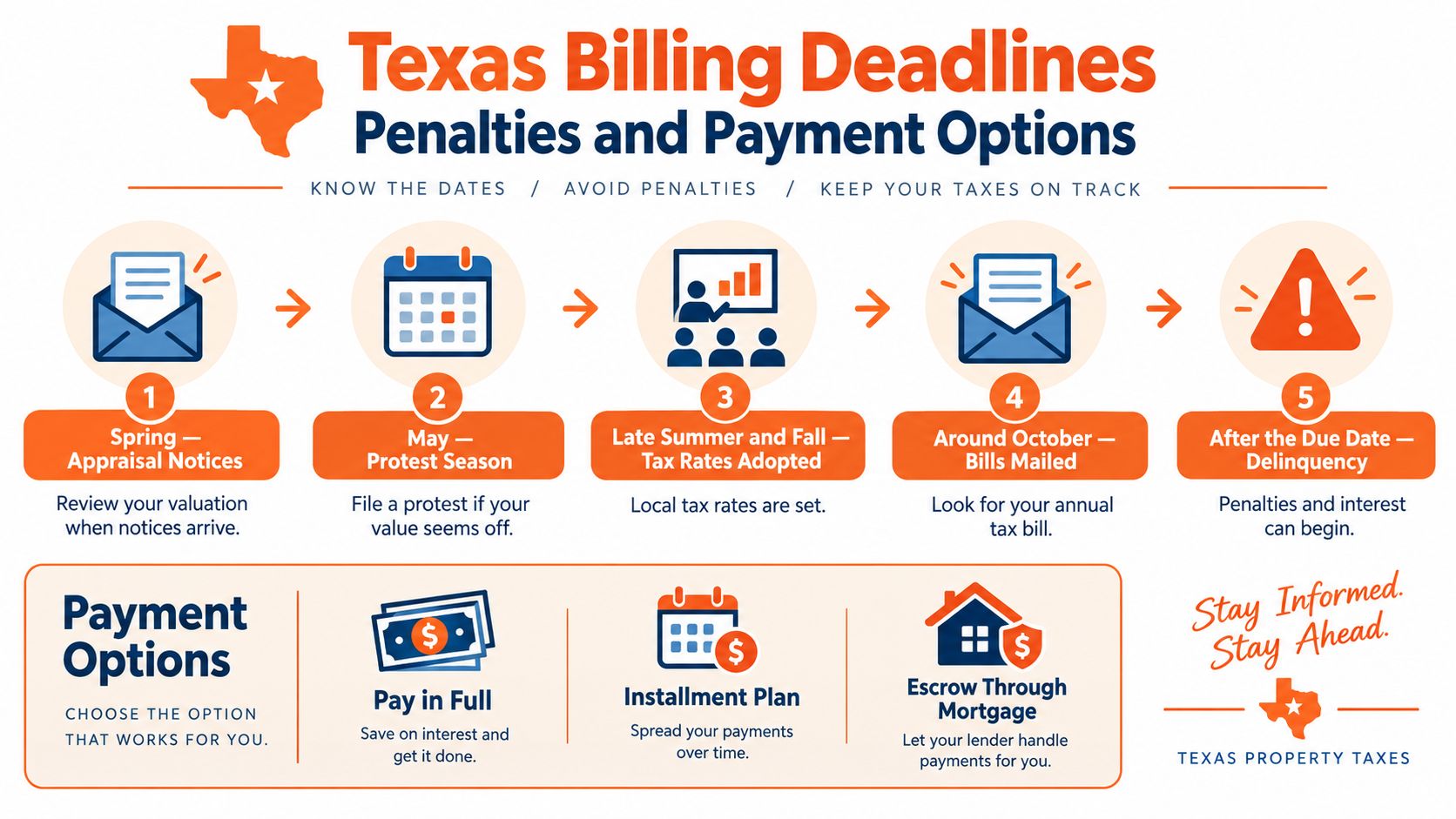
The Texas tax year runs on a calendar, and missing one date can cost you rights you can't get back that year. Appraisal notices arrive in spring. Protest season follows in May. Taxing units adopt rates in late summer and fall, bills are mailed around October, and delinquency begins after the due date at the start of February, when penalties and interest can begin.
The visual below maps that sequence so you can plan cash flow instead of reacting to a due date.
For a fuller date by date reference, keep the Texas property tax deadline guide beside your appraisal notice and your bill, because the protest deadline and the payment deadline serve different purposes and arrive months apart.
Installments for Seniors and Disabled Owners
Qualifying owners age 65 or older, disabled owners, and certain disabled veteran homestead owners may pay in four equal installments without penalty and interest, but they must provide written notice of intent with the first payment and meet a schedule that generally runs from before February 1 through before August 1, as explained on the Comptroller page on property tax payment options. Qualification alone doesn't enroll you. The written notice is part of the right.
Missing an installment can trigger a 6% penalty plus 1% monthly interest, and installment agreements generally cannot be initiated after the first day of the month following delinquency, according to that same Comptroller payment options guidance. If your mortgage servicer escrows taxes, talk to the servicer before choosing installments. You don't want the servicer paying in full while you're also trying to follow an installment schedule, or worse, each side assuming the other paid.
A Protest Doesn't Pause the Bill
This rule catches owners off guard. Challenging your assessment doesn't automatically suspend collection. The Texas Comptroller guidance on paying property taxes says taxpayers generally must pay the undisputed portion by the delinquency date when pursuing further appeals, and there's no legal right to withhold or escrow taxes merely to protest government spending. Taxpayers may instead make a payment under protest.
In plain terms, separate the amount you accept from the amount you dispute, pay what the rules require, and carefully document a payment under protest if you use that route. Refusing to pay because you've filed an appeal can create penalties while your value dispute is still pending.
This short video helps connect the billing calendar with the choices you make during protest season.
How to Protest Your Assessment in Travis County
A protest isn't a complaint that your bill feels high. It's an evidence process with a deadline, and the appraisal district responds to documentation about value, not to frustration about the total. Approach it like you're proving a number.
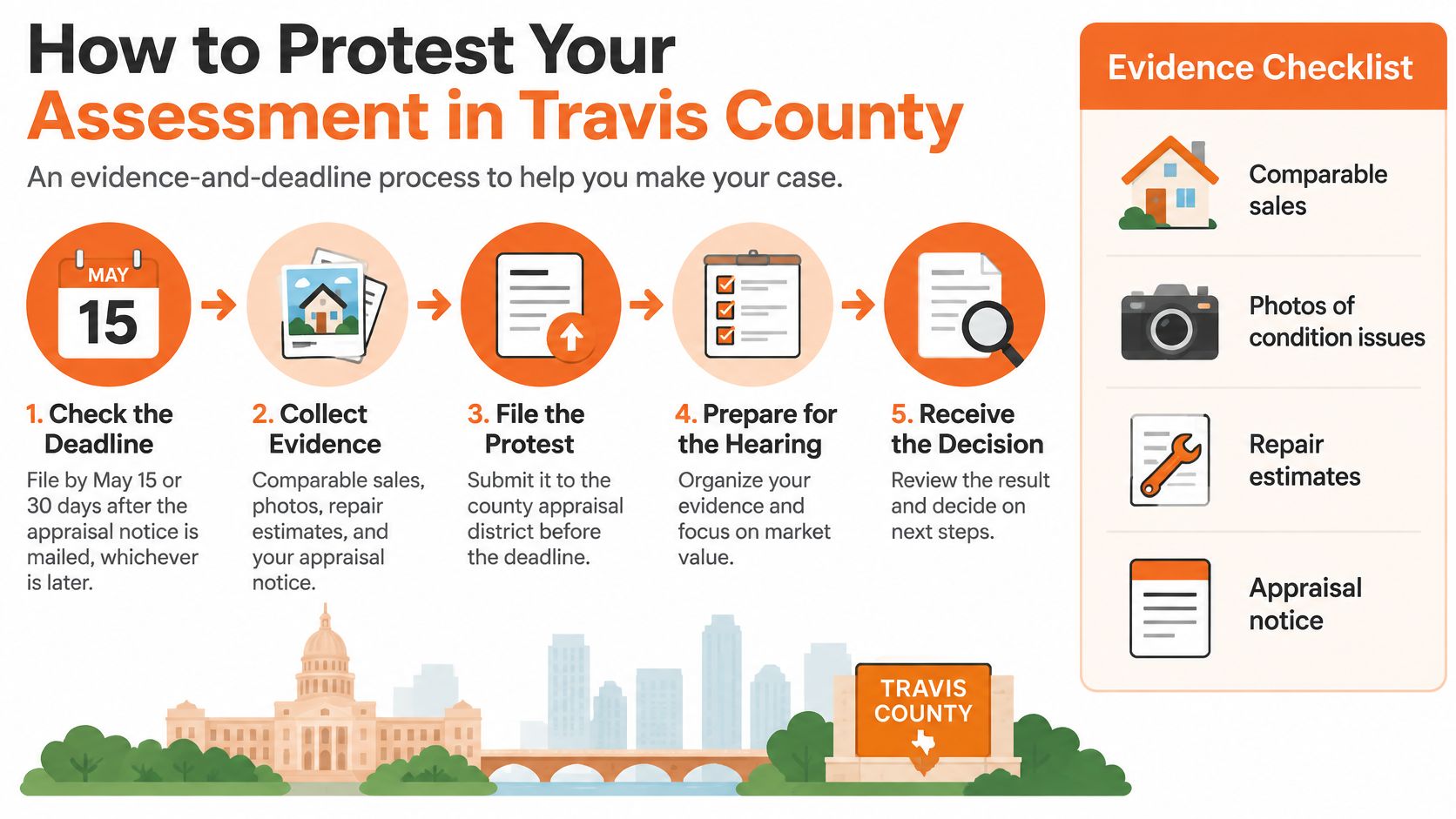
In Travis County, the filing deadline is May 15 or 30 days after the appraisal notice is mailed, whichever is later, as stated in the Travis Central Appraisal District online protest guidance. Preserve proof that you filed on time. A strong case filed late can lose before anyone looks at your evidence.
Evidence That Actually Addresses Value
- Comparable sales: Similar properties that sold under conditions you can explain and adjust
- Condition photographs: Images that document defects, deferred maintenance, or functional problems
- Repair estimates: Written figures that connect condition issues to market value
- Purchase information: Closing material and other documents that bear on what the property was worth
Submit evidence before an informal meeting so it can be processed and available to the appraiser, following the Travis Central Appraisal District guidance linked above. Walking in with unfiled papers wastes the one meeting where a quick correction is most likely. Reconcile your requested value to a specific valuation date and explain adjustments between your comparables and your property. A list of lower priced houses without adjustments for size, condition, or location rarely persuades anyone.
For county specific filing steps, use the Travis County appraisal protest guide while you assemble your packet, and keep your requested value consistent across every form and page.
The Formal Hearing and Burden of Proof
At a formal Appraisal Review Board hearing, present your supporting information in an organized sequence and bring five evidence sets, as instructed in that appraisal district guidance. Assume panel members haven't studied your property before you sit down. Lead with the value you're requesting, then show the evidence that supports it.
When the protested property has a market or appraised value of $1 million or less and the owner submits a properly conducted, recently completed, certified appraisal by a licensed appraiser at least 14 days before the hearing, the appraisal district bears the burden of establishing value.
That burden shift, described in the appraisal district guidance above, is a real procedural advantage for qualifying cases, but only if the appraisal is timely and properly done. Don't order an appraisal at the last minute and assume it qualifies.
A reduction in appraised value can lower your bill across participating taxing units. Your final dollar savings still depend on each unit's adopted rate and your exemptions, so don't promise yourself a specific refund until rates are set and the corrected taxable values are applied.
Exemptions and Missed Savings Worth Checking
Exemptions are recoverable money hiding in paperwork. They don't lower a tax rate. They reduce the value a rate is applied to, which is why a missing exemption inflates every affected line on your bill.
Texas property tax exemption applications generally must be filed with the appraisal district in the county where the property is located before May 1, and a qualifying residence homestead must be owned by the applicant and used as the applicant's principal residence, as outlined on the Texas Comptroller property tax exemptions page. Filing in the wrong county or claiming a second home as your principal residence creates problems, so get those basics right first.
The Core Exemptions to Verify
Texas school districts must provide an additional $60,000 residence homestead exemption to homeowners who are at least 65 or disabled, while local taxing units may adopt an additional homestead exemption of at least $3,000, according to the Comptroller exemptions page linked above. Local option amounts vary by unit, so don't assume the school figure applies everywhere.
- General homestead: For a qualifying principal residence, with the school amount covered earlier in this article
- Age 65 or disabled: An additional school exemption, plus possible local options
- Local option: An additional exemption a taxing unit chooses to adopt under state rules
- Disabled veteran: Tiered by disability rating, up to a total homestead exemption for qualifying 100% disability compensation
For disabled veterans, the Comptroller disabled veteran exemption guidance lists exemptions of up to $5,000 for ratings from 10% to 29%, $7,500 for 30% to 49%, $10,000 for 50% to 69%, and $12,000 for 70% to 100%. A veteran who is 65 or older with at least a 10% disability rating, totally blind, or has lost use of one or more limbs may also qualify for a $12,000 exemption under that guidance. Separately, a veteran receiving 100% disability compensation for a service connected disability, or classified as individually unemployable by the U.S. Department of Veterans Affairs, may qualify for an exemption of the total appraised value of the residence homestead.
To compare categories side by side, review the guide to property tax exemptions in Texas and then confirm your status directly with your county appraisal district.
Timing Rules That Recover Missed Years
The age 65 exemption becomes effective January 1 of the tax year in which the homeowner reaches age 65, and a homeowner who becomes disabled during the year can qualify as though eligible on January 1, as explained in the Comptroller guide to property tax relief for disabled veterans and other qualifying owners. Eligible homeowners generally don't need to reapply for a residence homestead exemption unless the chief appraiser requests a new application.
The normal exemption deadline is April 30, but disabled veterans and certain surviving spouses or children applying under Tax Code Section 11.22 may file up to five years after the delinquency date for the property's taxes, according to that Comptroller guide. That retroactive window is why an exemption audit matters. A missed filing might not be a permanently lost benefit, and it may support a prior year refund investigation.
How INTELLI Can Help Lower Your Real Estate Tax Bill
You can file a protest on your own, and some owners should. If your appraisal notice contains an obvious factual error, such as wrong square footage or a missing exemption, a direct correction may be straightforward. If you have clean comparable sales and time to prepare, attend meetings, and track deadlines, a do it yourself protest can work.
Most disputed values aren't that clean. The hard part is judgment. Which sales are comparable, how much to adjust for condition, and how a particular appraisal district tends to treat certain evidence are decisions that affect whether a requested value looks credible. Investors and commercial owners face the same problem at larger scale, across multiple parcels and deadlines.
What Professional Help Adds
INTELLI uses licensed property tax consultants and employs a data first approach, using public and private data to identify applicable exemptions, support filings, and test whether exemptions were correctly applied across relevant taxing units. Public appraisal and tax records show what the district has on file. Private client data can add purchase documents, condition evidence, leases, or operating details that public records don't capture.
That work covers more than one hearing. A bill level review can include valuation protests, exemption application management, and tax recovery audits that look for past overcharges, incorrect property details, or missed exemptions. Representation is offered on a no recovery, no fee basis for recovery work, with client communication handled through a secure portal.
Professional help earns its value when the dispute turns on evidence selection, not when the error is a single mistyped fact you can correct with one document.
Weigh the trade off. Doing it yourself costs time and leaves deadline risk with you. Hiring representation costs a fee when the model provides for one, and you should understand exactly when that fee is triggered before you sign. Ask who will handle your case, what data they'll use, how they'll communicate, and whether exemption and prior year recovery reviews are included or separate.
Start this week with a simple sequence. Pull your current bill and appraisal notice. Confirm every exemption line you qualify for is present, compare market value with capped appraised value, and identify any improvement value added to the cap. Then note your next protest and payment deadlines on a calendar you check. If the value still looks unsupported after that review, request a savings review before the filing window closes, because even a well documented case can't help you after the deadline passes.
Lowering a real estate tax bill starts with separating value, exemptions, and rates, then acting before protest, exemption, and payment deadlines close. INTELLI uses licensed property tax consultants and a data first approach with public and private data to review valuations, manage exemption filings, represent owners in protests, and audit past bills for recoverable overcharges. Visit INTELLI to request a review of your current bill and check whether your taxable value, exemptions, and prior year charges deserve a second look.