

Texas has no single statewide property tax rate, because your bill is built from combined local rates set for your exact parcel. A statewide benchmark puts the effective rate near 1.40% of owner-occupied home value, but that average won't predict what you'll pay at a specific address.
That surprises many people who search for what is property tax rate in Texas and expect one clean number. Texas doesn't work that way. Two homes worth the same amount can owe very different bills if they sit in different cities, school districts, or special districts, or if one owner claims an exemption the other doesn't have. The right question isn't "What's the Texas rate?" It's "Which taxing units cover my parcel, what's my taxable value, and what rates do those units charge?"
Why Texas Has No Single Property Tax Rate
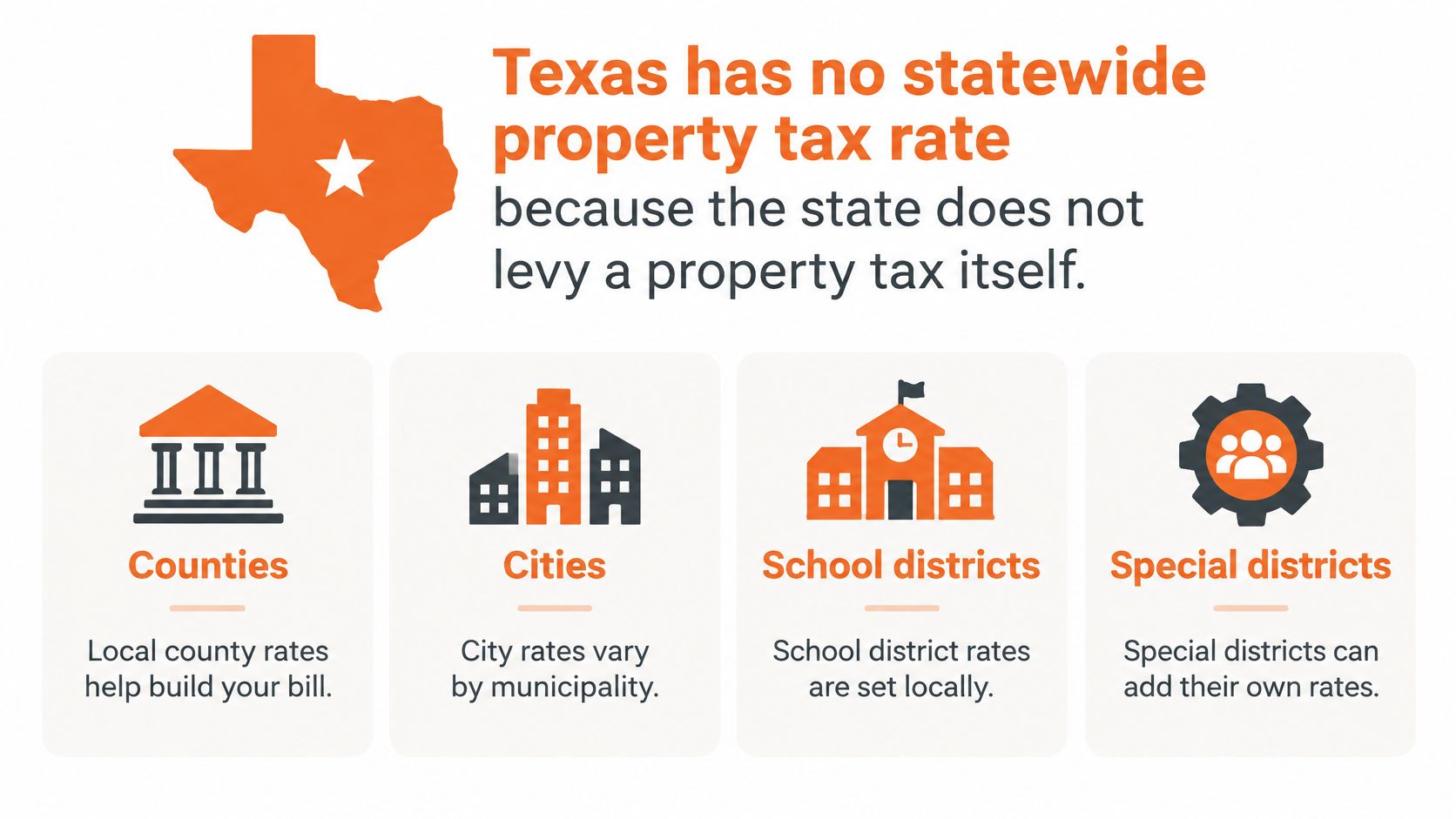
A Texas property tax rate is a parcel-specific sum. The state does not set one levy for every home; each county, city, school district, and special district that covers an address adopts a rate, and the combined rate is what reaches the bill.
Two rates readers often confuse
Start with the nominal combined rate: add the rates from every taxing unit with jurisdiction over the parcel. If those units total 2%, that 2% is the nominal rate.
The effective rate answers a different question: what share of the home's market value became tax? Divide the annual bill by market value. Exemptions and appraisal limits can reduce taxable value, so the effective rate can land below the nominal rate even when the nominal rate stays fixed.
What the statewide benchmark can and can't tell you
The Texas Comptroller's ratio study places the statewide effective rate near 1.40% of owner-occupied home value. On a $300,000 home, that implies about $4,200 a year before parcel-specific exemptions or adjustments.
Treat 1.40% as a classroom example and a rough order of magnitude. County outcomes can run well below or above a statewide average, and two equal-value homes can diverge once city, school, and special-district lines are drawn differently. A valid answer needs the exact address, the list of units touching it, the taxable value after exemptions, and each unit's rate.
Name the exact address first, then list every taxing unit that touches it. That is the only way to get a valid rate.
For context on why local funding pressures push some bills higher, Texas tax policy insights from Unitism explains the forces behind local rate choices. The parcel result still comes down to the same four inputs: units, value, exemptions, and rates.
The Taxing Units That Set Your Combined Rate
Your home usually sits inside several taxing units at once. You're in a county, often in a city, almost always in a school district, and sometimes in a community college district or one or more special districts. Each one can add its own rate to your bill.
Texas property tax is an ad valorem system, meaning it's based on value, administered by more than 4,796 local taxing units, according to the Texas Comptroller's property tax exemption guidance. Each unit adopts its own rate to fund local services, so your total rate is the sum of all units with jurisdiction over your property.
| Taxing unit | Typical services funded | Sets its own rate |
|---|---|---|
| Counties | Roads, courts, jails, county health services | Yes |
| Cities | Police, fire, streets, parks, utilities | Yes |
| School districts | Public schools and school bonds | Yes, within state limits |
| Community colleges | Higher education | Yes, where a district covers the property |
| Special districts | Water, hospitals, emergency services, utility districts | Yes, where they exist |
One value, several rates
The county appraisal district generally provides one appraised value that all your taxing units share. The county doesn't use one value while the school district invents another. Differences in your final bill come from the rates, exemptions, deductions, and special appraisals that apply to each part.
Say two homes have identical appraised values but sit in different school districts. Even if their county and city rates match, a different school rate changes the combined total, so the bills differ. Move one home outside city limits, and the city rate may drop off entirely.
That's why asking for "the Texas property tax rate" without naming the county, city, school district, and special districts can't produce a technically valid answer. Check the official component list through your county tax office or the Comptroller's rate data, and review how truth in taxation notices explain proposed local rates before rates are adopted.
Calculating Your Parcel's Bill Step by Step
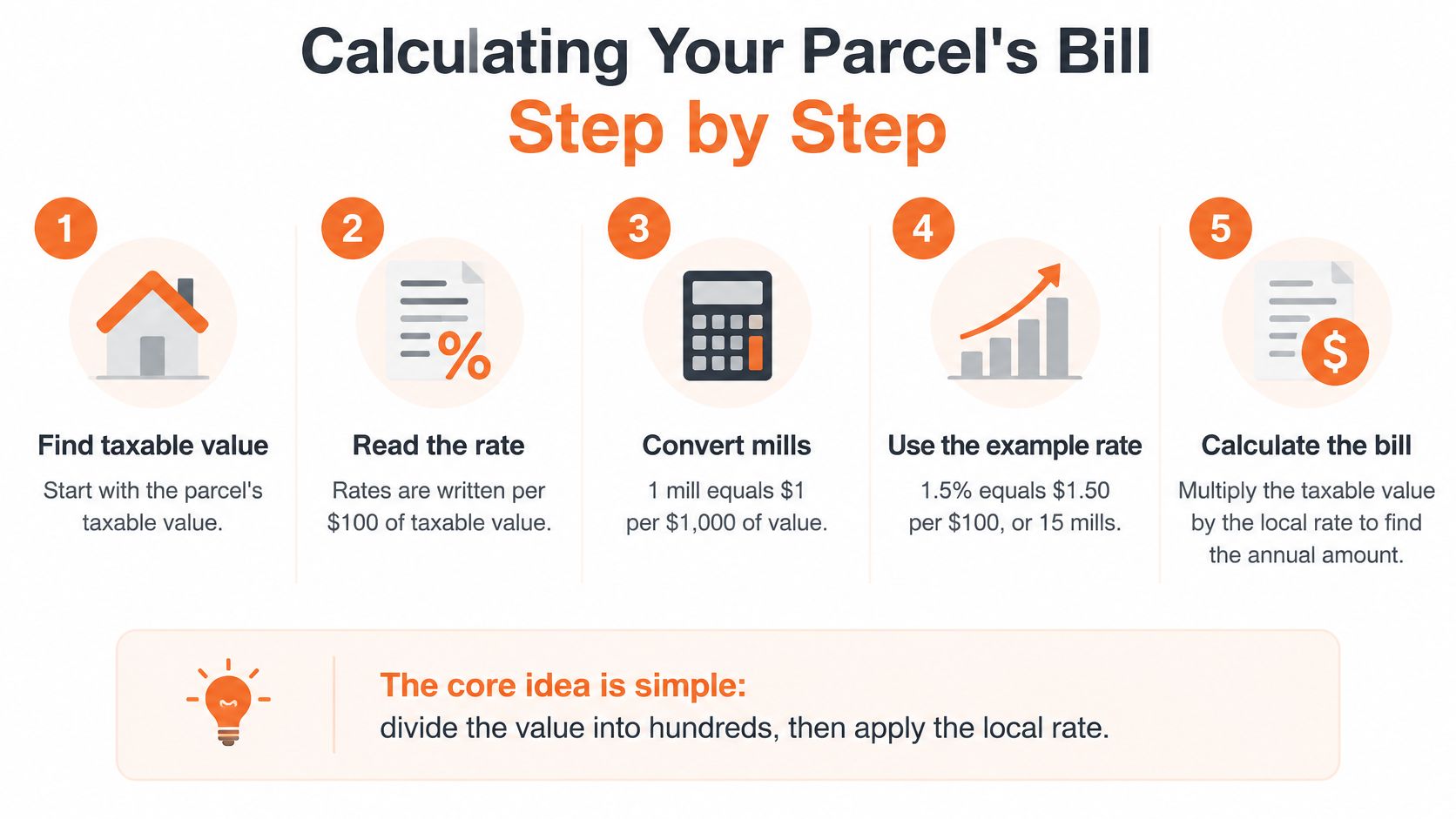
The working formula is short: tax due equals taxable value divided by 100, multiplied by the combined local rate written in dollars per $100. The same math works if you convert that rate to a decimal first. A $1.40 per $100 rate becomes 0.014, and either path reaches the same result.
Errors usually enter before the multiplication. A parcel can use the district's appraised value, a different taxable value after exemptions, and a combined rate built only from the units that cover that exact address.
How rates are written
Texas rates are commonly written per $100 of taxable value. A rate of $1.50 per $100 is the same as 1.5%. You will also see mills in some discussions. One mill is $1 per $1,000 of value, so 1.5% equals 15 mills.
To convert a per $100 rate into a decimal, divide by 100. A $1.50 rate becomes 0.015, which you can multiply directly by taxable value. To stay in per $100 form, divide value by 100 first, then multiply by the rate.
The five steps
- Find the appraised value and parcel ID: Use your appraisal notice rather than a listing-site estimate or a price you think the home could command. The common slip is starting with market value when the tax applies to the district's appraised and taxable values.
- Subtract exemptions to reach taxable value: Apply the residence homestead exemption and any other approved exemptions. Keep each exemption attached to the unit that grants it, because a school-only exemption does not automatically reduce county, city, or special district value.
- Find each unit's rate for your parcel: Pull the rates from the county appraisal district, county tax office, or the Comptroller's published rate information for the units tied to that parcel ID. A statewide summary can explain the system, but the applicable rate depends on the property's location and can change when a special district covers one street and not the next.
- Add the unit rates: Add county, city, school, college, and special district rates into one combined rate for a quick estimate. Calculate each unit separately when exemptions differ, because one unit may tax a lower value than another.
- Multiply taxable value by the rate: For the benchmark example, $300,000 divided by 100 gives 3,000, and 3,000 multiplied by $1.40 equals $4,200. The same result comes from $300,000 multiplied by 1.40%. Use that round-number case to check your method, then replace it with your parcel's value, exemptions, and units.
The video below walks through the same multiplication in a visual format if you want to check your arithmetic a second way.
Verify your result
Compare your estimate with the total on your actual bill and with last year's tax. A large gap usually points to a missed exemption, a changed value, a new taxing unit, or a rate change. Work backward unit by unit until the difference makes sense.
You can also calculate your own effective rate. Divide last year's tax by the appraised value. That gives you a clean number for comparing your burden with nearby properties in the same taxing units, while still remembering that exemptions can make two similar homes pay different amounts.
Practical rule: If your estimate and your bill don't match, don't adjust the rate until you've checked taxable value and exemptions. The error is usually there.
Published levy figures are not the same as actual tax collections, so treat an advertised total rate as a local assessment measure rather than a guarantee of your exact bill. If you'd rather have help checking a specific parcel, INTELLI helps property owners in Texas reduce their property tax bills, using a data-driven system to check values, exemptions, and deadlines. INTELLI does not charge customers if it does not lower their property taxes, and customers can call INTELLI at 512-987-6543.
How Appraisals and Exemptions Shape Taxable Value
Four numbers cause most of the confusion. Market value is what the home would likely sell for. Appraised value is the value set by the appraisal district. Taxable value is what's left after exemptions and limits. The tax rate is then applied to taxable value, not automatically to market value.
Texas separates these jobs. Appraisal districts determine eligibility and appraised value, while local taxing units set rates and collect revenue, as explained in the Texas Comptroller's appraisal and tax limitations guidance. If your value looks wrong, you deal with the appraisal district. If a rate changes, that's the taxing unit.
The homestead cap and the school exemption
A qualifying homestead generally receives a 10% annual appraisal-value cap. That cap can slow how fast the appraised value used for taxes rises, but it applies only after the property qualifies. It also doesn't stop your bill from rising if rates increase or exemptions change.
Texas requires school districts to provide a $140,000 residence-homestead exemption. That exemption reduces the value used for school taxes. It doesn't automatically subtract $140,000 from the value used by the county, city, or other units, though local jurisdictions can adopt additional options of their own.
| Step | What it means |
|---|---|
| Market value | What the home would likely sell for, $400,000 in this example |
| Appraised value | Value set by the appraisal district, $400,000 in this example |
| Less school homestead exemption | Reduces the value used for school taxes by $140,000 |
| Taxable value | The base the rates are applied to, $260,000 for school taxes in this example |
| Illustrative tax at 1.40% combined rate | Simplified single rate applied to the whole bill, $3,640 in this example |
Reading the worked example correctly
Start with $400,000. Subtract the $140,000 school exemption and you get $260,000 for school taxes. Multiply $260,000 by an illustrative 1.40% and you get $3,640.
That last step treats one rate as if it applied to the whole bill, purely to keep the arithmetic clear. Your real bill calculates each unit with its own taxable value and rate, then adds the parts together.
A missed exemption can cost more than a small rate difference. That's why taxable value is the first number to check on your notice, especially if you've recently bought the home, turned 65, become disabled, or qualify as a disabled veteran. Veteran exemptions tied to a VA disability rating reduce taxable value rather than the rate itself, so the dollar savings still depend on your combined local rates.
If the value itself looks inflated, review how a Texas property tax assessment is built and challenged before you decide whether to protest. Lowering taxable value and lowering the rate are different levers, and owners usually control only the value and exemption side.
Nominal and Effective Rates in Real Examples
Numbers make the distinction easier to hold onto. The examples here are hypothetical, with round rates chosen so you can follow the math without a calculator.
Same value, different taxing areas
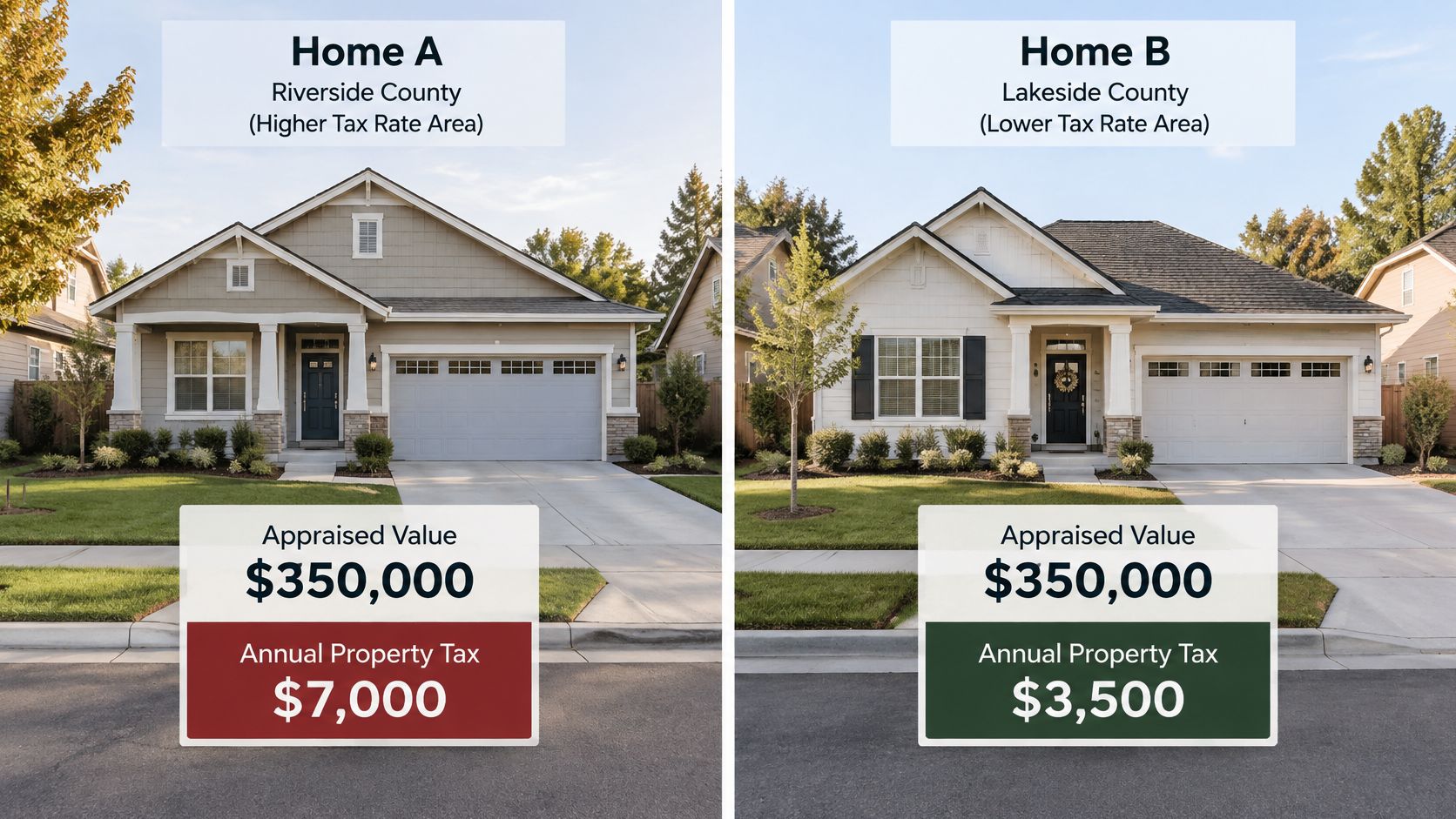
Say two homes each have a $350,000 appraised value, and neither owner claims an exemption. Home A sits in an area with a 2.00% combined rate, so the tax is $7,000. Home B sits in an area with a 2.60% combined rate, so the tax is $9,100.
The gap is $2,100, and it comes from the rates alone. The values are identical. The homes could look the same and sell for the same price, yet Home B costs more to own every year because different units, or higher rates from similar units, cover that parcel.
In this story, 2.00% and 2.60% are the nominal combined rates. They're the levy applied to taxable value. Because there are no exemptions in the example, each owner's effective rate matches the nominal rate.
Same street, different exemptions
Now put two houses on the same street, with the same appraised value and the same taxing units. One owner has an approved homestead exemption. The other doesn't, perhaps because the home is a rental or the owner never filed.
Both face the same nominal combined rate. The exempt owner, though, applies that rate to a lower taxable value for the relevant units, so the bill is lower. Divide each bill by the home's value and the exempt owner's effective rate is lower too.
The nominal rate tells you what the units charge. The effective rate tells you what you actually bore as a share of your home's value.
That distinction explains why neighbors can compare bills and think someone got a special rate. Usually nobody did. One taxable value is lower, one appraisal is capped, or one property sits across a district boundary.
Run your own self-check
- Find last year's total tax: Use the amount billed, not an estimate from a listing.
- Divide by the appraised value: That result is your effective rate for that year.
- Compare carefully: Compare only with properties in the same taxing units, or the comparison won't mean much.
Statewide averages describe Texas as a whole. Your bill is local, parcel by parcel. Once you know your own effective rate, you can tell whether a high bill is being driven mainly by value, by rates, or by a missing exemption.
Deadlines and Deferrals That Change Your Bill
A correct rate won't help if you miss the date to claim relief. The Comptroller's property tax exemptions guide identifies April 30 as the usual final day to file most exemption and special-appraisal applications. Different deadlines can apply when a property was not on the prior year's appraisal roll, so confirm your exact date with the appraisal district.
The dates that matter attach to your address. Because every parcel sits inside its own combination of taxing units and exemptions, the calendar that governs your bill is the one tied to your appraisal notice and your county, which is why two owners in the same city can face different filing situations.
A simple annual calendar
- Check the appraisal notice when it arrives: Confirm the value, parcel details, and exemptions shown.
- File exemption applications before the deadline: Don't assume an exemption carries over after a purchase or a change in status.
- Protest the value within the window on the notice: Missing that window can leave an inflated value in place for the year.
- Confirm exemptions on the tax bill: Check that every approved exemption appears before you pay.
Deferral is not a discount
In Travis County, homeowners with an approved age-65-or-older or disabled homestead exemption may defer payment while they continue living in the residence homestead. Deferred taxes accrue interest for as long as the balance stays unpaid, so the amount owed grows the longer the deferral runs.
Deferral postpones payment while the debt remains. The accumulated amount generally becomes due when the property is transferred or qualifying occupancy ends, which makes deferral a timing tool: it shifts when you pay while the combined rate on your parcel stays exactly the same.
Before choosing that route, read how a property tax deferral in Texas works and when payment comes due. For some owners, deferral protects cash flow. For others, a protest or a missed exemption fix saves more without adding interest.
If your appraisal looks too high or you're not sure every exemption is in place, INTELLI can review your specific parcel, check the taxing units and taxable value behind your bill, and handle the protest and paperwork for you. INTELLI uses a data-driven system built on public and private records to check values, exemptions, and deadlines, and you don't pay if your taxes don't go down. Enter your property street address on the homepage form to see what you could save before the next deadline passes.