
You opened this year's notice of appraised value, saw a higher number, and you're not sure the disabled person tax exemption is even on the account. Maybe Social Security already approved you, or a doctor wrote a letter, and the bill still looks unchanged. In Texas, that gap is common. The county chief appraiser decides the homestead claim, and a yes from another program does not settle it.
This walkthrough covers who qualifies, what each taxing unit can take off taxable value, which papers to bring, and how to fix a denial before the next filing window closes.
Who Qualifies for the Texas Disabled Person Exemption
The disabled person tax exemption is a residence homestead exemption, and it turns on one federal test. Three conditions apply in order. You need a disability that qualifies for Social Security Disability Insurance (SSDI) benefits under the federal standard. You need a home you own and live in as your residence homestead. You need a filed application with your county appraisal district.
The county chief appraiser decides eligibility. A benefits approval from another program does not close the file. The residence homestead exemptions guide from the Texas Comptroller states that the applicant must have a disability that qualifies for disability-insurance benefits under the Federal Old-Age, Survivors, and Disability Insurance Act, and that benefits from another program do not automatically establish eligibility. Once you're approved, that same guide requires school districts to exempt $60,000 of the homestead's appraised value under Tax Code Section 11.13(c). Cities, counties, and special districts may adopt an optional exemption of at least $3,000 under Section 11.13(d), and that amount is set unit by unit.
| Your situation | Counts automatically? | What to do |
|---|---|---|
| Approved for Social Security Disability Insurance | Yes, because it meets the federal SSDI standard | Keep the award letter ready for the appraisal district |
| VA disability rating alone | No, benefits from other programs do not automatically qualify | Ask the appraisal district whether your records are enough |
| Workers' compensation award | No | Supply medical evidence that meets the SSDI standard |
| Private disability insurance payout | No | Supply medical evidence that meets the SSDI standard |
An SSDI approval letter counts because it matches the federal standard. A VA rating, a workers' compensation award, or a private disability payout does not count on its own, though medical records behind those awards can support the file. Rental houses and second homes are out, because this exemption covers only the homestead. If you're sorting homestead rules more broadly, the Law Office of Bryan Fagan, PLLC offers a clear primer you can explore primary residence tax exemptions alongside the disability rules, and our page on who qualifies for a homestead exemption in Texas walks through ownership and occupancy in plain terms.
Veterans need a separate check. The Texas Veterans Commission reports that disabled-veteran exemption amounts currently range from $5,000 for ratings of 10%–29% to $12,000 for ratings of 70%–99%, and that veterans rated 100% disabled may receive a full residence-homestead exemption.
Ask yourself three questions. Do I have a disability that meets the SSDI standard? Is this property my homestead? Have I filed with my county? A yes to all three means you're ready to measure the savings and file.
How Much the Exemption Saves on Your Tax Bill
The exemption cuts taxable value. It does not mail you a check. Tax saved on each line equals the exempt amount multiplied by that unit's tax rate.
| Taxing unit | Exemption amount | Adoption | Tax saved formula |
|---|---|---|---|
| School district | $60,000 of appraised value | Required under Tax Code 11.13(c) | $60,000 × school tax rate |
| City, county or special district | At least $3,000 | Optional, set by each unit | Exempt amount × that unit's tax rate |
| Disabled and 65 or older | Both categories can apply | Applied per taxing unit | Use each category where it applies; they do not stack on the same unit |
A labelled illustration
Say the school tax rate were $1.00 per $100 of value. A $60,000 school exemption would remove $600 from the school portion of the bill. If a city adopted a $3,000 exemption and its rate were $0.50 per $100, that city line would drop by $15. Those rates are an illustration, not your county's rates. Real rates differ by county, city, and school district, so two homes of equal value can save different amounts.
How to read your bill
Look for an exemption label on each taxing unit's line. Compare that label with the amount the unit should have applied. A missing city line often means the city never adopted the optional amount, or the district never applied a claim you already filed. A person who is both disabled and 65 or older may receive both categories, but not from the same taxing unit. Pick the better fit on each line instead of adding them together.
The school portion can also sit under a ceiling once you qualify. Our guide to the Texas property tax freeze shows how that cap behaves after the first qualifying year, which is separate from the dollar exemption on this year's bill.
Practical rule: Multiply each unit's exempt amount by that unit's rate. Don't apply the school figure to the city line.
Documents That Prove Disability and Homestead Status
The county chief appraiser makes the eligibility decision, not the benefits agency. A letter from another program does not settle the question on its own. The Texas Comptroller exemptions page warns that benefits from other programs do not automatically qualify, and appraisal districts may request supporting disability documentation. That same page notes that qualifying disabled homeowners may receive an additional $60,000 school-district homestead exemption, and that the school district generally cannot increase its annual tax on the qualified homestead above the amount imposed when the owner first qualified.
Build the packet in the order a county reviews it.
Disability proof. Put the SSDI award letter on top, with the approval and its date visible. If SSDI is not approved yet, add medical records that speak to the federal standard. One labelled copy is enough. Keep the original.
Ownership proof. A recorded deed or a closing statement shows you own the home. Highlight the legal name so it matches the application.
Homestead proof. A driver's license, voter registration, or utility bill at the same address shows you live there as your main residence. Use the address on the tax account, not a mailing address from an old lease.
Identification and the account number. Copy the property account number from your tax notice onto the form. Names and account numbers should match on every page.
Districts ask for more than a benefits letter because a rating or an insurance payout can exist without meeting the SSDI test. If the district requests more, answer in writing, keep a dated copy, and note the request date so you can track the reply.
A clean packet is one labelled copy of each item, originals at home, and the same name and account number on every page.
Filing Deadlines and How Counties Differ
Exemption applications are generally filed with the county appraisal district before May 1. The Texas Comptroller's exemption application guidance also says a late residence-homestead application, including the disabled person exemption, may generally be filed up to two years after the original deadline. The exemption applies for the entire tax year if you qualified during that year, which can support a correction of a prior-year overpayment when ownership, homestead status, and disability evidence are documented.
What changes from county to county
Appraisal districts run at the county level. Forms, online portals, mail rules, extra document requests, and processing times are not the same everywhere. Travis Central Appraisal District, which serves Austin, is one office you can check against your own county's site. Optional city, county, and special-district exemptions also differ, so two neighboring cities can produce different savings on similar homes.
Confirm these items locally before you send anything:
- Filing method: Portal, mail, or in person, and whether the district wants originals or copies.
- Exact deadline date: The general date is May 1, and your district's calendar can add a local receipt rule.
- Optional city exemption: Ask whether your city adopted its own amount, and at what dollar level.
- Old claims: Ask whether the district still wants documents on a prior year you think was missed.
Our page on the homestead exemption deadline is the place to line up that May date with the rest of your homestead paperwork.
How to File the Exemption Step by Step
Work the claim in order. Each step has a reason and a slip that sinks otherwise solid files.
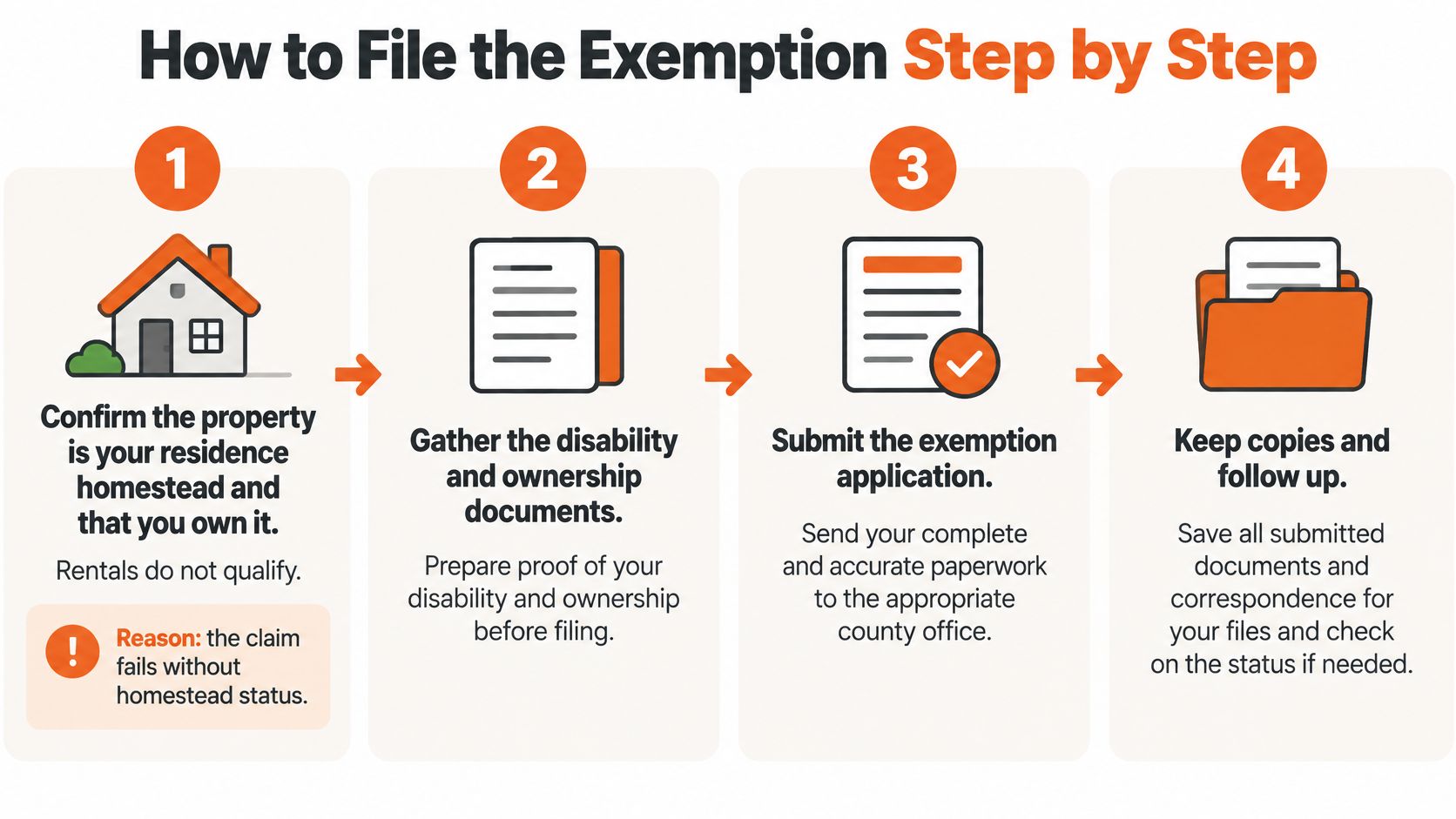
Confirm the property is your residence homestead and that you own it. Rentals do not qualify. The claim fails without homestead status. The common slip is filing on a house you rent out, or on a second home you visit.
Gather the disability and ownership documents. Use the packet order above. The common slip is sending a benefits letter with no medical support behind it when SSDI is not yet approved.
Get the application from your county appraisal district's office or website. Forms and filing methods differ by county. The common slip is using a neighboring county's form because it was the first PDF in a search.
Complete the form with your name, property account number, and disability details. Match the documents exactly, including middle initials. The common slip is a nickname on the form and a legal name on the deed.
File before May 1. Waiting for the tax bill is the usual miss. If that date has already passed, file anyway. Late residence-homestead filings can still be accepted within the two-year window.
Answer any documentation request inside the period stated on the letter. Silence is the most common reason a valid claim is denied. Reply in writing and keep the dated copy.
When the appraisal notice and the tax bill arrive, check that each taxing unit shows the exemption. A finished claim shows a confirmed exemption on the notice and on every relevant line of the bill. If one line is blank, that unit may not have adopted an optional amount, or the claim never reached that account.
Three Homeowner Cases and What Each One Saves
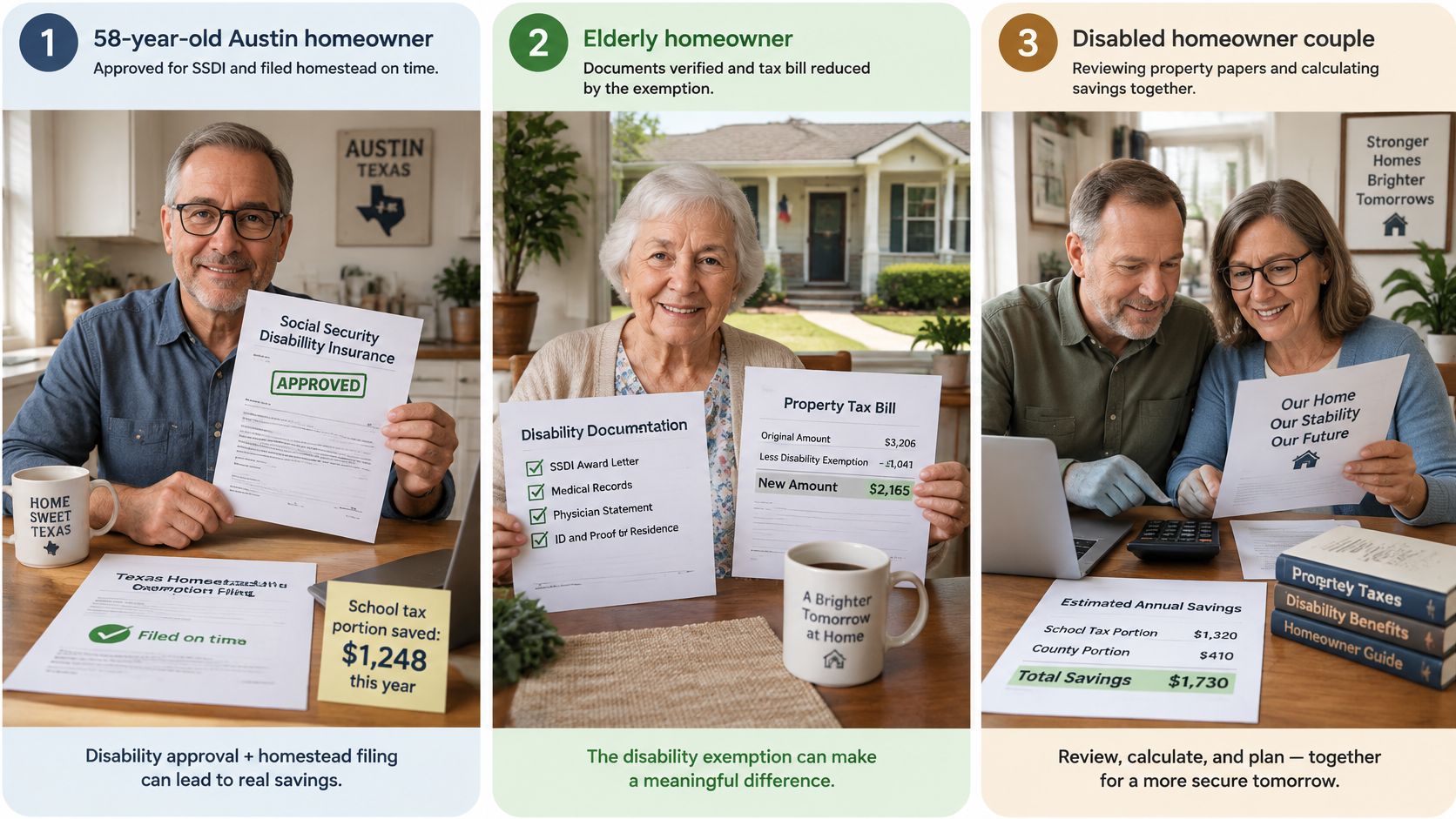
These three households are illustrations with rounded facts, not real clients. The photo below sketches the kind of Austin homestead each story turns on.
Case one, filed on time
Maria is 58, lives in her Austin house, and has an SSDI approval letter. She filed the homestead claim before the deadline. The school exemption applies, her city adopted its optional exemption, and the bill shows both lines. The award letter is the document that decided it. Her next step is to confirm both labels are still on next year's notice.
Case two, two categories, one per unit
James is 67 and has been disabled since age 60. Both the disability category and the age category can apply, but each taxing unit grants only one. He checks the bill unit by unit and keeps the stronger label on each line. The document that mattered was proof of the date he first qualified, because that date anchors the school ceiling. Next, he compares the city line with the school line instead of assuming they match.
Case three, the rental and the VA rating
Priya owns a rental house and has a VA disability rating, with no SSDI approval. The rental does not qualify for this homestead exemption, and the VA rating alone does not establish it. She claims the disabled-veteran program separately if she is eligible on a property that program covers. The missing SSDI letter is what blocked this particular exemption. Her next step is to ask the appraisal district which veteran form fits her rating.
If your facts look like Maria's, file and then read the bill line by line. If they look like James's, compare categories per unit. If they look like Priya's, don't force a homestead claim onto a rental.
Fixing a Denied or Incomplete Exemption Claim
The most common denial is disability proof that did not meet the federal SSDI standard. That usually happens because the file relied on a VA rating, an insurance letter, or a workers' compensation award.
| Symptom | Likely cause | Fix |
|---|---|---|
| Denied for lack of disability proof | Relied on a VA rating, insurance letter or workers' compensation award | Submit an SSDI award or medical evidence that meets the federal standard |
| Exemption missing from one tax bill | Optional city, county or special-district exemption not adopted or not claimed | Compare each taxing unit's line and ask the appraisal district about optional units |
| Claim treated as not homestead | Ownership or occupancy proof missing | Provide the recorded deed and proof of residence at the property |
| Filed after May 1 | Missed the general deadline | File now; late filing may be allowed up to two years after the deadline |
| Overpayment in earlier years | Exemption never applied in prior tax years | Review past bills; a documented correction may be possible for the year you qualified |
What takes one cycle, and what reaches backward
A missing disability letter or a blank homestead box is usually fixed in the current filing cycle. You send the SSDI award or the medical evidence, ask the chief appraiser what would satisfy the file, and watch the next notice. A blank city line is often a one-call question: did that unit adopt an optional amount, and was it claimed?
A late file and an older overpayment take a look at past years. File now if May 1 has passed. Then pull the bills for each year you already qualified and ask whether a documented correction is still open. Keep the request in writing.
A denial that cites several years, or a file the district has already rejected once, is worth a review by a licensed property tax consultant. Bring the denial letter, the proof you sent, and the bills for the years in question.
Confirm Your Exemption Before the Next Deadline
An exemption approved by the chief appraiser can still be missing from one of your tax bills, because each taxing unit applies its own amount. Run this check before the next May window, not after the bill is due.
- Read the notice of appraised value. The disabled person exemption should be named on the account, not only implied by a lower number.
- Compare the latest tax bill line by line against the taxing units in your county. School, city, county, and special districts each get their own look, and each can grant a different amount.
- Confirm optional exemptions. Ask whether your city, county, and special districts adopted their own amounts.
- Finish an open file. If the window is still open, file or answer any pending documentation request. A missing disability letter is a gap the chief appraiser can close only when the proof reaches the file.
- Ask about earlier years if a past bill shows the full amount for a year you already qualified.
If you want help with that check, our team uses a data-driven system to review exemptions and find errors. Our Tax Exemption Maximization service identifies every exemption available to you and handles the complex paperwork, including applications and deadlines. Our Tax Recovery Audits examine your tax history to find errors and pursue refunds for past overcharges, with no fee if no recovery is made. We don't charge you if we don't lower your property taxes.
Start with your most recent tax bill and the five steps above. Then decide whether to act on the findings yourself or with help.
INTELLI helps Texas homeowners confirm the disabled person tax exemption, complete the county paperwork, and look back at years where a qualifying homestead was taxed in full. A proprietary, data-driven review is how we tell a real exemption from a letter that will not satisfy the chief appraiser. Visit INTELLI to start with your latest tax bill.