
The deed is recorded; the appraisal account still shows the seller's value. A single adult or family can claim the general residence homestead by owning and occupying the home as the only principal residence. For 2025, that claim removes $140,000 from the home's appraised value for school-district taxes, according to the Texas Comptroller's property tax exemption guide.
That figure works like a coupon honored at one counter. It lowers the school-district line only. Austin and Travis County taxing units set their own homestead rules, so your total bill change depends on which units tax the address. Until the appraisal district processes a filed application, the account keeps billing at full value.
Who Qualifies for the Texas Homestead Exemption
Say you bought a house in Austin in March. The listing's tax estimate used last year's numbers, and the appraisal account still shows full value. A single adult or a family qualifies for the general residence homestead when they hold an ownership interest, occupy the home as their principal residence, and claim no other homestead in Texas or anywhere else.
The test is about where you live, not how many properties you own. The Texas Tax Code requires an ownership interest held by one or more individuals or through a qualifying trust, a property designed or adapted for human residence, and occupancy as the owner's principal residence. A rental house, second home, vacant lot, or investment property fails that test even when your name is on the deed. On a trust-owned home, the trustor or qualifying beneficiary has to be the person living there.
Five paths, one home
Age, disability, a veteran rating, and surviving-spouse status are added paths. None of them replaces living in the home.
| Exemption | Who qualifies | Where it applies | Core benefit |
|---|---|---|---|
| General residence homestead | Single adult or family with an ownership interest who occupies the home as their only principal residence | Mandatory for school districts; local option for cities, counties, and special districts | $140,000 removed from school-district value for 2025 and later |
| Age 65 or older | Residence-homestead owner who is at least 65 during the tax year | School districts statewide, plus local-option amounts where adopted | Extra school exemption and a school-tax ceiling |
| Disabled person | Owner who qualifies as disabled for federal disability-benefit purposes | School districts, with local amounts that differ by unit | Additional exemption, not from the same taxing unit as the over-65 amount in the same year |
| Disabled veteran | Veteran with a service-connected disability rating, or a 100 percent disability | Residence homestead across the taxing units on that property | Rating-based partial exemption, or a total exemption at 100 percent disability |
| Surviving spouse | Spouse who remains in the home after a qualifying owner dies and meets that path's survivor rules | Follows the deceased owner's over-65, disability, or veteran status | Continues the ceiling or exemption when the statutory conditions are met |
The general row covers a conventional house, a condominium, or a manufactured home when you own the improvement. The age-65 row adds a school benefit and a ceiling once you are at least 65 during the tax year. The disability row follows federal disability-benefit rules and cannot be collected with the over-65 amount from the same taxing unit in the same year. The veteran row follows the service-connected rating, up to a total exemption at 100 percent disability. The surviving-spouse row continues the deceased owner's path only when that spouse stays in the home and meets that path's rules.
What land and which tax line count
The homestead generally includes up to 20 acres when you also hold an ownership interest in that land. The same statute allows a separately secured and occupied portion of a structure, together with land and improvements under identical ownership. Your half of a duplex can qualify. A vacant lot next door, titled separately and never used as the residence, does not ride along.
The Texas Comptroller states that an adult is entitled to a $140,000 exemption from the appraised value of the residence homestead for school-district taxation. Cities, counties, and special districts may adopt a local-option exemption, or they may adopt none. The statute expressly includes a single adult, so you do not need to be married. Before you treat a listing's tax estimate as your future bill, understanding taxes before buying a home separates the school line from every other unit on the notice.
Buyers who move in after January 1
Owners who buy after January 1 may receive the exemption for the applicable portion of that tax year if the prior owner did not receive the same exemption and the new owner qualifies. Your file has to show occupancy, no second homestead, and that the seller did not already take it for that year. Applications go to the county appraisal district, not to the city tax office.
Practical rule: One primary home, and an ownership record that names the person who actually lives there.
Check those two points before you file. You claim this house and no other as a homestead. The deed or trust matches the occupant.
Over 65 Disabled and Veteran Paths
Start from the general homestead, then add one layer. An owner who turns 65 during the tax year keeps the residence homestead and adds the state age benefit on school taxes, plus a school-tax ceiling that limits later school-tax increases on that homestead. You do not drop the general claim to pick up the age claim. You stack them, and you still have to live in the home.
A person who qualifies as disabled for federal disability benefits uses that same additional school structure, documented on its own. The Comptroller application instructions say an eligible person may receive both the age and disability classifications in the same year, but not from the same taxing units. If you qualify for both, pick the classification each unit will grant, and do not expect two additional cuts from one school district.
Disabled veteran amounts
Partial exemptions step up with the service-connected rating. A veteran with a 100 percent disability, or with individual unemployability, can receive a total exemption of the residence homestead. These amounts sit on top of living in the home. They do not create a homestead for a house you rent out.
| Disability rating | Homestead exemption amount |
|---|---|
| 10% to 29% | $5,000 |
| 30% to 49% | $7,500 |
| 50% to 69% | $10,000 |
| 70% to less than 100% | $12,000 |
| 100% disability or individual unemployability | Total exemption of the residence homestead |
Read the rating on the award letter, not the percentage you remember from a clinic visit. A 70 percent rating and a 100 percent rating are different rows, and only the second clears the whole homestead. Our guide to the disabled veteran property tax exemption walks through how that total exemption is claimed on a Texas residence.
Surviving spouses are not one rule
A spouse who is 55 or older may keep an over-65 ceiling by staying in the home. The surviving spouse of a veteran with a 100 percent disability, or of certain veterans and first responders who died from a qualifying cause, can continue a total exemption if they remain in the residence and do not remarry. A spouse who moves out, or who remarries when that path forbids it, loses the continuation even if the deed still shows the old name.
File the standard residence-homestead application and attach the proof that matches your row. Age needs a birth date. Disability needs the federal award or the documentation your appraisal district accepts. A veteran rating needs the disability letter. Send the base application and the special proof together, and check that county's deadline before you assume a spring filing is still open.
A ceiling limits later school-tax increases on that homestead. It does not freeze the city, county, or special-district lines.
Homestead Savings in Austin and Travis County
Take one $450,000 Travis County homestead so the math stays on a single house. Removing $140,000 from school value does not remove $140,000 from the bill. If the school rate is about 1.00 percent, the school-line savings are about $1,400. That rate is an illustration, not a promise of what your district charges this year.
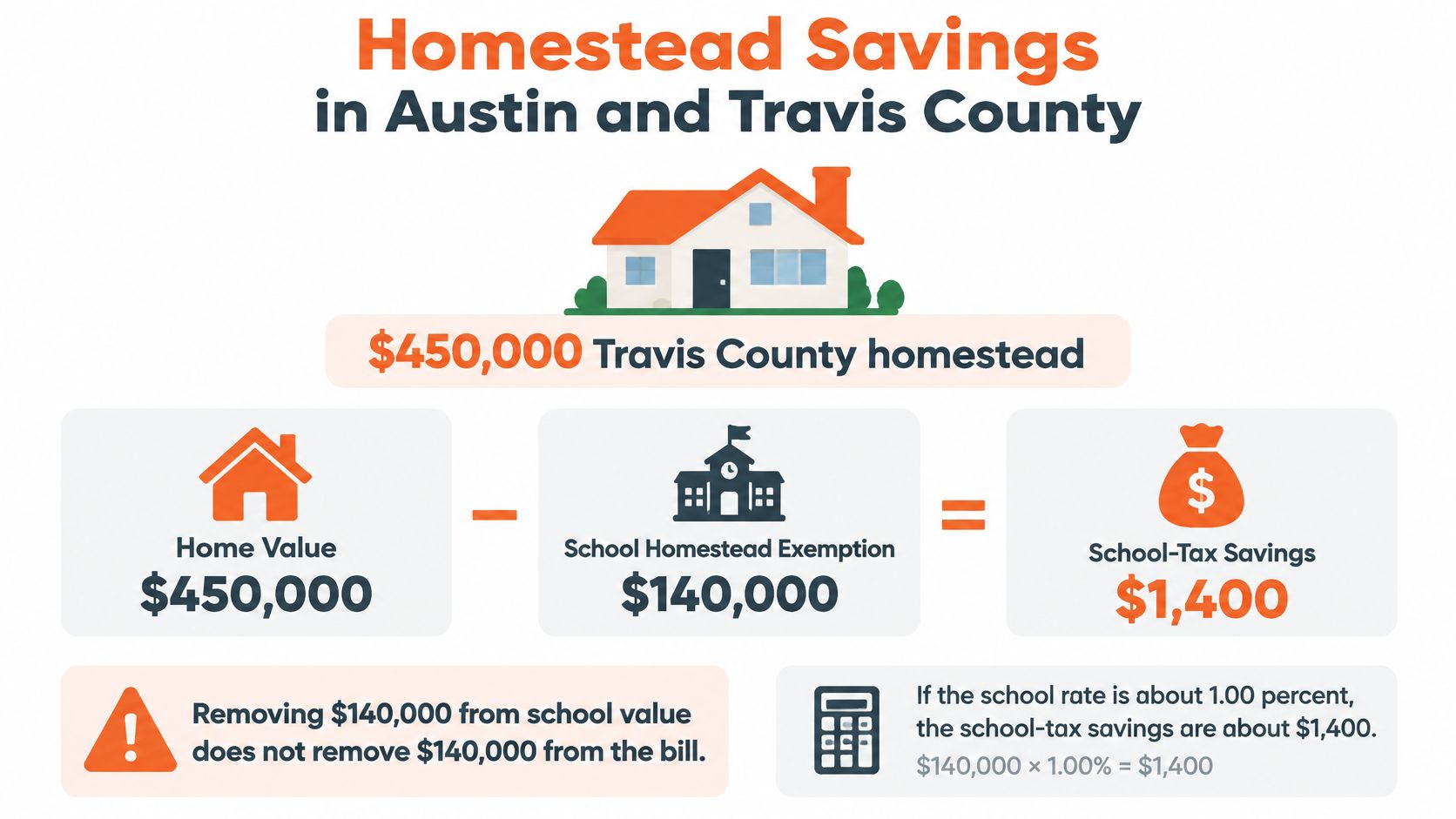
The Comptroller exemption schedule identifies the mandatory school-district residence homestead exemption as rising from $100,000 to $140,000 for the 2025 tax year. County, city, and special-district exemptions stay local-option and differ by jurisdiction. In Austin and Travis County, what you save depends on which taxing units cover that parcel.
One house, four different lines
A Travis County home is typically taxed by a school district, the City of Austin or another city, Travis County, and one or more special districts. Only a unit that adopted a local-option homestead adds a further cut, and that cut is separate from the school figure. A unit with no local option keeps taxing its full share of appraised value.
Adding the extra state-mandated over-65 or disability school amount raises the removed school value on this illustration from $140,000 to $150,000, and the illustrative school savings from about $1,400 to about $1,500. For scale, the Texas Comptroller's 2024 property-value figures reported $18,864,946,740 in statewide deductions for that state-mandated $10,000 homestead exemption for homeowners age 65 or older or with disabilities.
| Situation | School value removed | Illustrative school rate | Approximate school savings |
|---|---|---|---|
| General homestead only, 2025 and later | $140,000 | 1.00% | $1,400 |
| General plus over-65 or disability school amount | $150,000 | 1.00% | $1,500 |
| City, county, or special district with a local option | The local-option amount that unit adopted | That unit's own rate | That rate times the local-option amount |
| City, county, or special district with no local option | None from this exemption | That unit's own rate | $0 |
The 10 percent homestead appraisal cap limits how fast appraised value can rise after you qualify. It is not itself an exemption, and it does not shave a fixed dollar amount off the school line. A short walkthrough of how the school cut shows up on a bill is here:
Read each taxing unit on the notice rather than multiplying $140,000 by the combined rate. Our page on Travis County property tax exemptions is the place to line up the units that appear on an Austin-area account.
How to File with Your County Appraisal District
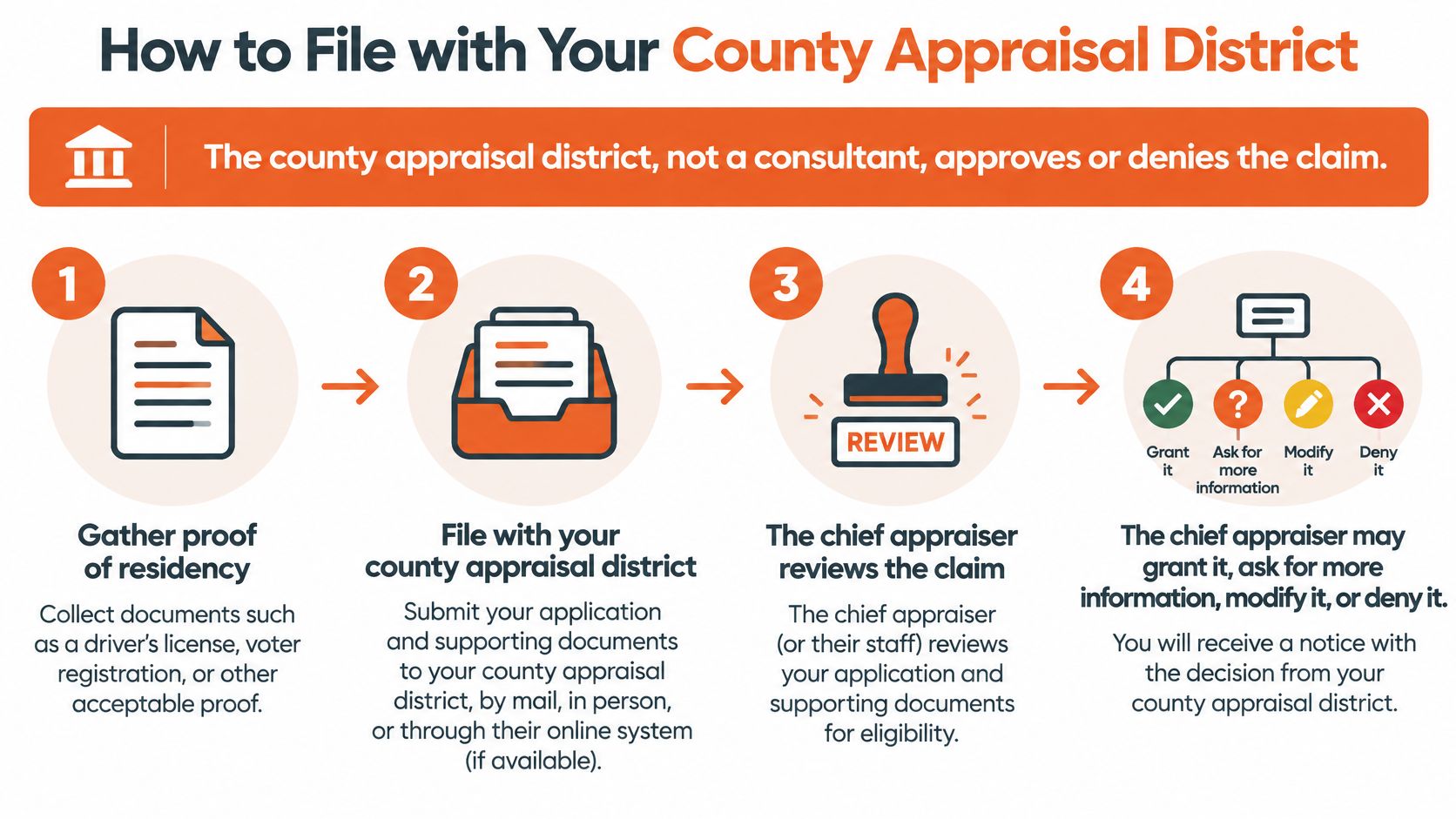
The county appraisal district, not a consultant, approves or denies the claim. The chief appraiser may grant the application, disapprove it and request more information, modify it, or deny it.
The filing path
- Confirm the property is your principal residence and that no other homestead is on file in your name.
- Complete the Comptroller residence homestead application, Form 50-114, for each county where the property sits.
- Attach proof that matches the claim. Use a Texas driver license or ID showing the address, ownership evidence if the deed is new, and, for a special row, a birth date, a Social Security disability award or equivalent physician documentation, or the veteran disability letter.
- File with the appraisal district by April 30. INTELLI's property tax consultants note that Comptroller descriptions put the usual deadline no later than April 30 or before May 1, so confirm the date printed on your district's notice.
- Watch for a request for more information and answer it before the appraiser closes the file.
A buyer after January 1 should say whether the prior owner already took the exemption. If the seller's exemption is still on the account, your partial-year claim can stall even when you moved in and you own the house.
INTELLI uses licensed property tax consultants and employs a data-first approach, using public and private data, to organize evidence and spot exemptions. That support does not replace the district's decision. The appraisal district keeps the legal authority to approve or reject the claim. For a Travis County property, file with the Travis Central Appraisal District, not the City of Austin. A step-by-step look at how to apply for a homestead exemption shows where Form 50-114 goes once the proof is in one packet.
Mistakes That Get Homestead Claims Denied
The costliest wrong assumption is that a new buyer gets the exemption automatically, or that a seller's exemption carries over. Neither happens. You file in your own name, or the account stays on full value for your year of ownership.
A rental, second home, or vacant lot. You live in Texas, but not in that property. Claim only one primary residence.
An old homestead left on the prior home. After the move, that leftover claim can void the new one. Remove the old homestead before you file the new address.
A missed spring deadline. You file in June and then wonder why the current bill did not change. File by the April 30 date your district prints, and confirm the exemption is recorded on the account.
Special paperwork with no base application. Age or disability documents do not stand alone. File Form 50-114 first and attach the special proof.
The wrong person in a trust. A trust-owned home fails when the occupant is not the trustor or qualifying beneficiary. Confirm the occupant meets the trust rule before you file in the trust's name.
A manufactured home or extra acreage. The improvement has to be yours, and homestead land generally stops at 20 acres. Confirm you own the manufactured home, and do not count acreage past that limit.
A city-only filing in Travis County. The city does not grant the residence homestead. File with the appraisal district responsible for the property.
A mid-year purchase with the seller's exemption still on. Your partial-year claim depends on the prior owner not having received it. Confirm it was removed, then file.
If the seller's exemption is still showing, call the appraisal district before you assume your March closing created a new one.
Each of these is a paperwork miss, not a judgment about whether you deserve a tax break. Fix the record, then file the one home you occupy.
Check Your Exemption Before April 30
If you live in the home, own an interest, and claim no other homestead, file the general exemption now, even if you are unsure about an extra row. If you turn 65 this year, have a qualifying disability, or hold a veteran rating, add that proof now rather than waiting for a later bill. A missing row does not get written onto the account because you mentioned it at closing.
Confirm the exemption appears on your appraisal district record before April 30, then read the next notice line by line against the approval letter. Owners in Travis County should check which taxing units appear on the notice before assuming any savings. A school cut and a city cut are different lines, and a unit with no local option will not move.
INTELLI serves Austin, Barton Creek, Lakeway, Georgetown, Hutto, Kyle, Pflugerville, and Round Rock, and areas in and around Travis County. We use licensed property tax consultants and a data-first approach, using public and private data, to organize evidence and identify exemptions you may have missed, which can help you meet the deadline. The average savings for an Austin homeowner with INTELLI is $2,500. Customers start by entering their property street address on the homepage form to see their savings. The appraisal district still makes the final decision on every claim.
INTELLI helps Texas homeowners get the residence homestead, and the age, disability, or veteran row that fits, onto the appraisal district record before the bill is set. We organize the proof, watch the deadline, and line the claim up with the taxing units on an Austin or Travis County account. Visit INTELLI and enter your street address to see where your savings start.