

If your property tax bill looks too high, do you know whether to challenge the property's value, question a tax rate, or correct a missing exemption? Calling the wrong office can consume the time you need to protect your protest rights.
Texas separates those responsibilities among several offices. Understanding that division, then keeping a county-specific filing calendar, helps you turn a frustrating notice into a focused review supported by records, comparable properties, and a clear opinion of value.
What a County Appraisal District Does in Texas
A county appraisal district, or CAD, is the local office that appraises taxable property in its county each year and supplies valuation information to counties, cities, school districts, and other taxing units. It's where you start when the property description, valuation, or exemption information looks wrong.
Say your notice describes a larger house than you own. You'd ask the CAD to review its property record, not ask the county tax office to change the value. If you disagree with the district's decision, the appraisal review board, or ARB, hears the dispute.
The ARB is different from the appraisal district's staff. The county tax office handles billing and collection, while taxing units, such as cities and school districts, adopt budgets and tax rates. A valuation protest doesn't give the ARB authority to rewrite those budgets.
Who handles what in Texas property tax
| Office | What It Handles | Where to Start |
|---|---|---|
| County appraisal district | Annual appraisal, exemptions, special appraisal applications | The CAD office or website for your county |
| Appraisal review board (ARB) | Hears protests on value, exemptions and special appraisals | Filed through the appraisal district |
| County tax office | Tax bills, payments and collections | Your county tax assessor-collector |
| Taxing units (cities, schools, counties) | Set budgets and tax rates | Each local government's finance office |
| Texas Comptroller | Ratio studies and published statewide property value data | Comptroller property tax pages |
State oversight isn't an individual appraisal review
Under Texas Tax Code Section 5.10, the Texas Comptroller's ratio-study program evaluates each appraisal district at least once every two years, measuring appraisal levels and uniformity; its 2023 report covered 128 districts and reported an overall statewide median appraisal ratio of 1.00.
That benchmark doesn't establish that your particular property is correctly valued. A district-wide statistical result can't resolve a mistaken building size, an overlooked condition problem, or an unsupported comparison on your account.
Use this routing test: for a value or exemption question, start with the CAD. For a bill or payment question, start with the tax office.
Deadlines and Notice Dates Every Owner Should Track
The general protest deadline is May 15 or 30 days after the appraisal district mails the notice of appraised value, whichever is later, and the mailing date, not the arrival date, controls the calculation, according to the Texas Comptroller's protest guidance.
For a hypothetical notice mailed May 20, adding 30 days produces June 19, which is later than the standard deadline. Don't count from the day you opened the envelope, and don't assume a conversation with an appraiser pauses the filing clock.
Write the mailing date on your property file when the notice arrives. Save the notice, envelope, and any electronic notification so you can distinguish the district's mailing information from your own receipt date.
Texas appraisal and protest calendar
| Milestone | Date or Rule | What the Owner Does |
|---|---|---|
| Valuation date | January 1 | The appraisal reflects market value as of this date; preserve relevant condition records |
| Notice of appraised value | Usually mailed by April 1 | Record the mailing date and compare the value with recent sales |
| Protest deadline | May 15 or 30 days after the notice is mailed, whichever is later | File the protest with the appraisal review board through the CAD |
| ARB hearing | Scheduled after the protest is filed | Bring evidence and be ready to state your opinion of value |
| Certified appraisal roll | By July 25 | Late protests need good cause and cannot be filed after records are approved |
| Tax bills | Issued in the fall after rates are set | Check exemptions, billing details, and payment instructions; payments are usually due January 31 |
Treat the notice-mailing and roll-certification milestones as administrative checkpoints, not reasons to postpone filing. Your actual notice and the district's current instructions deserve immediate attention.
Calendar safeguard: Track the protest deadline separately from the hearing date and the evidence-submission cutoff. They serve different purposes.
A late protest isn't a dependable fallback. Ask the district immediately about the applicable good-cause procedure rather than assuming that explaining a missed letter will preserve your rights.
At INTELLI, we use licensed property tax consultants and employ a data-first approach using public and private data to evaluate filing timing, exemption eligibility, and valuation evidence before the deadline passes.
How Texas Appraisers Set Market Value
Market value is the price a property would bring in an open-market transaction between informed parties who are not forced to act. Texas appraisal districts generally appraise taxable property at its market value as of January 1, using consistent methods to value groups of properties. The Texas Comptroller's property-valuation guidance explains this January 1 standard.
A district's mass appraisal is like a consistent measuring system applied across many properties, rather than a separate full appraisal report for each one. Consistency does not guarantee accuracy for an individual property, so check whether the district's records reflect its actual features and condition.
Market value and equal-and-uniform appraisal are separate grounds for review. Even if the market-value estimate seems plausible, similar properties may have inconsistent appraised values.
Evidence that supports each protest claim
| Claim | Evidence to Gather | Why It Matters |
|---|---|---|
| Value too high | Recent comparable sales of similar size, age and location | Shows what buyers actually paid |
| Condition problems | Repair estimates, inspection report, dated photos | Documents defects the roll may not reflect |
| Unequal appraisal | Appraisal records for similar nearby properties | Shows the property is valued differently from comparable ones |
| Functional obsolescence | Floor plan notes, age and layout issues | Explains value lost to design or outdated features |
| Deed or use restriction | Recorded deed, restriction documents, survey | Identifies limits on legal use and what a buyer would pay |
| Income-producing property | Rent roll, income and expense statements | Supports an income-based value for rentals and commercial space |
For example, a 2,400-square-foot home with a failing roof can be compared with similar nearby sales. Dated photographs and a contractor's estimate help explain how the roof affects the home's condition and what a buyer might pay. The repair cost alone does not establish the market-value adjustment.
Keep the purpose of each valuation clear
A selling estimate, refinancing appraisal, and tax appraisal answer related but different questions. A home valuation for selling or refinancing can provide context, but the tax appraisal concerns the property's value for tax purposes.
For tax-review preparation, INTELLI's property valuation methodology guide explains how to organize the reasoning behind a proposed value. Identify the disputed characteristic, show the supporting comparison, and explain the adjustment.
A tax protest challenges the appraised value or an exemption, not the tax rate. Keep the argument focused on evidence that supports a specific correction.
How to File a Property Tax Protest Step by Step
A useful protest identifies what's wrong, requests a specific correction, and preserves proof that you filed. The Texas Comptroller's protest and hearing guidance explains that owners and authorized representatives may present evidence, examine witnesses, and state an opinion of value before the ARB.
Use this process graphic as a filing reminder, then prepare the supporting documents separately.
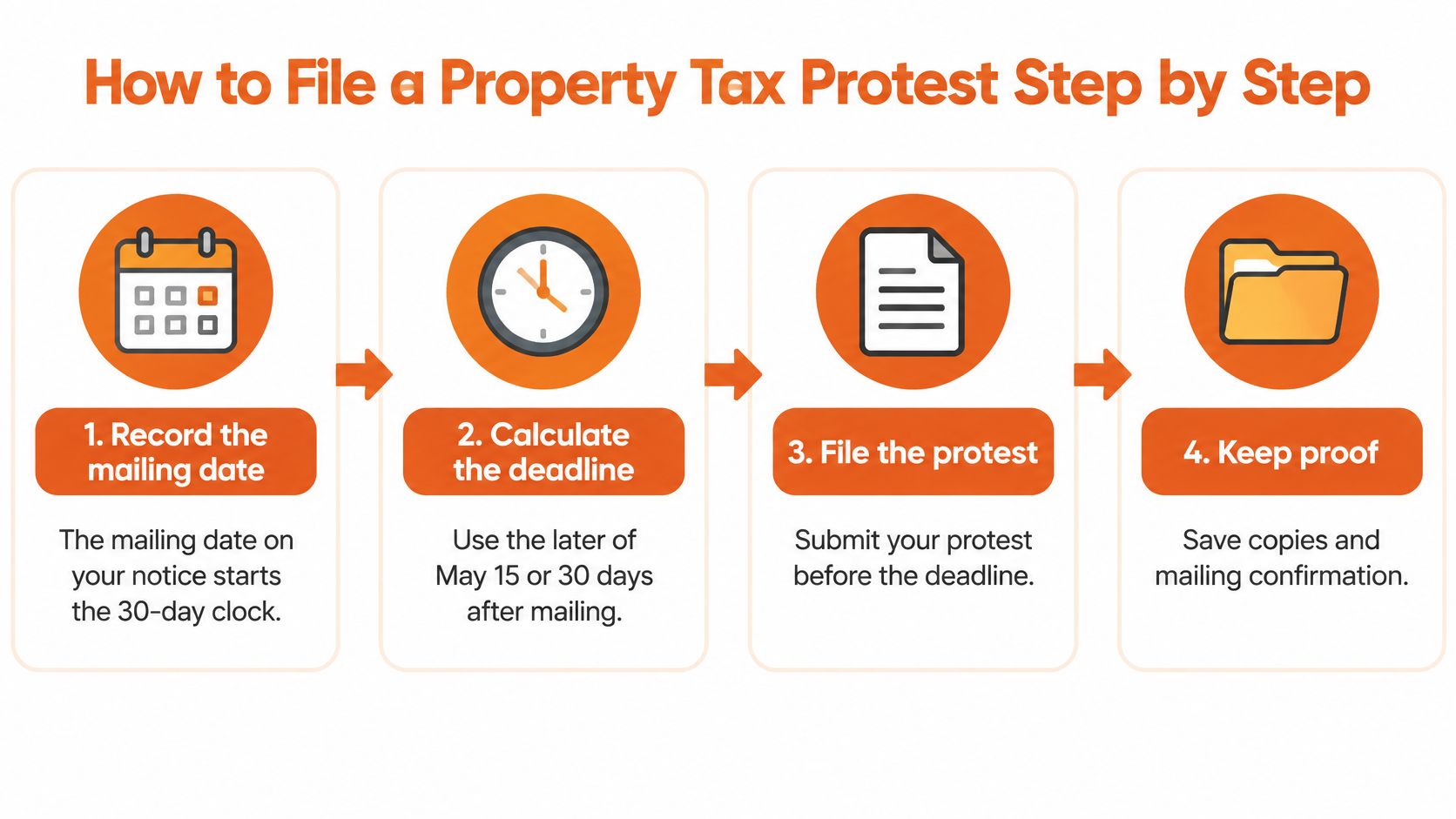
From notice to written decision
Record the mailing date. Find the date associated with the notice and retain the complete document. If it's unclear, ask the district to confirm its mailing record rather than substituting your delivery date.
Calculate and calendar the deadline. Use the later-of rule and add a reminder before the final filing day. Record the property account number beside the deadline so you don't confuse notices for different properties.
Request an informal conference. Ask appraisal district staff how to discuss the disputed value and submit comparable sales or correction documents. Don't let an informal discussion delay a protective written protest.
File the written protest on time. Identify the property and select the applicable grounds, including a disputed value or exemption when relevant. Send it through the CAD's accepted process, not to the county tax office, and retain the confirmation.
Build a quantified evidence package. Prepare a comparable-sales grid, condition photographs, repair estimates, surveys, and relevant income records. State the value you're requesting and show how the documents support it; review exemption eligibility when ownership or property use has changed.
Attend the hearing prepared to explain your calculation. Answer questions directly, distinguish your evidence from the district's comparisons, and identify any factual errors. Follow the county's instructions for submitting and displaying documents.
Review the written ARB order. Check the account, decision, and accompanying appeal information rather than relying on your recollection of the hearing. Keep the order and its delivery documentation in your property folder.
Evaluate further appeal promptly. Available routes and deadlines require attention to the particular order and appeal procedure. Don't assume that continuing an informal conversation preserves a separate appeal right.
Keep valuation records separate from rental-tax records
Landlords also need organized accounting records, but a federal deduction question isn't the same as a county valuation protest. VerticalRent's tax guidance for DIY rental owners provides context for that separate accounting task.
Bring the notice, the filed protest, an indexed evidence binder, and a one-page value summary. Your opening explanation should match the documents the board can actually review.
Keep proof of filing with those materials. A completed form on your computer isn't proof that the district received it.
Travis County and Austin Appraisal Records
The Travis Central Appraisal District's 2025 annual report lists 487,831 property accounts with a combined market value of $458,487,049,912. Its category totals show how much work sits behind the district's annual roll:
- Residential property: 423,321 accounts and $249,832,827,087 in market value.
- Commercial property: 25,758 accounts and $184,160,878,176 in market value.
- Business personal property: 38,752 accounts and $24,493,344,649 in market value.
The graphic provides a visual reference for that appraisal-roll scale.
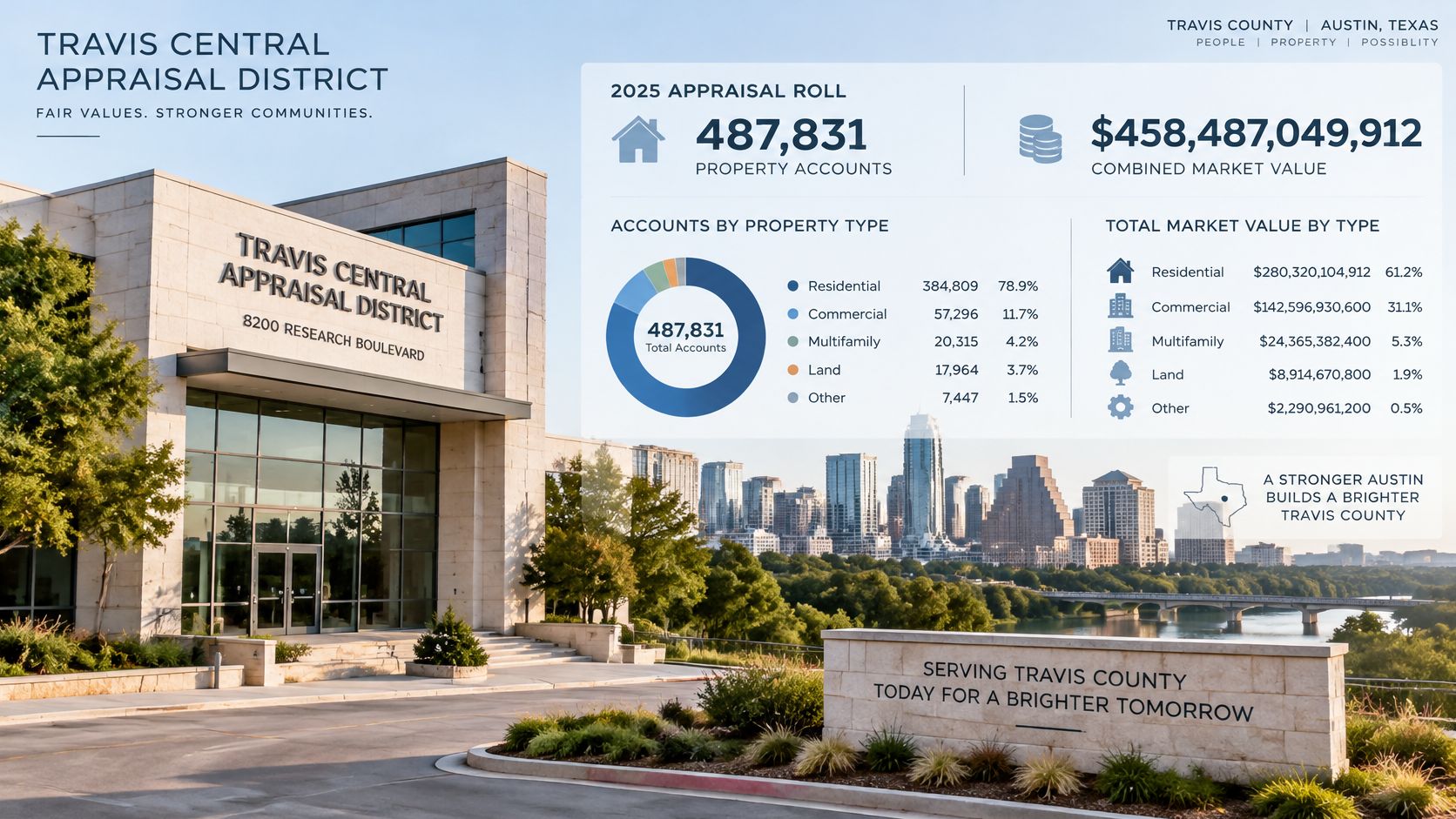
Travis Central Appraisal District roll history
The same annual report records the following totals and changes. The change shown for the intermediate year is calculated from the adjacent reported totals.
| Tax Year | Total Market Value | Change |
|---|---|---|
| 2020 | $281,851,353,216 | Baseline shown |
| 2021 | $314,594,449,350 | +11.62% |
| 2022 | $428,452,895,722 | +36.19% |
| 2023 | $463,332,450,474 | +8.14%, calculated |
| 2024 | $460,159,726,555 | -0.68% |
| 2025 | $458,487,049,912 | -0.36% |
The sharpest increase in this sequence added $113,858,446,372 to the roll. Later declines were much smaller than that earlier expansion, so an owner shouldn't interpret a modest district-wide decline as evidence that an individual account has returned to an earlier value.
What an Austin owner should check
Suppose you accepted a large increase during a strong sales period. When your next notice arrives, don't just compare it with last year's notice and stop. Check whether the district's sales evidence still fits your property's location, condition, and characteristics.
Roll totals describe the district, not your home's specific market. Account changes and the mix of property on the roll also mean the aggregate percentage isn't a ready-made adjustment for an individual protest.
Use the district's current hearing calendar and account records alongside its annual report. Our Travis County appraisal district guide provides additional local context.
The following video is an additional viewing resource.
INTELLI serves Austin, Barton Creek, Lakeway, Georgetown, Hutto, Kyle, Pflugerville, and Round Rock, and areas in and around Travis County. A service-area city name doesn't establish the correct filing office for every property, so confirm the county attached to the account before submitting paperwork.
How Appraisal Districts Differ Across Texas Counties
State law establishes the framework, but local offices administer the work. The Texas Comptroller's property-tax basics explains that appraisal districts perform appraisals and process exemption applications, while ARBs composed of local citizens decide disputes involving value, taxability, exemptions, and special agricultural appraisal.
The statewide deadline rule doesn't become a different rule when you cross a county line. What changes is the practical route for filing, submitting evidence, and appearing before the board.
Compare procedures before copying last year's process
| Item | What to Verify Locally |
|---|---|
| Hearing format | Whether your hearing is in person, by video, or by phone |
| Electronic filing | Which portal accepts your account and how confirmation appears |
| Protest form | The current form and accepted submission channels |
| Evidence cutoff | The submission deadline and required file format |
| Exemption paperwork | The applicable application deadline and supporting documents |
| Hearing calendar | Scheduling, rescheduling instructions, and attendance requirements |
Don't confuse an exemption application deadline with a protest deadline. Ask which rule applies to the particular application or denial, especially after a purchase, move, or change in use.
A reusable county checklist
- Confirm the office: Verify the appraisal district's website, contact details, and property account.
- Check the hearing arrangements: Record the ARB calendar and available attendance format.
- Verify filing instructions: Download the current form and confirm where it must go.
- Find the evidence cutoff: Save the upload instructions and submission confirmation.
- Review exemptions: Match the account's exemption list to the owner's current eligibility.
For a portfolio, keep a separate calendar for each county and a separate folder for each property. A successful upload in one county tells you nothing about whether another district received its protest.
At INTELLI, our licensed property tax consultants use public and private data in a data-first process when reviewing county appraisal records and preparing evidence. Local procedure still needs its own check, even when the properties share an owner.
Official Resources for Records and Filing Questions
Start with the Texas Comptroller for statewide explanations and published appraisal oversight information. For an individual account, use the Comptroller's county appraisal district directory to identify the local office; the Comptroller doesn't maintain individual local appraisal or tax records.
Your county appraisal district's website is the working source for the current protest form, filing instructions, ARB calendar, exemption applications, and annual report. Confirm the filing address and accepted submission method before sending anything time-sensitive.
Request records you can actually use
Ask for your property's appraisal record and the comparable-sales information the district used. Put the request in writing and identify the account number, tax year, and documents sought.
- Property characteristics: Review building size, construction details, condition classifications, land information, and listed improvements.
- Valuation support: Request the comparisons and explanation behind the proposed value.
- Exemption status: Obtain the account's current exemption information and identify any denial or missing application.
- Hearing documents: Keep scheduling notices, evidence instructions, settlement correspondence, and the written order together.
Our Texas property tax records guide can help you organize the records search. Save downloaded documents with descriptive filenames so you can distinguish the district's original record from a later correction.
Use the right legal and administrative route
For statutory review, consult Texas Tax Code Chapter 41 for protest procedures and Chapter 42 for judicial appeal of an ARB order. Read the instructions accompanying your order carefully and obtain qualified advice when choosing an appeal route.
For bills and payments, contact the county tax assessor-collector. For a tax-rate question, contact the finance office of the taxing unit that adopted the rate.
Recordkeeping rule: Save every written request and response, not just the documents that support your preferred value.
A complete file lets you explain what you requested, what the district supplied, and what remained disputed. That's more useful than a folder containing only screenshots of nearby properties.
Confirm Your Deadline Before You File
Before debating comparable sales, make the filing decision in order:
- Find the mailing date on the notice of appraised value and preserve the notice.
- Calculate the deadline using the later of the standard filing date or the notice-based period.
- Identify the correct appraisal district and confirm its accepted filing method.
- Choose your approach, either prepare the evidence yourself or get help from a licensed professional.
Don't postpone filing while searching for a perfect comparable property. Preserve the filing confirmation, then complete your evidence preparation according to the local schedule.
Decide what help you need
A straightforward record error may be manageable with clear documents and a concise explanation. A property with competing valuation issues, extensive condition problems, or several county accounts may require more coordination.
INTELLI uses licensed property tax consultants and a data-first approach drawing on public and private data to assess valuation evidence, exemption eligibility, and filing timing. We handle property evaluation, documentation gathering, deadline management, and hearing representation for our clients.
80% of the tax appeals INTELLI handles are successful. That record isn't a guarantee for an individual property, and the evidence still determines whether a challenge is supportable.
We don't charge customers if we don't lower their property taxes. Customers can call 512-987-6543 to discuss a notice and the help they need before the filing deadline passes.
INTELLI helps Texas property owners challenge inflated valuations with evidence and representation through the county appraisal process. Visit INTELLI to discuss your notice, confirm the paperwork you'll need, and get help managing your property's filing deadline.