

The notice landed in the spring mail, and the number on it jumped even though the street looks the same as last year. Nearby sales cooled, your roof still leaks, and the bill you remember from October no longer matches the figure the county just printed. That gap is the whole fight in a Texas property tax assessment. The district locked a value to a single day, then a later deadline decides whether you can challenge it.
Two clocks run on different schedules. January 1 fixes condition and market evidence. The protest deadline is a separate filing control. A case can rest on unequal appraisal or a bad record, not only on the claim that the total is too high.
What a Texas Property Tax Assessment Actually Sets
Say your notice shows a sharp rise while sales on the block stayed flat. The question that matters is narrow. What did the county appraisal district estimate the property would sell for on January 1?
Market value is the price the property would likely bring on the open market on that date. Appraised value is the district's working figure before caps and exemptions. Taxable value is what remains after those deductions. The Texas Comptroller's property-tax reporting guide defines taxable value as appraised or assessed value after applicable exemptions. Two homes with similar market prices can carry different taxable bases.
The school portion of the bill is simple arithmetic. Take taxable value, divide by 100, and multiply by the rate per $100.
Take a home the district appraises at $350,000. A $140,000 school homestead exemption leaves $210,000 taxable. At $2.00 per $100, the school portion is $4,200. Drop the taxable value by $20,000 and that same rate costs $400 less. Raise the rate and the bill climbs even if value holds.
Each county has a central appraisal district that sets value inside county lines. Cities, the county, school districts, and special districts set rates and send the bill. The Texas Comptroller's account of the assessment system describes that split, which grew out of the move to countywide appraisal at market value. A higher value does not always mean a higher bill when rates fall. A flat value can still hurt if a rate rises. Read the notice for the value first, then watch the fall rate hearings.
| Term | What it measures | Who sets it |
|---|---|---|
| Market value | Estimated open-market price as of January 1 | County appraisal district |
| Appraised value | District's market-value estimate before caps and exemptions | County appraisal district |
| Taxable value | Appraised value minus exemptions and applicable caps | Appraisal district, after exemptions |
| Tax rate | Dollars levied per $100 of taxable value | Cities, counties, school districts and special districts |
| Tax bill | Taxable value divided by 100, multiplied by each unit's rate | Taxing units collect the bill |
Match each line on your notice to that table before you argue about the rate. The district's number is the lever you can still move.
Key Dates in the Texas Assessment Year
Treat the year as a sequence, not a single deadline. Miss the evidence window and a later hearing has nothing solid to weigh.
| Stage | Typical timing | What the owner does |
|---|---|---|
| Valuation date | January 1 | Preserve condition photos, repair estimates and sales records as of this date |
| Appraisal notice | Spring, mailed by the appraisal district | Compare the notice with comparable sales and listed exemptions |
| Protest deadline | May 15 or 30 days after notice mailing, whichever is later | File the protest with the appraisal review board |
| Hearing notice | At least 15 days before the hearing | Confirm date, time, location and subject matter |
| ARB hearings | Late spring through summer | Present evidence in person, by phone or by videoconference |
| Certified appraisal roll | July 25 | Taxing units set rates from certified values |
| Tax bills | Typically October | Verify exemptions and taxable value on the bill |
| Delinquency | Unpaid taxes after January 31 | Penalties and interest begin |
The mailing date, not the day you opened the envelope
The Texas Comptroller's protest guidance sets the filing rule. Owners generally must file with the appraisal review board by May 15 or within 30 days after the district mails the notice of appraised value, whichever is later. That 30-day period runs from the mailing date, not the day the notice reaches you. Write the postmark or printed mail date on the notice the day it arrives. A notice that sits in a stack for two weeks can eat the extra time you thought you had.
After you file, the review board must send written hearing information. That notice covers date, time, location, subject matter, and access to estimated-tax information, and it must generally go out at least 15 days before the hearing. Use those 15 days to finish the packet, not to start it.
Why January 1 still controls in July
Photos, repair bids, and sales have to describe the property as it stood on the valuation date. A kitchen finished in March does not lower this year's value, and a storm in February does not either, unless the damage was already there on January 1. Hearings run from late spring through summer. Once the certified roll is due, taxing units build rates from those values. October bills are mostly a check that exemptions and taxable value survived. Penalties and interest start if the bill is still open after January 31.
Each appraisal district publishes its own notice dates, hearing calendars, and evidence rules. Confirm them locally before you rely on this framework. Some districts process online uploads much faster than mail, so file the packet early when that option exists.
Practical rule: Log the mail date, then build the January 1 file before you pick a hearing theory.
Licensed property tax consultants at INTELLI track these dates with a data-first approach built on public and private data. You still own every deadline.
How Appraisal Districts Estimate Market Value
Texas districts must use the approach, or mix of approaches, that fits the property. The Comptroller's valuing-property guidance confirms that sales comparison is typically preferred for single-family homes when adequate sales exist, while income valuation suits income-producing property. Cost fills the gap when sales and income are thin.
| Method | How it estimates value | Best fit property | Key evidence |
|---|---|---|---|
| Sales comparison | Adjusts recent comparable sales for size, age and location | Single-family homes with adequate sales | Closed sales near January 1 with quantified adjustments |
| Income capitalization | Converts net operating income using a capitalization rate | Apartments, offices and retail | Rent rolls, vacancy, operating expenses and cap rate |
| Cost | Replacement cost minus obsolescence, plus land value | New construction and special-use buildings | Construction cost, depreciation schedule and land sales |
Sales comparison for houses
Sales comparison starts with closed sales and adjusts for size, age, location, and condition. A comparable that sold for $420,000 with 200 more square feet of living area gets a downward adjustment before it supports your value. Saying "that house is nicer" without a dollar adjustment is a weak packet. I would rather bring three tight sales with written adjustments than ten listings that never closed.
Income and cost when the property earns or is unusual
Income capitalization turns net operating income into value. Say stabilized net operating income is $30,000 and the capitalization rate is 7%. Indicated value is about $428,571. A half-point move in the cap rate, or a vacancy swing, changes that result by tens of thousands. Apartment, office, and retail owners should reconcile rent rolls, vacancy, expenses, and the rate. A homeowner's packet built the same way usually misses the mark.
Cost estimates replacement cost, subtracts physical, functional, and economic obsolescence, and adds land value. It fits new construction and special-use buildings where buyers are scarce. It is a poor lead argument for a 40-year-old tract house with plenty of sales.
Check whether the district used the method that matches the property. If the model treated a rented retail strip like a house, or ignored condition on a sale grid, that mismatch is the protest. A clear walk-through of how districts build those models sits in this property valuation methodology note. Bring the evidence the chosen method uses.
Why Assessments Come Out Too High
A property can be overvalued because its records are wrong, its market evidence is weak, or the district treats it differently from comparable properties. A protest can address any of these issues. The Comptroller's publication on property tax protest issues identifies unequal appraisal and exemption denial among the grounds owners may raise.

Errors that move the number fast
- Wrong physical data. Check the district's square footage, bedroom count, lot size, and condition records. If an 1,800-square-foot house is listed as 2,400 square feet, show the correct measurements and ask for the record to be fixed. That gives the district a specific error to address before the value debate.
- Weak district comparables. A sale from a different school zone, a home with a pool you do not have, or a sale well after the valuation date may not support the district's figure. Identify what makes the comparison unsuitable and provide closer evidence where available.
- Unequal appraisal. Similar properties may be appraised at lower levels relative to their market value. Compare the properties carefully and document differences that affect value. A cherry-picked sample or unexplained adjustments weaken an equity argument.
- Land and improvement split. Review the separate land and building values. If the allocation appears inconsistent with the property record, ask the district to explain it and provide evidence supporting a correction.
- Denied exemptions or special appraisal. A missing homestead, over-65, disabled, agricultural, or historic benefit can affect the amount subject to tax even when the market value is defensible. Check that the property's records reflect the benefit claimed.
- Property without a homestead cap. Rentals and commercial parcels do not receive the residence-homestead 10% limitation. Their appraised values can rise sharply in a single year when market values increase.
The valuation date and protest deadline serve different purposes: the valuation date anchors the property's value, while the deadline controls when an owner must challenge it. Gather records that show what was wrong as of the valuation date, then file on time. For questions about unequal appraisal or a record correction, owners can compare legal research platforms, but the protest still needs evidence tied to the property and the issue. Equity cases need a paper trail of inconsistent treatment.
A sudden jump after local sales have slowed is a reason to review the district's valuation and supporting records.
How Exemptions Lower Your Taxable Value
Exemptions and caps apply after the district sets appraised value. Same market value, different taxable value, different bill. The Texas Tax Code homestead provisions put a $140,000 reduction on an adult's residence homestead for school taxes, plus an additional $60,000 school exemption for an adult who is 65 or older or disabled.
Walk the $350,000 appraisal again, this time for a senior. The $140,000 exemption leaves $210,000. The extra $60,000 leaves $150,000 subject to school taxes. At $2.00 per $100, that is $3,000 instead of $4,200. The house did not get cheaper. The taxable slice did.
A taxing unit may adopt an optional percentage homestead exemption of no more than 20%. If that percentage would produce less than $5,000, the exemption must be at least $5,000. Check which cities, the county, and other units adopted it. School relief and local optional relief are different mechanisms.
The residence-homestead cap limits the annual rise in appraised value to the lesser of market value or last year's appraised value plus 10%, plus the market value of new improvements. Under the Tax Code cap statute, the cap does not apply in the first year you qualify. It starts January 1 of the following tax year, and it ends if you and a qualifying spouse no longer qualify. The record should show both market value and the capped amount. Read both.
| Benefit | Effect on taxable value | Who qualifies |
|---|---|---|
| School district homestead exemption | $140,000 reduction from appraised value | Adult owners of a residence homestead |
| Additional school district exemption | Extra $60,000 reduction | Adults who are 65 or older or disabled |
| Optional percentage homestead exemption | Up to 20% of appraised value, with a minimum $5,000 reduction | Homesteads in taxing units that adopt it |
| Residence homestead appraisal cap | Annual increase limited to the lesser of market value or prior appraised value plus 10%, plus new improvements | Owners who qualify for residence homestead, starting January 1 of the year after first qualifying |
| Over-65 exemption for other taxing units | Local optional reduction set by that taxing unit | Owners who are 65 or older |
| Disabled veteran exemption | Statutory reduction tied to disability rating and eligibility | Qualifying disabled veterans |
| Agricultural and historic designations | Special appraisal or exemption under the use or designation rules | Owners who meet statutory use or designation rules |
Confirm every benefit appears on the appraisal record, including optional relief your local units adopted. Disabled-veteran, agricultural, and historic amounts follow their own statutes and local facts, so the dollar figure is not one statewide number you can assume. A fuller map of filings is in this guide to property tax exemptions in Texas.
INTELLI uses licensed property tax consultants and public and private data in a data-first process to flag exemptions and filing requirements. You still have to see the line on your own record.
How to File and Win a Protest
A strong protest starts with two separate controls: the valuation date and the filing deadline. Evidence must show what the property was worth, or what was wrong with its record, on January 1. The deadline determines whether the appraisal review board can hear the case.
The eight moves below are the version I would tape above a desk during notice season.
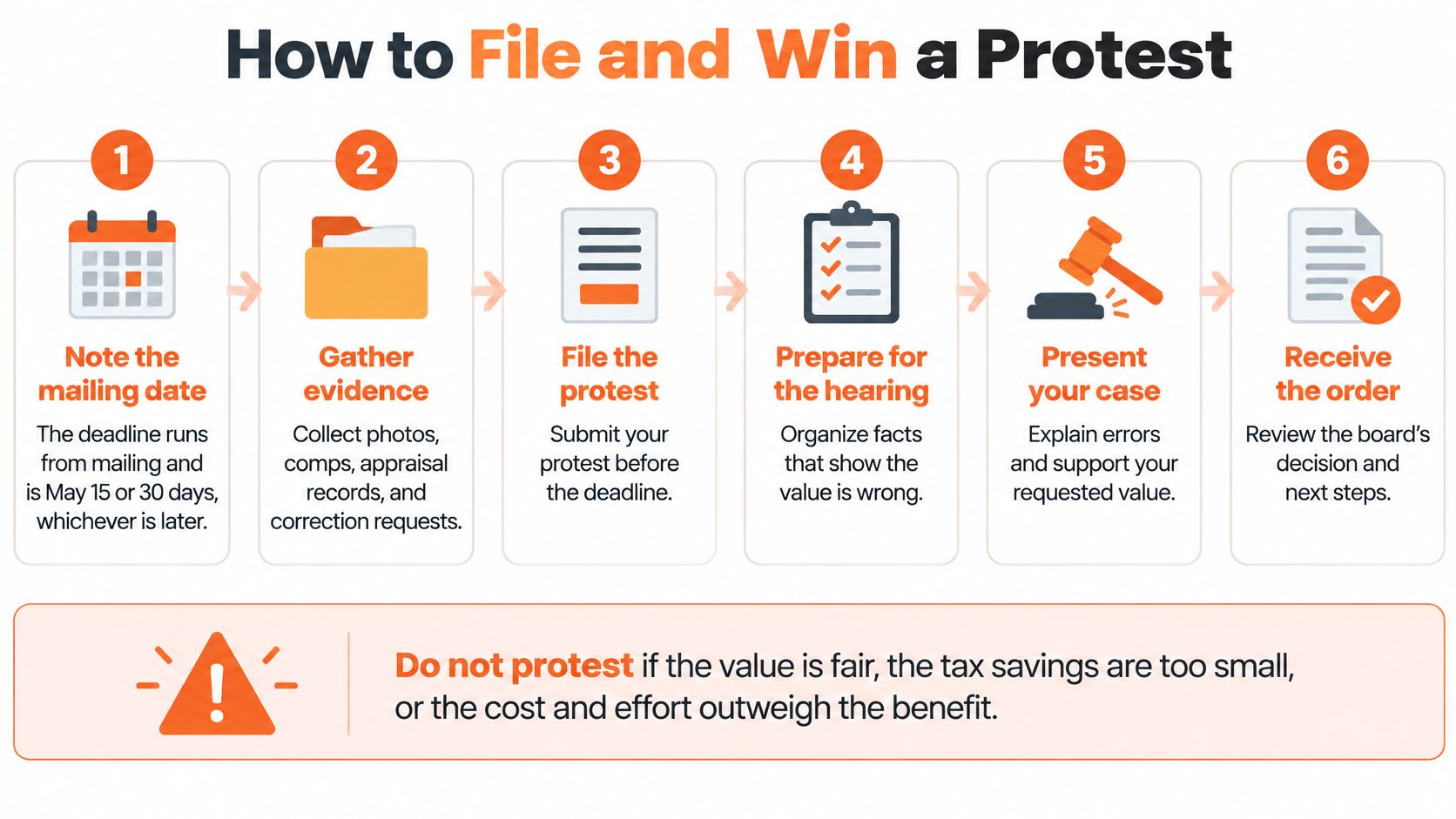
Eight moves from notice to order
- Note the mailing date. The deadline is May 15 or 30 days after the notice was mailed, whichever is later. Mark it before reviewing the proposed value.
- Compare the notice with January 1 evidence. Check the appraised value, exemptions, and any cap against sales, condition photos, and repair estimates that reflect the property on January 1. Recent listings may provide context, but they do not establish the case.
- Choose the protest ground that fits the evidence. Use market value when the sales comparison supports a lower figure. Use unequal appraisal when comparable properties are appraised more favorably. Correct errors in details such as size, class, or condition, and challenge a denied exemption when the record supports it. A focused argument is easier to support than several vague objections.
- File by the deadline, online if the district permits it. Follow the district's instructions for submitting the protest. Filing the form preserves the deadline, but evidence is needed to support the requested change.
- Submit the evidence before an appraiser meeting. Put the relevant records in the file early. Photos, repair estimates, sales evidence, and documentation of record errors are harder to consider if they arrive only as verbal explanations at a hearing.
- Discuss clear errors first, then examine the district's comparable sales. Ask which properties support the district's value. Compare those sales with your property and explain differences using a comparable property analysis. A useful comparison accounts for relevant differences rather than relying on sale prices alone.
- Request an appraisal review board hearing if the offer remains unsupported. Owners without a designated agent may request a telephone or videoconference hearing up to the fifth day before the hearing, under the hearing-format change in the Comptroller's 2025 property-tax law changes summary. That summary also addresses written notice when a protest is dismissed on jurisdictional grounds and expanded protest rights for certain historic-site exemptions, including the structure, access land, and the land-versus-improvement split. The Texas Tax Code allows the board to accept an agent's protest when authorization is filed by or at the hearing. Authorization does not fix a late filing or replace supporting evidence.
- Read the written order. Consider whether a district-court appeal is worth the cost if the order does not resolve the dispute. The hearing is not necessarily the last available step.
This short walk-through explains how to present evidence after the protest packet is in the file.
When I would skip the protest
Skip a protest when the value is supported, the record is accurate, and no exemption is missing. A small difference may not justify the time if it would not materially change the tax bill. Before filing, check the appraisal district's evidence rules, calendar, and upload instructions, including those for Austin and Travis County.
INTELLI is a Texas-based property tax reduction service that represents homeowners, investors, and businesses before county appraisal districts. Its licensed property tax consultants use a data-driven process to prepare evidence and check eligibility for legal exemptions, including Homestead, Over-65, Disabled Person, Disabled Veteran, agricultural, and historic designations. The service works on a results-based model.
If the sales support the notice and every exemption is already on the roll, spend the spring on the rate hearings instead.
If the January 1 value appears too high or the record is wrong, INTELLI's licensed consultants can prepare evidence and handle the filing on a results-based model. The firm serves homeowners, landlords, and commercial owners in Austin and across greater Texas. Visit INTELLI to see whether a protest or exemption review fits your property before the deadline closes.