
A covenant in real estate is a legally enforceable promise governing how land may be used or maintained, and when it runs with the land it can bind later owners, not only the people who signed it. You may be reading one now because a title commitment, deed, or association letter says your lot is subject to recorded restrictions, and you need to know whether the project you have planned is permitted.
What a Covenant on Your Deed Actually Means
Say you're buying in Austin and your title commitment lists recorded restrictions you never saw in the listing. You'd planned a small casita for family, maybe a short-term rental when it's empty, and a new roof in a different material. The city might allow all three, yet the documents tied to this lot could block one or more of them.
That's the confusion covenants create for most first-time buyers. A covenant is a private promise about the land itself. It can limit permitted structures, rentals, exterior materials, signage, parking, landscaping, or commercial activity, and it can narrow what the next buyer wants to do too.
A simple analogy helps. Zoning is the city's rulebook for the block. A covenant is a private rulebook that traveled with the deed, closer to an encumbrance on the title than to a permit condition.
Don't treat a use as allowed just because zoning allows it. Read the deed, declaration, title commitment, and every amendment first.
Why the wording alone isn't the whole answer
A restriction also doesn't win automatically. A court may refuse to enforce one that violates public policy, infringes civil liberties, or is pushed by someone without legal standing to enforce it. Recording, who brings the claim, and Texas statutes can all shrink a rule that looks absolute on paper.
So ask what is a covenant in real estate in practical terms, not legal terms. What does it forbid or require, who can enforce it, has Texas law overridden part of it, and does it change value or taxes? Those four questions turn a confusing title exception into a decision you can make before closing, building, or signing a lease.
Restrictive Covenants Affirmative Duties and CC&Rs
Start by sorting what you found, because the label tells you the risk. The table below puts the common types side by side so you can read your own documents against it.
How common real estate covenants differ
| Type | What it does | Binds later owners | Typical example |
|---|---|---|---|
| Restrictive covenant | Limits the owner's use | Yes, when it runs with the land | No short-term rental, exterior-material rule, or use limit |
| Affirmative covenant | Requires a specified action | Yes, when it runs with the land | Maintain a shared road or pay assessments |
| CC&Rs or declaration | Bundles subdivision rules in one recorded instrument | Yes, when recorded in county real-property records | Architectural control, assessments, and rental rules |
| Personal covenant | Binds only the original contracting parties | No | A side deal never intended to follow the land |
| Equitable servitude | Enforced in equity based on notice | Yes, with actual or constructive notice | A restriction a buyer could have found in the records |
Reading the rows in plain language
A restrictive covenant tells you what you can't do. An affirmative covenant tells you what you must do, such as maintaining a shared roadway or paying an association assessment. Cornell's Legal Information Institute explanation of restrictive covenants frames that split as limiting use versus requiring a specified action, and it's the most useful first cut for a buyer.
CC&Rs aren't a separate kind of promise so much as the bundle. In a subdivision, one recorded declaration can mix prohibitive rules, mandatory duties, permissive provisions, and administrative procedures. Architectural approval, assessments, rental caps, and sign rules often sit in the same document, which is why skimming one page misleads people.
For Texas association rules in everyday context, The Law Office of Bryan Fagan guide is a helpful plain-language companion when you're matching a declaration's language to association authority.
The test that decides whether it follows you
The key question is whether the promise runs with the land. Courts generally look for a writing, intent to bind successors, a connection to the property, and the required form of privity. Under an equitable servitude theory, actual or constructive notice can do similar work, meaning a restriction you could've found in the public records may bind you even if nobody handed it to you at closing.
A purely personal promise is different. If two owners made a side deal never intended to follow the land, it binds them, not the next buyer. That distinction matters when a seller says, "the neighbor and I agreed," but nothing in the recorded chain says successors are bound.
Use one Austin example to read the table. Zoning may allow a garage apartment, but a restrictive covenant in the declaration forbids a second dwelling unit. You'd label that restrictive, check whether it's recorded and intended to run with the land, and only then ask who can enforce it. Label every rule you find as restrictive, affirmative, or administrative before you argue about it. You'll spot quickly whether your problem is a banned use, a bill you must pay, or a procedure you must follow.
How Texas Covenants Are Created Recorded and Changed
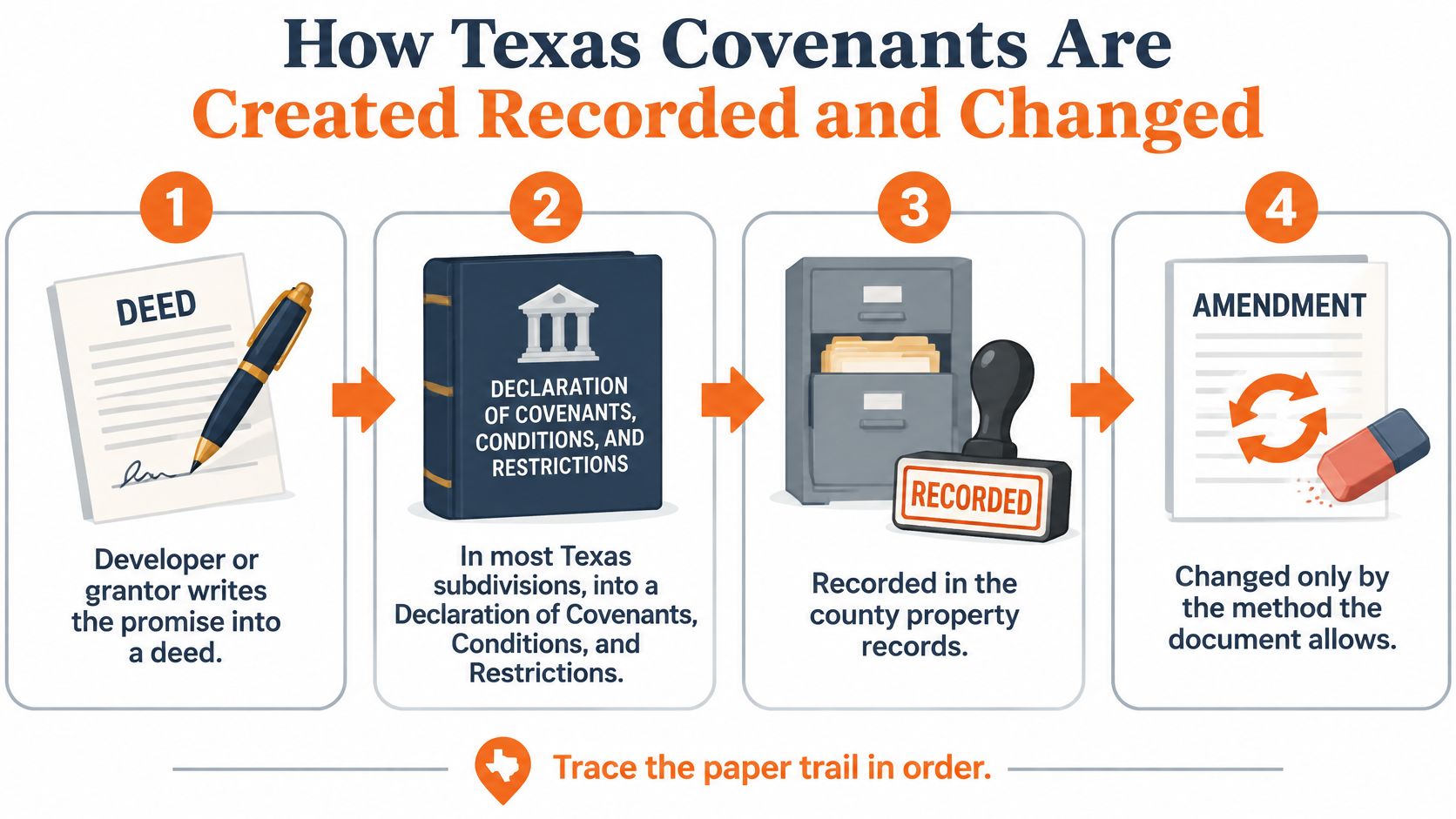
Follow the paper in order and most confusion disappears. The graphic below shows the path from a written promise to a recorded restriction that later buyers are expected to find.
Step one and two are creation and recording
A developer or grantor writes the promise into a deed or, in most Texas subdivisions, into a Declaration of Covenants, Conditions, and Restrictions or another dedicatory instrument. That declaration is then filed in the county real-property records. For an Austin-area lot, that usually means Travis County records, or the county where the land sits if you're just outside it.
Recording is what gives later buyers constructive notice. You don't need to have read the document at the kitchen table for it to matter, because it was available in the public record your title search should pull. The Texas State Law Library guide to CC&Rs explains that Texas treats a restrictive covenant broadly as a mandatory, prohibitive, permissive, or administrative covenant, condition, or restriction in such an instrument, and that Texas Property Code Section 209.0041 uses a 67% owner-approval threshold unless the declaration provides a lower percentage.
An unrecorded or badly indexed provision is a red flag. It may be difficult or impossible to enforce against a later purchaser, but don't decide that yourself during an option period. If a seller or neighbor claims a restriction exists outside the recorded chain, that's a question for a Texas real estate attorney before money changes hands.
The short video below walks through the same document trail visually, which helps if you're trying to connect a title commitment exception to the actual recorded declaration.
Step three is checking duration
Some declarations run in perpetuity. Others state a fixed term or automatic renewal periods unless owners vote to end them. An expired term can end a restriction you assumed was permanent, and a renewal clause can extend one you assumed was about to lapse, so read the duration paragraph rather than guessing from the document's age.
Step four is amendment
The declaration normally states its own voting procedure first. Check whether it sets a percentage below the Texas default, requires lender consent, or treats certain changes differently from ordinary amendments. A pending amendment on rentals or architectural control can change your underwriting after closing, so ask whether any vote is underway and get every recorded amendment, not just the original declaration.
Who Can Enforce a Covenant and How
A neighbor dislikes your new fence, but that alone does not give them authority to make you remove it. Enforcement depends on who has the right to act and what the recorded documents authorize.
A property owners' association can enforce a restriction when the declaration gives it that power. A neighbor needs legal standing, meaning a legally recognized interest in enforcing the restriction. Texas law presumes an association's discretionary enforcement is reasonable unless a court finds it arbitrary, capricious, or discriminatory. Texas Property Code Section 202.004
Covenant enforcement paths and what they require
| Remedy | Who uses it | What the owner faces | First limit to check |
|---|---|---|---|
| Monetary fine | Association under the declaration | A fine set by the governing documents, subject to notice and hearing requirements | Whether the documents authorize the fine and the required process was followed |
| Self-help remediation | Association | Repairs done and costs charged back | Whether the documents allow entry and cost recovery |
| Administrative proceeding | Association board or committee | A hearing before a lawsuit | Required procedure and evidence of waiver |
| Civil litigation | Association or a neighbor with standing | Injunction, damages, or both | Standing, public policy, and selective enforcement |
What each path feels like in practice
A fine is not automatically a daily charge. Its amount and process depend on the governing documents and applicable notice and hearing requirements. Self-help goes further: the association performs the work and seeks to charge you, if the documents permit entry and cost recovery.
An administrative proceeding gives the association a chance to address the alleged violation before a lawsuit. Check whether the documents require notice, a chance to cure, or a hearing. Civil litigation can result in an order stopping a use or requiring removal of a structure, so resolving a proposed change before construction may prevent costly rework.
Check authority first: Confirm that the association can enforce the specific rule, and ask about its enforcement history before deciding that a violation will be easy to ignore or challenge.
When Covenant Wording Does Not Control
A covenant may say “no solar panels,” yet Texas law can protect some solar devices. For a buyer planning an upgrade, the difference between the words on the page and the rule that can be enforced may shape what can be built and how appealing the property is to future buyers.
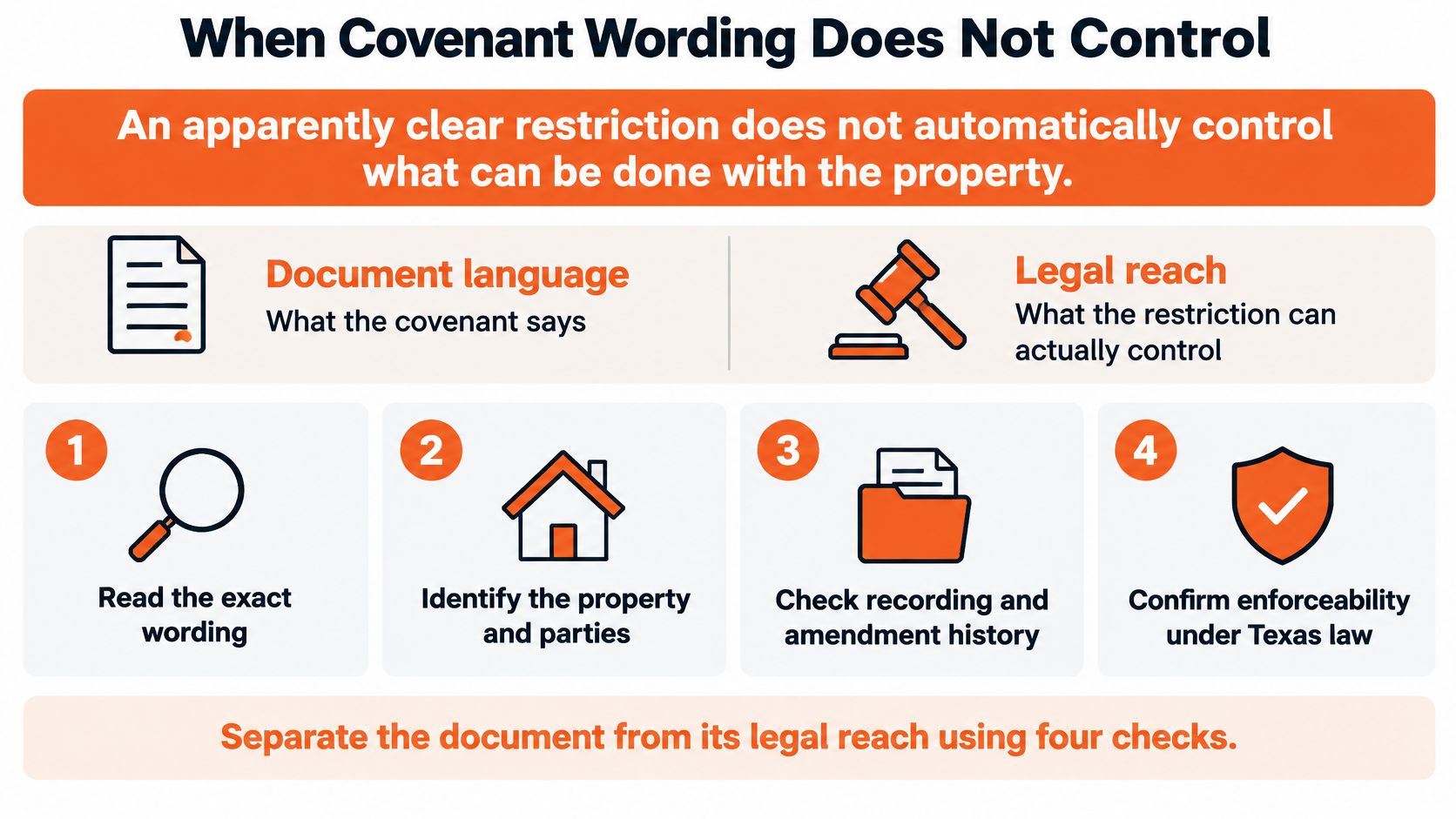
Run four checks before you give up or proceed
Read the recorded declaration first. Then ask whether state law limits the restriction, whether required procedures were followed, and whether the association has applied the rule consistently. These checks work like a zoning review: the written rule matters, but so do the authority behind it and limits imposed by law.
Under Texas Property Code Section 202.004, an association's discretionary enforcement is presumed reasonable unless a court finds it arbitrary, capricious, or discriminatory. The statute also allows a court to award civil damages of up to $200 per day for a violation. A disagreement with the rule alone may not resolve the issue; the key question is whether the restriction is authorized and enforceable in the circumstances.
Texas overrides owners miss most
Solar protections provide a clear example. Associations generally cannot prohibit or unreasonably regulate protected solar-energy devices. The 2025 Texas legislative update report notes that Texas House Bill 431, effective May 29, 2025, expanded the statutory definition of protected solar-energy devices to include solar roof tiles. A covenant drafted with conventional panels in mind may therefore reach less than its wording suggests.
Texas law also limits associations' ability to prohibit certain water-conservation measures, including rainwater harvesting, efficient irrigation systems, and drought-resistant landscaping. Associations may still regulate appearance, so the precise line matters.
For example, a Bee Cave or Austin covenant may require uniform green turf while an owner wants to replace part of the lawn with drought-tolerant plants. The question is whether the association is regulating appearance or effectively prohibiting a protected conservation measure. The planting plan and recorded documents can affect the answer.
Landlords and commercial owners can apply the same checks to renovations, leasing, signage, landscaping, and redevelopment. Before shelving a project, determine whether a statute, a missing procedural step, or the association's enforcement conduct narrows what the covenant can control.
How Covenants Change Value and Texas Taxes
A Bee Cave home may meet zoning rules for a garage apartment, yet a recorded covenant may prohibit one. That difference can remove potential rental income, narrow the buyer pool, and affect what the property is worth. A restriction can also add costs, such as required exterior materials or landscaping upkeep.
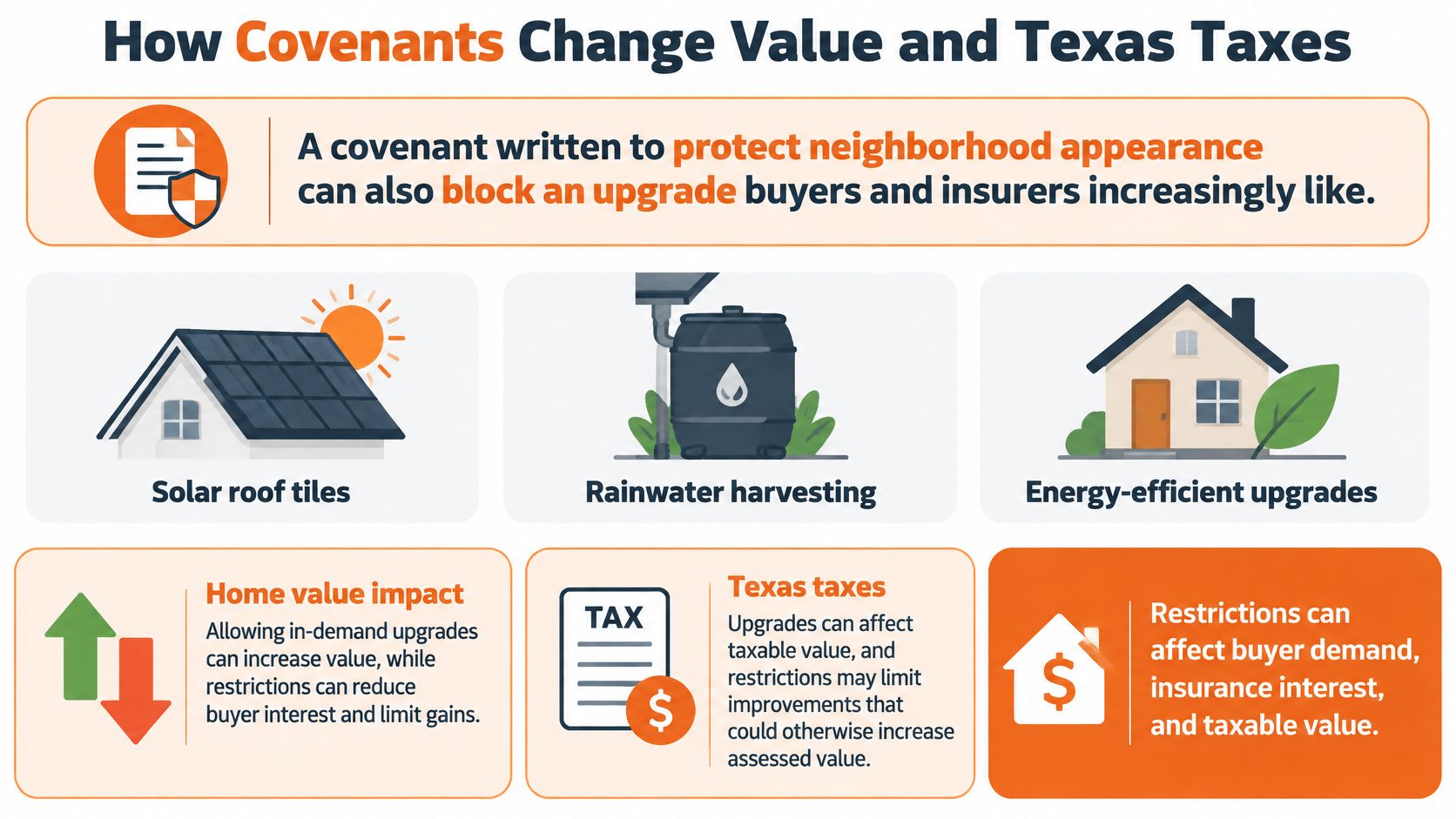
Ask three value questions, not for a formula
First, what uses does the covenant remove that zoning would otherwise allow? A restriction on a garage apartment, rental, or home business can limit income or flexibility a buyer might value. Second, what extra costs does it create, such as required materials, landscaping water use, assessments, or delayed repairs?
Third, does the restriction prevent an improvement that could appeal to buyers or reduce utility costs? The legal reach of a covenant depends on more than its wording: recording, who has standing to enforce it, selective enforcement, and statutory limits can all matter. If a restriction does apply, blocking an improvement may narrow buyer interest.
Restrictions can also support value by limiting nuisances, neglected exteriors, or incompatible nearby uses. In areas shaped by a historic preservation overlay zone, limits may protect neighborhood character while constraining changes an owner wants to make.
A covenant affects value when it removes a use, raises a cost, or limits an improvement buyers would value.
Where Texas property taxes enter the picture
The appraisal district's assessed value helps determine a property's tax bill. If a covenant affects the property's condition, permitted use, or operating costs, those details may help explain why its value differs from comparable properties. They are supporting evidence, not proof of value on their own.
According to the Texas Comptroller's property tax protest guidance, under Texas Tax Code Section 41.44 the usual deadline to file a protest is May 15 or the 30th day after the appraisal district mails the notice of appraised value, whichever date is later. The deadline runs from the mailing date, so note it when the notice arrives.
For an Austin-area property, keep records of restrictions that affect repairs, potential uses, or maintenance costs. Compare those limits with comparable sales, condition records, and income data where relevant. INTELLI uses a proprietary, data-driven system to prepare that evidence and watch these deadlines. A real estate attorney can assess enforceability; a property tax specialist can assess whether the restriction supports a different value for the tax year.
Review the Records Before You Buy or Build
Before option money goes hard, check whether the recorded rules fit the way you plan to use the property. A restriction that seems minor on paper can affect a rental plan, renovation budget, or resale appeal.
- Pull the full record: Get the deed, recorded declaration, title commitment, and amendments. Note the recording details so you can trace the chain, much as an abstract of title helps track ownership history.
- Label and list: Sort each rule as restrictive, affirmative, or administrative. Then list the uses you need, such as a particular rental term, sign, roof material, parking arrangement, or renovation.
- Check the operating rules: Review architectural standards, assessments, rental limits, and any pending amendment vote. Check the declaration for its approval threshold for amendments.
- Test the legal reach: Before redesigning a project, check whether notice, waiver, selective enforcement, or Texas rules on solar, irrigation, rainwater, or drought-resistant landscaping limit the restriction.
- Price the restriction: Use quotes and potential lost rent to estimate the effect on use, operating costs, and resale appeal. Consider whether the restriction also belongs in your appraisal evidence.
- Split the final calls: Ask a Texas real estate attorney about standing, amendment disputes, or lawsuits. Ask a property tax specialist about assessed value or protest deadlines.
A renovation and resale plan needs this review before financing terms are set. A prohibited addition or rental strategy can change the numbers behind the project. For background on sequencing the financing decision, see first-flip financing advice from Quicklending. The specific lot's recorded rules still determine what you can do.
For residential, rental, and commercial properties, INTELLI helps Texas owners reduce property tax bills. Its proprietary, data-driven system prepares evidence to challenge property valuations. Customers pay the 25% fee only after they see savings on their property taxes. Tax evidence can address value; it does not decide whether a covenant is legally enforceable.
If a covenant limits how you can use, improve, or lease a Texas property, include that restriction when reviewing its assessed value. Visit INTELLI to learn how the service can help with a property tax review.