

Qualifying Texas land is taxed on productivity value from agricultural income, not on what the parcel would sell for. For example, $40 in sustainable annual net-to-land income divided by a 10% capitalization rate produces a productivity value of $400 per acre.
You might be holding an appraisal notice that lists a surprisingly high market value for a pasture you still use for grazing. Before you assume the district has taxed those acres as a future subdivision, check which value it used. The practical questions are whether the land qualifies, whether the agricultural class is correct, and what happens if you change its use.
What Texas Agricultural Land Valuation Actually Taxes
A pasture outside Austin can attract a developer while still supporting cattle or hay. The buyer is considering roads, utilities, and future building sites. The agricultural appraisal considers the land's ability to produce agricultural income.
That distinction is the foundation of agricultural land valuation in Texas. It's a special appraisal, not a promise that the land has a low sale price, and it doesn't mean every part of a rural property receives agricultural treatment.

Two values for different questions
Under the Texas Comptroller's agricultural appraisal manual, Tax Code Section 23.41 values qualifying 1-d agricultural land according to its capacity to produce agricultural products, while Section 23.53 applies income capitalization to qualified open-space land. The manual also explains that appraisal districts record market value and productivity value separately.
Think of market value as pricing the land's possible next life. Productivity value prices the agricultural earning capacity of the land in its qualifying use. A wide gap between those figures can be the intended result, not a clerical mistake.
Development interest around Austin makes that distinction especially important. A buyer's willingness to pay for future housing doesn't tell you what a grazing operation can sustainably earn.
Notice check: Look for both market value and agricultural productivity value. Don't assume the largest number on the page is the number used to calculate tax on qualifying acres.
Keep separate property decisions separate
Agricultural appraisal addresses taxation. Insurance addresses a different set of risks, including the exposures associated with operating and maintaining agricultural property. If you're reviewing those protections too, agricultural insurance from Farm & Country Insurance offers a useful starting point for that separate discussion.
For the tax review, begin with the qualifying acres, their use, and their assigned agricultural class. Then examine the supporting records, the income calculation, and any planned change that could create rollback exposure.
Who Qualifies for 1-d and Open-Space Appraisal
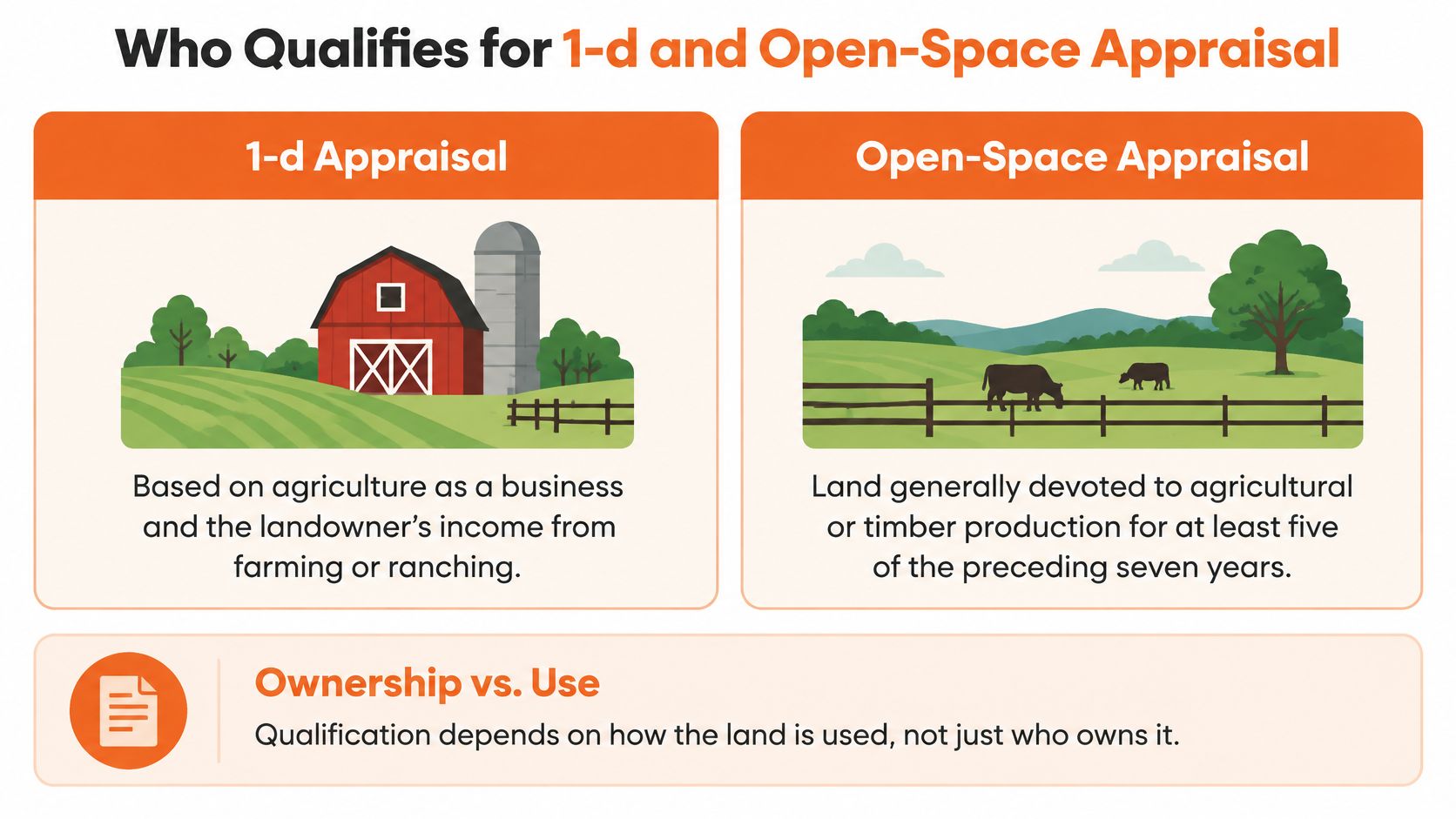
The label on a deed does not qualify land. Eligibility turns on history, current agricultural use, and whether the operation meets the county's degree-of-intensity standard. Qualification is the gate; once land qualifies, Texas prices agricultural earning power rather than a speculative next use.
1-d versus open-space 1-d-1 eligibility
| Test | 1-d agricultural appraisal | Open-space 1-d-1 |
|---|---|---|
| History required | Exclusive agricultural use or continuous development for three successive years inside the prior five | Agricultural or timber production for at least five of the preceding seven years |
| Current use | Principal agricultural use now | Current agricultural production, generally intended for sale, at the local degree of intensity |
| Intensity evidence | Local production or management standard | Acreage, animal units, or typical management the county accepts under its local standard |
| Land that may fit | Owner-operated land meeting the applicable business, owner, and use requirements | Open-space land, including leased land, if the actual use qualifies |
| Appraisal method | Capacity to produce agricultural products under Section 23.41 | Net-to-land income divided by the cap rate under Section 23.53 |
The Texas Comptroller's agricultural and timber appraisal guidance distinguishes the five-of-seven-year history for open-space appraisal from the three-successive-years-within-five history for 1-d appraisal, and requires qualifying agricultural intensity. They are separate tracks with different history tests.
Ownership alone doesn't establish eligibility. Buying land advertised as ag exempt doesn't prove that your intended use will satisfy the appraisal district.
Intensity means a recognizable agricultural operation
A county examines whether the operation resembles agricultural production practiced locally. A few animals kept as pets aren't equivalent to a managed grazing operation merely because both occupy pasture.
County materials often describe intensity through acreage, animal units, productive capability, principal devotion to agriculture, and accepted management practices. Read those as local standards to be matched with records, not as labels to repeat in an application.
A grazing lease can support an application, but the signature alone isn't enough. The records should establish what the tenant does, where the animals graze, and how the operation meets the county's expectations.
Match the evidence to the use
Different operations need different proof:
- Grazing leases: Keep lease terms, livestock records, animal-unit counts, and dated pasture photographs.
- Hay production: Retain cutting records, sales receipts, input expenses, and maps identifying harvested fields.
- Orchards: Document planting, maintenance, harvests, and product sales rather than relying on photographs of trees.
- Small livestock operations: Show productive activity and management, not animal ownership alone.
- Wildlife management: Confirm the separate open-space qualification path before assuming wildlife activity replaces agricultural production automatically.
At INTELLI, the review is data-driven: public and private data are compared against the applicable county standard before the file is treated as support.
For an initial open-space self-screen, ask whether you can document the required agricultural history, demonstrate current qualifying production, and show a level of management the county recognizes. If any answer is uncertain, resolve that gap before relying on the tax treatment.
Productivity Value Versus Market Value Per Acre
The basic calculation is straightforward:
Productivity value per acre = average annual net-to-land income ÷ applicable capitalization rate.
The Texas Comptroller's capitalization-rate guidance gives the framework: $40 per acre divided by 10% equals $400 per acre, while the same income divided by 8% equals $500. A higher divisor produces a lower value, which is why a capitalization rate doesn't work like a tax rate.
Market value and productivity value side by side
| Figure on the roll | What it measures | How Texas sets it | Worked per-acre result |
|---|---|---|---|
| Market value | Likely sale price, including development pressure | Generally full market value, retained on the appraisal record | A hypothetical development parcel could indicate thousands of dollars per acre |
| Productivity value under 1-d-1 | Agricultural earning capacity only | Five-year average net-to-land income divided by the cap rate | $40 net income at 10% equals $400 per acre |
| 2025 capitalization rate | Legal divisor for open-space land | Greater of 10.00% or the Farm Credit Bank of Texas prior December 31 rate plus 2.5 percentage points | Comptroller published rate of 10.00% |
Start with income after allowable costs
Net-to-land income isn't gross sales. The appraisal district estimates agricultural revenue under prudent management, subtracts allowable operating costs, and uses the prescribed averaging period. Relevant costs can include property taxes, fencing, and irrigation-well expenses.
That isn't necessarily the same as taking your latest farm tax return and dividing its bottom line by acreage. The appraisal process uses agricultural classes and prudent-management assumptions, rather than treating every owner's financing choices or unusual expenses as a new county valuation schedule.
For qualified open-space land, the statutory rate is the greater of the minimum rate or the specified Farm Credit Bank of Texas rate calculation. Use the rate published for the appraisal year you're reviewing, not a remembered rate or the interest rate on your own land loan.
A capitalization rate converts income into value. Your property-tax rate is then applied to taxable value to calculate tax. They aren't interchangeable percentages.
Check the class before arguing about the arithmetic
The calculation can be mathematically correct and still produce the wrong result if the district assigns the wrong class. Irrigated cropland, dryland cropland, improved pasture, and native pasture don't necessarily support the same income assumptions.
Compare the district's class description with actual conditions. Note irrigation availability, productive acreage, grazing capability, and management practices. A map showing where irrigation stops may be more useful than an appraisal showing what nearby development land sold for.
For broader context, INTELLI's explanation of property valuation methodology helps distinguish the questions different appraisal methods answer.
Ask for the district's class-specific income figure and capitalization calculation. For an appraisal year using a ten-percent rate, dividing the applicable income by 0.10 is a reasonableness check, not a substitute for confirming the class, qualifying acreage, and published annual rate.
How to File Before the May 1 Deadline
A strong application connects the parcel, the agricultural history, and the current operation. Don't send a stack of receipts without explaining which land and use they support.
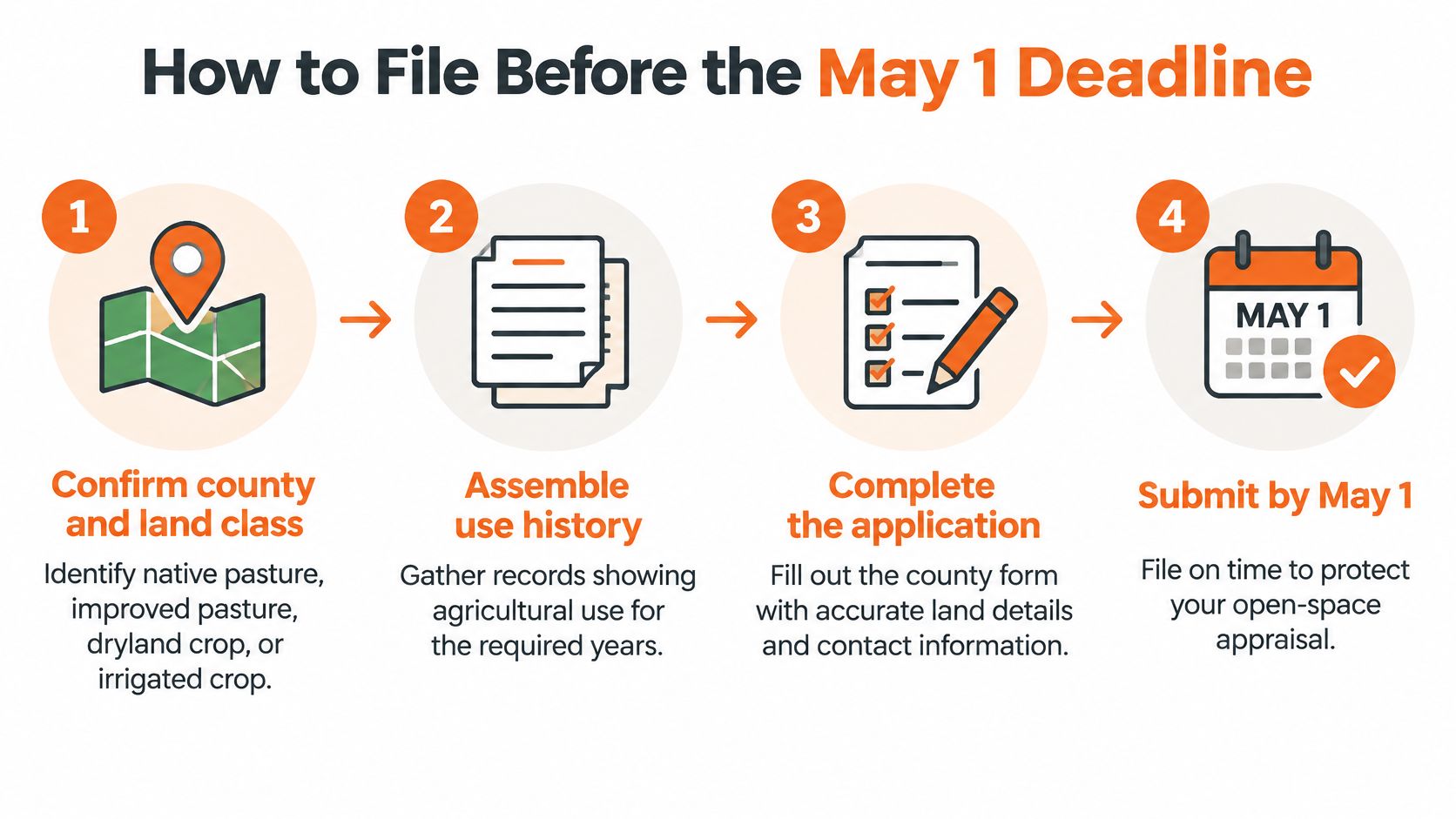
Follow the filing sequence
Confirm the county and agricultural class. Identify the responsible appraisal district and whether the acres are native pasture, improved pasture, dryland crop, or irrigated crop. Separate the homesite and other nonqualifying areas.
Assemble the use history. Organize records by year and by operator. Include prior-owner or tenant records where needed, plus leases, production and sales records, photographs, animal-unit counts, and a map of acres used.
Complete the application. Open-space applications commonly use Comptroller Form 50-129, filed with the chief appraiser. Make sure parcel identifiers, ownership information, acreage, and use descriptions agree with the supporting documents.
File before May 1 of the tax year. Keep proof of delivery or electronic submission. A completed form sitting in your records isn't a filed application.
Act promptly if you miss the deadline. A late application may be possible before the appraisal review board approves the appraisal records. The late penalty is generally 10% of the difference between tax at market value and tax under special appraisal, so confirm the available filing window with the district immediately.
Answer evidence requests. If the district asks for stocking records or additional history, respond directly to that issue. More unrelated photographs won't resolve an unexplained gap in qualifying use.
Protest a denial on time. Follow the deadline on the notice rather than assuming you have extra time. Build the protest around the disputed eligibility, class, or income issue, not only neighboring sale prices.
Build a packet someone else can follow
Required documents and what each proves
| Document | What it proves | Test it supports |
|---|---|---|
| Use history covering five of the preceding seven years | Agricultural or timber production during the qualifying years | Open-space history test |
| Lease and sales records | Who farms the land and that products are sold | Current use for sale |
| Production records and animal-unit counts | Local intensity standard is met | County intensity test |
| Dated photos and acreage map | Which acres are in production and which are idle or homesite | Parcel-level exclusion |
| Signed Comptroller Form 50-129 | Formal application to the chief appraiser | Filing before May 1 |
Approval generally continues without an annual new application while qualifying circumstances remain unchanged, unless the district requires one. A new owner or material change needs attention, so don't assume the seller's paperwork completes your obligations.
This week, gather the history, lease, production proof, acreage map, and signed application. Label each attachment so the reviewer can connect it to the relevant parcel and qualifying use.
Parcel Tax Savings and Rollback Risk
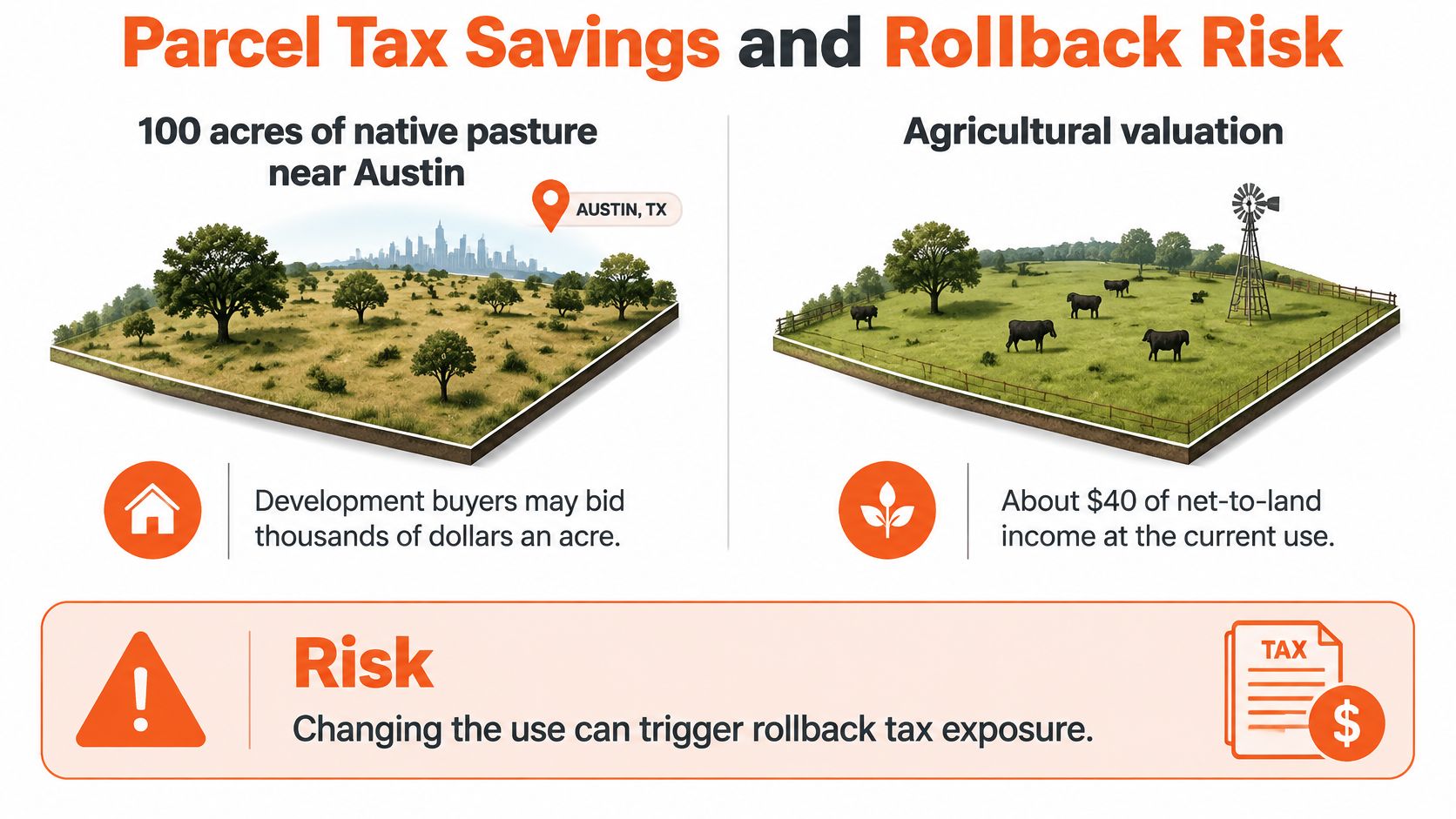
Parcel sketch A, native pasture near Austin. A hypothetical 100-acre tract carries a market indication of $8,000 per acre. If its applicable productivity value is $400 per acre, the land-value comparison is $800,000 at market versus $40,000 under agricultural appraisal. The taxable number under 1-d-1 reflects what the land can earn producing forage, not what a buyer would pay for the location.
Parcel sketch B, irrigated cropland. Assume sustainable net-to-land income of $120 per acre and a 10% capitalization rate. That produces $1,200 per acre, which shows why a more productive agricultural class can carry a higher productivity value than pasture.
County schedules set the actual values; these numbers only demonstrate the mechanics.
Translate the value difference into a tax estimate
For the pasture example, assume a combined tax rate of $2.00 per $100 of taxable value. Keep the rate hypothetical, because actual rates come from the taxing units serving the parcel.
| Hypothetical land calculation | Market-value treatment | Productivity-value treatment |
|---|---|---|
| Acreage | 100 acres | 100 acres |
| Value per acre | $8,000 | $400 |
| Total land value | $800,000 | $40,000 |
| Tax at the assumed rate | $16,000 | $800 |
The hypothetical annual land-tax difference is $15,200. That figure covers only the land; the home and other improvements require their own appraisal treatment, and agricultural qualification doesn't automatically extend to everything on the property.
A national land-price average can't establish this parcel's agricultural tax value. The USDA's 2025 land values and cash rents report reported average U.S. cropland value of $5,830 per acre and pastureland value of $1,920 per acre. Those are market benchmarks across broad categories, not Texas productivity schedules.
Protect qualification with actual operating evidence
The Austin County agricultural guidelines emphasize qualifying use, current agricultural production intended for sale, and locally accepted intensity. The practical lesson is to document the operation itself, not merely the presence of livestock or agricultural-looking land.
Keep agricultural income separate from solar leases, hunting income, conservation payments, and development expectations in your working analysis. Don't capitalize every receipt as agricultural income, and don't count the same earning opportunity in multiple valuation components. Ask how each agreement affects qualifying use before signing it.
A solar lease that removes productive acreage presents a different question from a grazing lease that continues the agricultural operation. Token animals don't resolve that distinction.
Compare savings with the cost of changing use
Changing qualified open-space land to a nonqualifying use can trigger rollback taxes. The rollback works like repaying a deferred benefit: the parcel was taxed on earning power for years, and the use change collects the difference back. Before clearing, developing, or committing acreage to another use, review rollback taxes in Texas and obtain a parcel-specific calculation.
Under the open-space rollback rules in Tax Code Section 23.55, the recapture generally covers the tax difference for the three years preceding the change, and the recaptured taxes are generally collected with interest on each year. Ask the appraisal district to show the tax difference and the interest separately for each of the three years so the total can be checked rather than guessed.
For a simplified hypothetical, if the annual tax difference remained $15,200 throughout that lookback, the recaptured difference alone would be $45,600 before interest. Actual exposure requires the historical values, rates, affected acreage, and applicable legal treatment, not merely multiplying the latest bill.
Before changing use: Ask for the estimated rollback amount in writing and identify the acres that would trigger it. Treat that estimate as a project cost alongside surveying, utilities, and construction.
A sale and a change of use aren't the same event. A buyer can acquire qualified land and keep the agricultural appraisal while the qualifying use continues; the recapture attaches to the change in use, not the deed. Address intended use, responsibility for potential rollback charges, and agricultural operating arrangements during transaction planning rather than after work begins.
Confirm the Appraisal Before You Pay the Bill
The notice should show a productivity value based on the land's agricultural earning power. A parcel can appear correct at first glance while an acreage line, land class, or special-appraisal entry produces the wrong taxable result.
Use the notice of appraised value to check the parcel details, acreage, agricultural class, values, exemptions, and protest instructions. If the notice does not show how the district reached the agricultural value, ask for the acreage and class breakdown behind it.
Match the problem to the evidence
The right records depend on the error:
- Missing special appraisal: Gather the application, delivery confirmation, use history, and any district correspondence.
- Incorrect agricultural class: Provide maps, irrigation information, production records, and photographs showing actual land conditions.
- Unsupported productivity figure: Request the class income schedule and calculation, then identify the specific assumption you dispute.
- Planned use change: Record the affected acres and proposed activity so rollback exposure can be reviewed separately.
Don't wait for the tax bill to begin this check. Follow the protest deadline printed on the notice, and keep copies of everything submitted.
Decide whether you want representation
A consultant doesn't replace a required application or turn nonqualifying use into qualifying production. Missing agricultural appraisal is also a different problem from an inflated market valuation on a house, even when both appear on the same property account. The useful question is whether the evidence supports the appraisal treatment assigned to each part of the property.
INTELLI helps Texas property owners reduce their property tax bills through property tax consultants and a data-driven approach. Its Assessment Appeals service challenges inflated property valuations with evidence and expert representation.
For an agricultural review, organize the current notice, agricultural history, lease or production records, and a description of any planned use change. That gives the reviewer specific records to test against county requirements.
INTELLI doesn't charge customers if it doesn't lower their property taxes. The immediate goal is a supported appraisal position and a clear understanding of the obligations attached to the land's current use.
INTELLI offers evidence-based property-tax review and representation for Texas owners who need help evaluating agricultural appraisal issues. Gather your notice, use history, and production records, then visit INTELLI to discuss a review of your property's qualification, classification, and valuation.