

For most Travis County owners, the 2026 TCAD protest deadline is May 15 or 30 days after the appraisal district mails the notice of appraised value, whichever date is later. That means May 15 isn't necessarily your final opportunity to file.
The counterintuitive part is that the mailing date controls, not the day you open the envelope. A landlord whose notice passes through a property manager and a homeowner who opens it immediately use the same calculation. The safest approach is to confirm that date, preserve your protest rights, and then finish building the valuation case.
The 2026 TCAD Protest Deadline at a Glance
The Texas Comptroller's protest guidance gives the usual 2026 deadline as May 15 or 30 days after the notice is mailed, whichever is later. Treat that as a calculation attached to your notice, not a recurring calendar appointment.
The Comptroller's statewide protest overview explains that mailing, rather than receipt, starts the notice-based period; deadlines falling on weekends or legal holidays move to the next business day. It also identifies the general notice targets shown below.
Key TCAD dates for the 2026 protest season
| Milestone | Date or rule | What it means for you |
|---|---|---|
| Homestead exemption application | April 30, or the next Monday if it falls on a weekend | Apply for the residence homestead exemption if eligible |
| Single-family notices of appraised value | Generally sent by April 1 | The mailing date starts the protest count |
| Other property notices | Targeted for May 1 or as soon as practical | Check the mailing date printed on your notice |
| Protest deadline | Later of May 15 or 30 days after notice is mailed | File by this date to preserve your rights |
| ARB hearings begin | After the May 15 filing deadline | Aim to have evidence ready before this point |
| Hearings generally completed | By July 20, with possible extensions for larger counties | Expect hearing activity during this window, subject to scheduling |
| Late protest cutoff for good cause | Before the ARB approves the records, typically mid-July | Written explanation and verifying documents are required |
The Texas statutory framework provides for hearings generally beginning after the filing deadline and completion by July 20, subject to applicable extensions. The exemption and late-filing rows involve separate procedures, not automatic extensions of an ordinary valuation protest.
Know what you're preserving
An appraisal protest challenges the district's appraisal or another protestable determination, not the tax rate adopted by a taxing unit. A lower value and a lower rate are different routes to a different tax bill.
Practical rule: File while you're organizing the evidence, not after every photograph, comparable sale, and repair estimate is ready.
TCAD accepts online protests. Early filing protects access to the protest process; it doesn't guarantee a reduction or eliminate later hearing requirements.
How to Work Out Your Own Protest Deadline
Use the actual notice rather than a neighborhood mailing estimate. For single-family residential property, the Texas Comptroller's valuation guidance identifies April 1, or as soon afterward as practicable, as the general notice mailing target for 2026. A target date isn't proof of when your particular notice was mailed.
Calculate from the document
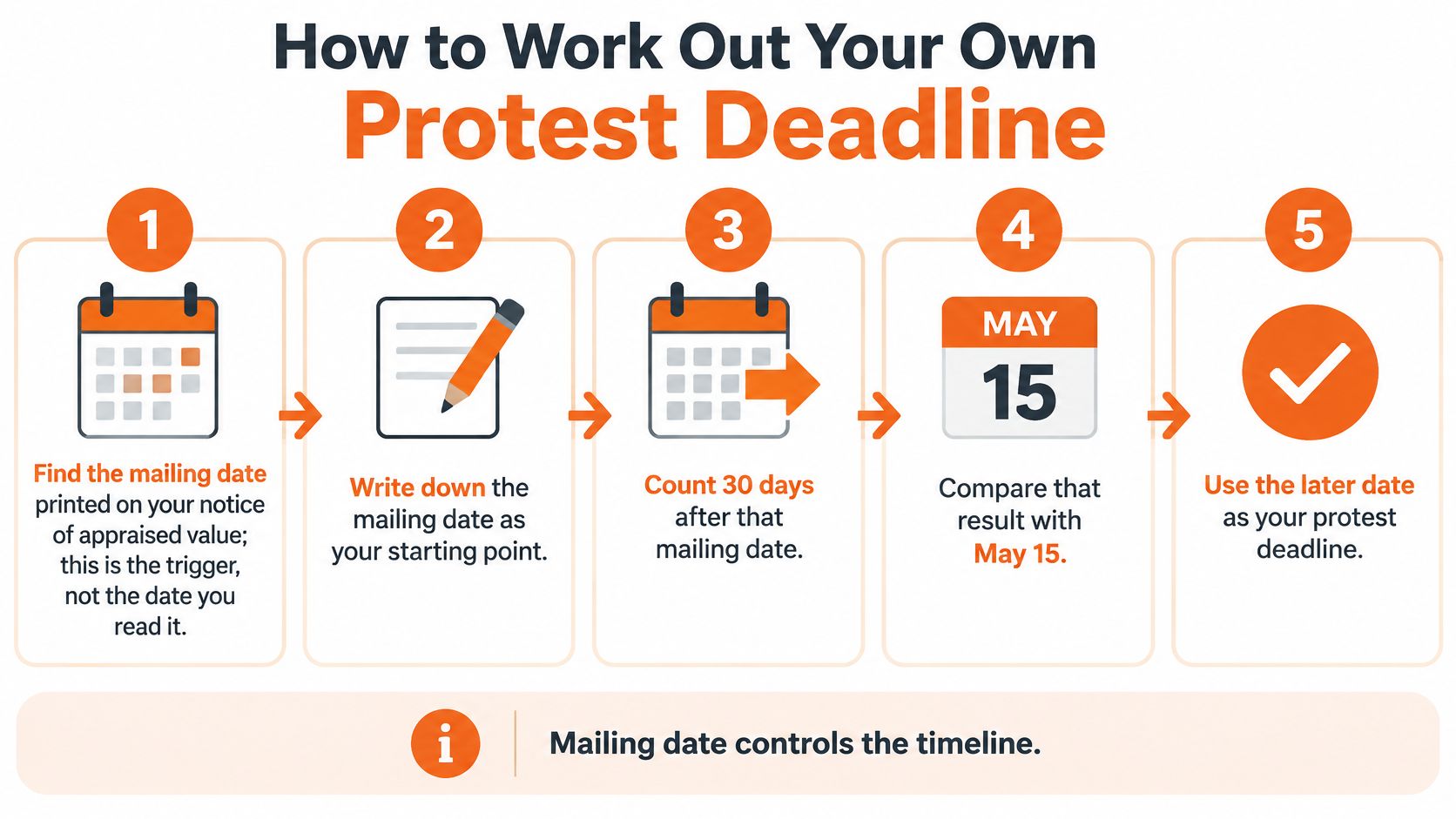
Find the mailing date. Locate the date on your notice of appraised value. If you're unsure which field controls, use this explanation of the notice of appraised value to distinguish the notice from a later tax bill.
Write down the calendar floor. Keep the statewide filing date beside the notice date. Don't assume an earlier notice-based result shortens your ordinary filing window.
Count forward from mailing. Calculate the notice-based period using calendar days, rather than counting only weekdays. Keep the calculation with the notice so another person managing the property can check it.
Choose the later result. That comparison is the central step. A delayed notice can produce a later filing deadline, but opening an envelope late doesn't create one.
Check the final day. Apply the weekend or legal-holiday adjustment after choosing the later date. The Comptroller's protest information document explains the May 15-or-30-days rule and the deadline adjustment.
Create a filing buffer. I recommend setting a reminder seven days earlier as a personal planning choice, not a legal requirement. File online and save the submission record rather than leaving the task in an unfinished browser tab.
Use this visual to check the sequence against your notice.
Test the calculation
For a hypothetical notice mailed April 3, adding 30 days produces May 3, so May 15 controls. For a hypothetical notice mailed May 10, the same calculation produces June 9, which is later and becomes the deadline, subject to any applicable final-day adjustment.
If you regularly manage legal calendars, MatterAlert's guide to counting court deadlines provides useful context on calendar-day versus court-day counting. Don't substitute a court's counting rules for the property-tax rule.
Landlords and absentee owners should ask their manager for the mailing date in writing. Keep the envelope and notice PDF, and assign a named person to submit the protest. Forwarding a notice isn't the same as filing one.
Special Cases That Change Your Protest Window
Not every notice follows the ordinary valuation calendar. Start by identifying who issued the determination and what changed, then match the notice to the appropriate procedure.
Review the notice and supporting paperwork together rather than relying on a calendar entry alone.

Protest deadlines and requirements by situation
| Situation | Deadline or rule | What you need |
|---|---|---|
| Standard residential or commercial protest | Later of May 15 or 30 days after notice is mailed | Timely notice of protest, followed by evidence under applicable hearing instructions |
| ARB-initiated change increasing liability | Generally within 30 days after notice delivery | Written challenge, the change notice, and supporting evidence |
| Agricultural change-of-use determination | Within 30 days after notice | Documents showing the facts of the use change |
| Good-cause late protest | Before the ARB approves the records, typically mid-July | Written explanation and verifying documents |
| Offshore worker or military outside the U.S. | Possible late-filing treatment, but before the account becomes delinquent | Proof of work location or qualifying service status |
| Tax rate or tax bill dispute | Not settled by an appraisal protest | A separate review process with the responsible taxing unit or office |
The Comptroller's property-tax protest guide describes the special 30-day notice-based windows for ARB-initiated increases and agricultural change-of-use determinations, plus qualifying offshore and overseas military exceptions before delinquency.
Match the exception to proof
For an ordinary valuation protest, identify the property and grounds first, then assemble the valuation evidence. For an ARB-initiated increase, retain the delivered notice and explain the disputed change. Agricultural cases need records of actual use, not merely a statement that the owner disagrees.
According to TCAD's frequently asked questions, a good-cause late protest, such as one involving serious illness, requires a written explanation and verifying documentation before record approval, typically in mid-July. TCAD also says a protest generally must be filed or delivered to the postal service or private carrier by the statutory deadline.
An offshore worker should document work location; a qualifying service member should retain service and location records. Neither should assume absence alone excuses every missed obligation.
A late protest is an exception to request, not a filing strategy.
Keep the applicable notice beside you when reviewing any additional process explanation.
For a rate or billing disagreement, identify the responsible taxing unit or billing office. Sending valuation evidence to TCAD won't, by itself, resolve that separate issue.
What Happens If You Miss the Deadline
Miss the date calculated from your notice's mailing date, and that year's appraisal generally stands. The ordinary chance to contest the value on that notice is gone for the tax year it covers.
About $1,000 in extra annual tax is the consequence in this simplified hypothetical: a home appraised at $500,000 should instead be valued at $450,000, and an assumed combined tax rate of 2% applies to the entire difference. The calculation is $50,000 multiplied by 2%. It isn't a Travis County rate quote or a promised saving.
Exemptions, applicable limits, and each taxing unit's rate change what hits the bill. If the same taxable overvaluation and assumed rate continued, that extra cost would appear again. Future appraisals and tax bills are not fixed.
The lost opportunity is procedural
Filing by the date that runs from the mailing date on the notice that applies to your property is what preserves the hearing. That filing is how sales comparisons, property-condition evidence, or an unequal-appraisal case reach the decision-makers. Without a timely protest, or an exception you qualify for, the district's value generally remains in place for that year.
An unanswered email does not keep the protest alive. An informal talk about correcting the value does not either. Only a filed notice does.
After a missed deadline: Confirm the filing record and ask promptly whether a statutory exception applies. Don't spend the remaining time arguing valuation before establishing whether the protest can be heard.
I would not treat a strong valuation file as a way back into a closed window. Any exception turns on why the mailing-date deadline was missed, not on how far the appraisal sits above what you think the property is worth.
Keep payment and protest separate
A value dispute does not, by itself, pause the tax bill. Keep tracking the bill, and confirm the payment rule that applies to the procedure you are in.
The immediate work is narrower than rebuilding the whole case: check whether any relief still fits this notice, write down the circumstances, and stop the same miss next cycle. For organizing that recovery sequence, missed deadline advice from Pretty Progress is only a general planning resource. It is not authority on Texas property-tax exceptions.
Assign one person to open the notice, compare the proposed value with relevant local sales, and calendar the filing from that mailing date before anyone starts calculating the last possible day.
How to File and Prepare Evidence Before the Deadline
File by the date calculated from your notice mailing date, then strengthen the evidence. A finished packet from a contractor, broker, or property manager does not help if that window closes first.
That date is not one fixed day on the calendar for every owner. It runs from the mailing date on the notice you received, and filing by it preserves the ordinary chance to argue market value, unequal appraisal, or incorrect property characteristics. Waiting for one more comparable does not move the date.
Move from filing to review
Submit a complete notice of protest. File through TCAD's online system or use an accepted delivery method under its current instructions. Identify the property and the actual grounds, such as excessive market value, unequal appraisal, or incorrect property characteristics, and retain proof of submission.
Pursue informal review. Present a clear proposed value and the documents supporting it to the TCAD representative. Consider a settlement based on the strength of your evidence, not just whether the offer is lower than the original appraisal.
Prepare for the ARB if there's no settlement. TCAD's protest guidance explains the informal and formal paths and states that formal-hearing notice generally must be mailed at least 15 days before the hearing. Read that notice for evidence-submission and participation instructions rather than assuming your initial filing completes the process.
Build an evidence package the reviewer can follow. Gather comparable sales with explained adjustments, dated photographs, repair estimates, and unequal-appraisal comparisons of similar properties. For rentals, include rent rolls, occupancy information, and income-and-expense statements that reconcile with the valuation argument.
Make the evidence answer a question
A photograph of damage establishes condition, but a repair estimate helps explain its financial significance. A low-priced sale is useful only if you can explain why that property is comparable to yours.
Skip a large, unsorted upload. Label each exhibit, identify the property it concerns, and state the conclusion it supports. If a comparable differs in size, condition, or location, acknowledge the difference rather than leaving TCAD to point it out.
For an income-producing property, separate recurring operating expenses from unusual expenditures. A rent roll that contradicts the income statement can distract from an otherwise supportable valuation.
INTELLI is a Texas-based property tax reduction service that uses a proprietary, data-driven system to prepare valuation evidence. Its explanation of the Travis County appraisal protest process shows how filing, informal review, and hearing evidence fit the deadline that runs from the notice mailing date.
The filing protects access to those later stages. Evidence can be completed after the protest is on file, provided you meet the applicable submission and hearing requirements.
Exemption Deadlines That Affect Your Protest
Exemption applications and valuation protests run on different calendars. Filing one doesn't automatically complete the other, and an accurate appraisal can still produce an unnecessarily high bill if an eligible exemption is missing.
TCAD's homestead exemption guidance sets the standard application deadline at April 30, moving to the following Monday when that date falls on a weekend; eligibility generally requires owning and occupying the home as a residence homestead on January 1 of the tax year. That guidance also describes relief for owners at least 65, qualifying disabled persons, and certain disabled veterans.
A veteran receiving 100% service-connected disability compensation, with a 100% disability rating or individual unemployability, may qualify for an exemption covering the total appraised value of a qualifying residence homestead. Review the eligibility documents carefully rather than treating every disability category as interchangeable.
Keep an existing exemption documented
Under TCAD's exemption verification process, the district conducts audits every five years and says it acts on verification submissions within 90 days. Owners may need to reapply when continued eligibility can't be confirmed, generally providing the completed form and a valid Texas driver's license or identification card showing the property address.
- Read verification requests. Don't discard them because the exemption appeared on a previous notice.
- Check the address. Resolve mismatches in the required identification and application records.
- Retain the submission. Keep the completed paperwork and evidence that you responded.
Use the Travis County homestead exemption overview to organize the application task separately from the protest. A removed or missed exemption can materially increase the bill even when no valuation correction is needed.
Confirm Your Protest Date and Act Before May 15
May 15 is the fallback, not a fixed day on every notice. Count from the mailing date on the notice of appraised value, then take the later of that date and May 15. Record the property identifier, the person who will file, and where the notice is stored before that later date arrives.
Complete your filing checklist
- Confirm the mailing date on the notice of appraised value.
- Calculate the controlling deadline using the later-date rule and any applicable weekend or holiday adjustment.
- Set an advance reminder and assign responsibility for submitting.
- Check exemptions separately, including the homestead application if you're eligible.
- Gather supporting records, including comparable sales, photographs, repair documents, and rental income records where relevant.
- File early through an accepted channel and save proof.
- Monitor hearing communications and respond to evidence and participation instructions.
Use this checklist visual to keep the filing task separate from the evidence work.
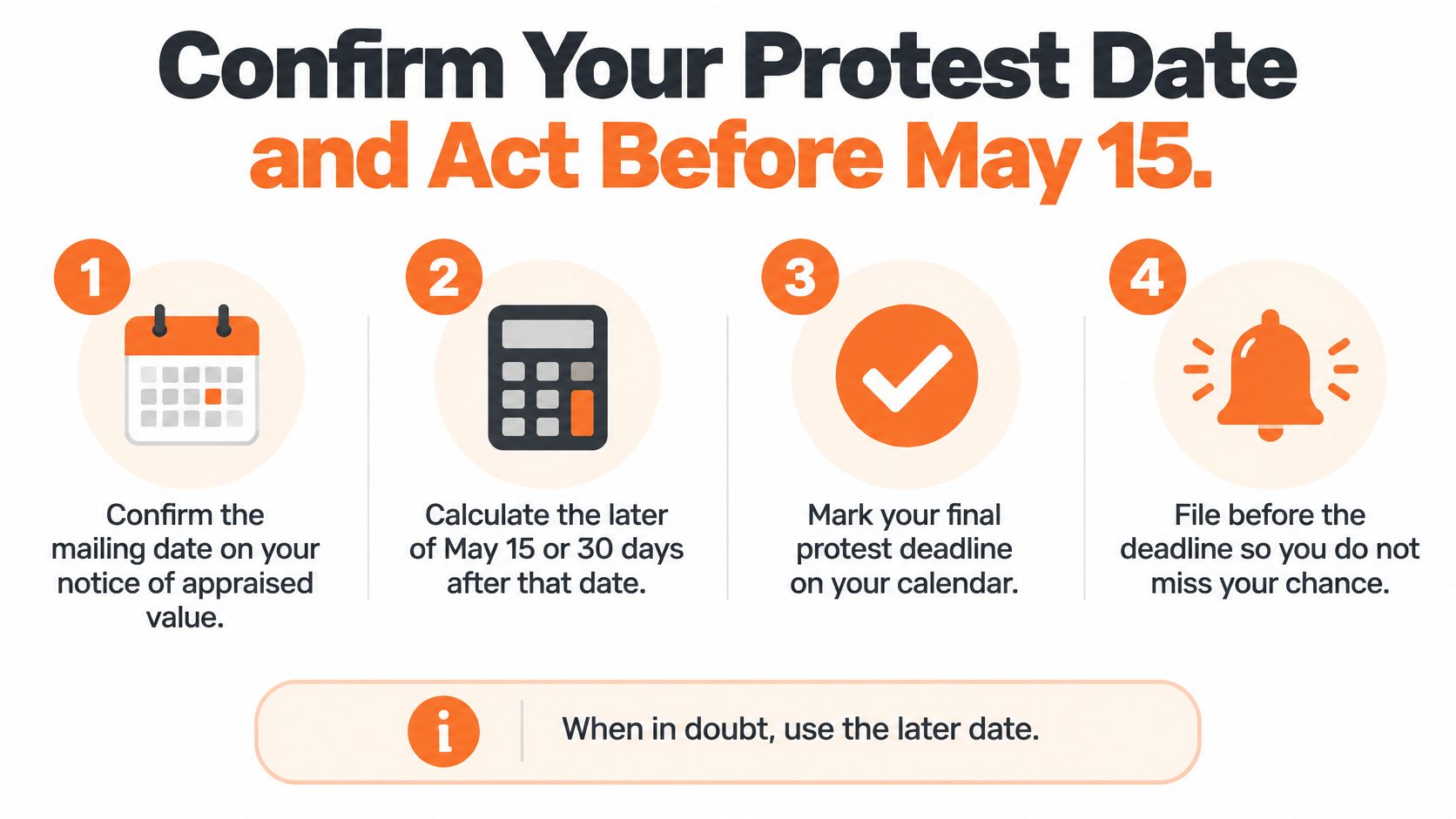
Filing by that calculated date preserves the chance to challenge the value stated on that notice. I would not spend the last day hunting for an exception you may not get.
For help with the notice, calendar, or valuation evidence, call INTELLI at 512-987-6543. INTELLI's free tax monitoring analyzes your property taxes and files whenever there's an opportunity to save, and INTELLI's Tax Recovery Audits have no fee if no recovery is made.
Confirm the date today and file early rather than relying on an exception later.
INTELLI uses public and private data to help owners prepare property-tax valuation challenges. Visit INTELLI to get help reviewing your TCAD notice, organizing supporting evidence, and protecting your filing opportunity before your deadline.