

You open the property-tax notice at the kitchen table and find another amount you didn't plan for. Your home may be worth more on paper, but your retirement income hasn't increased with it. In Texas, senior relief can help, but the available tools don't all work the same way. Some reduce taxable value, some limit future school-tax increases, and one postpones payment while creating a growing obligation.
The most important decision is understanding which kind of relief you're using. A permanent exemption can lower the bill, a school-tax ceiling can protect against higher appraisals, and a deferral can improve cash flow without removing the debt. The following guide explains how these options work, how Travis County homeowners can apply, and when an appraisal challenge deserves attention.
Navigating Senior Property Tax Relief
Marilyn, a homeowner in Travis County, has lived in the same house for years. She receives a retirement check, pays for ordinary household expenses, and watches the appraisal notice arrive with increasing concern. Her first instinct is to ask whether Texas has a senior “tax freeze.” That question is understandable, but it combines several different programs into one phrase.
The first step is checking whether the home qualifies for the over-65 residence-homestead exemption. Texas law requires a qualifying school district to grant an additional exemption to an eligible homeowner who owns an interest in the property and occupies it as a principal residence. The application is generally filed with the county appraisal district, and the Texas Comptroller's exemption guidance explains the state framework.

The exemption is not automatic just because a homeowner reaches the qualifying age. You need to confirm that the appraisal district has the correct homestead and age information. You also need to distinguish the exemption from the school-tax ceiling and from a deferral. Those distinctions matter if you're budgeting for the current year, planning to move, or thinking about what your heirs may eventually receive.
A practical review of the available tools
INTELLI states that it uses licensed property tax consultants and a data first approach combining public and private data. Its described evidence process compares technical findings with appraisal notices, public records, property databases, and other market evidence, which can help separate an exemption question from a valuation question. For example, an exemption may be missing even when the appraisal itself is reasonable. In another situation, the exemption may be active while the appraised value remains unjustifiably high.
Practical rule: Treat eligibility, taxable value, and payment timing as three separate questions.
A useful general explanation of Texas homestead rules is the Texas homestead exemption guide from the Law Office of Bryan Fagan, PLLC. Use it for background, then verify your own status with the appraisal district that maintains your property record.
The following video can help orient homeowners who are still learning the terminology. It shouldn't replace a review of your appraisal record or official tax documents.
For Marilyn, the right sequence is straightforward. She should verify her homestead status, confirm the over-65 exemption, inspect the taxing units listed on her bill, and then decide whether the remaining balance reflects ordinary taxes or an appraisal problem. A senior homeowner may need one of these steps, or several, but filing the correct exemption is the foundation.
Understanding the Over-65 Exemption and Tax Ceiling
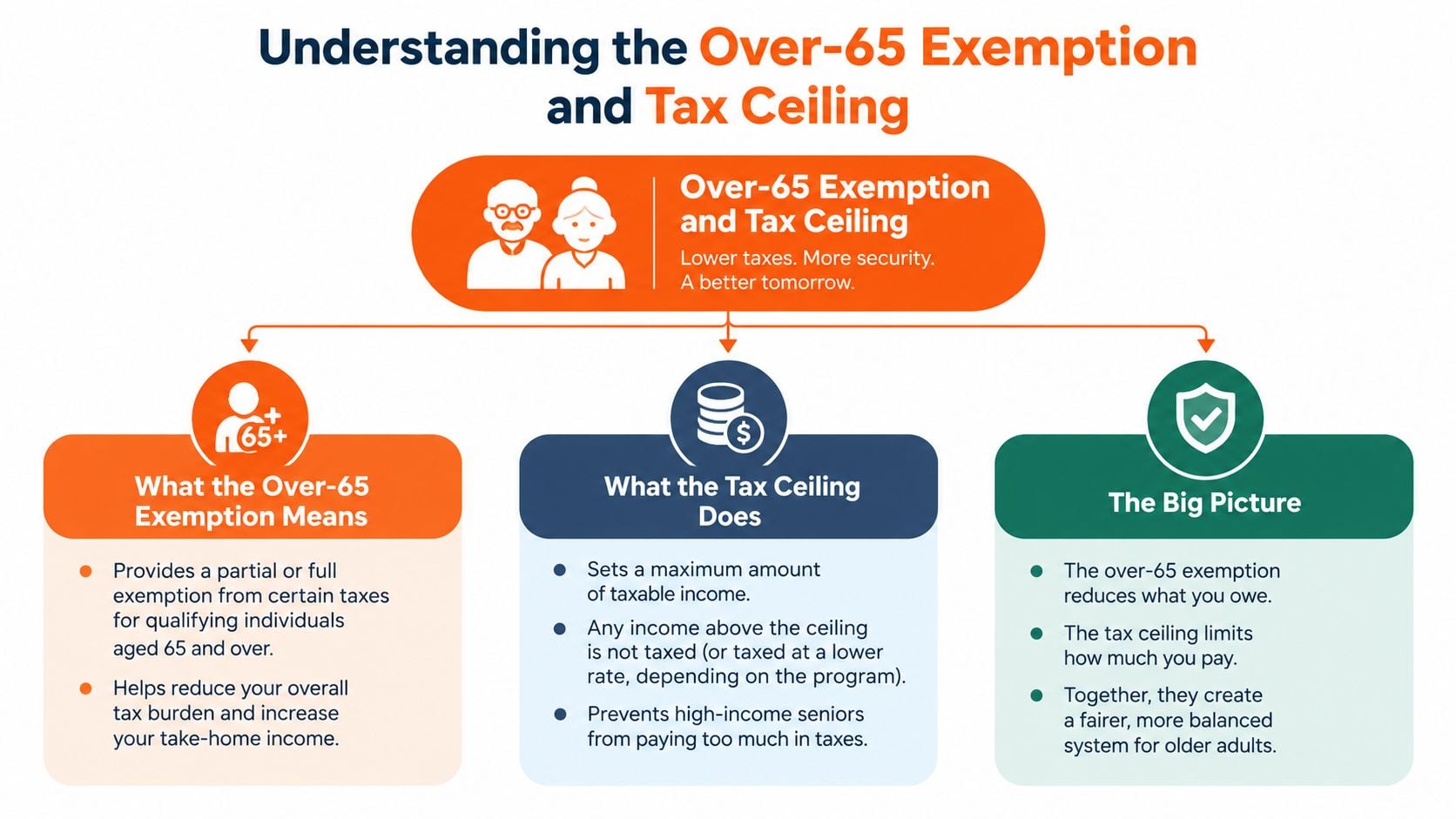
Texas senior relief has two main parts, and they solve different problems. The school-district exemption reduces the taxable value used by the school district. The school-tax ceiling generally limits later increases in school taxes caused by rising appraised value. Neither one is a universal freeze on every tax appearing on the statement.
The exemption lowers the school-tax calculation
Under Texas Tax Code Section 11.13(c), an eligible homeowner who is at least 65 years old, owns an interest in the residence, and occupies it as a principal residence receives an additional residence-homestead exemption from school-district taxation. The statutory text identifies the amount as $10,000, separate from the general residence-homestead exemption, as described in the Texas Comptroller's property-tax exemption materials.
The current benefit requires careful tax-year verification. Texas Comptroller materials also describe later statutory increases, and the applicable amount should be confirmed through the official appraisal-district record before you estimate savings. The current senior-focused guidance identifies the mandatory school-district exemption as $60,000, including for the full tax year when the owner turns 65 after January 1. Because these figures appear in different legal and explanatory materials, don't rely on an old form, website, or verbal estimate.
The calculation is not a percentage of your entire bill. It reduces the school district's taxable value, and the actual dollar effect depends on the school district's applicable tax rate. County, city, junior-college, and other taxing units can remain subject to their own taxable values and rules.
The ceiling protects one taxing component
Once a homeowner qualifies for the over-65 homestead exemption, the school taxes on that residence generally can't increase merely because the home's appraised value rises. The ceiling is based on the school taxes imposed in the year the homeowner qualifies. It can change when the homeowner makes improvements, adds value, or moves to another residence, and certain taxing units may have separate rules. The Texas Tax Code provisions on property-tax exemptions provide the legal framework.
Consider a simple example without assigning an unverified dollar amount. If your home's appraised value rises while you make no qualifying improvements, the school district portion can remain protected by the ceiling. The county or city portion may still change if those taxing units don't provide comparable protection. Your total bill, therefore, can rise even when the school-tax ceiling is working correctly.
That's why “tax freeze” can be a misleading shortcut. The ceiling protects school taxes from a particular type of increase. It doesn't erase the bill, freeze every taxing unit, or guarantee that the taxable value never changes. Review each line on the tax statement rather than applying one percentage to the total.
The Difference Between Tax Freezes and Deferrals
A tax ceiling and a tax deferral affect different sides of the problem. The ceiling generally limits certain future school-tax increases. A deferral postpones payment of property taxes on a qualifying residence homestead. If you're short on monthly cash, postponement may provide breathing room, but it isn't forgiveness.
Texas law allows an eligible person age 65 or older to defer payment under Tax Code Section 33.06. Comparable rules can apply to certain disabled homeowners and disabled veterans, and a surviving spouse may continue an existing deferral in specified circumstances. The Texas Comptroller's payment-option guidance explains that the deferred amount remains a debt secured by the property.
Why the future balance matters
Travis County states that Texas adds 5% annual interest to deferred taxes, and that the accumulated taxes and interest become payable when the home is sold or ownership transfers to heirs. If the property stops qualifying and the deferred amount isn't paid within 180 days, regular penalties, interest, and collection fees may apply, according to the county's property-tax frequently asked questions.
The practical difference looks like this:
| Relief option | What changes now | What can happen later |
|---|---|---|
| Exemption | Lowers taxable value for the applicable taxing unit | The savings generally reduce the bill rather than creating a repayment balance |
| School-tax ceiling | Limits certain school-tax increases caused by higher appraised value | Improvements, a new residence, or taxing-unit rules can affect the ceiling |
| Deferral | Postpones payment | Taxes and interest remain payable when eligibility ends, the home is sold, or ownership transfers |
A homeowner who uses a deferral should tell family members and include the obligation in estate and moving plans. Heirs may discover that the home carries accumulated taxes and interest when ownership changes. Someone considering refinancing, downsizing, or transferring the property should also ask how the outstanding balance affects that decision.
More detail about the distinction between a ceiling and postponed payment is available in INTELLI's explanation of the Texas property-tax freeze. The central question is simple: do you need to reduce the bill, protect against a specific future increase, or preserve cash today while accepting repayment later?
Deferral is a liquidity tool, not free relief.
Filing Your Exemption in Travis County
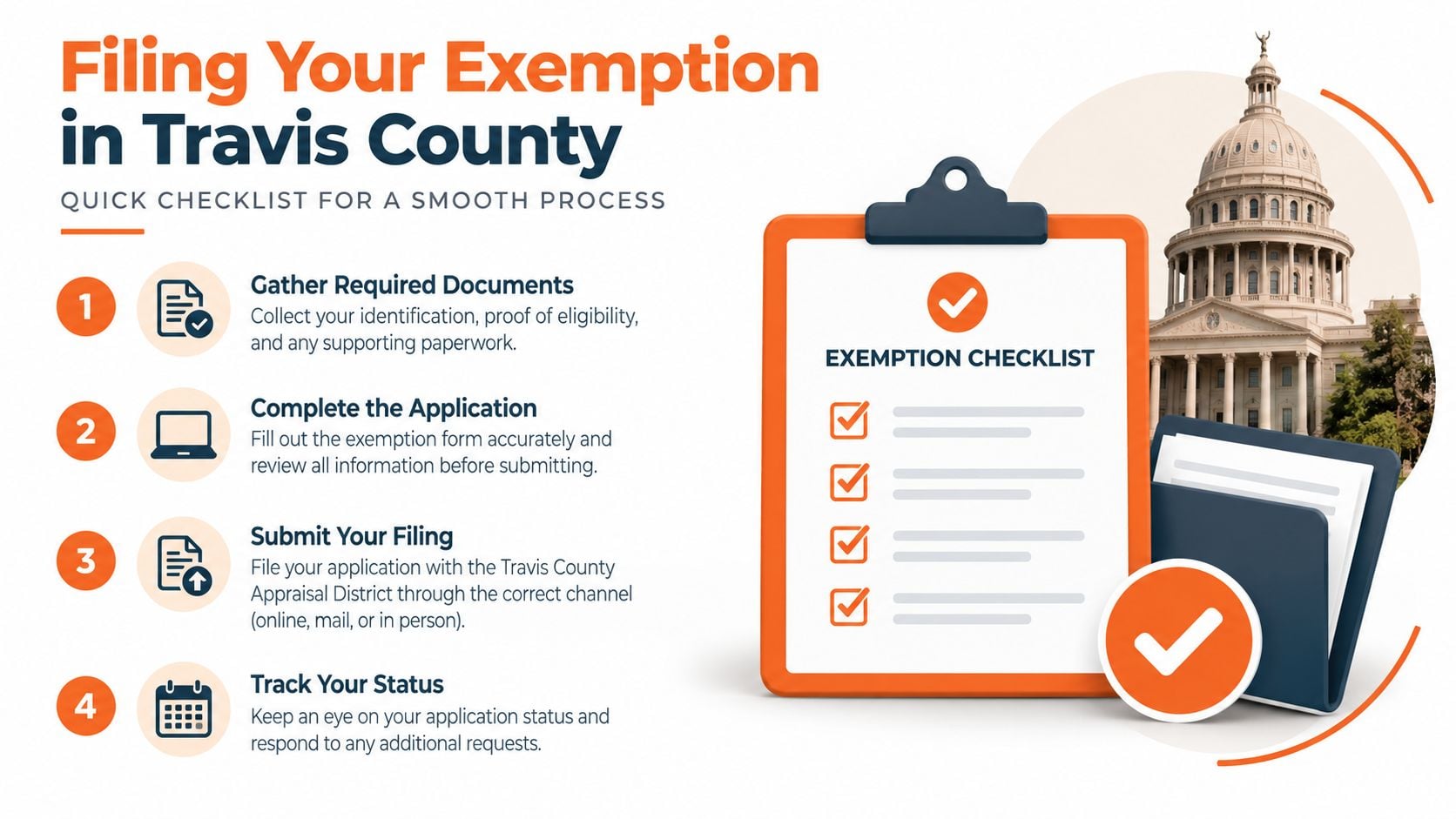
Travis County homeowners generally begin with the county appraisal district, because that office maintains the property record and processes exemption applications. Travis County states that exemption applications are free, so a homeowner shouldn't pay to obtain or submit the official form. Confirm current filing instructions and deadlines directly with the appraisal district, since forms and administrative requirements can change.
Build your application carefully
Use this checklist before submitting anything:
Confirm the property. Make sure the address on the application matches the residence you occupy as your principal home and the property account shown on your appraisal notice.
Confirm your eligibility. Check the age requirement and ownership information. If you own an interest in the property jointly, review how the appraisal district asks you to identify the owners.
Prepare supporting records. Have documentation that demonstrates age, ownership, and primary residence available. A government identification document may help establish identity and address, but follow the district's current instructions rather than assuming one document is sufficient.
Submit through the official channel. Use the current county form, online portal, mail procedure, or in-person process identified by the appraisal district. Keep a copy of the application and proof of submission.
Verify the result. After processing, inspect the property record or tax statement to confirm that the exemption appears. Don't assume that silence means approval.
The filing date matters because a missed administrative window can delay relief or require additional follow-up. If you turn 65 during the year, check how the current rules apply instead of waiting until the next tax cycle. The current senior guidance states that the benefit applies for the entire tax year even when the owner turns 65 after January 1.
Keep special situations in view
A surviving spouse may be able to retain a deceased spouse's over-65 benefit if the survivor is at least 55 years old, the deceased spouse qualified during the year of death, and the survivor continues to own and occupy the home as a primary residence. A homeowner may also qualify for both age-65 and disability exemptions in the same year, although the exemptions can't be claimed from the same taxing units. Those situations deserve direct confirmation before you file.
Homeowners who want help organizing the Travis County process can review INTELLI's Travis County property-tax exemption information. Whether you apply on your own or obtain assistance, the important habit is the same: retain the documents, check the property record, and challenge an error promptly.
Exemptions Versus Challenging Your Appraisal
An exemption and an appraisal protest attack different parts of the tax calculation. The exemption changes the taxable value or protects a qualifying school-tax amount under the applicable rules. A protest argues that the underlying appraised value is too high, often using property condition, comparable sales, public records, or other evidence.
That distinction matters for a senior who sees an exemption on the account but still receives an unexpectedly high bill. The exemption may be working exactly as intended while the appraisal value remains inflated. Applying for another exemption won't necessarily correct that valuation.
Compare the two approaches
| Question | Exemption review | Appraisal challenge |
|---|---|---|
| Main issue | Whether you qualify for a legal reduction | Whether the district's value reflects the property accurately |
| Typical support | Age, ownership, residence, and exemption records | Appraisal notices, condition evidence, comparable properties, and market documentation |
| Potential effect | Reduces the taxable value or limits a qualifying school-tax increase | Can reduce the value used as the starting point for taxes |
| Best first step | Confirm the exemption is filed and active | Compare the notice with credible evidence about the property |
A homeowner should gather the appraisal notice and examine the property description. Incorrect square footage, outdated condition information, omitted damage, or inappropriate comparable properties can support a valuation review. The evidence should relate to the property and the relevant appraisal period, not merely to a general belief that taxes feel too high.
INTELLI states that it prepares evidence to challenge inflated valuations and represents clients before county appraisal districts, with average reductions of about 15%, as described on INTELLI's property-tax service page. That result is a service claim, not a promise for any individual homeowner. A case depends on the property, the evidence, the appraisal record, and the applicable process.
Professional assistance may make sense when the valuation dispute is complicated, the homeowner can't attend or manage a hearing, or the evidence requires careful organization. The guide to protesting property taxes in Texas can help a homeowner understand the general process before deciding whether to proceed independently.
An exemption can lower the calculation. A successful appraisal challenge can address the value underneath it.
Maximizing Your Long-Term Savings
Return to Marilyn at the kitchen table. She confirms that her over-65 exemption is active, checks which part of the bill benefits from the school-tax ceiling, and compares the appraisal record with the actual condition of her home. She doesn't treat a deferral as a discount. Instead, she considers whether postponing payment would create a problem for her family when she moves or the home transfers.
That sequence gives her a more durable plan:
- Secure permanent relief first. File every exemption that applies and verify the account reflects it.
- Review the valuation separately. An exemption won't correct an appraisal that describes the property inaccurately or assigns an unsupported value.
- Use deferral deliberately. Consider the interest, repayment event, and effect on heirs before choosing postponed payment.
- Recheck after major changes. Improvements, a move, a change in ownership, or the death of a spouse can affect eligibility or the way relief applies.
Texas property tax relief for seniors can protect a fixed-income household, but the benefit comes from active review rather than from a single phrase such as “freeze.” Keep the exemption records, read the taxing-unit breakdown, and ask for clarification before signing a deferral or accepting an unexplained valuation.
INTELLI helps Texas homeowners review exemptions, organize evidence for inflated valuations, and move through county appraisal-district processes through a data first approach using public and private data. Visit INTELLI to review your property-tax situation and determine which relief path fits your home and long-term plans.