

Between 74% and 78% of homeowners have never appealed their property taxes, and 53% to 54% of homeowners don't know they have the right to do so. At the same time, roughly 30% to 60% of taxable property in the United States may be over-assessed, which means the assessment behind your tax bill may be higher than the property's defensible market value.
That answers the basic question, but it doesn't capture the practical difficulty. A property tax appeal is a formal challenge to the assessor's valuation, not just a request for a lower bill because taxes feel unreasonable. In Texas, the appraisal district starts with the upper hand because it has the official record, the valuation model, and the administrative process on its side. The owner must respond with evidence that directly challenges the value.
A successful protest usually depends on three things: filing on time, identifying the right valuation argument, and presenting professional-grade evidence. Frustration may motivate a homeowner to file, but frustration by itself won't persuade an appraisal review board.
Understanding the Reality of Property Tax Overassessment
Roughly 30% to 60% of taxable property in the United States is over-assessed, while fewer than 5% of taxpayers challenge their assessment, according to figures from the National Taxpayers Union cited in public reporting and analysis. The same body of information indicates that more than 40% of U.S. properties could save at least $100 through a successful appeal. These figures are summarized in property tax appeal success rate analysis.
A typical Texas homeowner doesn't experience that issue as an abstract statistical problem. The notice arrives, the appraised value has climbed, and the projected tax obligation no longer fits comfortably within the household budget. The owner may compare the number with a neighbor's bill, question whether the home could sell for that amount, or assume the county has made a mistake that someone will correct automatically.
No one at the appraisal district will automatically adjust an assessment because the increase seems excessive. The owner has to make a defensible case.

Why so many owners never file
A Texas-specific survey in 2026 found that 54% of homeowners had never protested, while 37% didn't know they could. Those findings reinforce what practitioners see every season. Many owners confuse an appraisal notice with a final, unchangeable determination, or they believe only commercial owners and attorneys can challenge a value.
That misunderstanding is costly because an appeal is a normal administrative remedy. It exists to correct overvaluation and unequal treatment, not to punish an owner for questioning the county's conclusion. A clear explanation of what a property tax assessment means helps separate the assessed value from the eventual tax calculation.
Practical rule: Don't argue that your taxes are unfair until you've identified whether the assessment is inaccurate, unequal, or affected by a missed exemption.
The strongest first question is simple: What evidence shows that the appraisal district's value exceeds the property's fair market value on the legally relevant date? That question moves the conversation away from emotion and toward a claim the board can evaluate.
Formal Versus Informal Property Tax Appeals in Texas
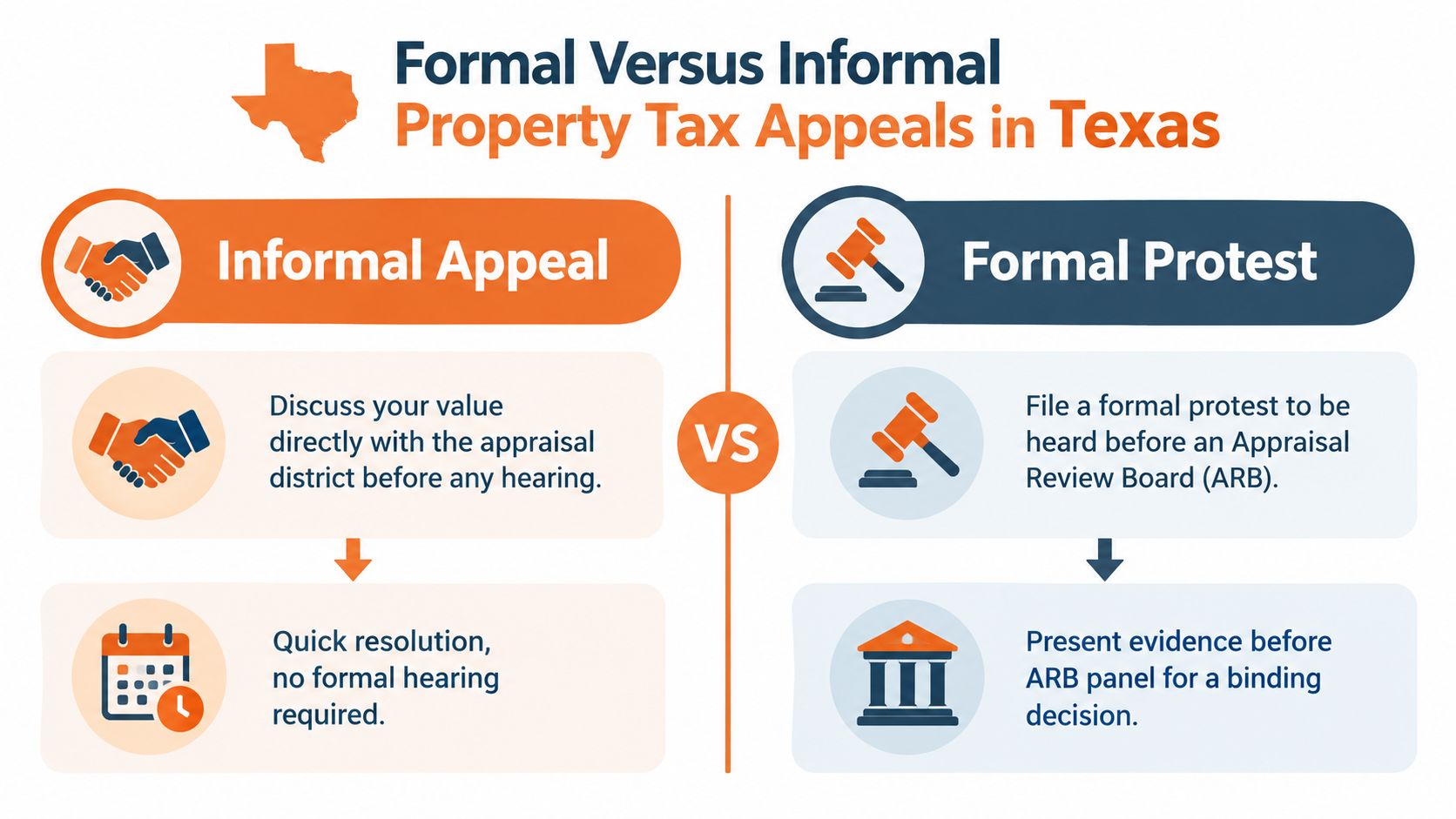
Texas homeowners generally encounter two stages before the dispute reaches a courtroom. The first is an informal discussion with the appraisal district, often intended to resolve obvious errors or reach an agreement before a formal hearing. The second is a written protest heard by the Appraisal Review Board, commonly called the ARB.
The informal stage can be efficient when the problem is straightforward. A wrong measurement, an incorrect property characteristic, or a missing document may be resolved without a full hearing. But informal doesn't mean consequence-free. If you show up without knowing your evidence, you may reveal your entire position while learning little about the district's valuation theory.
Choosing the right stage
A formal protest creates a defined record. The owner identifies the grounds for protest, submits supporting material, and receives a hearing before the ARB. Texas guidance states that the owner and appraisal district may present evidence, examine witnesses, and state an opinion of value. That makes the formal path more demanding, but it also gives the homeowner a structured opportunity to rebut the district's evidence.
The practical distinction looks like this:
| Informal discussion | Formal protest |
|---|---|
| May resolve clerical or factual errors quickly | Places the dispute before the ARB |
| Usually involves direct communication with district staff | Requires a formal filing and hearing process |
| Can be useful for learning how the district views the property | Allows the owner to present a developed evidentiary record |
| Doesn't replace careful preparation | Creates the path to further review after an ARB decision |
An owner shouldn't treat the informal meeting as a substitute for preparation. Comparable sales, condition records, photographs, appraisal material, and property-specific corrections should be organized before any discussion begins.
The burden remains with the taxpayer
The appraisal district's initial value carries administrative weight. You don't win by showing that another house has a lower tax bill, and you don't win merely by saying that prices have softened. You win by demonstrating why the district's valuation method or property data produces an incorrect result.
Texas's property tax protest guidance explains the broader process, including the route from the ARB to district court. A formal protest is therefore more than a conversation. It's the foundation for every later remedy.
Navigating Travis County Timelines and Deadlines
A strong valuation argument has no value if the owner misses the filing window. In Texas, a protest must usually be filed by May 15 or within 30 days of the appraisal district's notice mailing date, whichever is later. The Texas Comptroller emphasizes that the 30-day period runs from the mailing date, not the date the owner receives the notice. These rules apply to Travis County homeowners, although owners should still verify the current notice and county procedures.
Start with the calendar as soon as the appraisal notice arrives. Record the notice date, calculate the applicable deadline, and keep proof of submission. Don't rely on the assumption that a late filing will be accepted because the value is obviously wrong.
A working Travis County checklist
Use the following sequence:
Read the notice carefully. Confirm the property address, assessed or appraised value, listed characteristics, and exemptions. Errors in square footage, condition, quality, or property classification can affect the valuation analysis.
Confirm the deadline. Compare the May 15 rule with the applicable 30-day period from the notice mailing date. Use the later date only when the legal facts support it.
File the protest. Submit the written protest through the available county process and save the confirmation, copy, and timestamp.
Build the evidence file. Gather comparable sales, photographs, repair estimates, appraisal material, surveys, leases, income records, or other documents that explain why the value is wrong.
Prepare for notice of hearing. The ARB must send written hearing notice at least 15 days before the hearing, and a written protest hearing must be scheduled as soon as practicable, but no later than the 90th day after the board approves the appraisal records. The statutory timing appears in Texas property tax protest rules.
For Austin-area owners, Travis County property tax protest guidance can help organize the local process and preparation tasks. The important point is operational: put every deadline and document request on a calendar before negotiating with the district.
Texas rules also allow an owner to appear by affidavit, telephone conference, or videoconference. That flexibility can help an investor, landlord, or working homeowner participate without treating an in-person appearance as the only option.
Building Evidence for a Successful Appeal
The core issue in most protests is whether the assessor's value exceeds the property's fair market value as of the required valuation date. A board isn't deciding whether the annual tax bill feels burdensome. It is deciding whether the assessment is supported by the market and by the property's actual characteristics.
That distinction changes how you prepare. A neighbor's lower tax bill may suggest unequal treatment, but it doesn't independently establish your home's market value. A list of repairs may show expense, but the documents must connect the condition to a reduction in value at the relevant date.
Evidence that answers the valuation question
The most useful evidence usually includes:
- Comparable sales: Select properties that resemble the subject in location, size, age, quality, condition, and use. Explain the adjustments instead of presenting a stack of addresses without analysis.
- Professional appraisal: An appraisal can organize the market evidence and provide an independent opinion of value.
- Condition documentation: Use dated photographs, contractor estimates, inspection reports, and records of deferred maintenance to show physical limitations.
- Property records: Correct inaccurate square footage, construction details, amenities, land characteristics, or classification.
- Uniformity evidence: Compare the subject's assessment ratio with a representative sample of similar properties when state law permits an unequal-appraisal claim.
Texas law provides a particularly important strategy for qualifying properties. For property with a market or appraised value of $1 million or less, an owner who delivers a certified appraiser's report performed no later than 180 days before the hearing, and delivers it to the chief appraiser at least 14 days before the first hearing day, can require the appraisal district to prove value by clear and convincing evidence. The rule is set out in Texas Tax Code Section 41.43.
DIY evidence versus professional analysis
DIY research can work when the error is obvious and the comparable sales are genuinely comparable. It breaks down when an owner selects convenient listings, confuses asking prices with completed sales, or overlooks adjustments for condition and location.
A professional analysis costs time or money, but it can expose valuation inconsistencies that a quick online search won't reveal. Comparable property analysis is useful when the dispute depends on selecting and interpreting a representative sample rather than finding one lower-priced property.
The question isn't whether you can find a lower number. It's whether you can prove that your number reflects the subject property's market value on the legally relevant date.
The Role of Professional Data Analysis in Protests
A property tax protest becomes stronger when technical findings connect directly to the appraisal notice. The district may have inaccurate property data, an unsuitable comparable set, an unexplained adjustment, or an assessment ratio that differs from the local pattern. Those problems are easy to miss when the owner looks only at the final value.
INTELLI uses licensed property tax consultants and a data-first approach, combining public and private data to build evidence for protests. Its stated process compares technical findings with appraisal notices, public records, property databases, and other market evidence to identify inconsistencies that can support a lower value. Details about that approach appear in INTELLI's building condition assessment methodology.

Turning data into a hearing position
Data collection is only the beginning. Someone must decide which facts matter, organize them into a valuation theory, and present the argument in a way the ARB can follow. A large document package without a clear conclusion can weaken a case because the decision-maker has to reconstruct the owner's argument.
A useful professional workflow connects four questions:
- What did the district assume? Identify the characteristics, comparable sales, income information, and valuation method reflected in the notice or evidence.
- What is inaccurate? Isolate the factual or methodological error rather than attacking the entire system.
- What supports the correction? Match each disputed point with a sale, appraisal, photograph, record, or ratio analysis.
- What relief is legally available? Separate a value reduction from an exemption, classification correction, or recovery claim.
This approach also clarifies the difference between an appeal and an audit. The appeal challenges the current assessment. A broader review may uncover exemption omissions or prior overcharges that require a separate recovery process.
The following video provides additional context on data-driven property tax work. It should supplement, not replace, a property-specific evidence review.
A professional does not guarantee a reduction. The value of representation lies in disciplined preparation, local procedural knowledge, and the ability to present evidence that directly answers the district's case.
Exemptions and Recovery Audits for Maximum Savings
Lowering an assessment is only one part of managing a Texas property tax burden. An owner may also qualify for an exemption that was never applied, or may have paid more than necessary in an earlier period because the account contained an error.
Potential exemption categories include Homestead, Over-65, Disabled Person, Disabled Veteran, agricultural, and historic designations. Eligibility and filing rules vary, so an owner should verify the requirements with the relevant appraisal district rather than assume that ownership alone creates an exemption.

Why an exemption review belongs beside the protest
A value appeal asks whether the property is assessed too high. An exemption review asks whether the taxable value should be reduced for a different legal reason. These arguments can coexist, but they require different documentation and deadlines.
Owners should review:
- Residence status: Confirm whether the property qualifies for a homestead treatment and whether the application was processed.
- Age or disability status: Check whether the owner qualifies for an Over-65, Disabled Person, or Disabled Veteran exemption.
- Property use: Determine whether agricultural use or another qualifying use has been properly documented.
- Designation status: Review whether historic treatment applies and whether the required records are complete.
- Account history: Compare notices, exemption records, ownership changes, and tax statements across prior periods.
A recovery audit goes further than correcting the current notice. It examines past charges and account records to identify overpayments that may be recoverable under the applicable rules. INTELLI conducts tax recovery audits and pursues refunds on a no-recovery, no-fee basis, so the owner can evaluate the opportunity without paying a fee when no recovery is achieved.
That arrangement doesn't eliminate the need to review eligibility, records, or deadlines. It does address a common concern: hiring help shouldn't create another financial burden before anyone knows whether a recoverable issue exists.
Next Steps for Texas Homeowners and Investors
The process becomes manageable when the owner treats it as a valuation case rather than a complaint about the tax bill. Start by preserving the notice, checking the filing deadline, and writing down every factual issue that could affect value. Then gather evidence that answers those issues directly.
A homeowner with an obvious data error may be able to resolve the matter through an informal discussion. A property with complex improvements, unusual condition, rental income, or a significant value may require a formal evidentiary strategy. Investors should also review each parcel separately because a portfolio-wide assumption can hide property-specific errors.
A practical path forward
- Confirm the target. Decide whether you're challenging market value, unequal appraisal, property characteristics, classification, or a missing exemption.
- Measure the evidence. Use completed comparable sales, condition records, appraisal work, income documentation, and public records that match the relevant valuation date.
- Protect the deadline. File the protest within the applicable Texas window and retain proof of submission.
- Prepare for the ARB. Organize a concise argument, supporting exhibits, and answers to likely questions from the appraisal district.
- Review the outcome. If the ARB decision doesn't resolve the dispute, evaluate district court, binding arbitration, or the State Office of Administrative Hearings when the statutory requirements are met.
The Texas Comptroller identifies district court, regular binding arbitration, and SOAH as post-ARB paths. SOAH is available only in qualifying circumstances, and properties with an ARB-determined value over $1,000,000 may appeal there under the applicable rules, as explained in the Texas property tax basics guidance.
A calculator can help you estimate the relationship between assessed value and a potential tax obligation before you decide how much evidence preparation makes sense. For an initial estimate, use RealtyAPI.io's tax calculator tool, then confirm the result against your county's actual tax rates, exemptions, and account records.
The central lesson is straightforward. What is property tax appeal? It's the formal process of proving that the government-assigned value, treatment, or exemption record doesn't accurately reflect the property or the law. The owner who files on time and presents evidence has a real remedy. The owner who waits, relies on frustration, or submits unsupported comparisons gives the appraisal district an easier case to defend.
INTELLI reviews Texas property assessments, prepares data-supported protests, represents owners before appraisal districts, and checks exemptions and prior charges for additional recovery opportunities. Visit INTELLI to start a risk-free consultation designed for your property, county, and filing deadline.