
An ag exemption in Texas is not a single filing. It's a productivity valuation under Section 1-d-1, and the land must have been in agricultural use for five of the past seven years, meet the local degree-of-intensity test, and be filed on Form 50-129 by the county deadline.
You may be looking at a tax bill today and wondering why a nearby ranch pays much less on land that appears similar. The difference usually isn't ownership status, a homestead exemption, or the number of acres on the deed. It's whether the Central Appraisal District can verify qualifying agricultural use, local intensity, historical continuity, and complete documentation.
That distinction matters in 2026. Texas landowners often treat property-tax appraisal, sales-tax purchasing, and wildlife-management conversion as one benefit. They aren't. They're separate obligations that should be managed in one compliance workflow.
What the Texas Ag Exemption Is
A Hill Country landowner can hold raw acreage in the same school district as a working ranch across the fence and still receive a much higher appraisal. The difference is documented agricultural use, not the rural setting or the number of acres. The Central Appraisal District must be able to verify how the land is used, whether that use meets local standards, and whether the owner has maintained the required history.
The phrase ag exemption in Texas describes a property-tax appraisal method, not a blanket exemption from taxation. Under the state's 1-d-1 open-space agricultural valuation, qualifying land is appraised according to agricultural productivity rather than retail market value. The Texas agricultural and timber appraisal guidance explains the framework as productivity-based valuation.
The county appraisal district evaluates three approval gates:
- Current principal agricultural use: The land must be principally devoted to qualifying agricultural activity.
- Local degree of intensity: The operation must meet the level of agricultural activity accepted for that area.
- Documented history and timely filing: The property must satisfy the five-of-seven-years standard, and the owner must file Form 50-129 by the county deadline.
A grazing lease with an active producer carries more weight than occasional cattle, a few improvements, or a future-use plan. Keep lease records, receipts, photographs, production records, input purchases, and grazing documentation organized around the specific parcel.
Productivity valuation applies to qualifying land. It does not automatically cover every improvement. A residence, barn, or other non-land appurtenance may remain subject to market-value appraisal, as explained in the Texas Comptroller property tax manual.
Run the property-tax and sales-tax tasks as one workflow, while treating them as separate programs. Form 50-129 goes to the county appraisal district for the 1-d-1 appraisal. The Ag/Timber Number, issued through the Texas Comptroller, supports exemption certificates for qualifying purchases and has its own renewal cycle. It does not establish the parcel's property-tax eligibility.
The workflow also needs a calendar for 2025 and 2026 cap-rate changes, county-specific intensity standards, and any conversion to wildlife management. Wildlife use can involve separate documentation and management requirements, so do not assume a simple change in use preserves the existing appraisal.
For a practical explanation of productivity value versus market value, review this guide to current agricultural use value. The county is judging the land's use, productivity, records, and compliance, not merely the owner's identity or intentions.
The Three Eligibility Pillars Every Landowner Must Pass
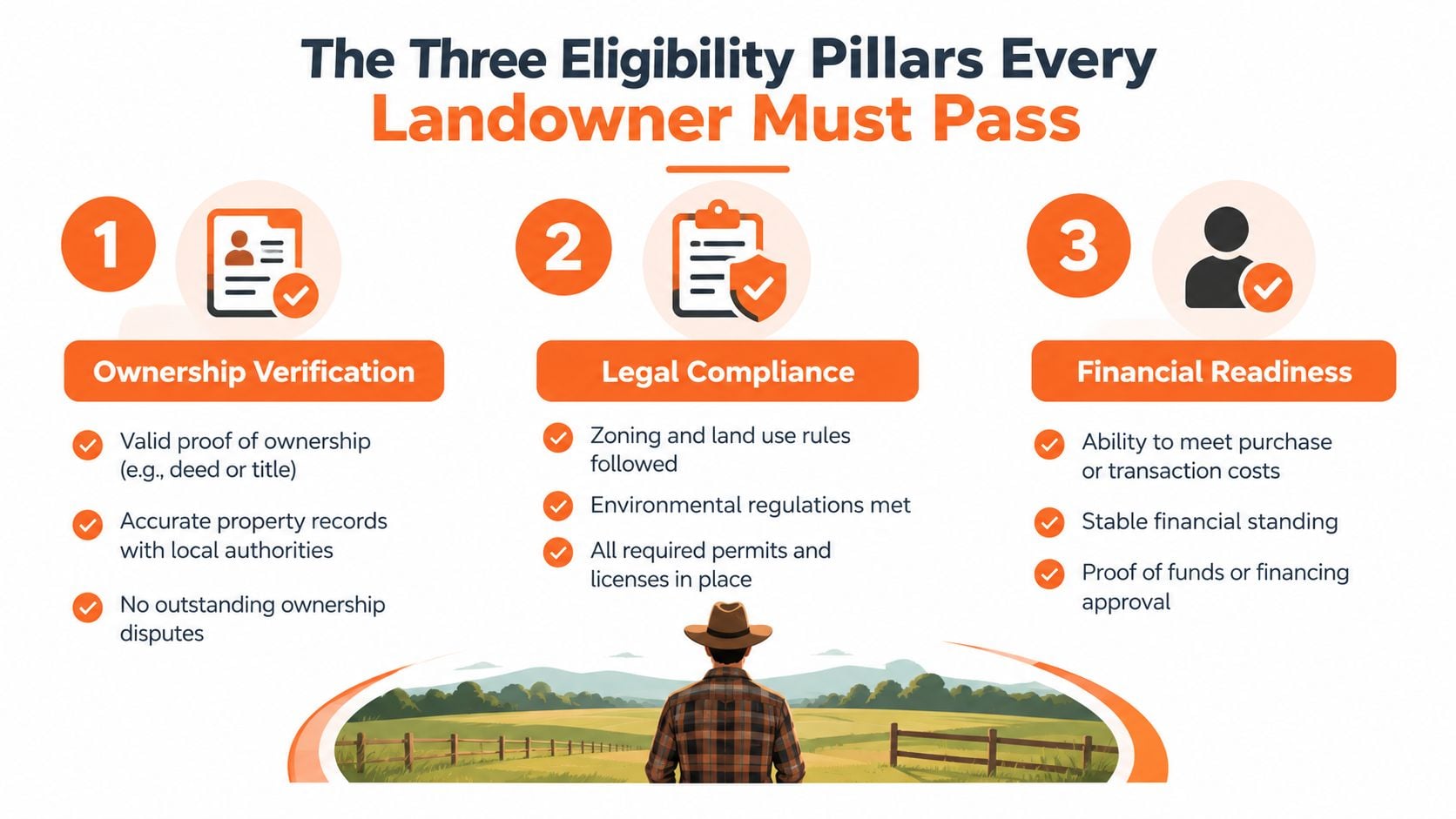
A successful application answers three separate questions. Is the land being used primarily for agriculture now? Is the operation intensive enough for the county and region? Can the owner prove the required history?
The Comptroller's agricultural appraisal framework identifies current principal use, degree of intensity, and the five-of-seven-years history as the core standards. (Texas Comptroller agricultural appraisal materials)
Current principal agricultural use
The land must be principally devoted to an agricultural purpose as of the relevant appraisal date. Examples can include cropland, improved pasture, orchards, livestock operations, and other qualifying production tied directly to the tract.
A grazing lease with an active producer is stronger than a statement that cattle occasionally visit the property. Hay receipts, lease records, input purchases, production records, photographs, and grazing documentation can help connect the activity to the parcel. The county wants to see an operation, not a future plan.
Degree of intensity
The degree-of-intensity test is local by design. It asks whether the operation resembles the agricultural use that is generally accepted in the region.
A few animals on a large tract may not meet the local standard. A smaller property with an intensive operation, such as managed beekeeping or nursery production, may have a stronger argument if the owner can show that the activity meets the county's published expectations. The correct benchmark isn't a statewide acreage shortcut. It's the local standard applied to the specific use.
Practical rule: Before filing, obtain the county's current intensity guidance and compare your stocking, production, management, or hive records against it.
Five of the preceding seven years
The historical test requires agricultural or timber use for at least five of the preceding seven years. That makes continuity important. A landowner who began using a parcel recently may have a legitimate operation but still lack the required history for the appraisal treatment.
Useful records include:
- Lease evidence: A signed agricultural lease identifying the property and active producer.
- Production records: Hay receipts, livestock records, crop documentation, or other records tied to the land.
- Input evidence: Purchases and expenses that show ongoing agricultural management.
- Parcel history: Prior appraisal records and documents that connect the use to the exact tract.
Dormant acreage, hobby plots, and unimproved lots usually fail because they don't demonstrate both current principal use and the required historical continuity. Treat these three pillars as a county review checklist, not as optional suggestions.
Filing Form 50-129 and the Ag/Timber Number
A strong application connects the county account, the actual land use, and the records that prove ongoing management. File Form 50-129 with the chief appraiser of the county appraisal district, not with the Texas Comptroller. The Comptroller's Form 50-129 guidance states that the application must reach the chief appraiser by the deadline set by the county appraisal district, commonly April 30 or May 1. (Texas Comptroller Form 50-129 guidance)
Check the county's current instructions before completing the form. Central Appraisal Districts differ in how they request supporting documents, describe local expectations, and handle late or incomplete submissions. Match the legal description, account number, ownership details, and acreage to the CAD record. Then identify the actual agricultural activity, the portion of the tract used, the operator when applicable, and the records available to support the application. “Farm use” alone gives the appraiser too little to evaluate.
Build the file before the deadline
Prepare a file that lets the appraiser connect the form to real land management:
- Parcel records: Account number, legal description, acreage breakdown, and ownership information.
- Use records: Lease agreements, grazing records, harvest documentation, hive-management records, or other production evidence.
- Intensity support: Stocking information, management logs, production records, and any county guidance relevant to the use.
- Historical support: Documents showing agricultural use during the required five-of-seven-years period.
Submit the initial application and respond to later CAD requests as separate administrative steps. A prior owner's approval does not automatically transfer, and a prior year's filing does not replace the current application. Keep a complete copy of every document, along with the delivery date and method.
Keep the sales-tax workflow separate
The Ag/Timber Number covers sales-tax exemption for qualifying farm and ranch purchases. The Comptroller requires purchasers, including non-Texas residents, to hold a valid registration number for qualifying tax-exempt purchases. The items must be used exclusively on a farm or ranch to produce agricultural products for sale, and the number must be renewed every four years. (Texas Ag/Timber Number requirements)
That registration does not establish eligibility for 1-d-1 appraisal. A landowner may hold an Ag/Timber Number and still fail the property-tax review. The reverse also applies: qualifying agricultural land does not provide a current sales-tax registration number.
Keep two calendars, one for the CAD filing and one for the Ag/Timber Number renewal. Track the county's deadline, document requests, and any change in use. Wildlife-management conversion, local CAD practices, and the 2025 and 2026 cap-rate rules belong in the property-tax file, not the sales-tax calendar.
Ag Land, Timberland, and Wildlife Management Compared
These appraisal paths use productivity-based valuation, but the county appraisal district will expect different proof for each one. Agricultural land depends on active farming or ranching at the degree of intensity the county accepts. Timberland follows timber-specific appraisal requirements. Wildlife management is a conversion path for land that already qualifies for agricultural or timber appraisal.
| Use Type | Standard | Documentation | Filing Trigger |
|---|---|---|---|
| Agricultural land | Current principal agricultural use, local intensity, and the required history | Leases, production records, receipts, and management evidence | Form 50-129 by the county deadline |
| Timberland | Qualifying timber use under the applicable appraisal framework | Timber-management records and documents supporting the use | County appraisal filing and applicable timber requirements |
| Wildlife management | Existing open-space agricultural appraisal plus active wildlife management | Written wildlife management plan and records of completed practices | Application to the county CAD by May 1 |
For standard ag land, show an operation that is active, documented, and credible for your county. A lease by itself may not establish sufficient use. Production records, receipts, photographs, and management notes should support the application. Timberland requires a separate review of the use and supporting records. Timberland and open-space land also use different cap rates, covered in the next section. (Texas Comptroller agricultural and timber FAQ)
Wildlife management is not a category an owner can select for a new parcel. Texas Parks and Wildlife Department states that the property must already be appraised as open-space agricultural land under Section 1-d-1. The primary use must then shift to wildlife management under a written plan. The owner must actively implement at least three of seven recognized practices, such as habitat control, erosion control, predator control, supplemental water, supplemental food, shelters, or census counts. (TPWD wildlife management legal summary)
File the conversion with the county Central Appraisal District, not with TPWD. TPWD states that wildlife-management applications must be submitted by May 1 each year, and only land already appraised as agricultural or timber land can convert. (TPWD wildlife valuation application guidance)
A wildlife plan must be implemented, not stored in a folder. Keep dated management records, photographs, invoices, maps, and activity logs tied to the parcel. That file gives the CAD concrete evidence that the listed practices occurred.
How the 2025 and 2026 Cap Rates Change the Math
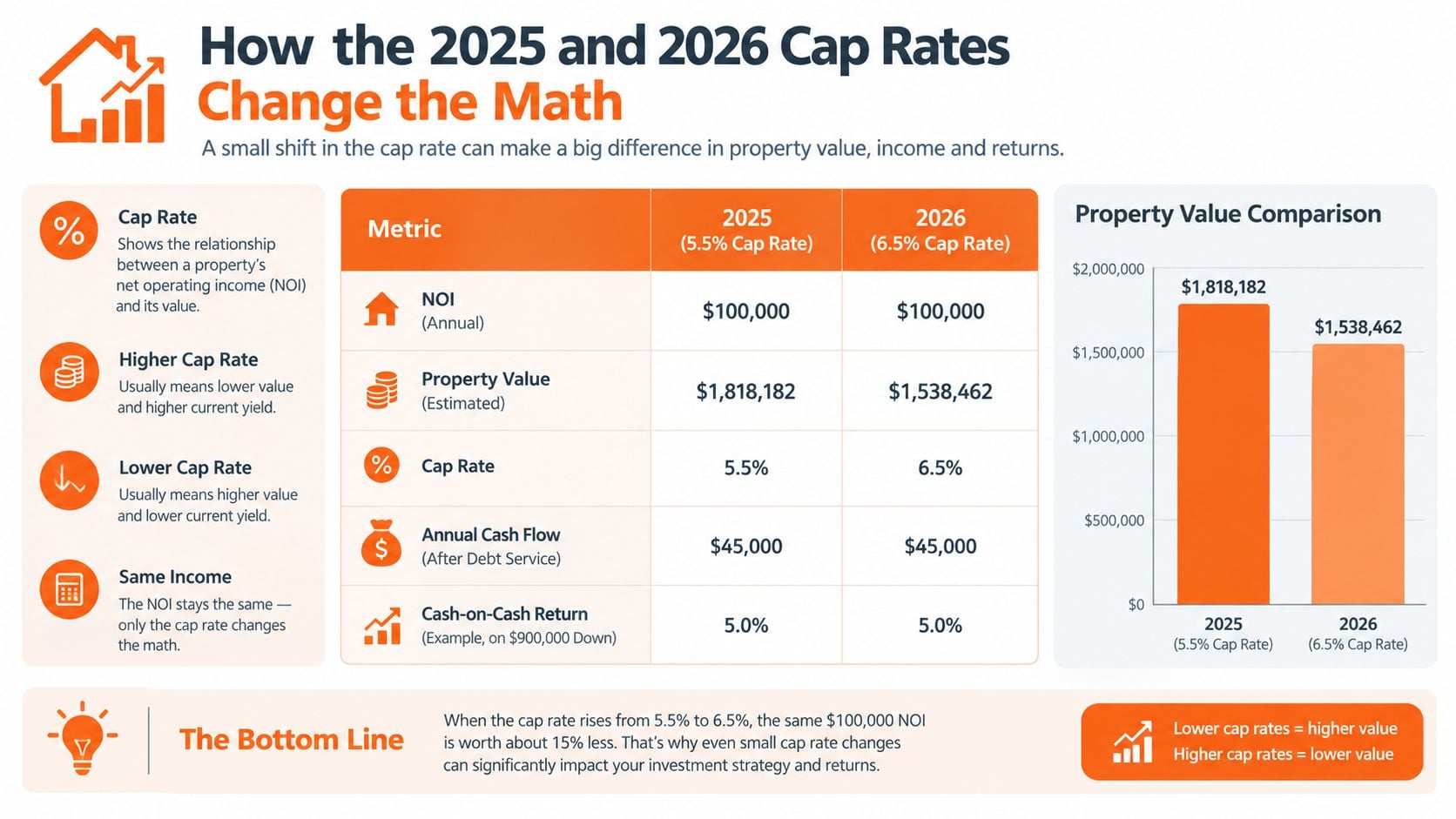
Eligibility gets the land into the productivity system. The cap rate determines the resulting taxable value. Divide net-to-land income by the applicable rate: 10.00% for 2026 agricultural and open-space land versus 7.75% for 2025 timberland. That change can materially alter the calculation. See this overview of Texas property taxes after the 2025 amendments for broader tax-rule context.
A clean comparison
Assume the same parcel produces $10,000 in net-to-land income:
| Cap rate | Illustrative net-to-land income | Illustrative calculated value |
|---|---|---|
| 10.00% | $10,000 | $100,000 |
| 7.75% | $10,000 | Approximately $129,032 |
The table demonstrates the formula, not your parcel's final appraisal. Category, income assumptions, degree of intensity, and the county's valuation work still control the result.
Build one evidence file for the full workflow. For property-tax approval, document the five-of-seven-years history, current agricultural use, and county-specific degree-of-intensity standard under 1-d-1 appraisal. If the land later converts to wildlife management, keep the written plan and records showing the required practices. Separately, obtain the Ag/Timber Number for qualifying sales-tax purchases and track its four-year renewal. A valid sales-tax number does not replace an approved productivity appraisal.
Review the income statements, lease rates, land classification, and cap-rate application used by the chief appraiser. County Central Appraisal Districts differ in how they apply intensity standards and review supporting records, so compare the calculation with local guidance. Challenge errors when the Notice of Appraised Value arrives. Waiting for the tax bill gives up the better opportunity to correct the valuation.
Common Myths That Get Applications Denied
Acreage alone doesn't qualify land. Texas has no single acreage number that replaces the degree-of-intensity test for every agricultural use and every county. A small tract can succeed with an intensive operation, while a larger tract can fail if the activity is sparse, casual, or unsupported.
The same problem appears with occasional hay cutting or a few animals. A one-time cut, informal grazing, or a barn on the property doesn't prove principal agricultural use. The CAD wants records showing a recognizable operation, appropriate intensity, and continuity.
Five assumptions to reject
- “My land is rural, so it qualifies.” Rural location helps explain the context, but it doesn't establish current use or local intensity.
- “I only need a fence and a barn.” Improvements are not agricultural production by themselves, and the structures may still be appraised at market value.
- “My homestead covers the whole parcel.” A homestead exemption doesn't automatically give the remaining acreage a 1-d-1 productivity valuation. That acreage must independently qualify.
- “A few cows are enough.” Livestock activity must meet the county's degree-of-intensity standard and be supported by records.
- “The history requirement is flexible.” The Comptroller's framework uses the five-of-seven-years standard. Missing records can leave an otherwise active operation unable to prove its history.
The strongest application connects use, intensity, and history to the exact account number and legal description. If your evidence only shows that agricultural activity occurred somewhere nearby, the county has a reasonable basis to deny the claim.
County-by-County Differences in Practice
Texas uses a statewide 1-d-1 framework, but the practical review happens inside each county appraisal district. Local intensity standards, acceptable documentation, wildlife-plan procedures, and communication practices can differ. That's why copying an application that worked in one county is risky.
A landowner comparing Travis, Harris, Williamson, and Llano counties should ask each CAD for current guidance rather than rely on informal acreage rules or a neighbor's experience. A cow-calf operation, hay tract, beekeeping operation, or wildlife conversion may require different supporting evidence depending on the region and the use.
| County / CAD | Typical degree-of-intensity | Wildlife plan rule | Common denial trigger | Annual renewal |
|---|---|---|---|---|
| Travis | Confirm the local benchmark for the specific agricultural use | Confirm plan format, submission method, and May 1 deadline | Weak intensity evidence or incomplete plan | Confirm directly with the CAD |
| Harris | Confirm whether the operation fits the local standard for the tract | Confirm county review requirements | Small-acreage use that appears incidental | Confirm directly with the CAD |
| Williamson | Confirm local standards for livestock, hay, or beekeeping | Confirm plan and supporting records | Records that don't establish active management | Confirm directly with the CAD |
| Llano | Confirm the rural-area standard for the specific operation | Confirm plan filing and implementation records | Missing historical proof or inadequate documentation | Confirm directly with the CAD |
The table is a planning tool, not a substitute for written county guidance. Texas law and Comptroller materials establish the broad framework, while the CAD evaluates whether your use meets local expectations.
The same packet can produce different results when the evidence doesn't address the receiving county's intensity standard.
Before filing, identify the correct CAD, request its current application instructions, confirm the deadline, and ask what records it expects for your specific use. A county-specific Central Appraisal District resource can help you locate the right office, but the final requirements must come from the CAD handling the parcel.
Pulling It All Together and When to Get Help
Run the property-tax and sales-tax obligations on one calendar, with separate filings and records. The property-tax file must support 1-d-1 eligibility, current principal agricultural use, the county's degree-of-intensity standard, a five-of-seven-years history, and Form 50-129. The sales-tax file needs a valid Ag/Timber Number for qualifying purchases, with renewal every four years.
Wildlife management has separate compliance requirements. The owner must submit a written plan to the county CAD by May 1 and implement at least three of seven recognized practices. An expired plan or missing activity records can put the conversion at risk.
Use a compliance file, not a loose folder
Maintain one file for each parcel:
- Ownership records: Deed, legal description, account number, and acreage.
- Use records: Leases, grazing logs, production evidence, receipts, photographs, and management notes.
- Deadline records: Form 50-129 submission, CAD correspondence, Notice of Appraised Value, and protest dates.
- Sales-tax records: Ag/Timber Number, exemption certificates, qualifying purchase records, and renewal date.
- Wildlife records: Written plan, maps, photographs, invoices, and proof of implemented practices.
Review the 2025 and 2026 cap-rate inputs when checking the productivity valuation. A lower tax result still depends on qualifying use and adequate evidence. County CADs apply the broad Texas framework to local intensity expectations, so a packet that works in one county may need stronger documentation in another.
Get professional help when ownership is complicated, historical evidence is weak, the property is converting to wildlife management, timberland classification is involved, or the productivity value is disputed. A consultant should test the records against the county standard, review valuation inputs, and identify the missing obligation.
INTELLI uses licensed property tax consultants and a data-first approach based on public and private data. Its review can cover county records, valuation evidence, cap-rate analysis, and parcel documentation before a filing or protest deadline.

Before filing, confirm the parcel's five-of-seven-years history, current agricultural use, local intensity benchmark, Form 50-129 deadline, Ag/Timber Number renewal date, and wildlife-management requirements. If the Notice of Appraised Value has arrived, review it immediately.
If you need help connecting Form 50-129 evidence, county intensity requirements, productivity valuation, wildlife records, and Ag/Timber Number obligations, INTELLI can review the property-tax issues through licensed consultants using public and private data.