

About 62% of property tax appeals result in some reduction, according to a 2026 summary of protest outcomes, while reported reduction rates reached 98.68% in Hays County and 89.2% in Harris County. Those figures don't guarantee that every protest will succeed, but they do challenge the assumption that filing is pointless. In Texas, the central question isn't whether owners can protest. It's whether they file on time and present evidence that changes the appraisal district's view of value. (Texas protest outcome summary)
Texas property owners can challenge an assessment every year, but the opportunity is controlled by a short calendar. A well-prepared protest usually combines the formal filing with comparable sales, property-record corrections, condition documentation, or income data. The mechanics preserve your rights. The evidence determines whether the result is a token adjustment or a meaningful reduction.
Why Texas Property Tax Protests Are Worth the Effort
Texas property tax protests are a routine way to challenge an appraisal, not a tactic limited to attorneys or large commercial owners. Reported figures show how widely the process is used. Harris County alone has been reported to receive 516,654 protests annually, involving $504 billion in protested value. That volume makes protests a significant part of property-tax administration in one of the state's largest markets. (Texas protest volume and outcomes)
The practical reason to file is that appraisal records can contain incorrect facts, weak comparable selections, unsupported condition assumptions, or a value that does not fit the property's market position. Filing preserves the owner's opportunity to address those issues with the appraisal district and, if needed, the Appraisal Review Board. Missing the deadline can prevent a persuasive valuation argument from being considered for that tax year.
The deadline drives the economics
Most Texas owners must file a Notice of Protest by May 15 or within 30 days after the appraisal district delivers the Notice of Appraised Value, whichever is later. The Texas Comptroller explains the annual process and filing requirements in its official property tax protest guidance.
The notice starts the work. The tax bill comes later, after the assessment is completed and taxing-unit rates are applied. By then, the main opportunity to challenge the property's appraised value has generally passed. That timing affects homeowners, landlords, and small commercial owners in Austin, Houston, Hays County, and other Texas markets.
A protest can still make financial sense when the expected reduction is modest. Correcting square footage may produce a limited adjustment, while well-supported market-value or unequal-appraisal evidence can affect a much larger assessment. The decision depends on the amount of overvaluation, the strength of the evidence, and the time needed to prepare and present it.
Practical rule: File first to preserve your rights. Refine the valuation argument and supporting documents immediately afterward.
Informal resolution also deserves serious attention. Ector County's 2023 annual report records 41,154 protests, including 16,656 informal resolutions. Of those informal resolutions, 14,237 resulted in a value reduction. Formal hearings totaled 9,116, and 5,692 resulted in a reduction. These results do not predict an individual case, but they show why a clear evidence packet can matter before an ARB hearing. (Ector County 2023 annual report)
Who Can Protest and What Grounds Work in Texas
Texas property owners can protest an appraisal that appears incorrect, excessive, or unequal. This includes homeowners occupying a primary residence, non-resident investors, landlords, and commercial property owners. An authorized agent may also act for the owner when the required written authorization or appointment is provided.
A protest does not require proof that the market declined. Texas appraisal disputes often turn on inaccurate property records, weak comparisons, or a valuation method that does not reflect the property's actual condition and income. The strongest grounds are specific, supported by documents, and tied to the value being challenged.
Grounds that usually deserve attention
Market value is too high. Show that the appraised value exceeds the property's true market value as of the relevant valuation date. Recent, comparable sales generally carry more weight than broad neighborhood trends. Adjust for location, size, age, condition, and features rather than presenting a list of superficially similar properties.
Unequal appraisal. Compare the subject property with a representative group of similar properties carrying lower appraised values, then make appropriate adjustments. A lower sale price alone does not establish unequal appraisal. This argument concerns how comparable properties are assessed, not merely what one property sold for.
Incorrect property characteristics. Errors in living area, room count, lot size, age, construction type, or condition can distort the district's valuation model. If a Travis County record lists 2,400 square feet but the actual living area is 2,180 square feet, submit reliable documentation supporting the correction, such as measured plans, appraisal records, or other property documents.
Condition and functional problems. Foundation movement, roof deterioration, water intrusion, unfinished repairs, drainage problems, and code concerns can reduce market value when the record does not reflect them. Photographs should identify the problem and its location. Repair estimates, contractor statements, inspection reports, and permits help connect the condition to a requested value adjustment.
Exemption or cap errors. A qualified homestead that received the exemption in the prior year may receive a 10% annual appraisal increase cap for the school district portion of taxes, excluding land value. The cap does not apply automatically to every property. Verify the exemption status, prior-year qualification, and capped value instead of assuming the increase is unlawful.
A Hays County homestead that increased 22% in one year warrants that review. The increase does not by itself prove an incorrect appraisal, but it may reveal a missing exemption, an incorrect prior-year qualification, or an error in the capped value or property record.
Income-producing properties require different evidence. For a Harris County rental, a major roof replacement and falling net operating income may support an income-approach argument based on actual rent, vacancy, operating expenses, and capital needs. The owner's inability to afford the tax bill does not establish market value. The evidence must show why the property's income profile supports a lower assessment.
Key Deadlines and Forms You Cannot Miss
A late protest can end the case before the evidence is reviewed. The standard Texas deadline is May 15 or 30 days after the Notice of Appraised Value is mailed, whichever is later. Some counties set an earlier date, including April 30, so the date printed on the notice and the county appraisal district's instructions control. Use this Texas property tax protest deadline guide as a calendar reference, then verify the deadline locally before filing.
Read the Notice of Appraised Value line by line. Check the property address, account or property ID, current and prior-year appraised values, exemptions, and stated protest deadline. The notice is not the tax bill. It identifies the value the appraisal district intends to place on the roll and opens the opportunity to challenge that record.
Form 50-132 and acceptable filing channels
The usual filing document is Form 50-132, Notice of Protest. Enter the owner's identifying information, property address, property ID, and contact details. Select the grounds that match the dispute, such as incorrect market value, unequal appraisal, both, or another applicable issue. If a representative will act for you, complete the agent information and include the required appointment documentation.
Sign the form and review every identifying field before submitting it. An unsigned form, missing property ID, or incomplete address can create a preventable filing problem. Counties may accept protests through an online portal, by mail, by email, or in person, but available channels differ. Save the portal confirmation, email receipt, submission screenshot, or delivery record.
Timing matters for both paper and electronic filings. A postmark after the deadline may lead to rejection, even if the form was prepared earlier. Submit electronic filings before the stated cutoff rather than leaving them in a draft folder.
A late-filing remedy may exist if you can show good cause, but it is not a dependable substitute for timely filing. After the ARB issues its order, separate appeal deadlines apply. A petition for judicial review generally must be filed within 60 days of receiving the written order under the applicable procedure. The Texas protest and appeal procedures explain the procedural path.
Building the Evidence That Wins Reductions
A persuasive protest doesn't contain the most pages. It contains the most relevant evidence, tied directly to the valuation issue. Appraisal districts and ARB panels respond better to a short, organized packet that identifies the requested value, explains the calculation, and cites the source for each important fact.
Match the evidence to the property
For a homestead, start with sales that resemble the subject property in location, size, age, condition, and features. Sales from the same neighborhood or school district are generally more useful than distant properties that only share a broad price range. A small group of tight comparisons usually beats a long list of loose ones, particularly when every adjustment is explained.
For rentals and multifamily properties, gather the records that describe actual performance:
- Rent roll: Show current unit rents, lease status, concessions, and occupancy.
- Operating statements: Use trailing operating results, supported by bookkeeping records.
- Vacancy history: Explain sustained vacancy, lease-up problems, or local conditions affecting income.
- Expense records: Include management, insurance, utilities, repairs, taxes, and other operating costs.
- Capital needs: Separate ordinary operating expenses from major repairs, such as a roof replacement.
The income approach should connect those facts to a supported value opinion. A rental owner who says expenses rose without showing the statements gives the district little to evaluate. A documented decline in net operating income, supported by actual records, gives the reviewer a reason to revisit the model.
Physical condition evidence can also carry substantial weight. Photograph foundation movement, roof wear, water intrusion, code violations, or unfinished damage. Date the images and add contractor estimates, inspection records, invoices, or other documents that show the cost and nature of the problem.
Cross-check the district's assumptions
Use multiple sources where available, including MLS records, county deed records, appraisal records, and the Texas Comptroller's property value study. The purpose isn't to overwhelm the reviewer. It's to identify discrepancies and show which source supports your position.
For a deeper review of comparable selection and adjustment logic, see this comparable property analysis resource. Agents and investors may also find a land transfer tax calculator for agents useful for transaction analysis, although transfer-tax calculations shouldn't replace appraisal evidence.
| Evidence Type | Residential Homestead | Rental / Multifamily | Commercial |
|---|---|---|---|
| Comparable sales | High weight when location, size, age, and condition align | Useful, but income performance may matter more | Relevant for market transactions with similar use and quality |
| Property-record corrections | High weight for square footage, rooms, lot size, and condition | Important for unit count, rentable area, and physical attributes | Important for rentable area, use, improvements, and site details |
| Income and expense records | Usually limited relevance | Central to an income approach | Often central, especially for stabilized or specialized assets |
| Photos and repair estimates | Strong for visible defects and deferred maintenance | Useful for unit and building conditions | Useful for physical deficiencies, obsolescence, and capital needs |
| Unequal-appraisal evidence | Compare similarly situated nearby properties | Compare similar assessed properties after adjustments | Requires careful selection of properties with comparable use and characteristics |
In Travis, Harris, and Hays counties, the practical advantage of this preparation is often realized during the informal conference. Informal resolution can avoid the uncertainty and time of a formal hearing, but don't treat an early offer as automatically fair. Compare the proposed value with your evidence and decide whether accepting it leaves a meaningful overvaluation unresolved.
Walking Into Your Appraisal Review Board Hearing
An ARB hearing is a semi-formal administrative proceeding, not a courtroom. The panel expects the appraisal district to present its position and the property owner to explain why the record or valuation should change. Procedure still matters, so preparation should begin before you arrive.
Arrive early enough to check in, locate the hearing room, and confirm that the panel has your evidence packet. Bring a printed summary with the requested value, the principal reasons for the protest, and a short explanation of each comparable or valuation input. A raw stack of documents forces the panel to do the organizing. Your summary should do that work for them.
What the hearing usually looks like
The CAD representative commonly opens with the subject property record, comparable sales, and, for income-producing property, the district's income model. You then present your counter-evidence. Address the panel directly, keep your tone professional, and move through the evidence in a logical order.
A strong presentation might begin with a factual correction, then explain the market or income evidence, and finish with a precise requested value. Don't spend the opening minutes describing how frustrating the tax bill is. The panel needs to understand why the appraised value doesn't reflect the statutory valuation standard.
Expect questions about comparable adjustments, property condition, sale dates, and differences between the subject and selected properties. Concise answers outperform long arguments. If you don't know an answer, say so and identify the document that supports your position instead of guessing.
Travis County hearings often run 10 to 15 minutes, while Harris County hearings can move faster and Hays County panels may focus heavily on the accuracy of the appraisal district's records. These local differences make a concise packet especially important.
What wins attention: A panel can follow a documented error or a well-supported comparison quickly. It can't evaluate an unsupported conclusion simply because the owner feels strongly about it.
Either party may request a 15-day postponement in writing before the hearing, subject to the applicable county procedure. Some counties also permit appearances by phone, which can help non-resident owners or people who can't travel. Confirm the option before relying on it, and ask how exhibits must be submitted for a remote appearance.
If the district offers a settlement, read the proposed value and any agreement language carefully. An informal agreement can be efficient, but you should know whether it resolves every issue you raised and whether any exemption matter remains separate from the valuation dispute.
Post-Hearing Appeals and Judicial Review Options
An unfavorable ARB order does not always end the dispute. Escalation makes financial sense only when the possible tax savings justify the time, fees, and procedural risk. First identify the specific error in the order, then match it to a remedy that can correct it.
A motion for rehearing may fit when the panel overlooked evidence, used the wrong standard, or made a material factual or procedural mistake. The deadline is generally 14 days after the ARB order, subject to the applicable county rules. This filing can preserve an issue without immediately taking on the cost of court proceedings.
Binding arbitration may work for a valuation dispute when the evidence is strong and the owner wants a structured alternative to district court. Eligibility generally includes properties with assessed values of $5 million or less, with lower thresholds for residence homesteads. Fees and eligibility rules affect the decision, so verify current requirements before selecting arbitration.
Judicial review in district court has its own deadline. A petition generally must be filed within 60 days of receiving the ARB order. Depending on the case and applicable procedure, an owner may pay the disputed tax under protest and pursue a refund, or file a Tax Code Chapter 42 petition when payment is not required. Review the applicable Texas protest and appeal procedures before filing.
The State Office of Administrative Hearings may provide another forum when Texas law allows it. A separate appeal of an ARB order to SOAH must be filed within 30 days of receiving that order. That deadline differs from the 60-day judicial review period, so one filing should not be assumed to preserve every option. The Texas Comptroller's protest guidance also outlines the available routes and requirements.
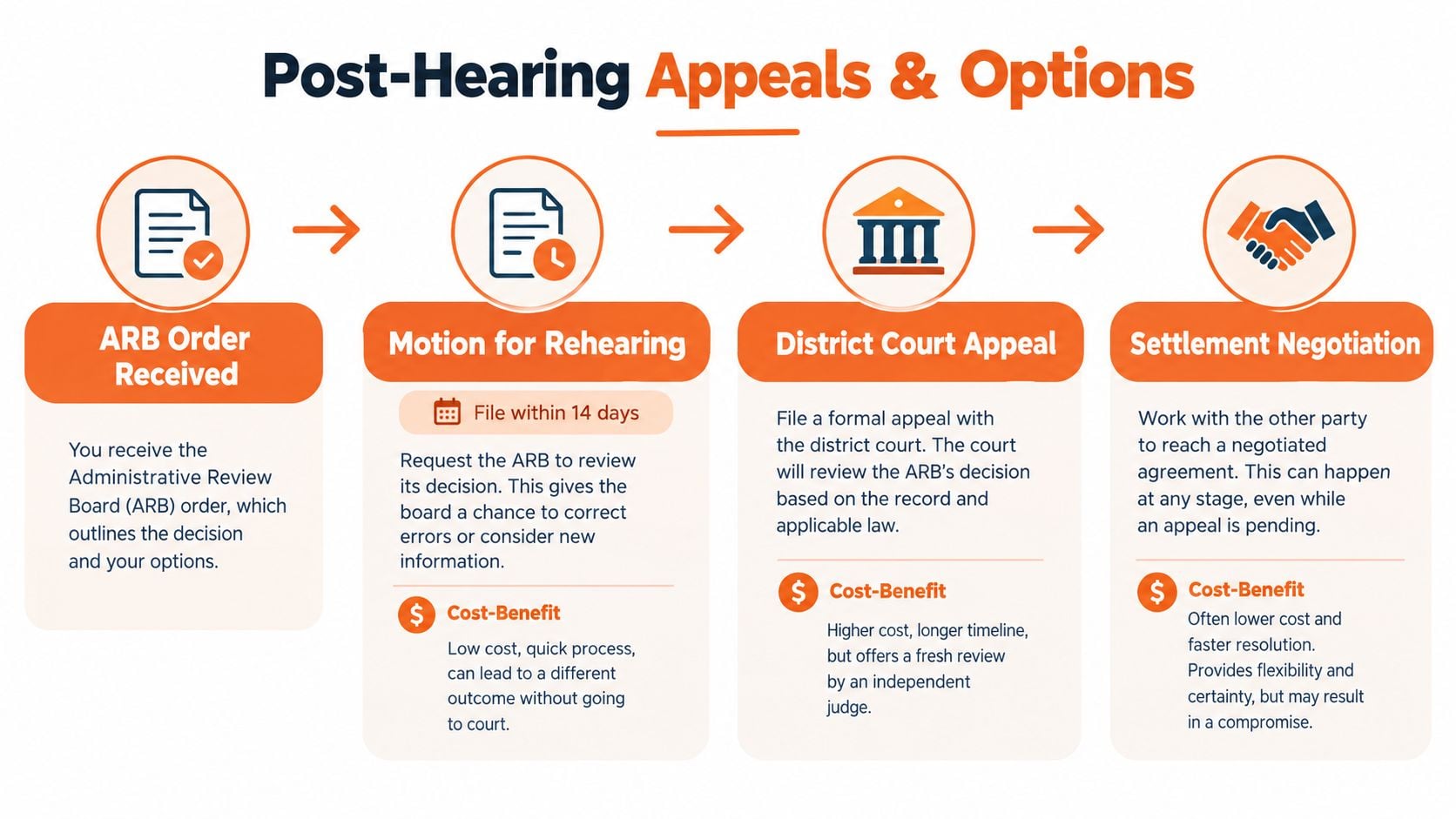
Professional review is usually worthwhile for large commercial tracts, complex income models, or cases with substantial value still in dispute. An average homestead owner may get better results by correcting the record, pursuing an informal settlement, and reserving court action for a clearly material error.
Filing on Your Own, Hiring a Pro, or Claiming Exemptions
The best filing route depends on three factors: the value at stake, the quality of the evidence, and the time available before the deadline. A homeowner with a clear record error may handle the protest efficiently. A commercial property with several parcels, income-based valuation, or unusual construction usually requires more analysis.
Check exemptions before challenging value. A qualified homeowner should review the general homestead exemption, over-65 or disabled-person eligibility, disabled-veteran provisions, agricultural or historic designations where applicable, and surviving-spouse rules. The applicable Texas guidance identifies a general homestead exemption of at least $100,000 off the school portion for most owners, an additional $10,000 for over-65 and disabled exemptions, and a $5,000 surviving-spouse exemption. Confirm the current requirements and whether the appraisal district applied the exemption correctly.
The homestead appraisal cap is a separate protection. A qualified homestead that received the exemption in the prior year may receive the 10% annual cap on the school-district portion of appraised value growth, excluding land value. Check the cap calculation independently. A successful value protest will not automatically correct a missing exemption or an incorrectly applied cap.
Choosing the filing route
DIY filing is practical when the record contains an obvious error or the property has a narrow set of comparable sales. The owner must still read the appraisal notice, collect supporting documents, submit the protest, attend the informal review, and answer questions clearly. That work can be worthwhile when the case is simple and the owner has time to prepare.
Representation makes more sense when the assessment is large, the property produces income, several parcels are involved, or condition issues require detailed records. It also helps owners who can identify an unreasonable value but cannot spend time learning county-specific ARB procedures. The trade-off is cost and less direct control, so review the agreement, contingency terms, service scope, and how exemptions will be handled before signing.
INTELLI uses licensed property tax consultants and a data-first approach, combining public and private data to prepare valuation evidence and represent owners in property tax protests. Its service is presented as a results-based option for homeowners, investors, and businesses, with compensation tied to a reduction rather than an upfront consulting charge. Owners comparing firms can learn more about why a licensed local property tax consultant still matters.

File personally when the evidence is straightforward and the potential savings justify your preparation time. Hire representation when valuation analysis, documentation, or the financial stakes justify delegated work. Claim applicable exemptions either way, because an exemption issue can remain unresolved after the appraised value changes.
The following video provides another visual introduction to protest routes and preparation choices.
INTELLI helps Texas homeowners, investors, and businesses prepare evidence, evaluate appraisal records, claim applicable exemptions, and pursue property tax reductions through licensed consultant representation. Visit INTELLI to review your property and start before the filing deadline.