

A capital improvement is a permanent upgrade that adds value, extends useful life, or adapts property to a new use. Routine repairs and maintenance generally preserve the property's existing condition instead of creating a lasting improvement.
You may be facing this question after opening a folder of home renovation receipts. A new roof, a leaking pipe, a replacement water heater, and a fresh coat of paint can all appear on the same list, yet tax and appraisal rules may treat them differently. The invoice total doesn't decide the label. The project's effect on the property does.
For a Texas homeowner, the distinction matters under three separate lenses. Federal income-tax rules ask whether a cost must be capitalized and recovered over time. Cost-basis rules ask whether the expenditure becomes part of the property's basis when you later sell. A Texas appraisal district asks whether the work contributes to the property's market value. Those questions overlap, but they aren't interchangeable.
What a Capital Improvement Actually Means
A Houston homeowner replaces a 15-year-old roof after storm damage. A few months later, the same homeowner pays a plumber to patch a leaking pipe. Both projects may cost thousands of dollars, but they don't necessarily have the same economic effect.
The roof replacement may be a capital improvement because it replaces a major building component and returns the property to a like-new condition. The pipe patch is more likely repair and maintenance because it restores ordinary operation without materially changing the property's capacity, usefulness, or serviceable life. The conclusion still depends on the project's actual scope, but the distinction becomes clearer when you ask what the work accomplished.
Practical rule: Classify the work by its lasting effect on the asset, not by the size of the invoice.
A capital improvement is a permanent modification, addition, restoration, or other upgrade that increases an asset's usefulness, productivity, or serviceable life. For accounting purposes, its cost is generally added to the recorded value of the existing property and depreciated over time instead of being immediately expensed. The U.S. Census Bureau's capital-expenditure instructions use a similar framework for major additions, alterations, structures, and capitalized repairs or improvements.
Routine maintenance usually keeps an asset in its existing operating condition. Cleaning, painting, patching, ordinary repairs, and similar work often fall into this category. A complete roof replacement can create a lasting economic benefit, while replacing a few damaged shingles may only preserve the roof's current condition.
Why the label changes the outcome
For federal tax purposes, a qualifying improvement generally becomes a capitalized cost recovered over time. A qualifying repair may generally be deducted in the year incurred, subject to the applicable rules. The IRS explanation of tangible-property improvements identifies an addition or partial replacement as an improvement when it constitutes a betterment, restoration, or adaptation to a new or different use.
The same roof invoice can also affect cost basis, the amount used in calculating gain or loss when the property is sold. A capitalized improvement generally becomes part of that basis, while an ordinary repair usually doesn't receive the same treatment. Separately, a Texas appraisal district may consider whether the project adds contributory market value, which isn't automatically equal to the project's cost.
Those are the three lenses used throughout this guide: federal capitalization, cost basis at sale, and Texas appraisal value.
How the IRS Decides What Counts as an Improvement
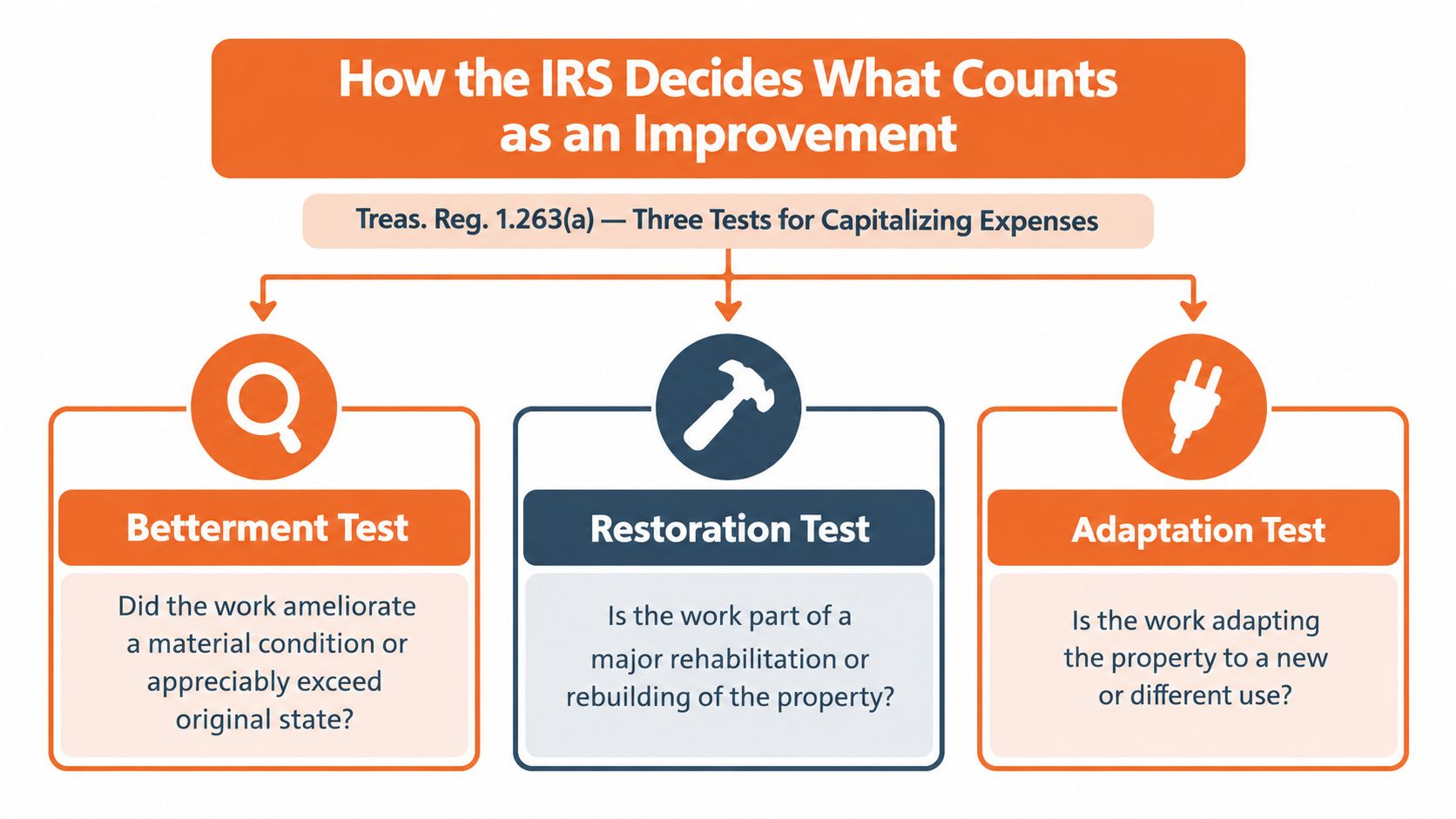
The IRS doesn't use a simple price threshold to decide whether work is a capital improvement. Its tangible-property framework focuses on whether the expenditure produces a betterment, restoration, or adaptation to a new or different use, as described in the IRS tangible-property regulations guidance.
The three tests
Betterment asks whether the work corrects a material defect, adds a major component, physically enlarges the property, or materially increases its capacity, productivity, efficiency, strength, quality, or output. For example, replacing a basic water heater with a commercial-grade system sized for a larger household may go beyond restoring ordinary operation.
Restoration covers work that replaces a major component or substantial structural part, rebuilds property to a like-new condition, or returns property from a state of disrepair. A complete rewire that replaces outdated aluminum branch wiring may be analyzed under this test because the project affects a major building system.
Adaptation applies when the work changes the property for a new or different use. Converting part of a home into a space designed for a different function may qualify even if the project doesn't enlarge the building.
The price tag isn't the deciding factor. A $2,800 deck rebuild could remain a repair if it only restores the deck to its ordinary condition, while an $800 bathroom faucet replacement could require capitalization if it forms part of an adaptation for a new use. Those examples illustrate the IRS principle, not an automatic result for every project.
If the project crosses the improvement threshold, related costs can also require capitalization. That may include costs to demolish, remove, or dispose of the old component, depending on the facts and applicable rules. Keep the contractor's scope of work rather than recording only a vague description such as “home repairs.”
For rental owners, the IRS also permits an election to capitalize certain repair and maintenance costs when the costs are consistently treated as capital expenditures in the owner's books and records. The IRS material on depreciation and tangible property can help organize the broader issue, but the classification should still follow the project's economic substance and the owner's tax position.
Capital Improvements Compared to Repairs and Maintenance
The dividing line becomes easier to apply when you compare projects on the same property. A full replacement, enlargement, or major system change often creates a separate long-lived asset. A patch, tune-up, or isolated component replacement often preserves the existing asset.
| Project | Capital Improvement | Repair or Maintenance |
|---|---|---|
| Roof work | Replacing the entire roof surface or a major roof system | Patching a leak or replacing a few damaged shingles |
| HVAC work | Replacing the full HVAC system with a major new system | Performing an annual tune-up or replacing a worn belt |
| Room work | Adding a structurally integrated room | Repainting an existing interior |
| Electrical work | Upgrading the electrical panel or major distribution system | Replacing one defective outlet |
| Exterior siding | Residing the entire exterior | Replacing a few rotten siding boards |
A partial re-roof can be a gray area. If the work replaces a substantial structural part or restores the roof to a like-new condition, it may be capitalized. If a contractor replaces only isolated shingles to keep the existing roof operating, the work may remain a repair. The scope, condition before the work, and result after completion matter more than the fact that both jobs involve roofing.
Homeowners comparing a repair with a larger replacement can also review this resource on comparing roof costs in Tyler from Home Pro's Remodeling & Repairs. The practical value is not just the price comparison. It's understanding whether the proposed work preserves the existing roof or replaces a major component.
The commercial version of the same question
Consider a 4,000-square-foot office with a rooftop HVAC unit. Replacing the entire rooftop unit may create a capital asset because the project replaces a major system. Swapping a single belt in the existing unit usually keeps the same system operating and is more likely to be an expense.
A large invoice can still describe a repair, and a smaller invoice can still be part of an improvement.
This classification flows into the owner's depreciation schedule, accounting records, and future cost-basis documentation. It also affects what evidence a property owner can present if a Texas appraisal district questions whether a project changed the property's market value.
Real Examples in Homes, Rentals, and Commercial Buildings
A primary residence provides familiar examples. Replacing the entire roof is generally a capital-improvement candidate because it replaces a major building component. Patching a few missing shingles is generally a repair because it addresses a localized problem. Repainting interior walls the same color is usually maintenance, while a full redesign that changes the room's function may require a closer analysis.
The label isn't automatic. A project's scope and result determine whether it materially improves the property, restores a major component, or adapts the space.
| Project | Property Type | Classification | Why It Matters |
|---|---|---|---|
| Complete roof replacement | Primary residence | Improvement candidate | It replaces a major component and may restore the roof to like-new condition |
| Missing-shingle patch | Primary residence | Repair | It addresses localized damage without replacing the roof system |
| Same-color interior repaint | Primary residence | Maintenance | It preserves the existing finish and use |
| Matching water-heater replacement | Long-term rental | Repair or gray area | A comparable replacement may restore ordinary operation |
| Conversion from a tank system to a tankless system | Long-term rental | Improvement candidate | The change may materially alter efficiency, capacity, or useful life |
| Parking-lot resurfacing | Commercial building | Gray area | The scope determines whether it preserves the surface or creates a substantial lasting upgrade |
| New HVAC chiller | Commercial building | Improvement candidate | It adds or replaces a major building system |
| Expanded loading docks | Commercial building | Improvement candidate | The expansion adds physical capacity |
| Reconfigured office floor plates | Commercial building | Improvement or gray area | The classification depends on whether the work adapts the space to a new use or merely repairs finishes |
How to pattern-match your invoices
Start with the physical result. Did the contractor add capacity, replace a major component, materially increase efficiency, or adapt the property to another use? If so, preserve evidence supporting an improvement classification.
Next, compare the condition before and after the work. A contractor statement that says “replace entire exterior siding system” communicates something different from an invoice that says “replace three boards.” Before-and-after photographs can make that difference easier to verify.
For rentals, don't assume that every replacement is a repair. Replacing a water heater with a similar unit may restore the existing system. Moving from a conventional tank to a tankless system may change the property's operating characteristics and require capitalization analysis under the federal rules.
Commercial owners should separate invoices by component. A parking-lot project, chiller installation, loading-dock expansion, and office reconfiguration may have different purposes and different treatment, even when one contractor manages the entire renovation.
How Texas Property Tax Treats Capital Improvements
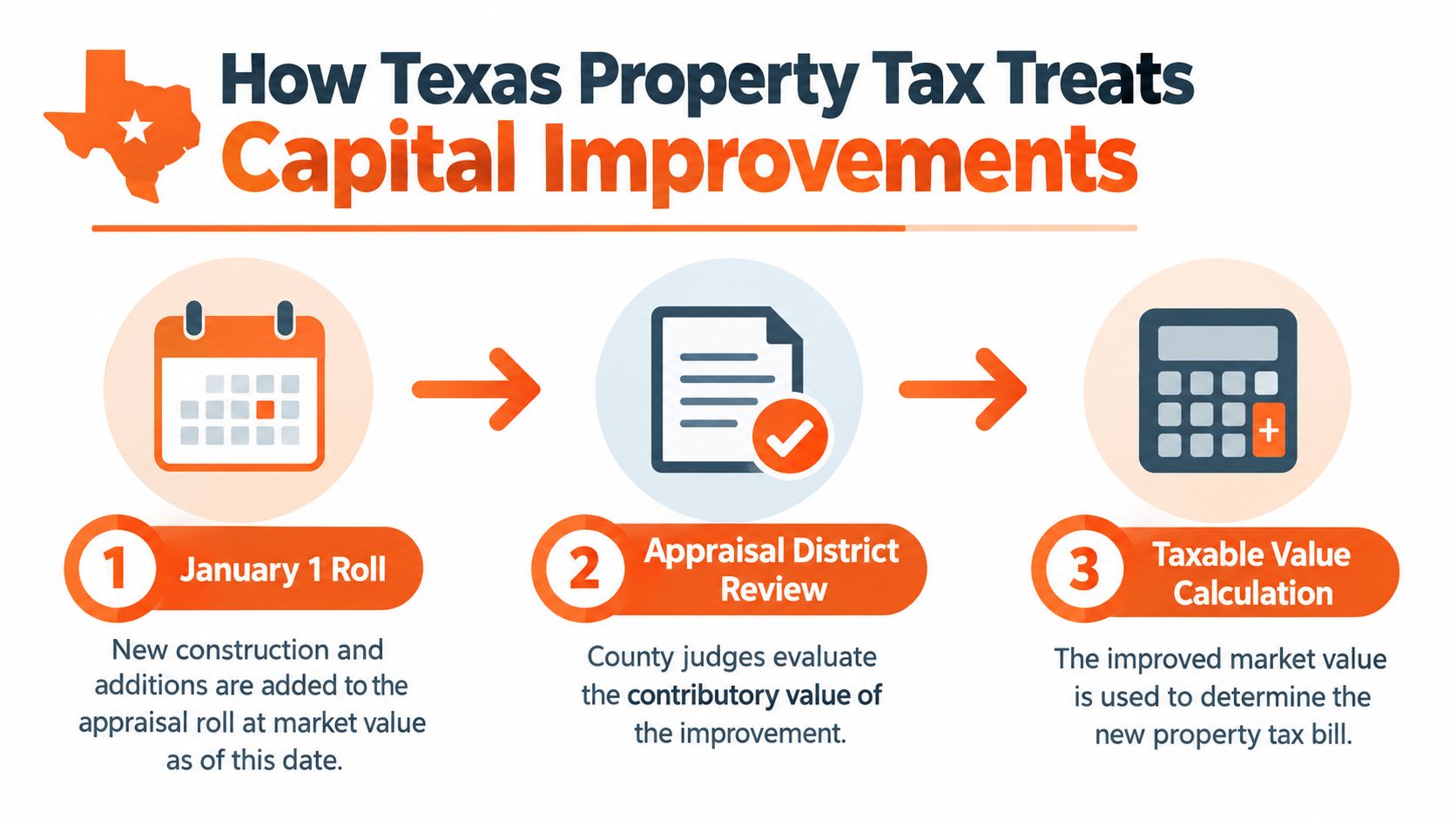
Texas property tax adds a separate question: How much market value does the improvement contribute to the property? That question isn't answered by federal depreciation treatment alone.
The Texas Comptroller describes a residence-homestead new improvement as work made after the most recent appraisal that increases the property's market value and wasn't included in the prior tax year's appraised value. The Texas Comptroller's explanation of property valuation connects the improvement to later appraisal treatment, but it doesn't create a rule that every project increases taxable value by its construction cost.
Cost is not the same as contributory value
Suppose you replace a roof for a substantial amount. The federal tax system may treat the work as a capitalized restoration. Your county appraisal district may consider the roof's effect on market value. Those conclusions can coexist without producing a dollar-for-dollar increase in the assessment.
An appraisal district looks at the property's market evidence, condition, comparable sales, and the improvement's contribution to the whole property. A kitchen renovation, energy equipment installation, garage addition, and roof replacement can each have a different relationship between project cost and market value. Ordinary repairs and maintenance generally don't qualify as a new improvement merely because the invoice is large.
Texas also uses a narrower property-tax meaning in some contexts. A specific Texas rule defines a capital improvement as a property improvement with a depreciable life of at least five years under generally accepted accounting principles, while excluding typical make-ready costs such as plasterboard repair, interior painting, and floor coverings. The Texas Local Government Code provision on capital improvements also uses a separate public-infrastructure concept for impact-fee purposes, so owners must identify the legal context before applying the label.
Evidence for a protest
A homeowner should preserve:
- Permits: Show the project's scope, location, and approval history.
- Invoices: Separate labor, materials, demolition, and component costs.
- Contractor statements: Describe whether the work replaced, added, enlarged, or adapted property.
- Photographs: Capture the condition before work and the completed result.
- Comparable evidence: Show how similar properties are valued and how buyers respond to similar improvements.
A homestead rule may allow a qualifying addition or value-enhancing project to affect the residence-homestead tax ceiling even though ordinary repairs are excluded. That doesn't mean the entire project cost becomes taxable value. The appraisal question remains the improvement's market contribution.
Depreciation and Records for Rental and Commercial Owners
Rental and commercial owners need records that explain both what they bought and when the asset was placed in service. A qualifying improvement generally becomes a separate depreciable asset rather than an immediate repair deduction.
For residential rental property, the IRS states that major building-component replacements and substantial structural parts are generally capital improvements. Those qualifying improvements are generally depreciated over 27.5 years using the straight-line method and a mid-month convention, as described in the IRS guidance on depreciation recapture for rental property.
The placed-in-service date affects when depreciation begins and how the first period is calculated. Owners should therefore record the month the completed improvement became available for its intended use, not merely the date of the first contractor payment.
| Asset Category | Recovery Period | Method | Convention |
|---|---|---|---|
| Qualifying residential rental improvement | Generally 27.5 years | Straight-line | Mid-month |
| Commercial building improvement | Determined under the applicable federal property rules | Determined under the applicable federal rules | Determined under the applicable federal rules |
| Repair and maintenance expense | Generally not recovered as a capital asset | Expense treatment may apply when permitted | Not applicable as a depreciable asset |
The table separates verified residential rental guidance from commercial treatment that may depend on the asset and applicable tax rules. Do not assign a commercial project a recovery period just because the invoice describes it as a renovation.
Build the file before filing
Keep the contractor agreement, detailed invoices, permits, engineering documents, asset ledger entry, depreciation schedule, and photographs together. If one project includes a roof, HVAC equipment, appliances, and land-related work, ask the preparer whether the costs should be allocated among separate components.
The file should also explain why the work was performed. “Replace failed rooftop unit” supports a different analysis from “add cooling capacity for expanded office use.” A clear description helps connect the expense to betterment, restoration, or adaptation.
The rental-property depreciation resource can help owners organize depreciation questions, but it shouldn't replace advice specific to the property, ownership structure, and tax return. Capture the documentation before filing rather than trying to reconstruct the project years later.
Putting It All Together for Your Texas Property
A capital improvement is a permanent change that adds value, extends useful life, or adapts property to a new use. The IRS focuses on economic effect through betterment, restoration, and adaptation. Cost basis focuses on the amount invested in the property for a future sale. A Texas appraisal district focuses on the improvement's contributory effect on market value.
Use this checklist when reviewing your next project:
- Ask whether the work becomes part of the property. A lasting addition, major component, or structural change deserves closer review than a temporary fix.
- Identify the physical effect. Does the work add value, extend useful life, increase capacity, improve efficiency, or change the property's use? Or does it only return the asset to ordinary operating condition?
- Apply the federal tests. Determine whether the project corrects a material defect, replaces a major component, restores the property, or adapts it to a new or different use.
- Separate tax treatment from appraisal treatment. A capitalized federal cost doesn't automatically become an equal amount of Texas taxable value. Look for market evidence and comparable sales showing the project's contribution.
- Preserve the evidence. Keep permits, receipts, contracts, photographs, engineering records, and placed-in-service information. Identify whether a homestead rule or another exemption applies to the property.
A Texas protest should focus on the valuation evidence, not just the fact that the owner spent money. Uniform appraisal standards, comparable sales, property condition, project scope, and depreciation records can help explain whether the appraisal district has overstated the improvement's contribution.
The same invoice can be an improvement under one framework and a repair under another. That isn't a contradiction. Federal capitalization, cost basis, and Texas contributory value answer different questions, so documenting the project's intent and effect matters more than relying on the dollar amount alone.
INTELLI helps Texas homeowners, investors, and businesses organize improvement evidence, evaluate appraisal issues, and pursue applicable property-tax exemptions. INTELLI uses licensed property tax consultants and employs a data first approach, using public and private data. Visit INTELLI to review your property-tax situation and prepare for the next appraisal or protest deadline.