
Your notice arrives, you open it expecting something close to last year's bill, and the appraised value is higher than the number you had in your head. You run a quick property tax estimator online, get a single dollar figure, and still don't know whether that figure is wrong, whether an exemption is missing, or whether you should protest. A useful estimate answers those questions. It gives you a range, shows its inputs, and tells you which ones you can change.
Five Inputs That Set Your Texas Property Tax Bill
Say a Travis County homeowner budgeted for last year's bill and opened a notice 9 percent higher in this hypothetical example. That gap usually starts with inputs, not the tax rate. If you don't separate appraised value, taxable value, and market value, you'll chase the wrong problem.
Texas doesn't use one statewide rate. A home inside Austin can sit in a city, a county, a school district, and one or more special districts. Each unit sets its own rate, so the same house value produces different bills across district lines. If you're checking what sets the property tax rate in Texas, start by listing every unit on your account rather than using a county average.
The Five Inputs to Copy First
The Travis County Tax Office notes on its general homestead exemption page that the appraisal district determines appraised value while exemptions reduce the amount subject to taxation, and that the general residence homestead exemption is for an individual whose home was the primary residence on January 1. That distinction drives the whole estimate.
| Input | Where to find it |
|---|---|
| Appraised value | Annual notice of appraised value from the appraisal district |
| Exemptions on the account | Exemption section of your appraisal district account |
| Taxable value | Appraised value minus exemptions, calculated for each taxing unit |
| Tax rate per taxing unit | Adopted rates published by county, city, school district and special districts |
| Market value | Appraisal district estimate, used for protest comparisons only |
Landlords need the same discipline on the income side. If you're modeling rent against tax, mortgage, and expenses, you can build a smarter rental income calculator and then replace its tax line with your per-unit estimate instead of a guess.
Copy the five inputs into a spreadsheet before you run any property tax estimator. A missing exemption or wrong taxing unit is visible at a glance, and you won't have to rebuild the math later.
Exemptions to Check Before You Trust the Number
The most expensive mistake isn't bad math. It's a missed deadline. The Texas Comptroller states in its exemption deadline materials that the general deadline for filing a property-tax exemption application is before May 1, with April 30 the last day for most exemption and special-appraisal applications. File late and you can keep a full year's tax at the higher level.
An estimate built on appraised value alone can overstate your bill when a qualifying exemption isn't on the account. It can also understate it if you assume an exemption you haven't filed for. Neither error helps you budget, and neither tells you what to fix.
Check Each Category Against Your Account
| Exemption | Who qualifies | Filing note |
|---|---|---|
| General residence homestead | Individual whose home was the primary residence on January 1 | Free to apply; one homestead per owner |
| Over-65 | Homeowners aged 65 or older | Apply with the appraisal district; keep age proof on file |
| Disabled person | Owners with a qualifying disability | Documentation of the disability is required |
| Disabled veteran | Veterans with a service-connected disability rating | Provide the disability rating letter |
| Agricultural appraisal | Land used for qualifying farming or ranching | Separate application; April 30 deadline |
Start with January 1 ownership and occupancy. If you bought or moved in after that date, don't assume the prior owner's status carries over in your estimator. Model the year you'll qualify, then model the current year without it.
Next, open the exemption section of your appraisal district account after you file. Don't rely on a submitted form or an email confirmation. The account has to show the exemption before your taxable value drops, so screenshot or save that page with the date.
Keep your Owner ID and PIN somewhere safe, separate from the notice itself. You'll need account access again when values change, and scrambling for credentials wastes the narrow window you have to act. Our guide to property tax exemptions in Texas is a useful cross-check when you're unsure which category fits.
I would mark April 30 on your calendar before you read any other part of an estimate. A value protest can't substitute for an exemption you never filed.
How to Run the Calculation Step by Step
Texas bills come from multiple local taxing units rather than one statewide rate. Travis County explains in its property tax rate information that rate-setting begins after the chief appraiser delivers the certified appraisal roll and estimated protested values to each taxing unit. That's why a property tax estimator must apply each unit's rate to that unit's taxable value.
Run It Per Unit, Not as One Blend
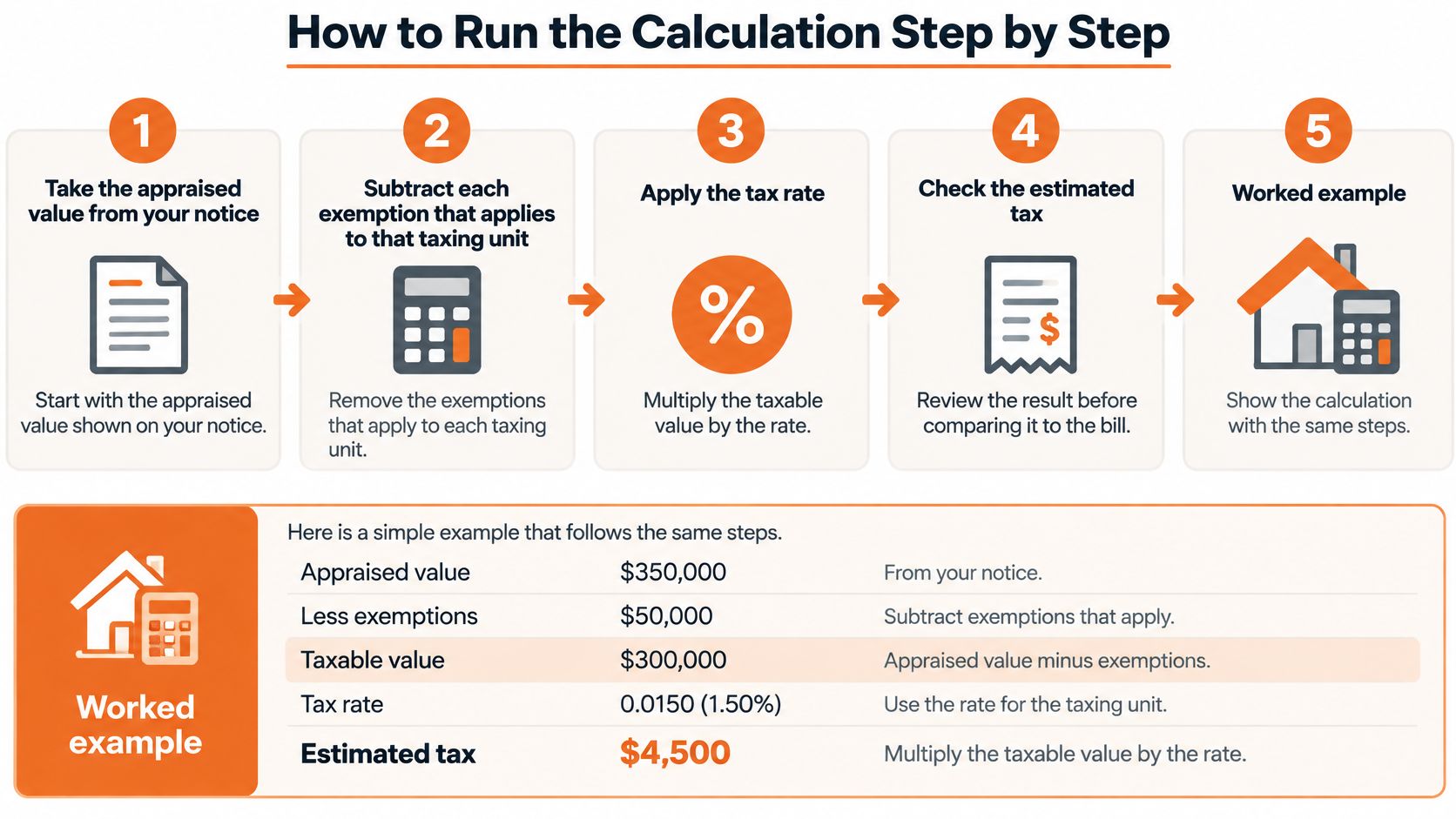
- Take the appraised value from your notice. Don't substitute purchase price or a listing estimate. The notice value is the starting point the taxing units will use.
- Subtract each exemption that applies to that taxing unit. A school exemption doesn't automatically reduce the county or city base by the same amount. Do this unit by unit.
- Confirm the adopted rate for each unit. Rates are listed per $100 of value. Proposed rates and last year's rates will skew the result.
- Divide taxable value by 100 and multiply by each rate. This gives you the tax for that unit alone. Keep the lines separate so you can spot which unit changed.
- Add the results for your total annual bill. That's your estimate, not a guarantee. Rates and taxable values can still move before bills are issued.
- Compare the total with last year's bill. Note whether the change came from value or from rate. That tells you whether a protest, an exemption check, or simple budgeting is the right response.
A Worked Example You Can Replace
Say a home is appraised at $450,000 in this illustrative example, with a $100,000 school homestead exemption. That leaves $350,000 taxable for school tax. The table applies that same $350,000 to four units to keep the example readable. That's a simplification, since real taxable values often differ by unit.
Every rate below is an illustrative placeholder, not an adopted rate for your property. Replace each one with the adopted rate for your own county, city, school district, and special districts before you rely on the total.
| Taxing unit | Rate per $100 | Tax on $350,000 |
|---|---|---|
| County | 0.30 placeholder | $1,050 |
| City | 0.50 placeholder | $1,750 |
| School district | 1.00 placeholder | $3,500 |
| Special districts | 0.10 placeholder | $350 |
| Total | 1.90 placeholder | $6,650 |
The math is simple on purpose. The hard part is feeding the property tax estimator the right taxable value for each line.
Why Your Estimate Can Drift From the Appraisal
The most common gap starts with a comparable sale that isn't comparable. A renovated house two streets over, with more living area and a newer roof, can pull an estimate up by tens of thousands of dollars in a hypothetical comparison if you don't adjust for those differences. Nearby doesn't mean similar.
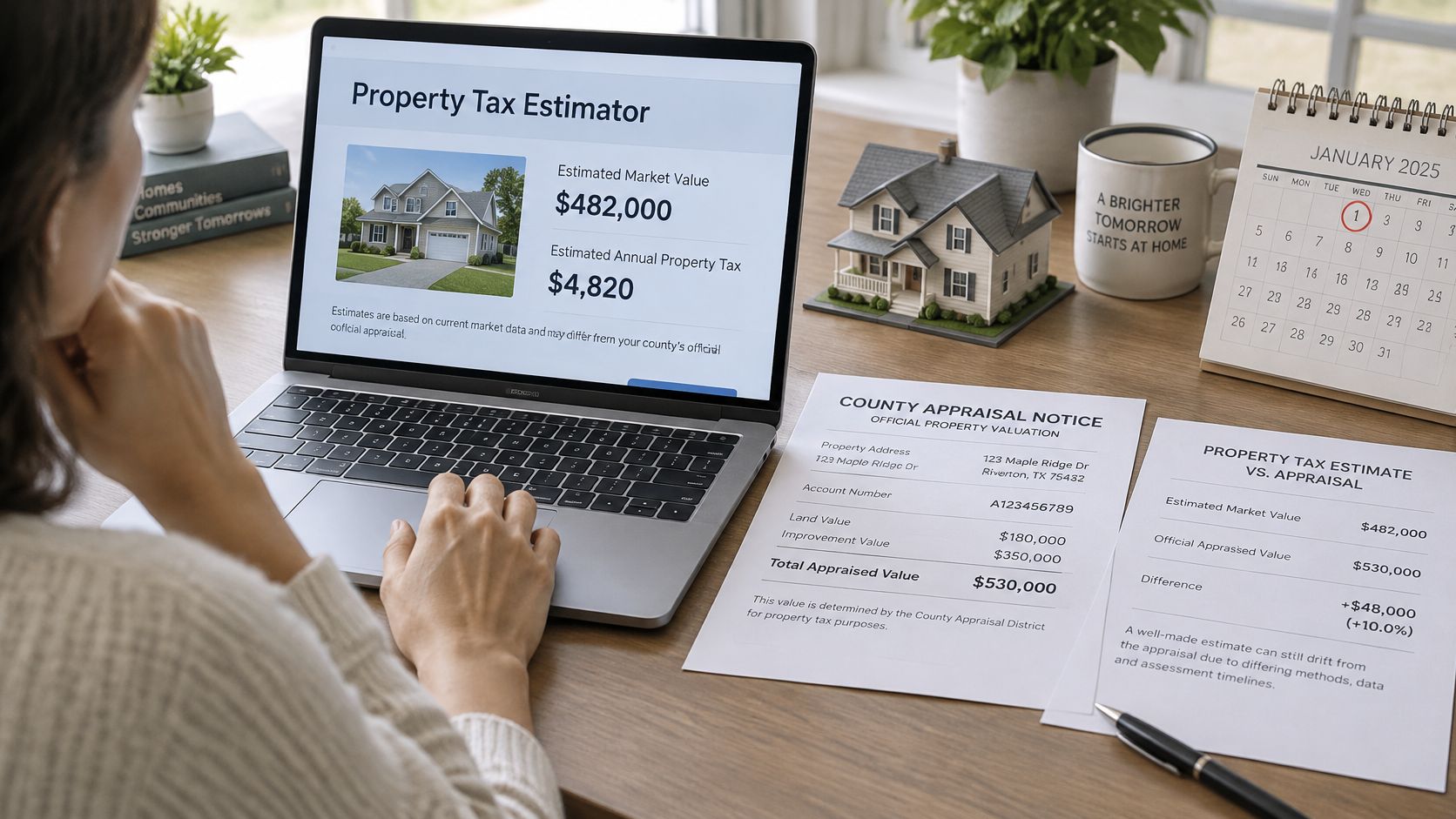
Texas guidance in the Comptroller's appraisal review materials describes a January 1 market-value workflow using comparable sales within 24 months of the appraisal date, with explicit adjustments for size, land area, age, condition, and location. If your estimate just averages recent sales prices, it isn't using that method.
There's also a useful reality check. The Texas Comptroller's 2022 statewide ratio study reported a combined median appraisal ratio of 0.98 across 120 appraisal districts, meaning studied properties were appraised at approximately 98% of market value overall. A large gap between your estimate and your notice is therefore worth investigating, not assuming away.
For rental or commercial property, the valuation question gets wider than comparable home sales. Reviewing investment property valuation insights from LendingXpress can help you see why income and cost considerations matter alongside sales, especially when a residential estimator is being forced onto an income-producing property.
| Gap | Why it happens | What to check |
|---|---|---|
| Appraised value above market | Comparable sales were not truly similar | Sales within 24 months and adjustments for size, age and condition |
| Taxable value below appraised value | Exemption was not filed or was filed late | Exemption status on the account and the filing date |
| Bill rose while value held | Each taxing unit sets its own rate after the certified roll | Adopted rate history for each unit |
| Market fell, appraisal did not | Appraisal uses the January 1 valuation date and reappraisal cycles | Valuation date and last reappraisal year |
| Estimate looks precise | A single figure hides the uncertainty | A low and high scenario from different comparable sets |
Other drift is quieter. The appraisal district record may miss deferred maintenance, overstate living area, or carry an improvement you removed. Mixed valuation dates create the same problem, since a sale after January 1 doesn't prove value on January 1.
Practical rule: Keep a dated file of comparable sales with photos, repair estimates, and notes on condition. That file is what makes an estimate credible if you later protest.
Decide Whether to Protest This Year
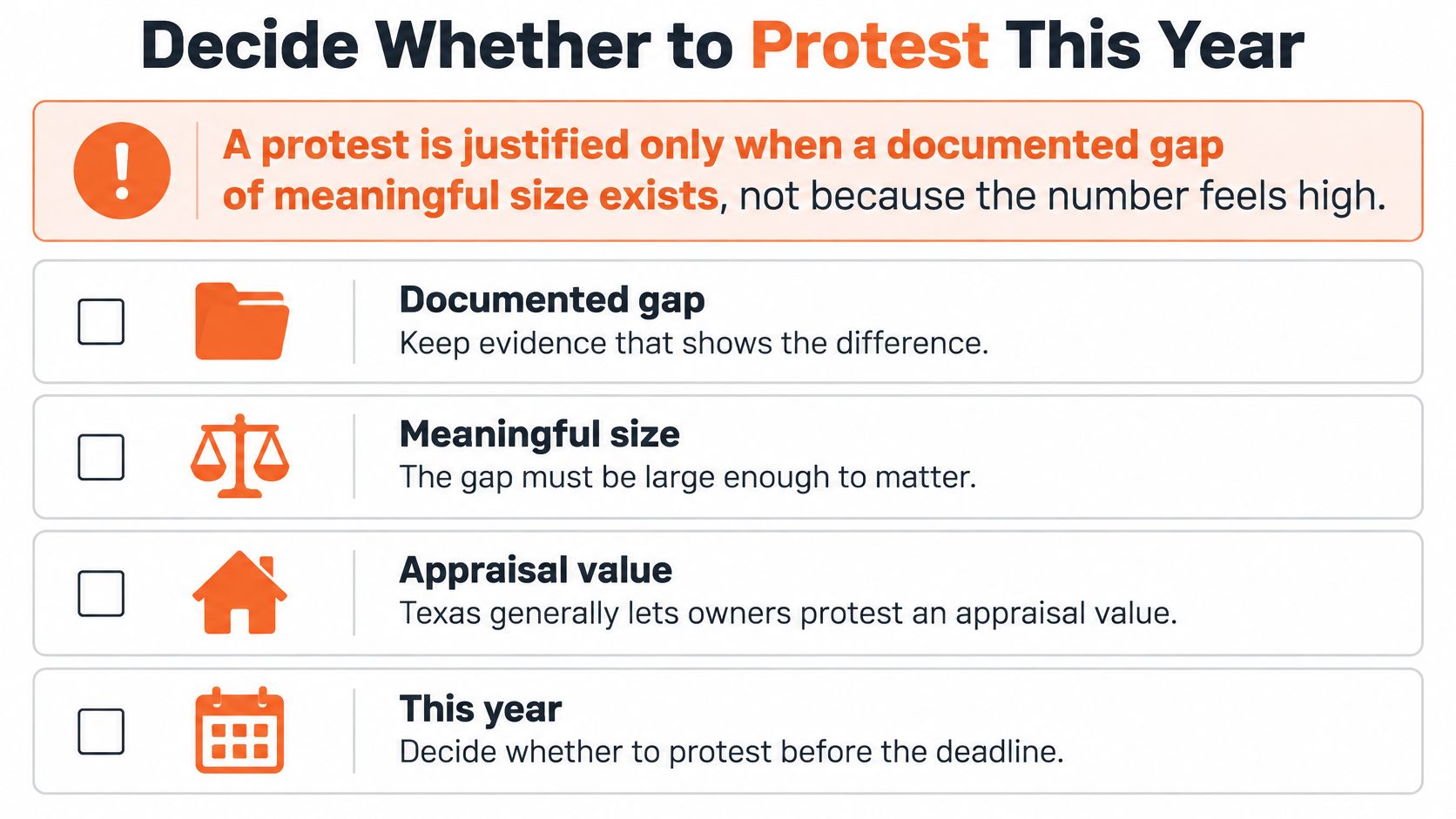
One decision rule does the work here. A protest is justified only when a documented gap of meaningful size exists, not because the number feels high. Feelings don't change an appraisal roll. Evidence tied to value, unequal appraisal, classification, or a record error can.
The Texas Comptroller's property tax protest guidance states that owners generally may protest an appraisal-district value or record error by May 15 or 30 days after notice delivery, whichever is later. Miss that window and your estimate becomes a budgeting tool for this year, not a basis for relief.
Pick One of Three Outcomes
A good property tax estimator doesn't end with a dollar amount. It sorts you into an action.
- Verify exemptions and records: Your appraised value looks defensible, but the taxable value is wrong because an exemption is missing or the property record lists the wrong size, age, or features. Fix the record and confirm the account reflects it.
- Request appraisal records and comparable data: You see a gap but can't yet prove it. Ask for the evidence behind the value, then test whether the sales used are similar to your property.
- File a protest on value: You have comparable sales and condition evidence showing a lower January 1 value, or a screened peer sample suggesting unequal appraisal. File before the deadline and keep your evidence organized.
Don't let a rate change distract you. A lower tax rate doesn't offset an inflated appraisal, because the rate applies to whatever taxable value remains. If the value is too high, you'll overpay at almost any rate your taxing units adopt.
A market estimate alone also doesn't test everything you can challenge. It won't catch unequal appraisal among similar properties, a wrong classification, or a record error in square footage or condition. Check those inputs separately, since each one needs different evidence.
You're already ahead of most owners if you check at all. HousingWire reporting on a 2025 national survey of homeowners found that 78% of homeowners had never challenged an assessment and 53% of nonappealers did not know they had the right to appeal. Knowing the deadline and the grounds puts you in a smaller, better-prepared group.
Your Dated Action Plan
- Calculate the estimate from the five inputs. Use the per-unit method, with a low and high scenario instead of one precise figure. A range shows you whether the gap survives reasonable changes in comparable selection.
- Confirm every exemption is on the account. Check that each one was filed before April 30 and appears in the exemption section. If it isn't there, your taxable value is overstated.
- Compare the estimate with the appraised value on the notice. Note any gap larger than your tolerance. Set that tolerance in dollars of tax, not dollars of value, since the tax effect depends on your combined rates.
- Gather evidence if the gap is real. Pull two or three comparable sales within 24 months, add photos and repair estimates for condition issues, and file before May 15 or the later 30-day deadline. Our overview of when to appeal property taxes can help you sanity-check timing.
- Keep the estimate on file if the gap is small or evidence is thin. Recheck next year with fresh sales. Filing a weak protest costs time, and a clean file this year makes next year's comparison faster.
If your lender escrows the tax, compare the new bill with your escrow payment. An increase can stay hidden inside a higher monthly mortgage payment until the account is reconciled, which is why some owners notice the change months late. Run the estimator against the actual bill, not the mortgage statement.
For scale, the average savings for an Austin homeowner with INTELLI is $2,500, and INTELLI does not charge customers if it does not lower their property taxes. That figure doesn't guarantee your result. It does show why a documented gap is worth testing rather than ignoring.
Keep the notice, write down your two strongest comparables the week the notice arrives, and calendar May 15 immediately. Waiting until you feel ready usually means the best evidence is harder to assemble and the deadline is closer than you think.
An estimate is a planning tool, not a bill. Treat any property tax estimator that gives you one number with no inputs, no range, and no deadline as incomplete.
INTELLI is a Texas property tax reduction firm that uses a data-driven system to challenge inflated valuations and represent clients before county appraisal districts. You can start a review through the form on its homepage by entering your property street address.
If your estimate shows a documented gap, missing exemption, or record error, get a second set of eyes on it before your protest deadline passes. Visit INTELLI, enter your property street address on the homepage form to see your potential savings, and let its data-driven review test your value, with no charge if your taxes don't go down.