

You open the appraisal district's notice in the spring and one value is printed on it. The tax bill lands in the fall with a bigger total and sometimes a different value attached. Owners who call the county ready to argue usually find the arithmetic is correct and the paperwork is incomplete, because the number on the spring notice is not the number the tax rate gets applied to.
Texas runs two separate stages. One stage sets the value of the property. The other decides how much of that value is exposed to tax. An error at the first stage overcharges you on a number you can challenge. A gap at the second stage overcharges you on a base you never see unless you look for it. The two get fixed by different actions, at different points in the year.
Here is the full calculation in order, from appraised value through assessed value and taxable value to the bill, then the levers that change each line.
Assessed Value and Taxable Value Side by Side
In Texas, assessed value is the figure the tax calculation starts from, and taxable value is the amount remaining after exemptions and other legally recognized reductions come off. The appraisal district sets appraised value from market conditions as of January 1. Texas applies an assessment ratio of 100% to most property, so assessed value and appraised value are normally the same number. The figure that drives your bill sits one line lower.
Appraised, assessed and taxable value compared
| Term | What it measures | Role in the calculation | What changes it |
|---|---|---|---|
| Appraised value | Value set by the appraisal district as of January 1 | Starting figure from the appraisal notice | Market conditions and a successful protest |
| Assessed value | Appraised value times the assessment ratio (100% in Texas) | Base before exemptions | Appraisal changes and the assessment ratio |
| Taxable value | Assessed value minus exemptions and limits | Base the tax rate is applied to | Exemptions, homestead cap and special appraisal |
| Tax bill | Taxable value times tax rate, divided by 100 | Final amount owed | Rate set by each taxing unit |
The headline number on the notice is not what the rate multiplies. Two houses on the same street with identical appraised values can owe different amounts the moment one qualifies for a homestead exemption and the other doesn't. The assessed value vs taxable value distinction shows up in small numbers too: the Travis County Tax Office illustrates a $100,000 home carrying a $10,000 exemption that is taxed on $90,000.
Three Checks to Run Before Anything Else
- Find the appraised value. It's printed on the appraisal notice and repeated on the tax bill. This is the only number a valuation protest can move.
- Confirm the assessment ratio. Texas property is assessed at 100% of appraised value, so the two should match. If a statement suggests otherwise, ask the district to explain the ratio in writing.
- List every exemption already showing. Whatever the district has on file is all it's applying. Anything missing from the statement is value you're being taxed on that you may not owe.
How Taxable Value Becomes Your Tax Bill
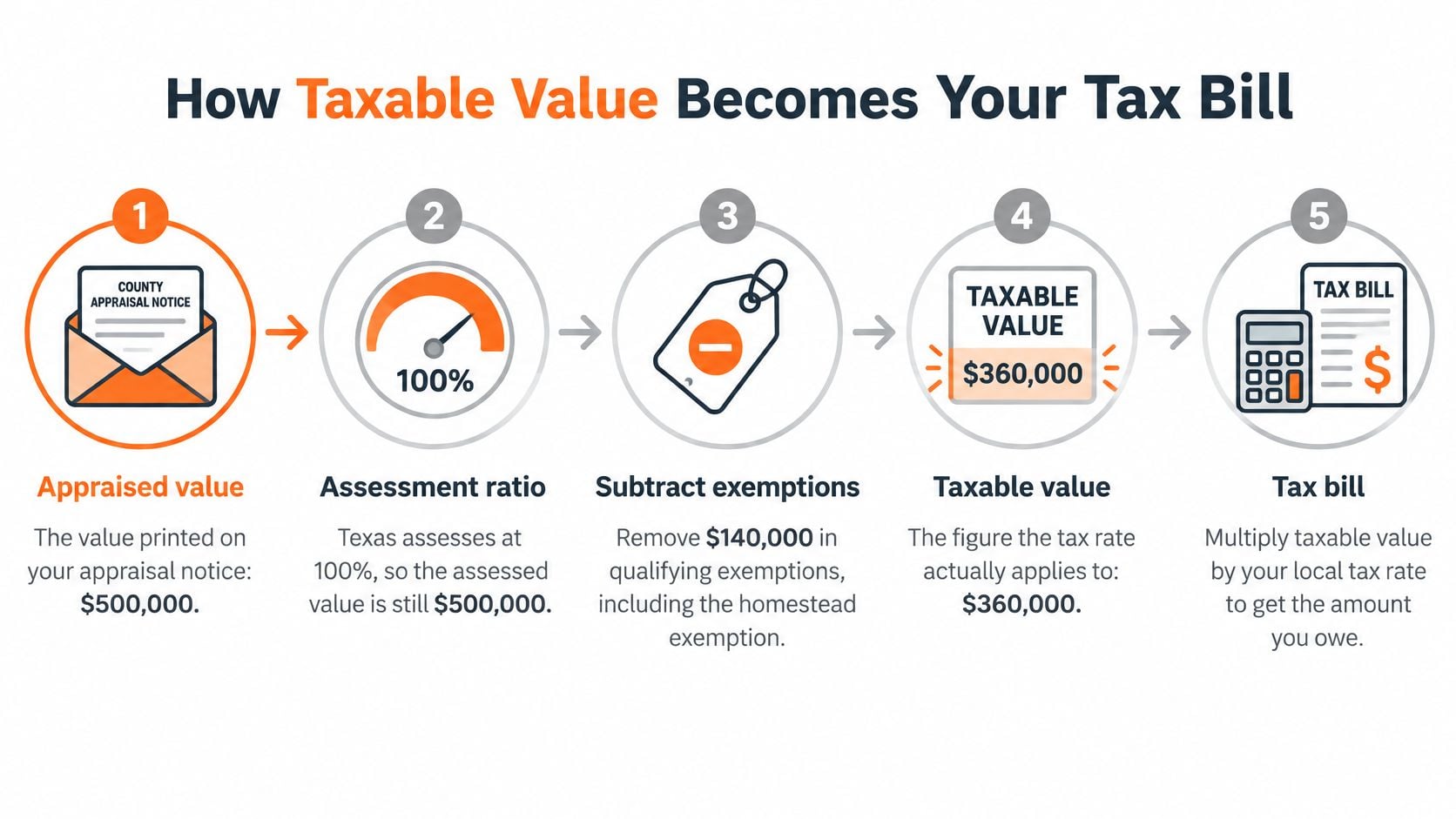
A $500,000 appraisal with a combined rate of 2.0% produces two very different bills depending on which steps in the calculation get applied. The order is fixed, and every line is checkable against your own statement.
- Start with appraised value. The appraisal district determines it from market value as of January 1. Nothing else in the formula can be corrected if this number is wrong, which is why the protest process targets it directly.
- Apply the assessment ratio. Texas law defines assessed value as appraised value multiplied by the applicable ratio, per the Texas Comptroller's property tax guide. At 100%, the assessed value is still $500,000, and the step exists so the state can apply a different ratio if statute ever sets one.
- Subtract qualifying exemptions. Assume $140,000 in homestead and other qualifying exemptions. Taxable value is assessed value minus those partial exemptions, which brings the base to $360,000. This is the first point where your own paperwork changes the outcome, and the Comptroller's exemption guidance treats assessed and taxable value as distinct calculations for exactly this reason.
- Multiply by the rate and divide by 100. $360,000 × 2.0 ÷ 100 = $7,200. The state formula runs assessed value less exemptions equals net taxable value, then net taxable value times the tax rate divided by 100 equals taxes owed.
- Compare against the no-exemption result. The same home with no exemptions would owe $10,000 ($500,000 × 2.0 ÷ 100). That $2,800 gap comes from the smaller base alone. No rate changed and nobody did you a favor.
Worked example: exemptions and the tax bill
| Line | Amount | Calculation |
|---|---|---|
| Appraised value | $500,000 | Set by the appraisal district |
| Assessed value at 100% ratio | $500,000 | $500,000 x 100% |
| Less qualifying exemptions | $140,000 | Homestead and other exemptions |
| Taxable value | $360,000 | $500,000 minus $140,000 |
| Tax with exemptions at 2.0% | $7,200 | $360,000 x 2.0 / 100 |
| Tax with no exemptions at 2.0% | $10,000 | $500,000 x 2.0 / 100 |
Two details get lost in that clean example. The 2.0% is a combined figure for illustration; each taxing unit sets its own rate and gets calculated on its own line, which is why the bill has several rows that don't share a rate. That also means a given exemption is worth a different dollar amount at each unit, so the savings have to be sized row by row, not once. The same logic applies to where a reduction lands: a protest shrinks the base at step one, an exemption claim shrinks it at step three, and the two fixes are measured and filed separately.
What to check on your statement: confirm each line matches those five steps, and flag any line where an exemption you qualify for is absent or the appraised value looks inflated against what nearby homes actually sell for.
Appraisal districts must reappraise property at least once every three years under the Texas Property Tax Code, and many of them value annually, so this isn't a review you do once a decade. For the wider picture on rates and local levies, this explanation of how property taxes are calculated in Texas walks through the rate side.
Exemptions and Caps That Lower Taxable Value
Most owner-occupied homes get their first reduction from the residence homestead exemption. Each taxing unit adopts its own percentage exemption, and state law sets a floor: if the adopted percentage would produce less than $5,000 for a particular homestead, the exemption must equal at least $5,000, as the Texas Property Tax Code provides. That floor is why the dollar benefit of a percentage exemption differs from one property to the next, and this overview of homestead laws in Texas covers the eligibility rules behind it.
The homestead appraisal cap works on a different line entirely. For a qualifying residence homestead, the annual increase in appraised value is limited to the lesser of market value or the prior year's appraised value plus 10% of that prior value and the market value of new improvements. The Comptroller's guidance on appraisal limitations works an example: a prior appraised value of $300,000 plus $30,000 (10%) plus $20,000 in qualifying improvements caps the amount at $350,000 before market value is considered. The cap begins January 1 of the tax year after you qualify and ends January 1 of the year after you stop qualifying.
Exemptions and value limits that reduce taxable value
| Benefit | What it reduces | Who qualifies | Key rule |
|---|---|---|---|
| Residence homestead exemption | Taxable value of a qualifying home | Owner who occupies the home as a principal residence | Set by each taxing unit; at least $5,000 if the percentage gives less |
| Homestead appraisal cap | Annual growth in appraised value | Property with a residence homestead exemption | Growth limited to prior value plus 10%, plus new improvements |
| Over-65 exemption | Taxable value of a senior's home | Owners aged 65 or older | Added to the homestead exemption; confirm each taxing unit's amount |
| Disabled person or disabled veteran exemption | Taxable value | Owners with a qualifying disability | Amount and eligibility set by each taxing unit; confirm locally |
| Special appraisal (agricultural or timber) | Market value replaced by productive value | Land used for qualifying production | Valued on income capacity, not market value |
The cap limits growth in appraised value. It does not establish market value and it does not eliminate taxes, so it can't rescue a home whose assessed value was already too high the year the owner qualified.
Senior and disability benefits stack on top of the homestead exemption rather than replacing it, and the amounts differ by taxing unit, so the school district line and the city line may not show the same reduction. Agricultural and timber appraisal is the one benefit that changes the valuation method itself, pricing land by what it can produce rather than by what a buyer would pay. Our Tax Exemption Maximization service identifies every exemption a property qualifies for and handles the paperwork, which matters because an unclaimed exemption costs the same every year until someone files it.
List the exemptions already on your statement, note the ones you qualify for but have never claimed, and confirm the filing deadline with the county appraisal district before the year closes.
Protests, Exemptions and Caps Compared by Stage
Four levers change what you owe, and they don't act on the same line of the calculation. Treating them as one item is where owners misjudge what a protest can and can't do.
Protest, exemption, cap and special appraisal compared
| Lever | What it acts on | When it applies | Best fit |
|---|---|---|---|
| Valuation protest | Appraised value | When appraised value exceeds market value | Overvalued property with comparable sales evidence |
| Exemption claim | Taxable value after assessment | When an owner qualifies but the exemption is missing | Eligible owner who has not yet claimed it |
| Homestead appraisal cap | Annual growth in appraised value | Residence homestead after its first qualifying year | Owner-occupied home in a fast-rising market |
| Special appraisal | Value used for tax | Qualifying agricultural or timber land | Land used for qualifying production |
Taxable value absorbs all of it. The Comptroller's biennial property tax report explains that taxable value is assessed value minus applicable exemptions while also accounting for special appraisal provisions and value-limitation agreements. Two properties carrying the same $400,000 market or assessed value can generate different bills once one of them qualifies for an exemption or a special valuation.
A practical contrast makes the split obvious. A house appraised at $500,000 with a market value near $430,000 is a protest candidate, because the evidence is comparable sales. A qualifying owner who never filed for the homestead exemption has a gap that no appraisal argument touches, because the district isn't wrong about the value, it's working from incomplete paperwork. Fixing the first does nothing for the second.
Winning a protest can still leave a larger bill. A lower appraised value shrinks the base, but each taxing unit sets its own rate, so a higher rate applied to a smaller base can still produce more tax than last year. Compare the rate lines on the new notice with the prior year's notice before assuming the win settled anything.
Decision rule: if market value sits below appraised value, start with a protest. If an exemption is missing, file the claim first, because it turns on eligibility rather than valuation evidence.
Our Assessment Appeals service challenges inflated valuations with comparable sales evidence and representation at the hearing, which is the right tool for the first case and the wrong one for the second.
Why Each Taxing Unit Can Show a Different Taxable Value
On one Travis County statement, the same house can show a different taxable value under the county, city, school district and MUD lines. The appraisal is shared. The deductions are not.
- County, which funds roads, courts, and health services
- City, which funds police, parks, and planning
- School district, usually the largest single line on the statement
- Special districts, such as a municipal utility district or an emergency services district
Taxable value works like several ledgers opened from the same appraisal. Every unit starts with the roll, then applies the exemptions and limits it adopted. That is why a homestead reduction can be large on one line, smaller on another, or missing where the unit never granted that option.
The stage matters as much as the dollar amount. A valuation protest attacks the appraised value upstream, before each unit calculates its taxable base. A missed exemption works downstream, after the unit has already decided which reductions it allows. Size them separately: measure a protest by the gap between appraised value and supported market value, then measure an exemption by the dollars each taxing unit subtracts.
Rates explain the second difference. The Comptroller's truth-in-taxation rate calculations begin with taxable value on the certified appraisal roll and adjust for property that received a new exemption or special appraisal that year. A successful appeal, a newly granted exemption and a special appraisal can all lower the base, yet each enters at a different point and can affect units unevenly.
In Travis County, a homeowner typically sees separate lines for the county, the city, the school district and any special district, each carrying its own taxable value. One exemption can look fully applied beside the school district and absent beside a special district.
The Comptroller also warns that taxable values in its school-district reports may not match appraisal-district figures. Treat any summary number as a starting clue, then pull each unit's taxable value, compare it with the appraised value, and mark any line where an exemption dropped out. For the rate side of the same statement, this guide to how Texas property tax rates are set walks through the mechanics.
Repeat that check every year, for every unit. INTELLI uses a proprietary, data-driven system to prepare evidence and identify both valuation and exemption opportunities for property owners.
Use Cases for Homeowners, Investors and Commercial Owners

Where you start depends entirely on what kind of property you hold.
The homeowner in a rising neighborhood. You live in the house and claim the homestead exemption. Your first job is confirming that appraised value growth stayed inside the cap and that the exemption appears on every taxing unit's line. If it does, and market value supports the appraisal, there's nothing to fix. First step: pull the current statement and check the homestead line on each unit.
The investor with three rentals. None of those properties is a homestead, so neither the homestead exemption nor the growth cap applies. The lever is a protest built on rental income records and sales of comparable properties, and each building gets assessed and protested on its own. First step: gather twelve months of rent records and two comparable sales before filing.
The senior with a modest house. Picture a long-time owner in a paid-off home whose over-65 exemption was never filed, sitting next to a duplex investor whose building is assessed above market. Both are overpaying, for unrelated reasons. The senior needs an eligibility claim, not evidence about value. The investor needs a valuation argument. Neither problem is solved by the other's fix.
The commercial owner. No homestead, so the work is a valuation protest plus any special appraisal that fits the land use, with each property's taxable value checked unit by unit. If you're weighing capital work against a sale, these sell versus renovate trade-offs are worth reading first, since improvements change what the district can defend at a hearing.
We handle residential, rental and commercial properties, and the average savings for an Austin homeowner working with INTELLI is $2,500.
If you'd rather see the calculation walked through on screen, this covers the same ground.
Choose Your Lever Before You Pay or Protest
Run this checklist before you write a check or file anything.
- Confirm the appraised value and the ratio. Texas assesses at 100% of appraised value, so the two numbers should match. If they don't, you've found your question.
- Audit the exemptions, cap and special appraisal on the statement. Compare what's listed with what you qualify for. A missing benefit repeats every year you leave it unclaimed.
- Recalculate taxable value for each taxing unit. Use the five-step method, because each unit applies its own rate to its own base and one unit's error hides behind another's correct line.
- Pick one lever. Protest if appraised value exceeds market value. Claim an exemption if one is missing. Take no action if both check out and the rate movement explains the rest.
- Verify the filing deadline with the county appraisal district. A missed deadline usually costs the entire year's benefit, and no appeal can recover it afterward.
The order matters because eligibility and valuation are separate tests. A missed exemption can't be argued with comparable sales, and an overvaluation can't be cured by paperwork.
We monitor Texas property taxes at no charge and file whenever there's a real opportunity to save. We charge 25% of the savings we achieve, and you owe nothing if we don't lower your bill.
The deciding question is simple. Can you verify a taxable value lower than the one your bill implies? If you can, you have a claim worth filing. If you can't, you at least know the bill reflects your paperwork rather than an error, which is worth knowing before the next notice arrives.
INTELLI reviews your appraisal notice line by line, separates a valuation problem from an exemption problem, and pursues whichever one is costing you money. Our consultants work from public records and your own documentation to build the case, and you pay nothing unless your taxes come down. Visit INTELLI to have your assessed value and taxable value checked against what your county has on file.