

Most Texas owners must file a written protest by the later of May 15 or 30 days after the appraisal district mails the notice of appraised value. Waiting for the tax bill is usually too late.
The familiar advice to “appeal by May 15” leaves out the part that can change your deadline: when the district mailed your notice. It also overlooks a separate question. Is the problem an inflated value, or is the district taxing your property using the wrong facts or exemptions?
Knowing when to appeal property taxes starts with reading the appraisal notice, not reacting to the bill. Missing the ordinary protest window can cost you the chance to correct that year's appraisal through the usual process.
The Protest Deadline That Actually Applies
The mailing date controls the ordinary protest clock, not the day you opened the envelope. The Texas Comptroller's protest guidance says most owners must file a written protest with the county Appraisal Review Board by May 15 or within 30 days after the appraisal district mails the notice, whichever is later.
Save the envelope along with the notice. For an electronically delivered notice, download the document and preserve the delivery record. If the printed deadline and your mailing records don't seem to agree, contact the appraisal district promptly rather than assuming you have extra time.
Match your notice to the right deadline
The notice schedule and the protest deadline aren't the same thing. A district's target for sending notices doesn't replace the filing deadline tied to your particular notice.
Texas protest deadline by notice situation
| Situation | Deadline that controls | What to do |
|---|---|---|
| Notice mailed on the usual spring schedule | Later of May 15 or 30 days after mailing | File a written protest as soon as the value and exemptions are checked |
| Homestead notice | Generally mailed by April 1; protest still the later of May 15 or 30 days after mailing | Review value, homestead, and other exemptions that week |
| Non-homestead property | Generally mailed by May 1; same later-of protest rule | Don't wait for a hearing date to be assigned |
| Notice mailed after mid-April | The 30-day period can extend beyond May 15; use whichever date is later | Count from the district's mailing date or electronic send record, checking the envelope or postmark |
| Deadline already missed | A late protest may be allowed for good cause, but isn't guaranteed | Document why the notice was missed and file immediately |
| Protest procedures | Published by the district between May 1 and May 15 | Read the county rules before choosing informal or formal review |
Start with the ordinary-schedule row: compare the calendar deadline with the deadline calculated from mailing. The homestead and non-homestead rows explain why notices may arrive at different times, not why owners should wait to act.
For a late notice, preserve evidence of when the district sent it. For a missed deadline, contact the district immediately about the procedure for requesting a late protest. Finally, read the published protest procedures before choosing how to submit or attend a review.
Preserve the deadline before preparing the hearing
You don't need to wait for a hearing appointment before filing. Filing the protest preserves your opportunity to present the dispute; preparing the supporting packet is a separate task.
Practical rule: Put the filing deadline on your calendar the day the notice arrives, then keep proof that the district received your protest.
Travis County follows the same later-of approach and generally limits late protests to qualifying circumstances. Good cause is a possible exception, not a reliable filing strategy.
These are Texas procedures. If you own property elsewhere, confirm that state's rules and the relevant county calendar before relying on any deadline in this guide. The later tax-payment deadline doesn't reopen an ordinary appraisal protest window.
When an Appeal Is Worth Filing
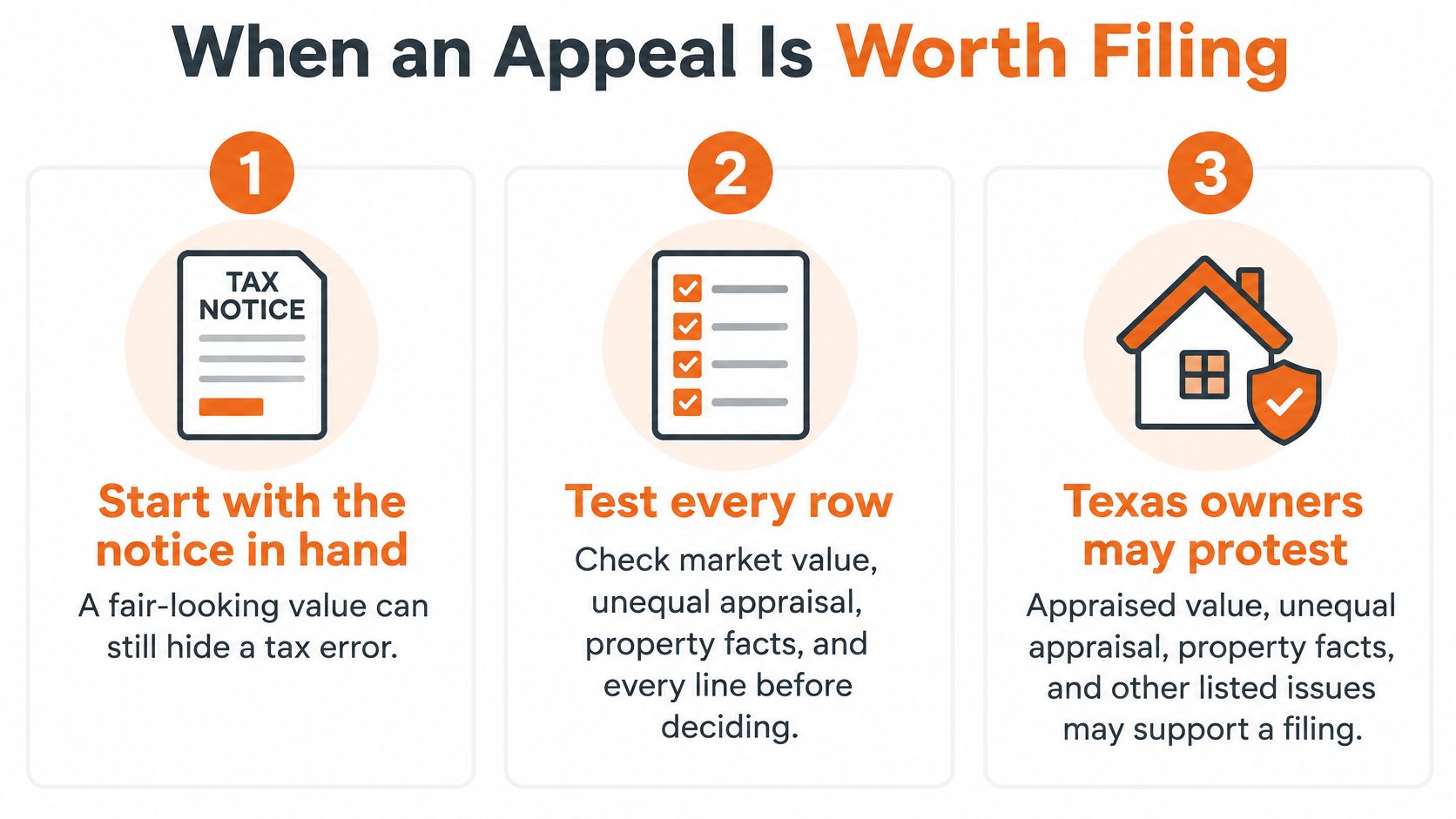
A notice can look accurate and still leave money on the table. The appraised value might match recent sales while an exemption you qualify for sits unapplied, or the account describes a garage, a lot size, or a condition rating that doesn't match the building you own.
The Texas Comptroller's appraisal-notice guidance treats exemptions and other appraisal-district actions as protestable issues alongside disagreements over appraised value. That distinction matters for a homeowner claiming a homestead exemption, a disabled veteran documenting eligibility, or a business owner correcting a property classification.
An appeal works like disputing a bill: sometimes the amount is wrong, and sometimes the account itself is wrong. Run through this checklist before deciding that a protest isn't worth the effort.
Separate a value dispute from an eligibility dispute
Say a Travis County home receives a hypothetical notice showing $480,000, while three comparable closed sales fall between $430,000 and $445,000. That's a potential market-value case, provided differences in size, condition, location, and sale timing don't explain the gap.
Now say the same home's value matches the market, but the owner's qualifying homestead or other exemption is absent. Lower-priced sales won't prove that case. The owner needs to establish eligibility and show what the district omitted or denied. Owners who fixate on the value line often miss the stronger argument sitting in the account details.
What to protest and what proves it
| Protest reason | Appeal when | Evidence to attach |
|---|---|---|
| Excessive market value | Noticed value is above recent similar sales | Three to five closed sales with size, condition, and location adjustments |
| Unequal appraisal | Similar accounts are appraised lower | Neighboring account values and the same adjustment factors |
| Wrong property characteristics | Square footage, class, condition, or land data is off | Photos, measurements, repair bids, or a survey |
| Missing or denied exemption | Homestead, over-65, disability, or veteran status is absent or refused | Application, deed or ownership affidavit, occupancy proof, and age or disability records |
| Use or classification error | Agricultural, historic, or property category doesn't match the use | Use records and the designation application |
For unequal appraisal, don't select neighboring accounts solely because their values are lower. Check whether they're comparable. A smaller, older building with fewer improvements doesn't establish unequal treatment of a larger renovated property.
Classification also needs care. Agricultural treatment and historic designations aren't interchangeable with ordinary residence exemptions, and actual use alone doesn't establish every qualification. Identify the precise treatment you're seeking and supply the corresponding application and records.
Check eligibility paperwork before ruling out an appeal
A homestead exemption doesn't apply itself. The Comptroller's residence-homestead application instructions explain that owners must apply with the appraisal district in each county where the property is located, and an owner whose name isn't on a recorded ownership instrument may need an affidavit or other compelling ownership evidence.
A recent purchase, a qualifying status change, or a submitted application doesn't guarantee the appraisal account reflects it. Compare the account record with your documents and confirm what the district approved. For more distinctions between valuation and administrative disputes, use our guide to property-tax appeal reasons.
File while the applicable window is open whenever you can point to a specific, supportable error. A protest built on a missing exemption, a wrong square footage figure, or documented comparable sales gives the reviewer something concrete to weigh. If the facts, exemptions, and valuation all check out, a protest may offer little benefit.
Budgeting is a different task from proving an appraisal error. AI2Fin's resource can help you plan tax alongside your cash flow; a tight budget on its own isn't evidence that the appraisal is wrong.
At INTELLI, customers start by entering their property street address on the homepage form to see their savings. The team applies a proprietary, data-driven system to test the district's assumptions, and 80% of the tax appeals INTELLI handles are successful. Customers pay the 25% fee only after they see savings on their property taxes, and INTELLI doesn't charge customers if it doesn't lower their property taxes. Those results aren't a guarantee for an individual property.
How to File Before the Window Closes
Filing and proving a protest are different jobs. Your first job is to submit a valid written protest through the district's accepted process; your second is to build the case the reviewer can evaluate.
Use the county appraisal district's protest form or official e-file portal. Our property-tax appeal form guide can help you understand the information to assemble, but the district's current submission procedures control.
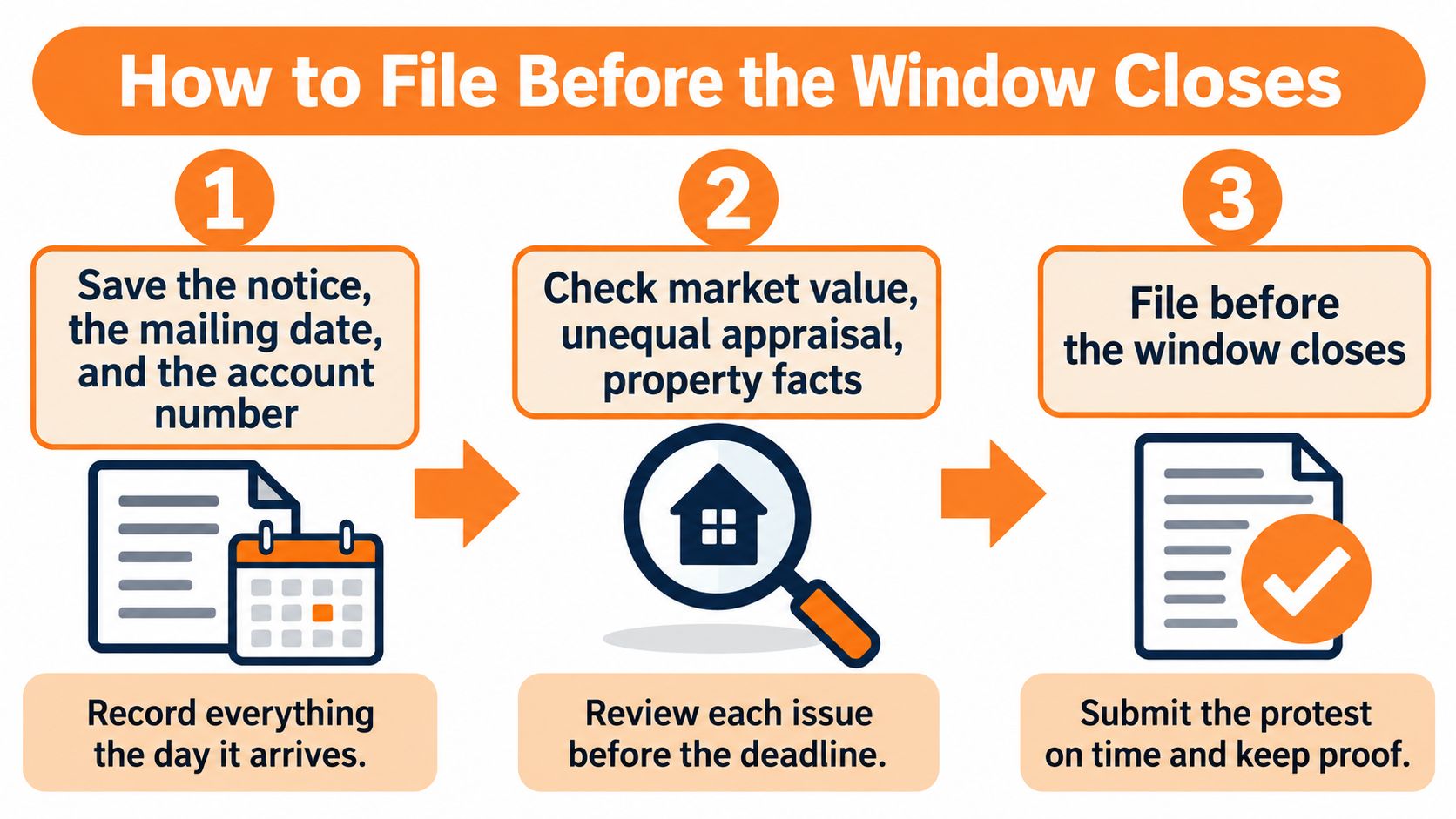
The filing sequence is straightforward when you keep the notice, account details, and confirmation together.
Submit first, then organize the presentation
Save the notice and delivery records. Record the account number and mailing date when the notice arrives so you don't calculate the deadline from memory. Keep the original document, envelope, and any electronic delivery confirmation together.
Choose the actual protest grounds. Review market value, unequal appraisal, property characteristics, and exemption status before completing the form. This prevents you from selecting only market value when the main problem is a missing homestead exemption.
File the written protest before your calculated deadline. Use the county form or accepted electronic process, identify every applicable ground, and retain the submission receipt. A phone conversation with an appraiser isn't a substitute for a filed protest.
Request the district's supporting evidence. Ask for the property record card, sales information, comparable accounts, and other material supporting the disputed appraisal. Reviewing those records helps you respond to the district's reasoning instead of arguing against an assumption it never used.
Use informal review if it's offered. Bring a concise summary stating the correction you want and the evidence supporting it. An informal agreement may resolve the dispute, but don't assume the matter is closed until you have written confirmation and understand any remaining hearing obligation.
Attend the Appraisal Review Board hearing if the dispute remains unresolved. Submit the packet under the county's exhibit procedures and prepare a short spoken explanation of the requested result. Don't rely on the reviewer to discover your strongest point inside an unlabeled collection of documents.
Obtain and save the written order. Record when you receive it and preserve the delivery evidence, because further review has its own deadlines. Leaving the hearing without knowing how the order will arrive makes the next stage harder to manage.
Check the filing before you press submit
A complete filing should identify the property account, the grounds you're protesting, your opinion of value or requested exemption correction, and reliable contact information. Include an authorized representative's information when someone is acting for you.
A saved draft isn't a filed protest. Keep the confirmation page, acknowledgment email, or other accepted proof of submission.
County portals differ in how they handle attachments, hearing preferences, and acknowledgments. Read the district's published procedures, check that uploads opened correctly, and confirm that the protest covers the right account. Portfolio owners should track each account separately rather than assuming a submission for one property covers the others.
Evidence That Holds Up at the Hearing
A 2,100-square-foot Austin home with dated finishes and foundation movement sits at the center of this worked example. The owner submits a renovated 2,800-square-foot sale two miles away because its price looks helpful. Without an explanation of the differences, that comparison gives the reviewer little basis for changing the subject property's value.
What persuades is the relationship between the properties: distance, size, condition, and a stated adjustment for each gap.

Replace the weakest comparisons
A weak comparable set contains distant properties, substantially different sizes, or renovations the subject home doesn't have. A usable set starts with similar homes nearby, then explains each remaining difference with a defensible adjustment. Our guide to comparable property analysis explains how to organize those comparisons.
For the Austin house, foundation photographs should sit beside the relevant contractor estimate and an explanation of how the condition affects the valuation argument. Don't assume every repair dollar produces an identical reduction in market value. A $12,000 foundation repair estimate supports a condition adjustment; it does not automatically translate into a $12,000 cut in appraised value.
The right three comparable sales beat ten weak ones.
Lead with the requested value, label each exhibit, and explain why each comparison belongs in the packet. For unequal appraisal, apply the same discipline to the district's account values rather than substituting sale prices.
Present exemption proof as a different kind of case
Exemption disputes require eligibility evidence rather than a market-price argument. The Texas Comptroller's exemption guidance states that qualifying homeowners who are at least 65 or disabled receive an additional $60,000 school residence-homestead exemption, and an adopted local-option exemption for these taxpayers cannot be less than $3,000. The same guidance says homeowners who turn 65 or become disabled during the tax year qualify immediately as though eligible on January 1.
That benefit reduces taxable value rather than cutting the tax bill dollar for dollar. Age-based eligibility also involves ownership and principal-residence requirements, while disability eligibility generally follows the federal Social Security disability-insurance definition.
When an affidavit or authorization is involved, SendItFax's explanation of what makes a document legally binding provides useful background. The appraisal district's own form, signature, and supporting-document requirements still control what the board accepts.
Keep your spoken explanation focused on the requested correction. The board reviews appraisal and exemption disputes, not whether the tax rate feels affordable. INTELLI's Assessment Appeals service challenges inflated valuations with evidence and expert representation, testing the district's model rather than relying on a generic filing.
Deadlines After the Appraisal Review Board
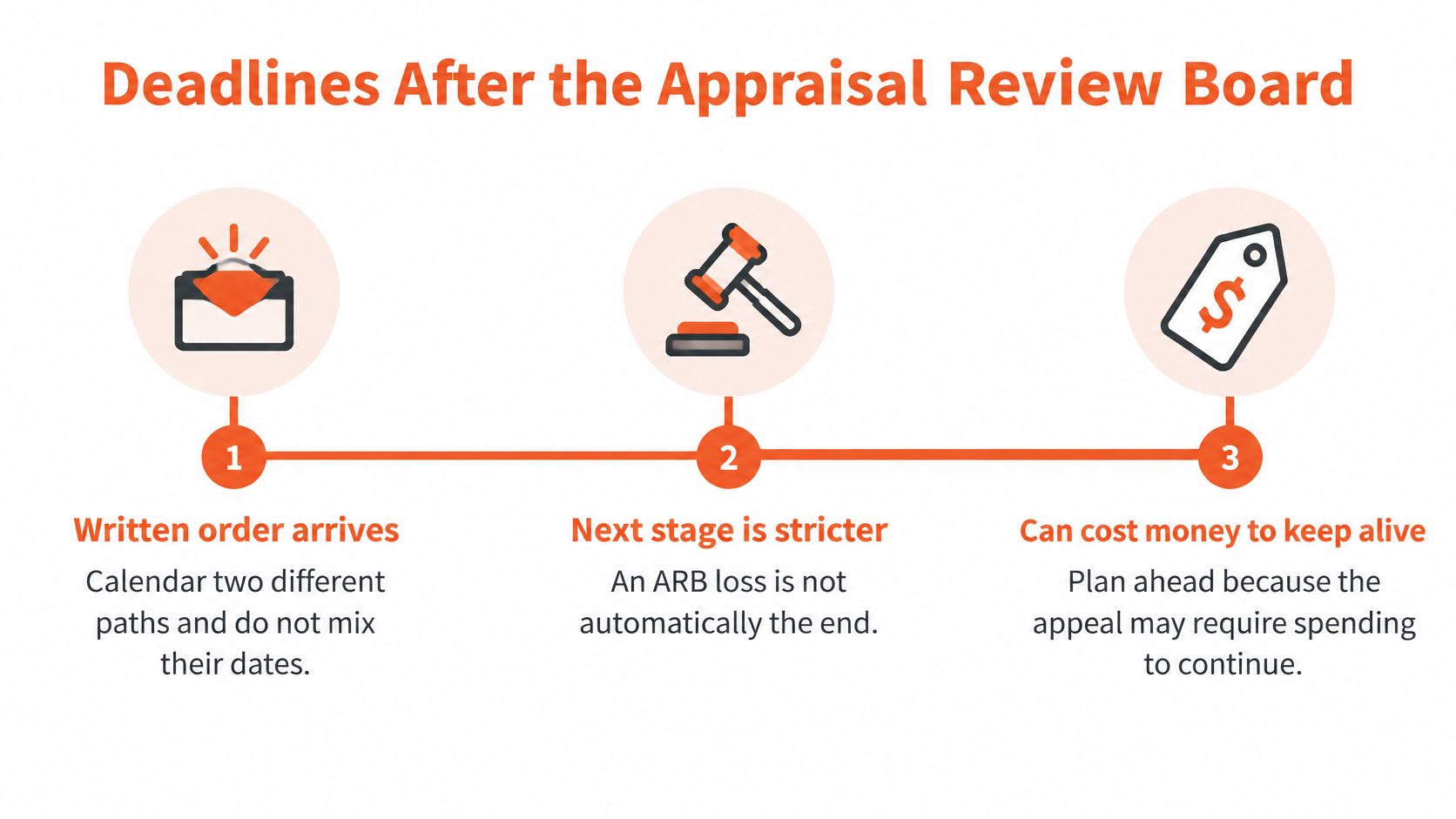
The day you receive the written ARB order, save the order and evidence of receipt. An unfavorable decision doesn't automatically end the dispute, but further review requires a separate choice of forum, eligibility review, and deadline calculation.
Don't confuse the date printed on the order with the date you received it. Keep both, and have the applicable deadline confirmed before committing to a route.
Separate the court clock from the state-office clock
The State Office of Administrative Hearings says its appraisal-appeal route generally requires a notice filed with the county chief appraiser within 30 days after receiving the ARB order, plus a $1,500 deposit within 90 days after receipt. These are separate obligations: filing the notice doesn't satisfy the deposit requirement.
For district court, the Texas Comptroller's protest and appeal guidance describes a general 60-day period after receiving the ARB's written order to petition. That guidance also explains that residence-homestead notices are generally due by April 1 and other notices by May 1, subject to delivery as soon thereafter as practicable, which is why the actual notice record matters throughout the process.
Post-ARB deadlines
| Milestone | Deadline | Action and consequence |
|---|---|---|
| ARB order received | Record the actual receipt date immediately | Calendar every applicable clock below the same day |
| Notice of appeal, State Office of Administrative Hearings route | Generally 30 days after receiving the ARB order | File with the county chief appraiser; a missed notice can end this route |
| Deposit, State Office of Administrative Hearings route | $1,500 within 90 days after receiving the ARB order | Submit the full amount; a short or late deposit can result in dismissal from the hearing schedule |
| District-court petition | Generally 60 days after receiving the written order | File the petition in district court; this clock runs independently of the state-office deadlines |
| Tax payment | Required portion due before the delinquency date | Pay on time, or the appeal can be lost even after a timely filing |
Each route carries its own entry requirements, and the table above reflects them. The state-office route requires both the 30-day notice to the chief appraiser and the $1,500 deposit within 90 days, while the district-court route requires a petition inside the 60-day window. Either path also expects the required portion of taxes paid before the delinquency date, so an owner choosing one should budget for the deposit or filing work and the tax payment at the same time.
Use the order's arrival as the prompt to organize the next decision.
Decide whether continuing is proportionate
Compare the potential tax benefit with the deposit, professional costs, preparation time, and strength of the evidence. A substantial, well-supported valuation gap may justify further review. A small disagreement based mainly on dissatisfaction with the bill may not.
Keep the valuation analysis, condition records, exemption documents, district evidence, and written order in the same file. Focus on proving the underlying appraisal issue rather than arguing that the first hearing felt unfair.
- Record each deadline separately. Include receipt, notice, petition, deposit, and tax-payment requirements that apply to your chosen route.
- Confirm payment obligations. Don't assume a pending appeal suspends the duty to pay the required portion of taxes.
- Get route-specific advice early. Court proceedings and administrative hearings require different preparation.
The spring ARB protest remains the practical appeal for a typical owner. Preserving that opportunity gives you the most accessible chance to correct the appraisal before a later dispute becomes more expensive and procedurally demanding.
INTELLI helps Texas property owners challenge inflated valuations, document exemption eligibility, and manage the protest process. Visit INTELLI and enter your property street address on the homepage form to explore potential savings before your filing window closes.