

You've unpacked, updated the mortgage payments, and opened a property appraisal notice that still looks higher than you expected. Maybe your closing paperwork mentioned a homestead exemption, or the property record already shows one. Neither tells you whether your own exemption covers the right tax year.
The useful question isn't just whether an exemption looks approved. It's whether TCAD applied your eligibility to the correct property, year, and taxing units. A missing year can mean paying a full bill when you were entitled to relief.
Check Whether Your Home Qualifies First
Start with your living situation: did you own the home and use it as your primary residence at the start of the tax year? The Travis County general homestead exemption guide describes the January 1 ownership-and-occupancy test and allows residential property on owned or leased land of no more than 20 acres.
Ownership alone doesn't qualify a property. Your personal residence is different from a house you own to collect rent, keep for vacations, or hold through a business entity. A condominium or mobile home can qualify just as a detached house can.
Eligibility by situation
| Situation | Qualifies? | Reason |
|---|---|---|
| Primary home you own and live in on January 1 | Yes | Meets the core ownership and occupancy test |
| Home you bought or moved into after January 1 | Potentially during the purchase year | Ask TCAD about current-year eligibility rather than automatically waiting |
| Second home or vacation property | No | Not a residence homestead |
| Rental or investment property | No | Owner must occupy it as the principal residence |
| Home owned by an LLC, corporation, or other business entity | No | Business entities are excluded |
| House or mobile home on leased land of 20 acres or less | Yes | Land must be used privately for residence |
| Property on more than 20 acres | Partly | Confirm the eligible residential acreage with TCAD |
| Homestead already claimed in another state | No | Only one homestead may be claimed |
A purchase after the start of the year requires a timing check, not an automatic decision to wait. TCAD accepts applications from recently purchased homes during the year the owner qualifies.
The application is free and goes to Travis Central Appraisal District, not the county tax office. If your situation falls in the qualifying category, assemble your documents. If the property is strictly a rental or second home, a residence homestead filing won't change that.
Gather Your Documents and Complete Form 50-114
Use Texas Comptroller Form 50-114, with a Texas driver's license or state identification card showing the property address, as described in TCAD's application guidance. Enter the owner names, property address, and actual occupancy date carefully. Don't substitute the closing date if you moved in later.
Use this checklist to organize the information before you start.
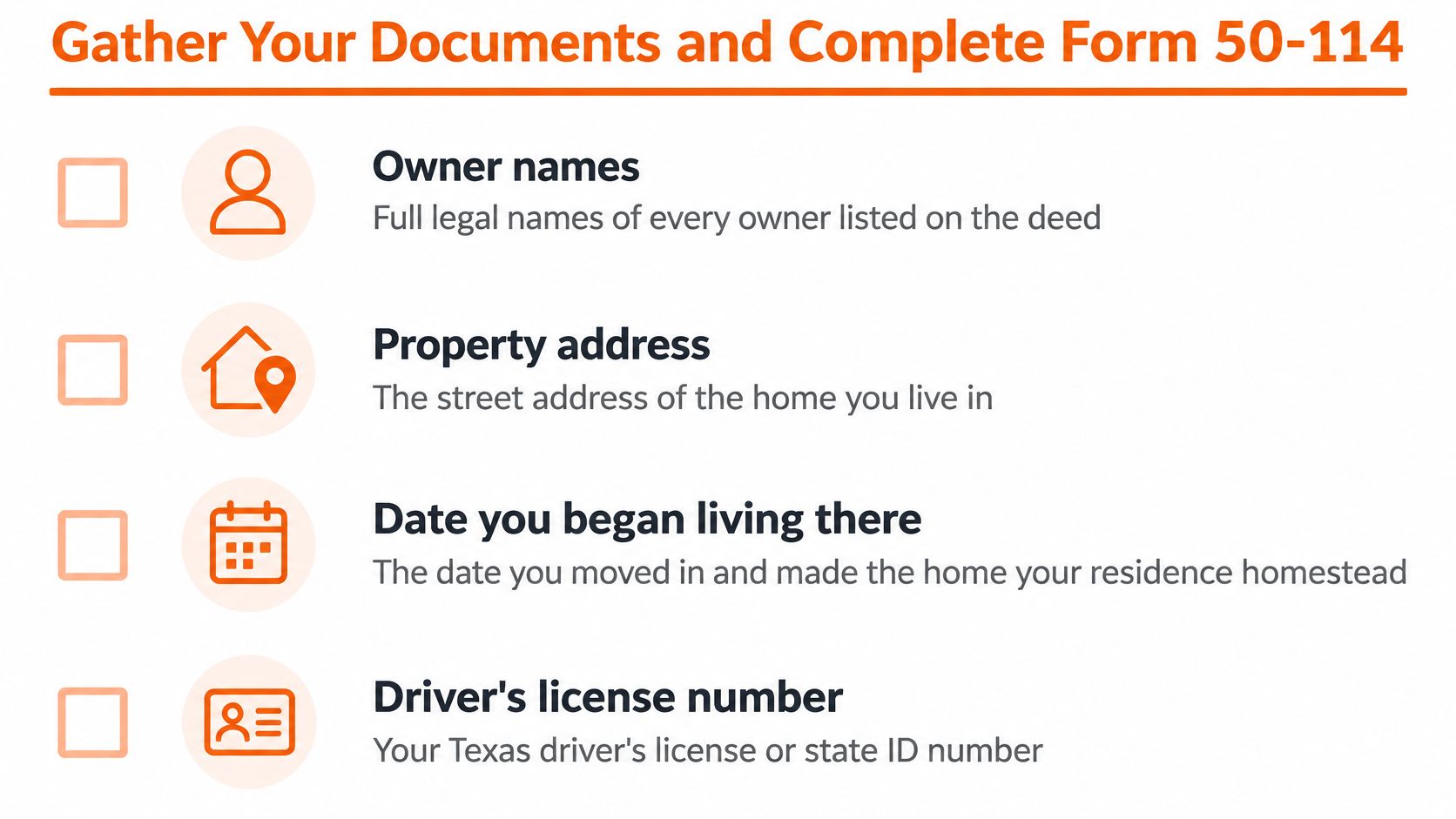
- Ownership paperwork. Keep the deed or closing statement beside you so the application matches the ownership record. Attach supporting paperwork when the application or TCAD requests it.
- Matching identification. Check the address on your Texas driver's license or state ID before uploading it. A readable image of an outdated address still creates a problem.
- Completed application. Review the occupancy declaration, other-homestead questions, signatures, and requested attachments. An unsigned form isn't ready to submit.
- Trust or name-change documents. Have these available if the deed and identification don't show ownership in an immediately consistent way. Trust ownership deserves a separate eligibility review rather than an assumption that every trust qualifies.
Fix mismatches before submitting
Say a couple moves into their new house during the summer but keeps identification showing their old apartment. They should update the address before filing through the ordinary application process. Submitting inconsistent documents invites a request for clarification and delays the decision.
Don't assume the seller's exemption transferred to you. An exemption visible on the property record may reflect the previous owner, not an approved application in your name.
The video provides another way to follow the filing process.
Before submitting, check that your former home no longer carries a homestead claim you're maintaining. If you find a duplicate, contact the relevant appraisal district and resolve it rather than signing a declaration that conflicts with its records.
Submit Before the Deadline and Track Your Filing
A submission confirmation proves you sent an application. It doesn't prove TCAD approved the requested tax year.
TCAD's homestead application page accepts online, mail, and in-person applications at 850 East Anderson Lane, Austin, Texas 78752, and states that action will occur within 90 days after receipt. It also explains that recently purchased homes can be submitted during the year the owner qualifies.
Follow the process through the property record, not just through the upload screen.
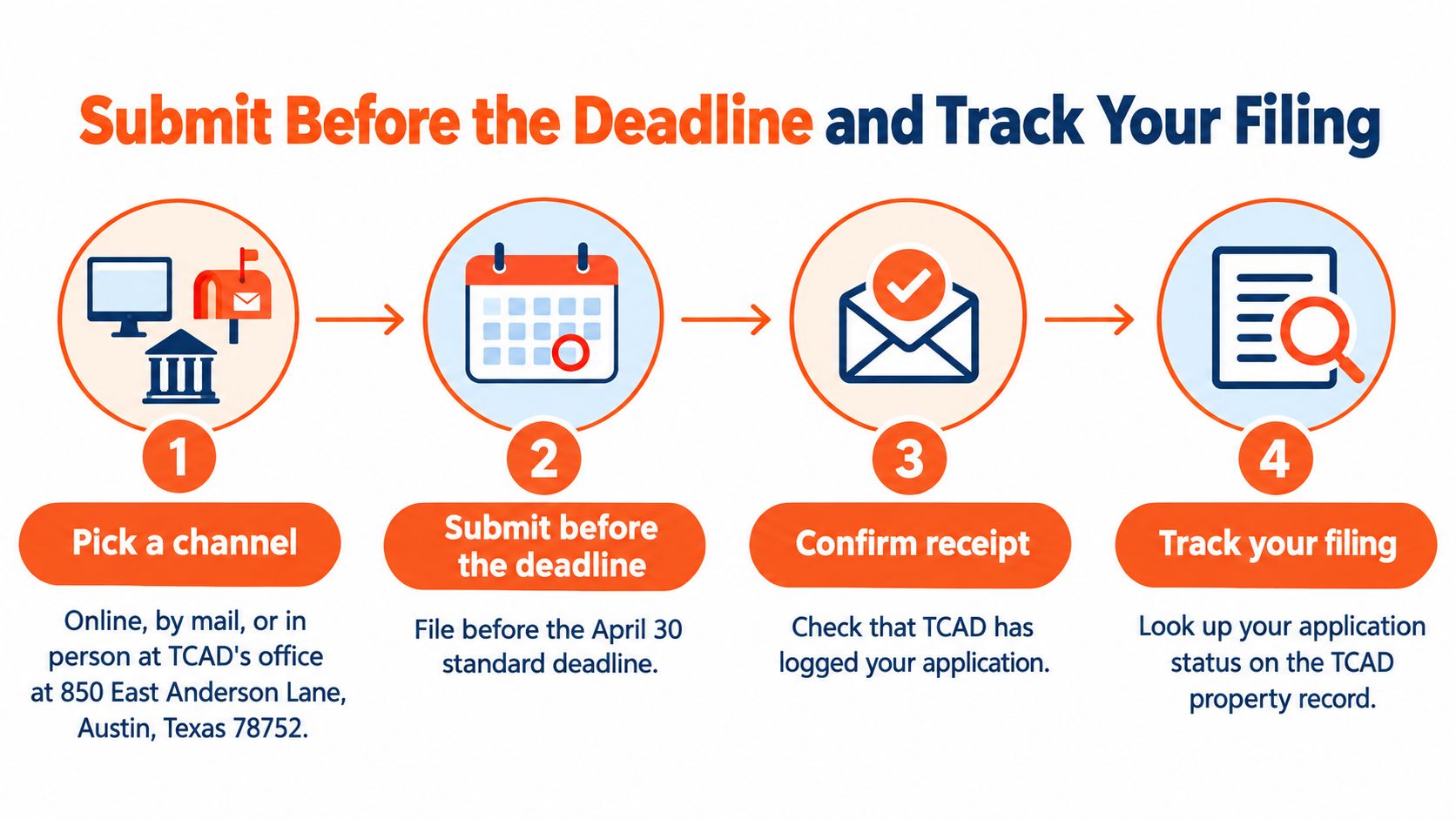
- Pick a channel. Online filing makes saving a confirmation straightforward. Mail or an office visit can suit an application with supporting documents that need explanation.
- Submit before the standard deadline. Aim for early April rather than the last week of the filing window. That's a practical buffer for missing paperwork, not a promise that processing will finish before the deadline.
- Keep proof of receipt. Save the online confirmation, certified-mail documentation, or a stamped copy from an office visit. Keep a complete copy of everything submitted.
- Inspect the result. Look for the exemption on the appraisal record and review the effective year. Compare the decision with the year you requested.
- Follow up when processing runs beyond the stated window. Contact TCAD with the property account information and confirmation available. Ask whether anything is missing and whether the application has been assigned a decision.
Key dates for a Travis County homestead filing
| Date or window | What happens | What you should do |
|---|---|---|
| January 1 | Standard ownership and occupancy checkpoint | Confirm your status; ask about current-year treatment if you purchase later |
| January 1 to April 30 | Standard filing window for the current tax year | File online, by mail, or in person |
| Early April | Recommended target, not a legal deadline | Submit with time to correct paperwork |
| Up to 90 days after receipt | TCAD acts on the application | Check your appraisal record and correspondence |
| Up to two years after the delinquency date | Statutory late-filing relief may remain available | Request review of the eligible missing years |
Mailing advice: Use certified mail with return receipt and retain the complete packet. Don't rely on a last-minute mailing when you still have time to submit through a more traceable channel.
What the Exemption Saves on Real Travis County Homes
Savings equal the taxable-value reduction for each taxing unit multiplied by that unit's tax rate. The exemption shrinks the number your taxes are calculated on. The rate itself stays put.
The Texas Comptroller's exemption guidance identifies the $140,000 school-district exemption, an additional $60,000 school exemption for eligible homeowners age 65 or older or with disabilities, and local-option exemptions of up to 20%, subject to a $5,000 minimum. Each taxing unit sets its own local-option percentage, so confirm what your county, city, and any special district has adopted before counting on the full 20%. On a $400,000 home, the school exemption alone pulls $140,000 out of the taxable base before any local option applies.
Illustrative savings at a 2.0% combined rate
The following is hypothetical arithmetic, not a property-tax estimate. It applies an assumed 2.0% rate to the sum of the school reduction and a local reduction calculated as 20% of appraised value. School and county levies carry different rates, so applying one combined rate to both generally overstates real savings. Treat the figures as a scale check.
| Appraised value | School $140,000 reduction | Combined savings at 2.0% |
|---|---|---|
| $250,000 | $140,000 | $3,800 |
| $400,000 | $140,000 | $4,400 |
| $550,000 | $140,000 | $5,000 |
| $750,000 | $140,000 | $5,800 |
| $550,000, eligible older or disabled homeowner | $140,000 plus $60,000 | $6,200 |
In that same hypothetical model, the extra school reduction adds $1,200, and the savings recur every year the exemption stays on the account. An approval effective for a later tax year leaves the current year's taxable value untouched, which is how a filing that looks approved can still cost a full year of savings.
Run your own numbers through the homestead exemption calculator, then substitute the rates and exemptions for your actual jurisdictions. If the taxable value on your appraisal record hasn't dropped by roughly what your exemptions allow, part of the reduction hasn't landed.
Why Homestead Applications Get Denied and How to Fix Them
You filed, but the exemption doesn't appear on your notice. That can mean an unprocessed application, a documentation problem, a denied claim, or approval for a different year. Don't assume the missing entry proves you're ineligible.
Start with the application status and decision letter. Then match the symptom to the specific correction.
Denial symptoms, causes and fixes
| Symptom | Likely cause | Fix |
|---|---|---|
| Exemption missing from the notice | Application not filed or not yet processed | Check your TCAD record, then call with your confirmation |
| Denied for no occupancy | Home rented or principal-residence status not established | Provide occupancy evidence and ask TCAD which year qualifies |
| Denied as a duplicate claim | Homestead still claimed elsewhere | Correct the other claim and request reconsideration |
| ID shows the wrong address | Identification conflicts with the application | Update the ID and supply the corrected document |
| No decision after the stated processing window | Receipt problem, incomplete packet, or processing delay | Confirm receipt and ask what remains outstanding |
| Several past years missing | Exemption never filed or applied only prospectively | Request late-filing review for each eligible year |
| Exemption shows but value still high | Exemption doesn't resolve an inflated appraisal | Consider a value protest by the notice deadline |
Recovering a missed year
Under Texas Tax Code Section 11.431, the chief appraiser must accept and approve or deny a late homestead application filed no later than two years after the taxes' delinquency date, subject to statutory exceptions. This is not merely a period measured from closing or from the date you discovered the problem.
When approval follows approval of the appraisal records, the statute requires notification to the tax collector within 30 days. For taxes already paid, the collector must refund the owner who paid them within 60 days after that notification; unpaid bills are reduced instead, and no separate refund application is required.
Say an owner paid full bills for successive eligible years without ever filing. A late application may recover relief for the years still within the statutory window, but approval for the current year alone doesn't establish that those earlier years were corrected.
An approved exemption isn't proof that every eligible year has been fixed. Check the effective year and the corresponding bill or refund separately.
If TCAD denies eligibility, review the denial's protest instructions. A denial and an inflated appraisal involve different issues, but either may warrant appraisal review board action by the applicable notice deadline.
Renewals, Moves and Stacking Other Exemptions
An approved exemption generally carries forward without annual reapplication. Respond if TCAD requests verification in writing, and review your eligibility when ownership, occupancy, or personal circumstances change.
The practical distinction is between keeping an existing benefit and qualifying for another one. Don't assume the appraisal district will infer a new eligibility category from unrelated records.
- Report a change in use. Notify TCAD when you move out or convert the home to a rental. Leaving an ineligible exemption in place can expose you to corrected taxes and penalties.
- Update age or disability eligibility. An eligible older or disabled homeowner can receive an additional school-district value reduction alongside the general homestead benefit. Submit the necessary information rather than assuming the birthday or status change updates the property record.
- Separate the school tax ceiling from the exemption. The qualifying older-homeowner ceiling generally limits school taxes by reference to the qualifying year; it isn't another deduction from appraised value. Improvements and other qualifying circumstances can affect its treatment.
- Review veteran benefits separately. A disabled veteran exemption can operate alongside homestead relief, with eligibility and the amount determined by the applicable disability category and rules.
How other exemptions interact with the homestead
| Benefit | What it changes | Stacks with homestead? |
|---|---|---|
| Over-65 or disabled school exemption | Adds an eligible school taxable-value reduction | Yes |
| Over-65 school tax ceiling | Generally limits school taxes using the qualifying-year amount | Yes, when eligible |
| Disabled veteran exemption | Reduces taxable value according to the applicable disability rules | Yes, when eligible |
| Rental or second property | Provides no residence homestead benefit | No |
Use the Texas over-65 property tax exemption guide to distinguish an added exemption from a tax ceiling before requesting changes. Buying an investment property doesn't transfer your residence benefit to that property.
Update promptly: Send new eligibility information when it applies, then verify that TCAD added the correct benefit rather than merely receiving your documents.
Confirm Your Exemption and Choose Your Next Step
The job is finished when the correct exemption appears for the correct year and the taxable-value calculation reflects it. Anything short of that is a filing, not a result.
When your appraisal notice arrives, compare its exemption listing with the TCAD property record. Check the owner, property account, effective year, and taxable value for each taxing unit. A general approval message does not answer all of those questions, and an exemption applied to the wrong year can sit unnoticed while you pay tax on the full appraised figure.
Set the notice next to your saved application and read the two side by side.

Compare taxable value with appraised value, not just this year's bill with last year's. A bill can change because rates or valuations changed even when the exemption was applied correctly. If an expected exemption is absent, identify whether you need a status inquiry, corrected documents, a late application, or a protest. Each path carries its own paperwork and its own clock, so naming the problem correctly is what keeps a fixable gap from costing you a full year of savings.
Choose the right level of help
- File yourself if the facts are straightforward. Clear title in your name, matching identification, uncomplicated occupancy, and no missed years usually make a direct application practical.
- Get help if the record needs interpretation. Trust ownership, multiple properties, additional age or disability benefits, and missing prior years call for closer review of eligibility and effective dates.
- Keep control of the evidence either way. Retain your application, attachments, confirmation, decision, and corrected tax records.
The Travis County Appraisal District guide covers the local record and protest timelines behind those decisions. One professional option is INTELLI, which uses a proprietary, data-driven system to review applications, deadlines, and missed exemption opportunities.
Qualify, file early, and verify. Those steps protect against an obvious denial and the quieter problem of an exemption that looks approved while an eligible year goes uncorrected.
INTELLI helps homeowners review homestead eligibility, pursue applicable exemptions, and identify missed relief. Visit INTELLI if you need help checking your Travis County filing or determining whether prior-year corrections remain available.