

You open your spring appraisal notice and find a property value, an exemption line, and a deadline to protest. Your first question is probably whether the value looks right. But the notice also reflects decisions governments have been making for centuries: what to measure, how to record it, who deserves relief, and how owners can challenge an assessment.
The history of property taxation isn't just a story about old revenue systems. It's a practical guide to understanding why your Texas property record, exemption application, and supporting evidence matter today.
Property Tax Eras at a Glance
Property taxation has survived because governments can identify land, document its characteristics, and connect it to an owner. Unlike a shipment of goods or a bank balance, a parcel can't move to another jurisdiction when the tax collector arrives.
The basic process remains recognizable: identify taxable property, estimate its taxable value, apply the applicable rate, and collect revenue. What has changed is the machinery around that process, including parcel maps, assessment standards, legal protections, and relief for particular owners.
Property tax eras and their lasting legacy
| Era | Period | Core Feature | Legacy Today |
|---|---|---|---|
| Ancient Rome | Late third to early fourth century CE | Land valued by productive capacity, recorded in censuses | Standardized assessment and periodic reassessment |
| England valuation survey | 1910 to 1915 | Parcel-level records linked to assessment numbers | Auditable property data drives valuation |
| U.S. local dominance | 1902 to the 1940s | Local property taxes support schools and services | Local valuation still funds local services |
| Court and reform era | 1970s to 1990s | Courts test school funding and assessment fairness; voters adopt caps and exemptions | Caps and exemptions shape what owners pay |
| Texas appraisal districts | Current annual valuation cycle | County appraisal districts appraise; local units set rates | Separate appraisal notices, protests, and bills |
| Modern homestead rules | Current law and application cycle | Exemptions reduce the taxable base | Eligibility and applications affect the bill |
These eras overlap rather than replace one another. A modern appraisal district still needs the reliable inventory that Roman administrators needed, while an owner's ability to challenge unequal treatment reflects much later legal developments.
For a Texas homeowner, the useful distinction is between the property record, the valuation, and the tax treatment. An incorrect building description, an unsupported market value, and a missing exemption are different problems. Each needs its own evidence and remedy.
Where Property Taxes Began and Why They Exist
Land gave early governments a practical way to raise revenue: officials could locate it and assess what it produced. An agricultural property tax worked like a utility meter for land, measuring characteristics linked to productive capacity rather than electricity use. That basic idea still appears on modern appraisal notices, where a property's recorded features help shape its valuation.
Ancient Rome developed an early systematic approach. During Emperor Diocletian's reforms in the late third century CE, the jugatio-capitatio system considered land area and quality, crops, settlers, cattle, and agricultural equipment, as described in Encyclopaedia Britannica's account of Diocletian.
The illustration compares this effort to measure a taxable resource with the familiar idea of tracking utility use.

From inventory to recurring assessment
Roman administrators had to identify resources, compare different holdings, and check taxpayers' declarations against official records. The units known as juga and capita helped organize obligations, while censuses gave officials a way to review declared resources.
Rome later organized assessments into recurring cycles, allowing officials to adjust rates without making a fresh inventory of every holding. This separated two tasks: recording what existed and setting the rate applied to it. The same distinction helps explain why today's appraisal notice and tax bill reflect related but separate steps.
Several familiar administrative ideas were already taking shape:
- Classification: Officials distinguished among properties and resources rather than treating every holding identically.
- Characteristic-based valuation: A property's productive qualities affected its tax obligation.
- Official records: Declarations could be checked against a documented inventory.
- Scheduled reassessment: Officials revisited assessments instead of leaving them unchanged indefinitely.
Why the record still matters
Suppose an ancient record described poor, uncultivated land as productive cropland. The owner might then face an obligation based on resources the holding did not provide. A modern record that lists unfinished space as finished living area can create a similar mismatch: the valuation begins with an inaccurate description.
Practical rule: Check whether the government has described the property correctly before disputing its value.
A government needs dependable revenue, and fair collection depends on dependable records. The purpose of property tax is therefore closely tied to how properties are recorded and assessed. A recurring charge is only as defensible as the inventory and valuation behind it.
How the United States Built a Local Property Tax System
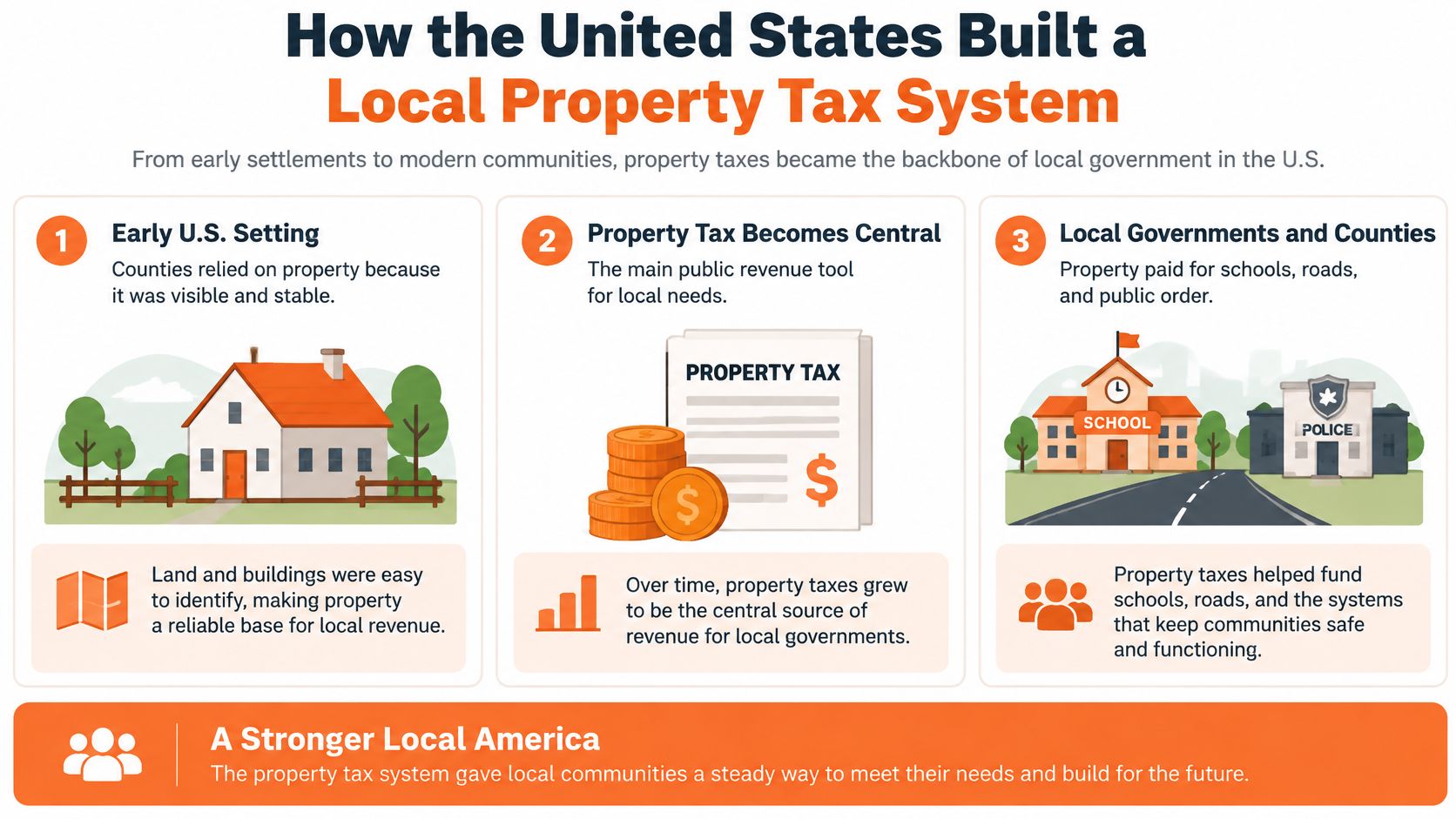
A local property tax works like a utility meter for land: it gives towns and counties a way to connect property within their boundaries to the cost of local services. American local governments used property taxes to support schools, roads, and public order, while states increasingly built other revenue sources.
In 1902, property taxes generated 68% of combined state and local government revenue and 42% of revenue across federal, state, and local governments, according to this historical public-finance analysis hosted by the University of Maryland. The figures show how central property taxation was to public finance.
The infographic summarizes how property taxes became a foundation of local government.
States and local governments took different paths
States increasingly adopted income and sales taxes, while local governments continued to rely heavily on property taxes. The historical figures make that divergence clear.
State and local shares of own-source general revenue from property taxes
| Year | State Share | Local Share |
|---|---|---|
| 1902 | 45.3% | 78.2% |
| 1932 | 15.2% | 85.2% |
| 1942 | 6.2% | 80.8% |
These percentages measure own-source general revenue, not every dollar available to governments. A government's reliance on the property taxes it collects itself differs from its reliance on all revenue, including transfers.
That local dependence gives assessment accuracy a public consequence. When officials divide a levy across the tax base, inconsistent valuations can shift responsibility among property owners. The appraisal notice records one step in that process, while local decisions about the levy and rates determine how the tax is collected.
What an assessment error does to a budget
Consider a hypothetical county assessment roll of $1 billion that is understated by 5%. That leaves $50 million less taxable value, not $50 million less revenue. At an unchanged tax rate, the revenue shortfall is the missing taxable value multiplied by that rate.
Officials might respond with spending choices, rate changes, or other available revenue. An individual owner's bill depends on how local government establishes its levy and rates, not only on whether the assessment roll rises or falls.
Check each part of your notice separately:
- Taxing units: Identify which school district, city, county, and special districts apply.
- Property description: Confirm that the assessment covers the correct parcel and improvements.
- Value treatment: Distinguish the property's value from the taxable amount used by each unit.
A lower valuation does not automatically mean a lower final bill. Local budgeting and rate decisions remain part of the calculation, so the notice reflects both the property record and the choices made by taxing units.
Court Rulings and Laws That Shaped Fair Assessment
A property tax can follow a published formula and still raise questions about fairness. Courts have considered how local property wealth affects school funding, while other rulings have examined whether comparable properties receive comparable assessments. These issues connect through the tax base, but each asks a different question.
The timeline shows how disputes over assessment and school funding have shaped property-tax policy.

School funding and constitutional boundaries
Serrano v. Priest challenged a system in which school funding depended on local property wealth. The case brought a broader question into focus: a tax base tied to a parcel can affect the resources available to schools across a community.
San Antonio Independent School District v. Rodriguez rejected a federal constitutional challenge to the school-finance arrangement before the Court. That outcome did not close the door to every fairness argument. State constitutional challenges could still follow a different path.
In Edgewood Independent School District v. Kirby, the Texas Supreme Court found the state's school-finance system unconstitutional under the Texas Constitution. The cases illustrate how the same system can face distinct tests under federal and state law. A ruling on one constitutional question does not automatically answer another.
Equal treatment and limits on growth
Allegheny Pittsburgh Coal Co. v. Webster County concerned comparable properties assessed at sharply different shares of market value. The dispute highlights why evidence about nearby assessments can matter alongside evidence of a property's sale price. Like checking a utility meter against similar homes, comparisons can help reveal whether the assessment process treats properties consistently.
Policy responses have also addressed different concerns:
- California's Proposition 13 limited growth in assessed values and generally tied reassessment to changes in ownership. The approach can make costs more predictable for existing owners while leaving recently purchased properties with different assessments.
- Texas homestead appraisal limits restrict how quickly the appraised value of qualifying homesteads can rise. A cap affects assessment growth, not necessarily the final tax bill.
- Texas homestead exemption expansion reduces the taxable value for eligible homeowners. An exemption changes how much value is taxed, rather than setting a ceiling on appraisal growth.
This video offers another perspective on the relationship between property taxation and public policy.
A cap and an exemption do different jobs. A cap limits how quickly an assessment can rise; an exemption removes part of the value from taxation. Neither corrects an inaccurate property record.
For owners, the enduring tension is stability and equal treatment. A rule can protect a longtime resident from a sudden assessment increase while giving a similar home purchased more recently a different taxable assessment. Those past choices still show up today as limits, exemptions, and differences on appraisal notices.
How Texas Built Its County Appraisal System
Texas has no state property tax. The Texas Comptroller's property-valuation guide explains that county appraisal districts value taxable property, while local taxing units adopt rates and use the revenue for services.
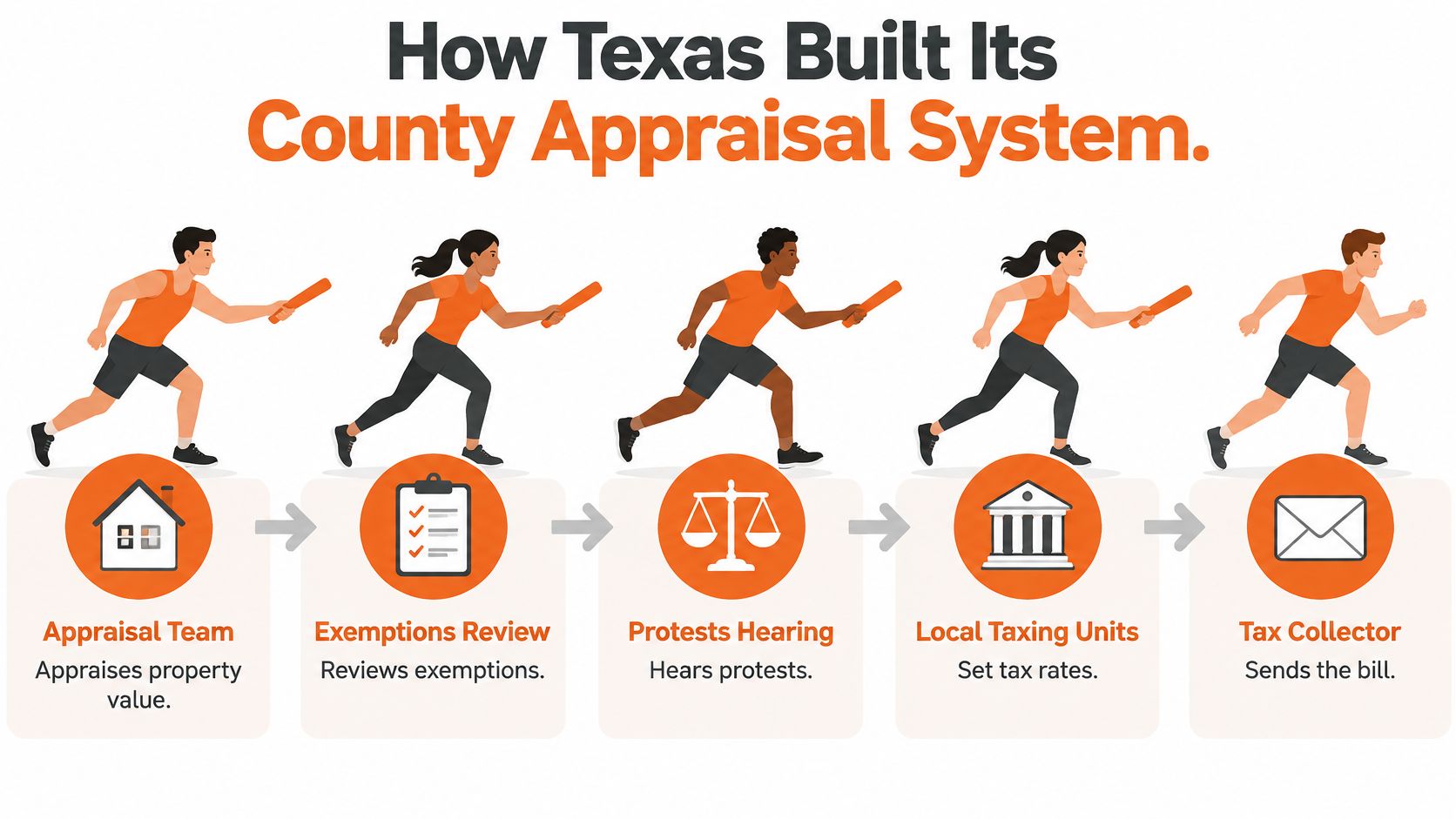
The system resembles a relay race. Different participants handle valuation, exemption eligibility, protest review, rate adoption, and collection. Knowing who holds responsibility prevents you from taking a valuation complaint to an office that can't resolve it.
The process flow shows those handoffs.
Follow the responsibility, not just the envelope
Texas requires equal and uniform valuation, and appraisal districts determine value as of January 1 each year. The Texas Comptroller's property-tax basics also explains how conditions and ownership on that date affect the annual process.
- Appraisal: The district establishes the property's value for the relevant valuation date. For a homeowner receiving a spring notice, evidence should address the property as it stood on that date.
- Exemption review: The district checks eligibility and applications. Keep the application confirmation and supporting documents with the property record.
- Protest or appeal: The owner challenges a disputed value, unequal appraisal, or another protestable issue through the appropriate process.
- Rate adoption: Local taxing units establish their rates. A successful valuation protest doesn't directly change those rates.
- Collection: The collector issues the bill using the applicable values, exemptions, and adopted rates.
A sale or improvement after the valuation date needs careful treatment. It may provide useful evidence, but it doesn't automatically change the condition or ownership relevant to that year's assessment.
Build a local evidence file
For an Austin or Travis County property, start with the local account record, building sketch, photographs, and relevant sales. The explanation of a county appraisal district can help you identify which office maintains the information you need.
INTELLI uses licensed property tax consultants and employs a data-first approach, using public and private data, to evaluate appraisal accuracy. That's one option alongside reviewing the district's records yourself or seeking other qualified assistance.
The important historical lesson is administrative: Texas separates the bodies that estimate value from those that set rates. Your evidence needs to address the decision you're challenging.
Texas Homestead and Exemption History Explained
A homeowner's appraisal notice can show several kinds of tax relief, each shaped by different rules. An exemption removes value from the taxable base; a rate change alters the tax charged against that base. Keeping those steps separate helps explain why one line on a bill may change while another does not.
The Texas Comptroller's exemption guidance identifies a $140,000 school-tax residence homestead exemption under Tax Code Section 11.13(b) and allows a local-option homestead exemption of up to 20% of appraised value under Section 11.13(n). Most exemption applications go through the county appraisal district, generally before May 1. The chief appraiser determines eligibility.
Match the relief to the property and owner
Texas homestead protections focus on qualifying owner-occupants. Other provisions address age, disability, service-connected disability, agricultural use, or historic preservation. These forms of relief work differently, and meeting one set of criteria does not establish eligibility for another. The history of these rules remains visible in the exemption names, eligibility tests, and application steps owners encounter today.
Texas exemptions, value rules and application timing
| Exemption | Who Qualifies | Value or Rule | Application Timing |
|---|---|---|---|
| Residence homestead, school taxes | Qualifying owner-occupied primary residence | $140,000 under Tax Code 11.13(b) | Generally before May 1 |
| Local-option homestead | Qualifying residence in a taxing unit that adopts it | Up to 20% under 11.13(n) | Confirm the district's application requirements |
| Over-65 and disabled person | Owners meeting the applicable age or disability criteria | Additional school-tax exemption under 11.13(c) | Apply through the appraisal district when eligible |
| Disabled veteran | Veterans meeting service-connected disability requirements | Reduction scaled to disability rating | Confirm the applicable application and eligibility date |
| Agricultural appraisal | Land meeting qualifying agricultural-use requirements | Productive-use valuation rather than ordinary market valuation | Confirm the special-appraisal filing requirements |
| Historic property | Property meeting applicable historic or archaeological criteria | Relief authorized for the qualifying designation | Confirm local adoption and application requirements |
Agricultural appraisal is a separate valuation method for qualifying land, not another homestead exemption. Historic designation also does not automatically reduce taxes. The applicable local provision and its requirements determine whether relief applies.
Read the taxable-value result
For a hypothetical home appraised at $300,000, subtracting the $140,000 school exemption leaves $160,000 subject to school tax, before other applicable adjustments. That figure applies to the school-tax calculation, not necessarily to every city, county, or special district on the bill. Each taxing unit may have its own adopted rate and applicable exemptions.
The history of homestead rules is still present in current paperwork: ownership and occupancy records, eligibility evidence, application receipts, and the appraisal district's decision can all help explain a missing exemption. The overview of homestead laws in Texas provides further context. If relief does not appear, these records can help distinguish an unfiled application from an eligibility disagreement or processing error.
Rules do not carry across state lines. Owners with property elsewhere need to check that jurisdiction's requirements. For New York City property, Blue Sage Tax & Accounting Inc. offers information on how to reduce NYC property taxes.
INTELLI uses a data-driven review of public and private data to identify potentially qualifying exemptions and check whether they were applied correctly. Eligibility still depends on the governing law and the owner's documented circumstances.
Who Bears the Burden of Property Tax Today
A property tax notice is a live record of old policy choices. Its assessed value, exemptions, and payment obligations show how rules built across different eras affect owners today. Recurrent property taxes represented 5.6% of total tax revenue in high-income countries in 2022, compared with 1.9% in middle-income countries and less than 1% in low-income countries, according to the OECD's Tax Policy Reforms 2025. Effective valuation and collection systems help make this revenue possible.
Revenue alone does not show whether the burden is fair. A tax can strain an owner with limited cash, while an outdated assessment can favor someone whose property has appreciated substantially.
Different owners encounter different rules
The practical burden depends on legal treatment and economic circumstances:
- Long-held owners: In acquisition-based or capped systems, some may have lower taxable assessments than recent purchasers of comparable homes.
- New buyers: Current purchase evidence can make differences between market value and a protected assessment more visible.
- Renters: Landlords may seek to recover property-tax costs through rent, although local rental conditions affect what they can charge.
- Investors and commercial owners: They generally cannot assume that owner-occupied homestead protections apply to rental or business property.
Consider two identical duplexes on the same street. One owner has held a property for 20 years; the other bought last year. Where assessment protection depends on ownership history, the assessment roll may show different taxable values even if both properties could sell for similar amounts.
That difference is not universal. Ownership duration alone does not establish that a Texas rental duplex qualifies for homestead protection. The applicable rule must explain the treatment shown on the account.
Fair assessment means checking whether a value is supportable and whether comparable properties receive consistent treatment.
Relief can protect owners or shift burdens
Targeted relief can help an eligible owner remain in a home while the property's current value is still assessed. Broad preferences, stale assessments, or uneven access to appeals can leave other taxpayers carrying more of the obligation. The appraisal notice is where these older policy choices become visible as values, exemptions, or deadlines.
For investors, the purchase price is only part of the analysis. Compare each jurisdiction's assessment rules, exemptions, and recurring ownership costs before committing to a purchase. Destin real estate investing is a location-specific resource, but the rules for the property under consideration should guide the budget.
An owner-occupant should check household eligibility, a landlord should confirm how rental property is treated, and a commercial owner should examine the property's use and valuation evidence. The historical rule that matters is the one applied to the account today.
Protest Your Appraisal Before the Deadline
When your appraisal notice arrives, treat it as a record to check before accepting the bill. The notice connects the history of property taxation to today's value, exemptions, and deadlines. Protest when the record or valuation evidence supports a challenge.
- Read the notice: Find the valuation date, appraised value, exemptions, and protest deadline.
- Confirm relief: Check whether homestead, age-related, disability, veteran, or agricultural provisions may apply. Special appraisal and exemptions are separate.
- Audit the record: Compare square footage, property use, improvements, and ownership with your documents.
- Build comparisons: Gather relevant sales and comparable assessment records. Explain what makes each property similar and note meaningful differences.
- File on time: Texas owners generally have until May 15 or 30 days after delivery of the appraisal notice, whichever is later, under the Texas Comptroller's protest guidance.
Choose the help you need
The Royal LePage Brookside Realty appeal advice discusses evidence for British Columbia assessments. Those local rules do not govern Texas protests.
INTELLI uses a data-driven approach combining public and private data to examine overvaluations, missed exemptions, and record errors. It prepares evidence and represents clients before county appraisal districts. You can also review the evidence yourself before deciding whether to file or seek help. Results vary by property, and no savings are guaranteed.
Gather your notice, property details, and eligibility documents. Then visit INTELLI to discuss whether a documented valuation challenge or exemption review fits your property.