

You've unpacked, started making mortgage payments, and opened your first Travis County appraisal notice. Now you're looking for the homestead exemption you expected to lower your property taxes, and the numbers don't look as straightforward as you'd hoped.
For a homeowner researching homestead in Austin, Texas, the most useful distinction is between an exemption that reduces taxable value and an appraisal cap that limits future valuation increases. They work together, but they don't promise the same savings, start on the same schedule, or prevent every tax-bill increase.
Who Qualifies and the Deadlines That Matter
A Travis County residence homestead exemption lowers the taxable value of a home you own and occupy as your primary residence. Owning a house isn't enough by itself. The district needs to establish that it's your home, not property you hold as an investment.
Travis Central Appraisal District's homestead guidance describes the general eligibility test as ownership and primary-residence occupancy on January 1, with applications due April 30, an extension when that deadline falls on a weekend or legal holiday, and processing that can take up to 90 days.
The distinction between buying and occupying matters. Closing documents establish when you acquired the property, while your move-in circumstances establish when it became your primary residence. Don't assume those dates are interchangeable.
Key Dates for the Travis County Homestead Exemption
Use these milestones to organize your application and follow-up. For a recent purchase or unusual occupancy situation, confirm the applicable treatment directly with the district rather than deciding eligibility from the closing date alone.
| Milestone | Date or Rule | What It Means |
|---|---|---|
| Ownership and occupancy test | January 1 of the tax year | The general test asks whether you owned and lived in the home as your primary residence on this date |
| Application deadline | April 30 | Extended when the date falls on a weekend or legal holiday |
| Processing time | Up to 90 days | File early if you need the exemption reflected before tax statements are final |
| Appraisal cap starts | Second full year of qualifying | A recent buyer may not see the 10% limit in the first year |
| Investment-only rental | Not eligible | Owner must occupy the property as a primary residence |
A buyer who closes after the eligibility date shouldn't automatically budget for a full-year exemption. Ask TCAD how the purchase date, occupancy date, and any existing exemption affect the account before assuming the benefit must wait until the following year.
Eligibility Isn't the Same as Approval
Your application needs identification showing the property address. Check that your name, property information, and address agree before submitting, especially if you've recently moved.
Then inspect the appraisal record. An application confirmation proves you submitted something; it doesn't prove the district approved the exemption or applied it to the correct account.
Practical rule: Treat the exemption as confirmed only when the district's property record shows it.
For landlords, a property used solely as an investment generally doesn't qualify for residence homestead treatment. Living elsewhere while owning an Austin rental doesn't satisfy the primary-residence requirement.
Start with your occupancy history, identify the filing deadline, and open the property record. Those checks tell you whether you're preparing an application, waiting for processing, or resolving a missing exemption.
How Much the Homestead Exemption Saves in Travis County
TCAD reported that the average Travis County property owner saved $3,663 from a homestead exemption in 2025, according to its published homestead information. That's an average tax-bill impact, not a guaranteed reduction for every household.
Your result comes from the interaction between your property's value, the exemptions each taxing unit allows, and the rates those units adopt. A county exemption doesn't automatically establish the taxable value used by your school district, city, or other taxing entities.
For tax year 2025, Travis County's taxpayer statement lists a homestead exemption equal to 20% of appraised value, the maximum permitted by law.
Savings Drivers for a Travis County Homestead
| Factor | How It Changes Your Savings | What to Check |
|---|---|---|
| Average Travis County saving | $3,663 average for 2025 | Treat it as an average, not a guaranteed result |
| Taxable value | A percentage exemption removes more dollars of value from a higher appraisal | Compare taxable value before and after the exemption |
| Travis County homestead exemption | 20% of appraised value for tax year 2025, the maximum permitted by law | Confirm the county exemption on your appraisal record |
| Local tax rates | Each taxing unit sets its own rate, so a rate increase can offset savings | Compare rates on your tax statements |
| Age 65 or older or disability | Additional qualifying exemptions can reduce taxable value further | Apply for the applicable category and confirm the record |
| Qualifying date | Eligibility follows the applicable ownership and occupancy rules | Confirm how your acquisition and move-in dates affect the benefit |
A Worked Dollar Example
For an illustrative home appraised at $400,000, applying the county percentage above removes $80,000, leaving $320,000 taxable for that county calculation:
$400,000 − $80,000 = $320,000
The removed value isn't the tax saving. To estimate the county tax saving, multiply the exempted value by the county's applicable tax rate, expressed in the correct units.
For the total bill, calculate each taxing unit separately and add the results. Multiplying the remaining county taxable value by a combined rate would only work if every included taxing unit used that same taxable base, which you shouldn't assume.
Our guide to Austin tax rates helps you separate the rate question from the exemption question. If you also own property outside Texas, Global on Orlando property taxes offers a useful comparison, but Florida rules shouldn't determine your Travis County estimate.
Compare the taxable-value entries by taxing unit, not just the headline appraisal. That's where you can verify which exemption changed the calculation.
How to File Your Homestead Application Step by Step
Prepare the application from your property record, not from memory. Keep your appraisal notice, identification, and submission confirmation together so you can answer a district question without starting over.
This visual summarizes the application process, from checking residency through confirming the account update.
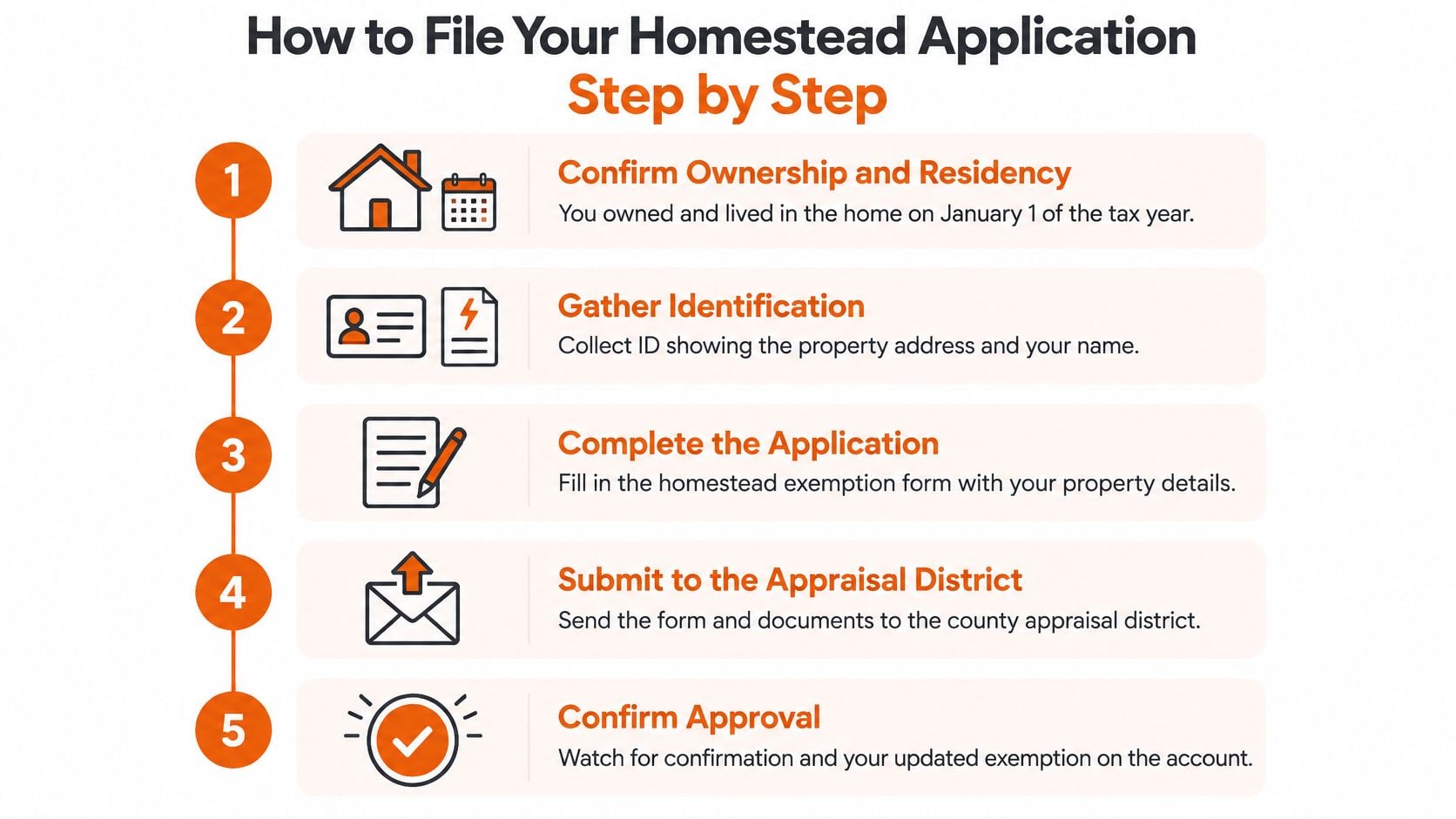
Prepare, Submit, and Verify
Confirm ownership and primary-residence occupancy. Compare your closing documents with your actual move-in history against the eligibility date. If you bought or moved during the tax year, ask the district which application treatment applies instead of guessing.
Gather identification and property information. Use identification showing the property address, and take the account or parcel information from your appraisal notice. A mailing address and a property's physical address can serve different purposes, so don't substitute one for the other without checking the form.
Complete and submit through TCAD's offered filing route. Use the district's current application instructions and submit by the applicable deadline. Review attachments before sending, since an otherwise complete form can still need follow-up if the identification is missing or doesn't match.
Submit early enough to allow processing. Don't schedule filing for the last available day if you need the record updated before tax statements are finalized. Save the submission date and confirmation somewhere you can retrieve them.
Inspect the appraisal record after processing. Look for the residence homestead exemption on the correct property account. Don't mistake an email acknowledging receipt for a completed exemption decision.
Contact the district if the exemption doesn't appear. Have your application confirmation and property account information ready, then ask whether the application is pending, incomplete, or awaiting additional documentation. Record the requested next action so you can follow through accurately.
Keep Evidence of the Finished Application
A late or incomplete application can delay when savings appear on a bill. If you discover a problem, ask the district what correction or late-filing options apply to your circumstances rather than assuming the benefit is permanently lost.
Use a folder labeled with the property address for your submitted form, supporting identification, confirmation, and district correspondence. Save a copy of the updated property record as well, so you can distinguish what you submitted from what the district ultimately recorded.
A successful filing ends with an updated account, not just a sent application.
The accompanying video provides another way to review the homestead application topic while you prepare your documents.
At the finish, you should hold both proof of submission and a property record showing the exemption. If you have only the former, keep the follow-up task open.
How the 10% Appraisal Cap Limits Future Increases
The 10% appraisal cap limits valuation growth, not the tax bill itself. It protects a qualifying homeowner from having the existing homestead's appraised value immediately follow a much larger market increase.
Under TCAD's reappraisal plan, the limited appraised value is the lesser of current market value or the prior year's appraised value increased by 10%, plus qualifying new improvements; the limitation generally begins in the second full year of qualifying.
Think of the calculation as a comparison, not an automatic annual increase. The district considers the market-value figure and the cap calculation, then uses the lower applicable amount.
Appraisal Cap Outcomes With Illustrative Values
Every figure in this table is hypothetical. Assume the homeowner already qualifies for the cap, and treat the renovation amount as added appraised improvement value, not the contractor's invoice.
| Scenario | Prior Appraised Value | Illustrative Current Market Value | Illustrative Limited Appraised Value |
|---|---|---|---|
| Market rises 20% | $300,000 | $360,000 | $330,000 |
| Market rises 5% | $300,000 | $315,000 | $315,000 |
| Market falls 4% | $300,000 | $288,000 | $288,000 |
| Market rises 20% with a $25,000 renovation | $300,000 | $385,000, including added improvement value | $355,000 |
In the first scenario, the limitation prevents the existing home's appraised value from following the entire market increase. In the next scenario, market value is already below the cap calculation, so the district doesn't raise the appraisal to the cap just because it could.
The falling-market example is especially important. A cap is a ceiling on the calculation, not a floor that prevents the district from recognizing a lower market value.
The renovation example shows why an addition can produce a larger overall appraisal increase. The improvement value enters the calculation separately from the growth limitation on the existing homestead.
The Values on Your Notice Mean Different Things
The TCAD homestead exemption guide distinguishes market value, the estimated January 1 sale value, from net appraised value, which reflects appraisal limitations, and taxable value, which reflects applicable exemptions.
Read those entries in that order:
- Market value: Review whether the district's estimated property value is supportable.
- Net appraised value: Check whether an applicable limitation changes the value used before exemptions.
- Taxable value: Identify the remaining amount subject to each taxing unit's rate.
Our explanation of assessed value versus taxable value can help you interpret those labels without treating them as interchangeable.
A capped appraisal can still lead to a higher bill because local taxing entities set their rates separately. Improvements and other applicable charges can also change the final amount. When budgeting, review the valuation calculation and the tax calculation independently.
Rentals, Sales and Renovations
A homestead benefit doesn't attach permanently to a building regardless of who owns it or how it's used. A change in occupancy, ownership, or physical condition should trigger a fresh review of your tax assumptions.
When the Home Becomes a Rental
Misconception: Owning an Austin rental makes it your homestead. Investment ownership alone doesn't satisfy the owner-occupancy requirement. For a property used solely as a rental, review valuation and rental-property tax issues separately from residence homestead eligibility.
Misconception: Moving out leaves the exemption untouched. If you establish your primary residence elsewhere and convert the former home to investment-only use, don't continue budgeting as though its residential status hasn't changed. Confirm the district's treatment of the move and any circumstances affecting eligibility.
Our guide to rental property tax rules provides a starting point for that review. If you're also preparing a short-term rental, CS Outsource's guide to how to get your home Airbnb-ready can help with listing preparation, but operational readiness doesn't establish homestead eligibility.
What Buyers and Renovators Should Question
Misconception: The seller's capped value becomes the buyer's permanent starting point. A sale can end the seller's appraisal limitation. Build your ownership budget using the likely post-sale valuation treatment, not just the seller's most recent tax bill.
A seller's tax statement describes the seller's account. It isn't a promise about your future bill.
Misconception: The cap shelters every dollar of a renovation. New improvement value can enter the appraisal calculation separately. Keep project descriptions, permits, invoices, and dated photographs so you can distinguish an addition from work that maintains the existing property.
Misconception: A new owner gets the full cap benefit immediately. The qualification schedule matters. Before assuming your first notice is wrong, check whether the limitation should already apply to your ownership period.
Ask yourself:
- Acquisition: When did I acquire the home?
- Occupancy: Is it my primary residence on the relevant eligibility date?
- Improvements: What changed physically since the last appraisal?
These questions help you identify whether the issue is eligibility, timing, or valuation before contacting the district.
Getting Professional Help Without Giving Up Control
You don't have to hire someone to file a homestead exemption. Travis Central Appraisal District confirms that professional filing assistance isn't required and describes its valuation objective as 100% of market value, with taxpayers paying their fair share.
The useful question is whether you need help completing an eligibility application or evaluating the property's appraisal. Those are different tasks, and the right level of assistance depends on which problem you're trying to solve.
Keep the notice and supporting documents together while you make that decision.

Compare the Work, Not Just the Filing
| Task | Handling It Yourself | Optional Professional Help |
|---|---|---|
| Establishing eligibility | Gather ownership, residency, and identification documents | Help organize the eligibility review |
| Confirming the exemption | Check the district account and resolve missing items | Assistance tracking discrepancies |
| Reviewing valuation | Assemble property-specific evidence | Organize evidence for a valuation challenge |
| Understanding the bill | Separate values, exemptions, and rates | Explain which component caused the change |
INTELLI uses licensed property tax consultants and employs a data-first approach, using public and private data. We use that approach to organize valuation evidence and distinguish appraisal limitations from exemption amounts and tax-rate changes.
That work doesn't replace the district's decision or guarantee a particular reduction. A valuation challenge needs support for why the appraisal should change, not merely proof that the resulting bill feels expensive.
Decide What You Want to Handle
Before choosing assistance, ask:
- What's wrong? Is the exemption missing, or do you disagree with the appraised value?
- What can I complete on time? Can I gather documents, submit the application, and track the response?
- Who will verify the result? Will I personally check the appraisal record and follow up?
Property condition documentation can also help you describe the home accurately. For routine maintenance, HoneyDo Crew offers reliable help with small repairs, but repair work and tax representation serve separate purposes.
Filing alone can be enough when eligibility is straightforward and you're comfortable checking the record. Consider professional assistance when the appraisal itself needs investigation or you want support organizing a documented challenge.
Confirm Your Exemption Before the Next Tax Bill
Open your current appraisal record before assuming your homestead benefit is active. The strongest protection against a missed saving is a documented account check followed by action on anything that doesn't match.
Close the Loop on Your Account
Find the exemption entry. Pull your current appraisal notice and property record, then confirm that the residence homestead exemption appears on the correct account. Keep a copy of what you reviewed.
Compare taxable values by taxing unit. Use the prior statement alongside the current record, and investigate changes rather than judging only the total bill. Separate a valuation change from an exemption adjustment, a rate change, or an improvement.
Check the cap's start year. If you bought recently, confirm when the limitation should apply to your ownership. Record that year with your purchase documents so you don't budget from an assumption.
Set eligibility and filing reminders. Put the ownership-and-occupancy checkpoint and applicable application deadline on your calendar. Allow time beforehand to correct identification or locate missing paperwork.
Resolve discrepancies with the district. Provide your application confirmation and identify the exact account entry you believe is missing or incorrect. Ask what documentation or action is needed next.
Choose who handles any valuation question. You can continue independently or consider INTELLI's licensed property tax consultants and data-first approach combining public and private data. Hiring assistance remains optional.
Keep Savings Expectations Separate
The average savings for an Austin homeowner with INTELLI is $2,500. That business average isn't a guaranteed result, isn't the district's homestead average, and shouldn't be added to an exemption estimate as though the benefits were automatically separate.
When you finish, you should have a verified record, saved supporting documents, and a clear choice about handling the remaining work yourself or getting help. Put the next filing reminder on your calendar while the account is still open.
INTELLI helps Austin homeowners evaluate property valuations and understand how exemptions affect their tax position. Visit INTELLI and enter your property street address on the homepage form to see your savings, or call 512-987-6543 to discuss your property tax questions.