

Your first property tax bill on a new Austin home lands in the fall, and the number is bigger than you budgeted for. You pull up the notice from the Travis Central Appraisal District and find three figures stacked together: market value, assessed value, and taxable value. Only the last one gets multiplied by the tax rate, and the gap between it and the assessed value is the homestead exemption doing its job. When that gap isn't there, you're paying tax on value you didn't have to.
The Austin homestead exemption is not a rebate and not a one-time discount at closing. It's a standing status attached to your name and your address, and it does two jobs. It removes part of your value from taxation this year, and it slows how fast the district can raise your assessed value in the years that follow.
Most of the confusion comes from timing. Ownership dates, partial years, and verification letters trip up people who did everything right at the closing table. Here's how each rule works in Travis County.
Who Qualifies for the Austin Homestead Exemption
A couple closes on a condo in East Austin in March. They move in over a weekend, forward their mail, and by June they're asking whether the exemption covers them this year or next. It's the most common question homeowners bring to the kitchen table, and the answer comes down to two words the appraisal district treats precisely.
Own and occupy. To qualify for the general residence homestead exemption, you have to own the home and use it as your principal residence. Travis County measures both conditions as of January 1 of the tax year. Live there on January 1 and the exemption can apply to that year. Close in March and you've missed the January 1 mark for that year, though a partial-year rule can still apply to the remainder of it. If the terminology feels slippery, this plain-English explanation of what owner-occupier means covers how occupancy gets judged in practice.
Eligibility by situation
| Situation | General homestead exemption | Additional programs to check |
|---|---|---|
| Owner-occupied primary home owned on January 1 | Eligible | Over-65 or disability benefits if age or status qualifies |
| Home bought mid-year and occupied as principal residence | Partial-year exemption may apply | Confirm prorated amount with the appraisal district |
| Rental or investment property | Not eligible | None under the homestead rules |
| Second home or vacation property | Not eligible | None; only one primary residence qualifies |
| Owner age 65 or older | Eligible if owner-occupied | Additional over-65 exemption amount |
| Owner with qualifying disability | Eligible if owner-occupied | Additional disability exemption amount |
| Disabled veteran | Eligible if owner-occupied | Veteran exemption amounts depend on the VA disability rating |
| Surviving spouse of an eligible owner | Check program rules | Eligibility depends on the specific program being claimed |
The table sorts the easy cases from the ones that need a phone call. Filing costs you nothing, and you submit the application yourself rather than through a company. Treat the grid as a starting point and confirm your exact status with the appraisal district before you assume a benefit applies.
Buying Mid-Year and Owning More Than One Property
A teacher buys a house in Round Rock in June and moves in over the summer. Her old place in Austin doesn't sell quickly, so she leases it to a tenant in August. She now owns two properties and lives in one of them. Which address carries the exemption?
Texas changed the answer for situations like hers on January 1, 2022. A property purchased on or after that date that becomes your principal residence during the year can qualify for a prorated general residence homestead exemption for the rest of that year, as the Travis Central Appraisal District explains in its verification guidance. Two conditions decide it. The home can't already carry a general homestead exemption for that year, and you can't hold a general homestead exemption on another property for the same year.
The partial exemption is not the cap. The prorated amount reduces taxable value for the portion of the year she owned and occupied the home. The 10% limit on assessed-value growth is a separate mechanism that becomes relevant after a full calendar year of ownership and occupancy beginning January 1. Treating them as one rule is where homeowners get their expectations wrong.
Her steps are short and dated.
- Confirm the move-in date. A utility connection, a mover's invoice, or the closing statement fixes the day the Round Rock house became her principal residence.
- File for the new home. The application names that address and that occupancy date.
- Take the exemption off the old house. The Austin property becomes a rental, and rental status doesn't coexist with homestead status.
Records carry the argument. A lease, a closing statement, and the dates on utility accounts are what the district reviews when a question comes up. Timing gets messier when the two transactions don't line up, and if she sells first and needs temporary housing after a fast sale while the next closing drags, those dates belong in the file too.
Practical rule: One address, one homestead. The moment a second property carries the status, one of them is wrong.
How Much the Exemption Saves and How It Changes Taxable Value
In 2025, the homestead exemption produced an average property-tax saving of $3,663 for a Travis County property owner, according to the Travis Central Appraisal District. That's not a rounding error in a household budget. It's the kind of number that shows up in an escrow analysis every spring and resets a monthly payment.
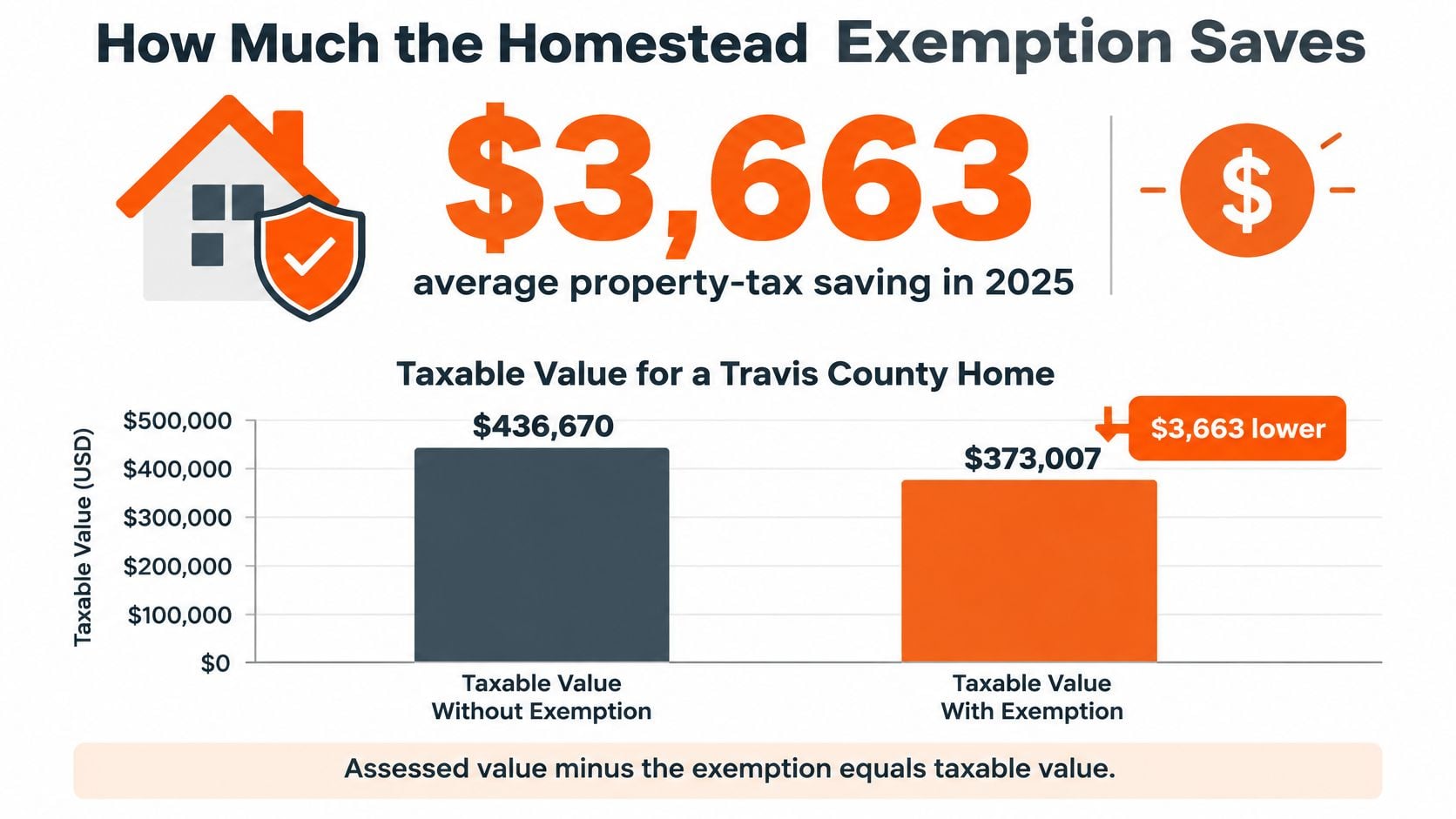
The mechanism is simple: the exemption shrinks the number the rate multiplies. Your bill is taxable value times a rate. Remove value and the rate applies to less. Nothing about your market value changes, and the district doesn't lower your appraisal because you filed a form.
Run the arithmetic on a hypothetical $400,000 home to see the shape of it.
| Step | Value | Note |
|---|---|---|
| Market value | $400,000 | Set by the appraisal district as of January 1 |
| Taxable value without exemption | $400,000 | Full value taxed by the school district |
| Less school homestead exemption | $100,000 | Illustrative school exemption for a homestead |
| Taxable school value | $300,000 | Base for the school tax calculation |
At an illustrative 1.0% school rate, that $100,000 reduction saves about $1,000 on the school portion of the bill alone. Real rates differ by taxing unit and by year, and city, county, and special district exemptions are separate decisions made by each of those bodies, so a real bill rarely matches a clean percentage.
The distinction that trips people up is the one between assessed value and taxable value. An exemption changes the second number, while a protest challenges the first. Pull out your most recent appraisal notice and find the exemption line. Add the exempt amount back to your taxable value and you'll see what you would have paid without it.
How to File and Meet the April 30 Deadline
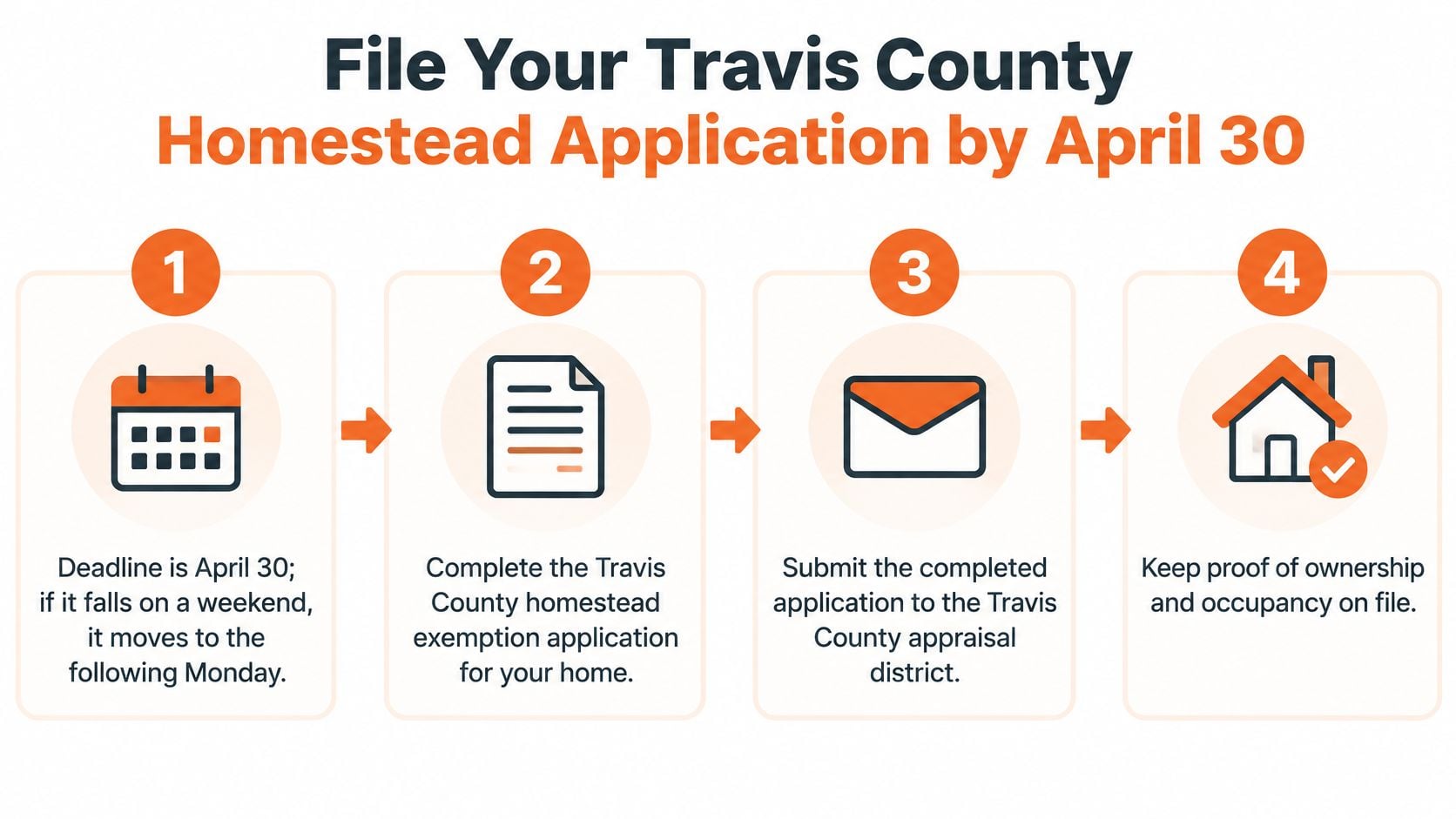
A completed Travis County homestead exemption application is due April 30. When April 30 lands on a weekend, the deadline rolls to the following Monday, per the Travis Central Appraisal District deadline notice. That's the entire calendar for most homeowners: one date, once a year, protecting a benefit that keeps paying.
Why January 1 decides your tax year
Eligibility is tied to ownership and occupancy as of January 1, so the closing date on your deed doesn't satisfy the test for the year you bought. TCAD's guidance is explicit that purchasing or moving into a property doesn't retroactively qualify it for the prior tax year. Move in during February and the general exemption starts with the following tax year, with the partial-year provision as the only bridge for the current one.
Six steps to a confirmed exemption
- Confirm the January 1 test first. Before gathering a document, check that you owned the home and lived in it as your principal residence on January 1. That fact is the hinge the whole process swings on, and it's the one the district rechecks later. If you want the background on how the local office handles records, this explanation of the Travis County appraisal district walks through the workflow.
- Match your Texas ID to the property address. The application gets checked against a Texas driver's license or state identification card showing the home's address. Update the address on your license before you file, not after, because a mismatch is the most common reason a clean application stalls.
- File it yourself, at no cost. TCAD states plainly that filing is free and that you're not required to hire a third party to submit the application. Online filing, mail, and counter drop-off all work.
- Keep proof of submission. Screenshot the confirmation page, save the email, or keep a dated receipt if you file in person. Timeliness disputes are settled with evidence rather than memory, and the confirmation is five seconds of work.
- Read the next appraisal notice. The exemption should appear on your account as an amount removed from value. If no exemption line exists, the record never processed your application, regardless of what you remember submitting.
- Call the district the day you spot a gap. Waiting until the fall tax bill arrives leaves almost no room to correct a record before the year closes. A call with your application confirmation number resolves most missing-exemption cases in one conversation.
Deadline habit: A recurring April 1 calendar entry beats a perfect memory. Districts process thousands of applications in the final week.
If you closed after January 1
A May closing doesn't satisfy the January 1 test for that year, even though you own and live in the home by summer. The partial-year provision for homes purchased on or after January 1, 2022 is the only route to relief for the balance of that year, and the full exemption takes hold with the next tax year. Plan for that gap when you set your escrow budget, because the first bill after a purchase is often the one that surprises people.
Before the next cycle, put two reminders in your calendar. The first on April 1, to confirm the exemption sits on the record. The second for the week your appraisal notice arrives, to compare this year's taxable value against last year's and to check the exemption amount against what's on file.
When the paperwork is right and the bill still looks wrong, the issue usually sits in the assessed value rather than the exemption. INTELLI uses licensed property tax consultants and a data-first approach, drawing on public and private data to check whether the exemption, the assessed value, and the cap were all applied correctly. The average savings for an Austin homeowner with INTELLI is $2,500, and we don't charge customers if we don't lower their property taxes. Start by entering your property street address on the homepage form to see your savings.
How the Homestead Cap Limits Assessment Growth
The exemption lowers this year's bill. The homestead cap sets a speed limit on how fast the assessed value behind next year's bill can climb. Think of a highway with a posted maximum. Traffic still moves, sometimes quickly, but it can't pass the limit without a documented reason.
Travis County applies the limit once a qualifying owner has owned and occupied the home for at least one calendar year beginning January 1. From that point, annual increases in assessed value are limited to 10% or the current market value, whichever is less, as the TCAD homeowner toolkit explains. The cap applies to the assessed value used for taxation, and it operates separately from the exemption itself.
Say last year's assessed value was $400,000 and the district's market value estimate jumps to $500,000. The cap allows an assessed value of no more than $440,000 for the year. The $60,000 difference between that and the market figure is value you don't pay tax on, and the capped number becomes the base the next year's calculation builds from.
The walkthrough below shows how the exemption and the appraisal process interact on a live Travis County account.
What the cap doesn't cover
Construction resets part of the math. TCAD notes that the cap can be affected by changes such as adding improvements, which lands squarely on Austin homeowners remodeling kitchens, adding a pool, or building a garage. New square footage and new structures get added to the assessed value, so a $40,000 addition can push the base past what the 10% limit alone would allow.
Keep receipts, permits, and contractor invoices. When a value question comes up, those documents let you show the appraiser exactly what was built, when, and what it added, rather than arguing from memory. The exemption and the cap work as a pair: one reduces the base today, the other slows the base's growth tomorrow, and a licensed consultant can verify that both were applied correctly.
Verification Letters, Moves and Losing the Exemption
The exemption renews on its own. That convenience is exactly what makes it easy to lose.
Travis CAD generally doesn't require an annual reapplication. The exceptions are narrow and specific: the chief appraiser asks for a new application in writing, you move, or your eligibility changes. Texas law now requires appraisal districts to review every residence homestead exemption at least once every five years, and Travis CAD began its review program in 2024, with full implementation anticipated by 2026, according to its adopted reappraisal plan. Reviews catch genuine problems and they also catch paperwork problems, and the owner on the receiving end often doesn't know a question exists until a letter arrives.
A verification letter is not a bill. It's a request for evidence, and it carries a reply date.
The situations that draw scrutiny are ordinary ones: a temporary move, a former home kept as a rental, two residences in different counties, a mailing address that doesn't match the homestead property. Review materials indicate owners may receive verification letters and get an opportunity to respond before any removal happens. That response window is the whole game.
- Keep proof of primary residence at the property. Utility bills, a homeowners insurance declaration, and a Texas driver's license showing the home address are the documents a reviewer asks for.
- Open every letter from the appraisal district. A verification request looks like routine mail, and the reply date is printed on it.
- Respond by the stated date with documents, not explanations. A stack of bills settles in one review what three paragraphs of description won't.
- Mark the exemption as ended when you move out. Leaving it in place on a home you've left is the mistake that turns into a back-tax correction.
- Never claim the homestead on a second property. Only one primary residence can carry it, and cross-checks between records catch duplicates quickly.
Renting out the home after a move ends the exemption. Landlord status and homestead status don't coexist on the same address, and a tenant's lease is the clearest evidence that the owner no longer occupies the property. If the exemption is removed in error, gather the documents that show occupancy, contact the appraisal district, and consider a formal protest with professional help before the deadline passes.
INTELLI works with Austin and Travis County homeowners to confirm that the homestead exemption, the assessed value, and the 10% cap were each applied the way the law requires, and our licensed property tax consultants step in when they weren't. We charge 25% of the savings we achieve and nothing at all if your taxes don't come down. Visit INTELLI and enter your property address to see what your bill should look like.