
You opened the Appraisal Review Board order, and the value still looks too high. You've already gathered records, attended a hearing, and explained why the appraisal district's number doesn't fit your property. Now you need to decide whether another challenge is worth the money and which route addresses your complaint.
Start with the envelope, email, or delivery record, not another search for comparable sales. When you received the order matters. So does whether you're challenging the value or the way the hearing was handled. Binding arbitration for Texas property tax disputes isn't a second protest, and choosing the wrong procedure can leave the underlying problem unresolved.
Where Binding Arbitration Fits in the Texas Appeal Path
Texas property tax appeal routes compared
| Route | When it applies | Filing deadline | Typical timeline | Deposit or cost | Binding effect | Main trade-off |
|---|---|---|---|---|---|---|
| Informal settlement conference | Before the ARB hearing, with appraisal district staff | Arrange before the scheduled ARB hearing | Settled before the ARB hearing | No arbitration deposit | Binding only if the owner signs an agreement | No independent decision; binds only if signed |
| ARB hearing | Protest heard by the Appraisal Review Board | Hearing date on the protest notice | Set by each county's ARB calendar | No arbitration deposit | ARB order binds unless appealed | Local decision-maker; the order binds unless appealed |
| Regular binding arbitration (RBA) | After an ARB order on appraised value, market value, or unequal appraisal | Within 60 days after receiving the ARB order | District review, optional settlement, then arbitrator decision | Current Comptroller chart sets the deposit by property value and homestead status | Binding on both parties | Independent value decision instead of district-court litigation |
| Limited binding arbitration (LBA) | After a covered procedural violation | 11th through 30th day after delivering the violation notice | Notice, filing window, then arbitrator decision | $450 or $550 deposit | Binding procedural determination | Fixes procedure, not value |
| District court lawsuit | After an ARB order, as the litigation alternative | Verify the judicial deadline immediately using the order and counsel | Petition, litigation schedule, then judgment or settlement | Court costs plus counsel | Court judgment | Judicial review, but filing makes RBA unavailable on the same matter |
The Texas Comptroller's regular binding arbitration guidance establishes the table's 60-day receipt-based deadline, qualifying valuation issues, and restriction against RBA after a lawsuit on the same matter. The Comptroller's arbitration comparison document establishes LBA's 11-to-30-day filing window and $450 or $550 deposits.
Identify where you are in the process
An informal conference is a negotiation with appraisal district staff. It carries no arbitration deposit and doesn't produce an independent valuation decision. Review any proposed agreement carefully before signing, because an accepted settlement isn't another offer you can disregard.
The ARB hearing is the formal local protest stage. There's no arbitration deposit to attend it, but the resulting order controls unless successfully challenged through an available appeal route. Don't confuse the hearing date with a later appeal deadline.
RBA is a formal escalation after the ARB has ruled on a qualifying valuation dispute. An independent arbitrator from the state-maintained registry hears evidence and issues a binding decision. You're seeking a different decision-maker, not reopening negotiations before the same local board.
LBA addresses specified failures in the hearing process. A complaint that you weren't allowed to present evidence differs from a complaint that the board considered your evidence but reached the wrong value.
District court is the litigation alternative. It deserves consideration when the dispute calls for judicial review, but filing suit isn't a placeholder while you decide whether to arbitrate.
Read the routes as choices, not a checklist
Use the Texas property tax appeal process guide to identify your current stage before preparing another submission. You don't need to pursue every row.
Match the route to value versus procedure, then review the deadline information accompanying your order and your actual receipt record. Read the timeline column as the sequence of events, not a promised completion date, and the final column as the compromise you're accepting.
Which Owners Qualify for Binding Arbitration
Who can use regular binding arbitration
| Case | ARB value ceiling | Eligible for RBA |
|---|---|---|
| Residence homestead, any value | No ceiling | Yes, if other rules are met |
| Other real or personal property valued $5 million or less | $5 million | Yes, if other rules are met |
| Other property valued above $5 million | Above the permitted ceiling | No |
| Owner has already filed a district-court suit on the same issue | Not applicable | No |
| Taxes not paid timely | Not applicable | No |
The Texas Comptroller's RBA eligibility rules set the general $5 million ARB-determined value ceiling, exempt residence homesteads from that ceiling, and require timely tax payment and no district-court lawsuit on the same issue.
The important number is the value determined by the ARB, not your purchase price, mortgage balance, or requested value. Likewise, don't assume that a house receives residence-homestead treatment because it's residential property. Confirm its actual status.
Match your property to a realistic scenario
Consider these hypothetical applications of the eligibility rules:
- Austin residence homestead: A home with an ARB value of $1.2 million clears the value test because residence homesteads have no ceiling. The owner still needs to satisfy the other filing and payment requirements.
- Travis County rental duplex: A non-homestead duplex with an ARB value of $3 million falls within the permitted band. Rental use doesn't itself prevent RBA.
- Commercial building: A non-homestead building with an ARB value of $8 million exceeds the ceiling. A strong valuation argument doesn't overcome that eligibility problem.
These are illustrative property values, not market estimates or promises that a particular appeal will qualify. Each scenario assumes the ARB ruled on an issue RBA can address.
Separate statewide rules from county administration
The statutory eligibility framework applies statewide. Austin and Travis County owners don't receive a different value ceiling from owners elsewhere in Texas, and a property manager shouldn't assume that moving a dispute to another county changes the legal test.
Local administration still matters. Appraisal districts use their own notices, ARB calendars, and hearing practices, so keep each property's paperwork separate when managing a portfolio. An order for a rental property shouldn't disappear into the folder for your residence.
Eligibility check: Confirm the ARB value, homestead status, tax-payment record, and litigation status before spending time polishing the arbitration application.
Retrieve payment confirmations rather than relying on memory or an escrow statement showing a planned disbursement. If a lender pays your taxes, verify that the payment was made. If counsel is already involved, confirm whether a petition has been filed, not merely drafted.
What Deposits and Arbitrator Fees Really Cost
Arbitration deposits and fee rules by case
| Case | Deposit | Retained by Comptroller | Arbitrator fee if owner wins |
|---|---|---|---|
| LBA, residence homestead valued at $500,000 or less | $450 | $50 | Appraisal district pays |
| LBA, residence homestead valued above $500,000 | $550 | $50 | Appraisal district pays |
| LBA, other property at any value | $550 | $50 | Appraisal district pays |
| RBA, residence homestead | Tiered under the RBA homestead schedule | $50 | Appraisal district pays |
| RBA, other property | Tiered under the RBA property-value schedule | $50 | Appraisal district pays |
The Comptroller's Property Tax Arbitration System arbitrator guide supplies the listed LBA deposits, the $50 administrative retention, and the fee-allocation rules. It also explains that regular binding arbitration deposits follow property-value and homestead categories rather than a single flat amount.
That distinction drives the filing decision. A deposit for a procedural complaint does not establish what a valuation appeal requires, and choosing the wrong remedy can consume part of the 60-day window without moving the dispute forward. Match the deposit to the arbitration track before authorizing payment.
Understand what the deposit covers
The deposit funds the arbitration process. It is separate from consulting fees, appraisal work, and the owner's preparation time. The arbitrator's compensation is subject to statutory and regulatory maximums, while the Comptroller retains the administrative portion.
When the decision favors the owner, the appraisal district pays the arbitrator's fee. When the decision favors the district, the case is dismissed, or the owner withdraws untimely, the Comptroller's procedures provide for payment of the arbitrator's fee from the owner's deposit.
For a worked example, take the other-property LBA row. From the $550 deposit, $50 is retained and $500 remains available toward the arbitrator's fee under the applicable procedures. Budget the full $550 as money at risk rather than assuming it will come back.
Representation sits outside those government charges. INTELLI, for example, charges 25% of the property tax savings achieved, paid only after the customer sees savings. Whatever firm or adviser you use, read the engagement agreement closely enough to separate professional fees from arbitration deposits and evidence expenses.
Compare costs with a supportable tax benefit
Measure the potential tax savings against the total cost of pursuing them, not the disputed value against the deposit.
Use the property tax protest cost guide to separate government charges from representation costs. Then build a simple worksheet:
- Supportable reduction: Identify the value change your evidence can reasonably establish.
- Tax effect: Estimate the resulting tax change using your property's applicable tax information, accounting for exemptions or limits that affect the bill.
- Cash exposure: Add the required deposit, representation fees, and necessary evidence expenses.
- Decision: Ask whether the likely benefit justifies both the expenditure and a binding outcome.
A large disagreement with the district does not automatically produce large tax savings. Organized evidence and a meaningful tax effect can justify further review even when the owner would prefer to close the file.
How to File for Regular Binding Arbitration
Start a dedicated arbitration folder as soon as the order arrives. Keep the ARB order, receipt evidence, protest records, tax-payment confirmations, and valuation exhibits together so you're not reconstructing the file near the deadline.
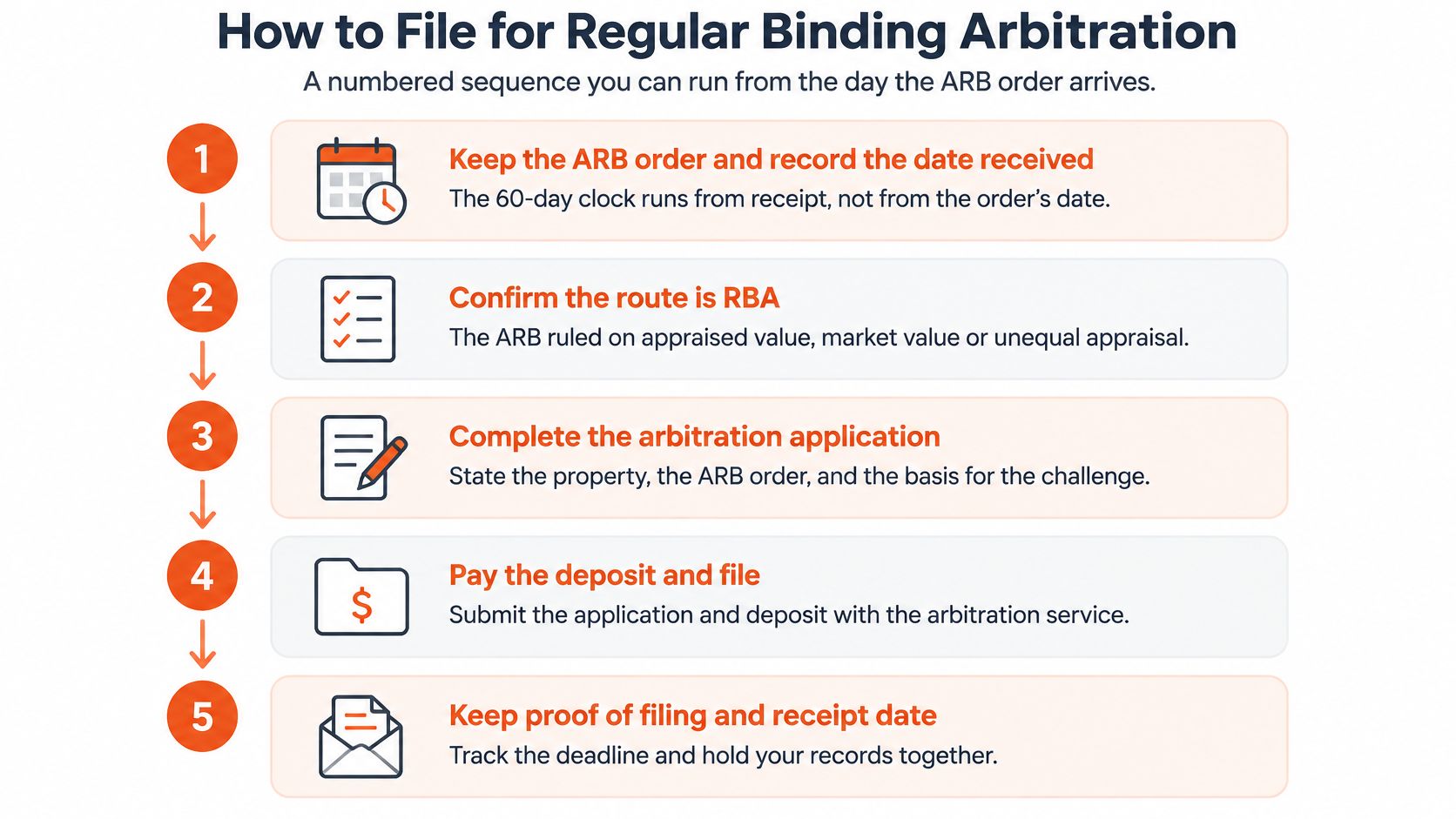
Use this visual checklist to keep the filing documents organized.
Run the filing sequence from receipt
Preserve the order and receipt date. Save the envelope, email, portal notification, or other delivery record with the order. Under the Comptroller's regular binding arbitration instructions, the request and required deposit must be filed within 60 days after receiving the ARB order, so waiting for the tax bill can jeopardize the remedy.
Confirm that you need a valuation appeal. Read the determination and identify whether the dispute concerns appraised value, market value, or unequal appraisal. Describe the actual valuation error rather than writing only that the hearing felt unfair.
Check payment and litigation status. Obtain confirmation that taxes not in dispute were paid timely and establish that no district-court suit has been filed on the same matter. A pending conversation with your lender or attorney isn't a substitute for checking the records.
Calendar the deadline with a preparation buffer. Enter the receipt-based deadline, then schedule an earlier internal completion date for reviewing the form and arranging payment. Use the Texas property tax protest deadline guide to keep the initial protest stage distinct from your post-ARB filing obligation.
Submit the request and required deposit together. Before payment, confirm the RBA deposit tier for your property using the current Comptroller chart, not an estimated amount. Save the completed application, payment confirmation, and filing acknowledgment in the same folder.
The Comptroller's arbitration administration guidance requires agents and represented owners to use the Property Tax Arbitration System, paying by credit card or electronic check; eligible unrepresented owners may use paper forms with a check or money order. It also gives the appraisal district 10 days to review the request, followed by an optional 45-day settlement period, or referral of certain discrepancies to the Property Tax Assistance Division.
Monitor administrative review. Watch for communications about the request instead of assuming successful payment means every administrative issue is resolved. Keep copies of responses and the documents you submit.
Use settlement constructively, then prepare for the arbitrator. Present a supported value and the strongest evidence explaining it, rather than repeating every point from the protest. If the dispute remains unresolved, organize the exhibits and explanation you'll present to the independent arbitrator.
Prepare evidence that someone else can follow
For a home, label comparable sales, explain meaningful differences, and attach dated condition photographs or repair estimates where relevant. For a rental or commercial property, reconcile rent rolls, income, expenses, and the valuation assumptions you're challenging.
An unequal-appraisal argument needs a coherent comparison, not a collection of neighboring properties selected only because their values are lower. Make the reasoning visible: identify the property characteristics, explain comparability, and show how the evidence supports your requested result.
This video offers another way to review the arbitration process while you assemble your file.
Treat filing and payment as a single deadline-controlled task. A strong valuation case won't repair a lost arbitration right.
Make the appeal-path decision promptly after delivery. Waiting until your evidence is perfect before checking eligibility and filing requirements puts the procedural task in the wrong order.
Limited Binding Arbitration for Procedural Violations
Limited binding arbitration is for covered procedural failures, including:
- Hearing procedures: The ARB failed to follow required hearing procedures.
- Required materials: Evidence or taxpayer-rights materials weren't provided within the required advance period.
- Scheduling: A hearing wasn't scheduled as required.
- Participation: The owner was denied the opportunity to present evidence, question witnesses, or make arguments.
The Texas Comptroller's limited binding arbitration guidance identifies these issues under Tax Code Section 41A.015, including the requirement for specified materials at least 14 days before the hearing, and requires filing no earlier than the 11th day and no later than the 30th day after delivering the violation notice.
LBA seeks compliance with a procedural requirement. It doesn't ask the arbitrator to decide that your building should be valued lower because nearby properties sold for less.
Build the complaint around a documented event
Suppose, hypothetically, that required evidence arrives four days before the hearing, rather than within the advance period identified in the Comptroller's guidance. Preserve the email headers, portal timestamps, envelope, and the actual materials received.
Your complaint should identify what was missing or late, who was responsible, and how the delivery record demonstrates the defect. A statement that the district was unhelpful won't establish the same thing as a documented failure to provide required materials.
Deliver the required written notice of the alleged violation and preserve proof of delivery. Calculate the permitted filing window from that event, rather than borrowing the receipt date from a valuation appeal.
Know what the arbitrator will address
The Comptroller appoints an eligible arbitrator from its registry. The ARB, chief appraiser, and property owner participate as parties, so prepare a focused record that explains the alleged procedural failure and the compliance you seek.
Keep the complaint narrow enough to evaluate. Attach the hearing notice, relevant correspondence, delivery evidence, and any record showing that you attempted to present evidence or question a witness.
Keep the remedy aligned: An unfavorable value isn't, by itself, proof that the hearing procedure was unlawful.
Review the applicable deposit category before submitting the request. Don't assume a procedural complaint substitutes for preserving a separate valuation appeal: if your real objective is a different property value, evaluate the valuation route on its own requirements.
Decide Whether to File for Binding Arbitration
Choose your route this week, while the documents and delivery records are easy to retrieve. The clock that matters starts when the ARB order arrives, and the right next move is the procedure that can deliver the remedy you need.
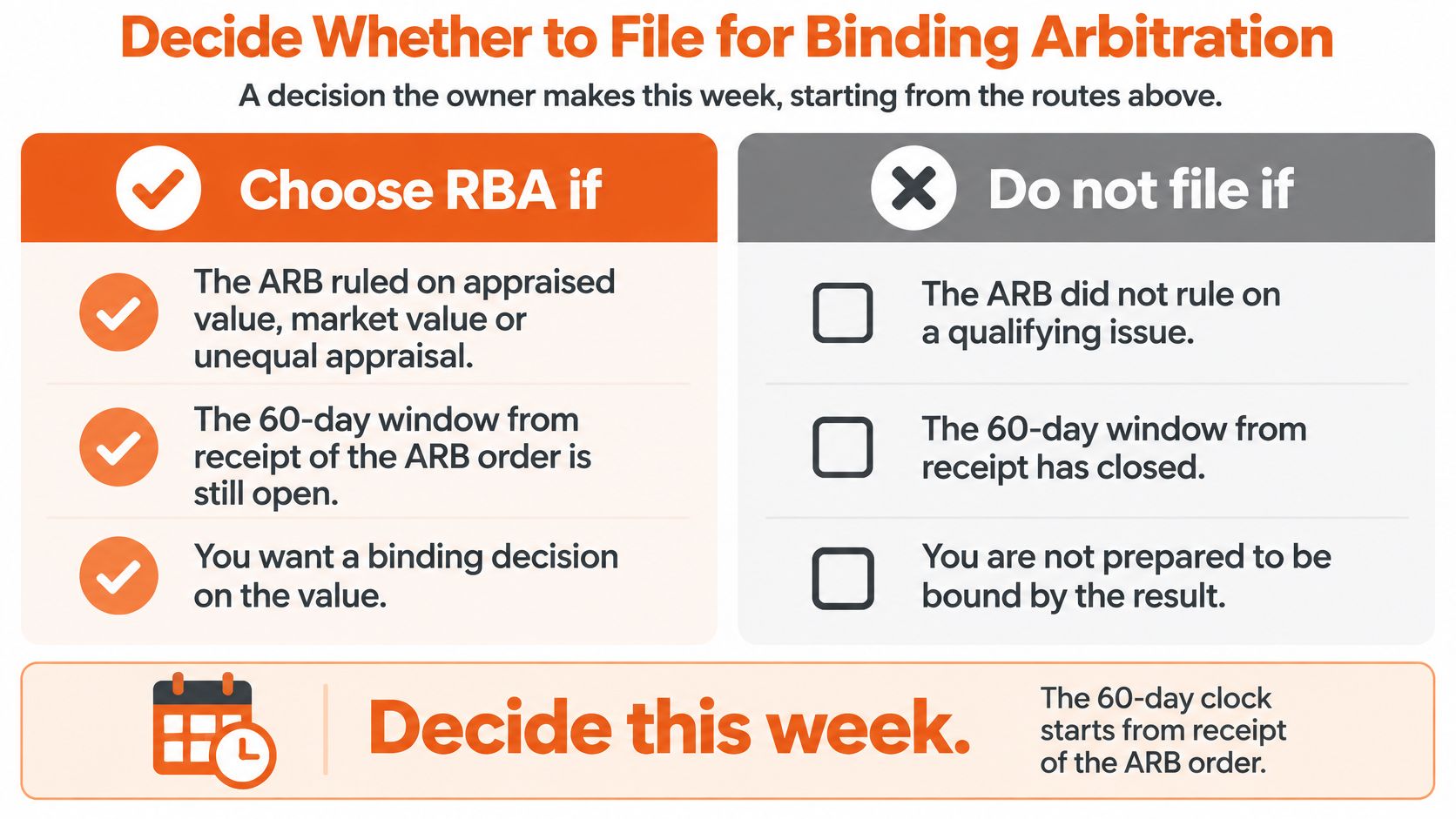
Use this decision guide to distinguish a qualifying valuation appeal from a complaint that belongs elsewhere.
Make the choice from the records
Choose RBA when the ARB decided a qualifying valuation issue, your filing window remains open, and you meet the property, payment, and litigation requirements. Be prepared to accept a binding decision rather than treating arbitration as preparation for a future court case.
Choose LBA when you can identify a covered procedural defect, document the required notice, and file within its permitted window. Dissatisfaction with how persuasive the board found your evidence isn't enough.
If your protest hasn't been heard, focus on the informal conference and ARB preparation. If judicial review is needed, consult counsel before filing, because a lawsuit on the same matter makes RBA unavailable.
For investors, the broader economics matter too. The tax strategy insights from Homebase provide commercial-real-estate tax context, but broader planning shouldn't delay a deadline-controlled property-tax decision.
Require evidence and clear fee terms
Before authorizing the next step, assemble a compact decision file:
- Order and delivery record: Establish what was decided and when you received it.
- Eligibility documents: Confirm homestead status, payment records, and whether litigation has begun.
- Evidence and economics: Identify the supported valuation argument and the likely tax benefit.
- Payment instructions: Verify the correct deposit category and filing method.
INTELLI is a Texas-based option for reviewing property-tax eligibility, evidence, and deadlines. INTELLI uses a data-driven system to prepare evidence for property-tax appeals, and its team represents clients before county appraisal districts. That review should begin with the documents that determine which remedy remains available, not a promise that every unfavorable order deserves arbitration.
Customers pay 25% of the property tax savings achieved, and only after they see savings on their property taxes. Review the engagement terms and how any government arbitration deposit is handled before proceeding; a results-based service fee shouldn't be confused with the state's filing requirements.
Today's concrete task is to gather the order and notice, preserve the receipt record, and calendar the applicable filing window. Then decide whether your evidence supports the requested remedy before committing money to it.
INTELLI helps Texas property owners evaluate inflated valuations, prepare evidence, and manage property-tax deadlines. Visit INTELLI or call 512-987-6543 to discuss your ARB order and whether a qualifying post-ARB appeal is appropriate for your property.