

You're holding last month's rent in the same account that pays the mortgage, the plumber, and your groceries. A tenant just gave notice, and you can't point to one line that says their deposit is still there. The balance looks fine. The story behind it doesn't.
That's the moment commingling in real estate stops being a class topic and becomes a file you have to defend. Texas owners run into it with a single rental and with a small portfolio. The fix is the same idea either way: money you hold for someone else has to stay identifiable from the day it arrives until the day you pay it out.
What Commingling Means for Real Estate Money
An owner with three rentals takes a tenant's security deposit, say $1,500, and drops it into the checking account that also pays the mortgage and the plumber. The tenant moves out months later. The owner opens the statement and can't show where that deposit went. The cash may still be somewhere in the account. The proof is gone.
Commingling is mixing money that belongs to someone else, a tenant, buyer, seller, investor, or client, with your own money, or with other money in a way you can't trace to its owner.
The line that matters is narrower than "never put client money together." Pooling client funds inside a properly identified trust or escrow account is allowed. Putting that same money into a personal or operating account is not.
A labeled jar can hold several people's coins if every coin is logged to its owner. Tip those coins into your own wallet and the log no longer matches the cash. The wallet is your operating account. The labeled jar is the trust account.

Four kinds of money that get mixed
- Rent: Collected for an owner, then spent on that property's bills or on yours.
- Security deposits: Held to secure the lease, then absorbed into everyday cash.
- Earnest money: Received for a buyer or seller, then parked in a business account until Monday.
- Owner distributions and management fees: Money you've earned, left sitting with money you only hold.
Practical rule: If the bank statement would look the same whether the tenant had paid you or not, that deposit isn't separated.
Before you read the deadlines, sort every dollar you handle into two piles: money you own, and money you hold for someone else. If you can't name the person for a dollar, treat it as held money until you can.
Legal and Financial Risks Beyond the License
A landlord may have enough money in the bank to cover every deposit and still be unable to prove which funds belong to which tenant. That gap can turn a bookkeeping failure into a licensing and tenant-protection problem.
License exposure
Under the Texas Occupations Code, failing to account for or remit money received for another person, including commingling trust funds, can be grounds for suspension or revocation of a real estate license. Texas property-management compliance guidance explains that a licensee's own funds must remain separate from money held for someone else, and that trust-account records must be maintained. The records matter because they show who owns the money and where it went.
What a tenant can claim
Texas Property Code section 92.102 defines a security deposit as money held mainly to secure a tenant's performance under a lease. Application deposits and advance rent are not included in that definition. A landlord may deduct legally chargeable damages, but not ordinary wear and tear.
If a landlord acts in bad faith, the tenant can recover $100, three times the amount wrongfully withheld, and reasonable attorney's fees. A landlord who fails to return the deposit or provide an itemized statement within 30 days is presumed to have acted in bad faith.
Commingling alone does not automatically give a tenant the deposit. The tenant still has to prove wrongful withholding. But late accounting, weak records, or improper deductions can make that dispute harder to defend. If the account is mixed, the landlord may struggle to show the deposit remained identified or that a deduction was reasonable.
Records that have to agree
- Bank statements: Show when the deposit arrived and whether it was used for unrelated bills.
- Move-in and move-out photos: Help distinguish actual damage from ordinary wear.
- Invoices and the lease: Connect each charge to a lease term and an actual cost.
- Deposit ledgers and transfer records: Identify the tenant and show whether the deposit moved with the property.
A deposit ledger that names each tenant and records transfer dates is the proof a tenant or regulator may ask to see. Keep it consistent with bank statements, photos, invoices, and the lease. That paper trail can show whose money was held, what happened to it, and why a deduction was made. For separate property expense records, use a rental property tax filing guide.
Common Examples and Red Flags to Watch
Most violations start as a shortcut, not a plan to take someone's money.
Rent lands in personal checking because the trust account is a second login and you're in the truck. A repair at one duplex gets paid from rent that belongs to another property. A management fee sits in the trust account for months after you earned it. A security deposit is forgotten after the property is sold, so the new owner has the building and nobody has a written handoff of the cash. During a short week, the trust account covers a utility bill, with a promise to put the money back.
New Mexico's rule is a useful wider lens, even if you only operate in Texas. It covers wrongful deposits or disbursements, a property or client ledger that goes deficient, placing money from a broker's personally owned property into an account that holds other people's funds, failing to withdraw money owed to the broker within a reasonable time, and using money designated for one property or transaction for another. New Mexico's commingling rule shows the violation can exist while every dollar is still inside one bank account. A bad ledger, a cross-property transfer, or a delayed withdrawal is enough.
California draws a clock on earned money. The Department of Real Estate treats commissions, fees, or other income left in a trust account for more than 25 days as prohibited commingling, and depositing personal or company money into that account is a violation even when separate records exist. Under California Business and Professions Code section 10176(e), commingling is grounds for suspension or revocation. If you work across state lines, read each state's rule. Don't assume Texas uses that 25-day count.
Red flags on last month's file
- Account title: The bank name has no trust designation.
- Totals: The ledger doesn't match the bank balance.
- Owner draws: Owners are paid deposits out of pooled cash with no property split.
- Temporary transfers: Money moved "for a few days" and never came back.
- Missing names: Deposit records don't name the tenant.
- Cash without paper: A receipt has no written record.
- Personal card: A manager pays property bills on a personal card and plans to reimburse later.
Texas Trust Account Rules and Boundary Cases
A landlord can have enough cash in the bank and still lose a deposit dispute. If the records do not show which tenant or property each dollar belongs to, the account balance alone cannot prove the deposit was protected. Texas trust-account rules focus on both proper handling and records that let someone trace the money.
TREC's rules treat money a broker receives for another person, including rent, earnest money, security deposits, and other client funds, as trust money.
| Rule | Texas requirement | What it means in practice |
|---|---|---|
| Deposit deadline | Deposit the money, or deliver it to an authorized escrow agent, by the close of business on the second working day after receipt, unless the principals agree otherwise in writing | If rent is received Friday, the deadline is Tuesday, assuming no holiday affects the working-day count |
| Personal or operating account | Trust money may not go into a broker's personal or operating account | Keep tenant or buyer money out of your own checking account |
| Pooling client funds | Funds belonging to multiple clients may share one properly identified trust account | Pooling is allowed if records show whose money each amount represents |
| Separate accounts | Separate accounts are permitted, not required | Choose an arrangement and keep clear records |
| Monthly accounting | A property-management trust account with activity requires an accounting at least monthly | Match the account activity to the property records and provide the required accounting |
| Record retention | Deposit and withdrawal records must be kept for four years | Retain statements, receipts, and ledgers for that period |
| Improper withdrawals | Paying operating expenses, or making a withdrawal that is not a proper trust disbursement, is prima facie evidence of commingling | Paying a personal bill from the account remains a problem even if you repay the money |
| Delegation | A broker may authorize another license holder to make transfers | The broker remains accountable for the funds |
| Consequences | Commingling can support license suspension or revocation | The risk includes the broker's license, not just the money |
| Earned fees left in trust | Texas rules cited here do not set a fixed number of days for withdrawing earned fees | Keep earned fees distinguishable from client funds, and document any withdrawal |
| Deposit when a property is sold | After acquisition, the new owner must return the security deposit. The former owner may remain liable until the deposit is transferred or the new owner assumes the liability | Record the transfer and its accounting as part of the closing paperwork |
A separate bank account for security deposits is not required. TREC's answer on security-deposit accounts says a manager may keep a tenant's deposit in a trust or escrow account that also holds money for one or more managed properties. The boundary is clear: the deposit can share an account with other client funds, but not with personal money.
One account, four properties, one sale
An owner manages four Austin rentals through one trust account and keeps a separate ledger for each property. That setup can comply with the pooling rule. The key is being able to trace each amount to the right tenant and property. An account balance without that record is like a shared envelope with no names on the contents.
Now one duplex sells. Texas law makes the new owner responsible for returning the security deposits after acquisition. The former owner may still be liable until the money is transferred or the new owner assumes the liability. Saying the deposit remains “in the account” does not show that either event occurred. Keep a written accounting that identifies each tenant, the amount, and when the money was transferred.
The rule permitting a broker to delegate transfers is a separate point. TREC guidance on who may move commission money addresses who may receive or pay commission in a transaction. It does not establish the account-identification, deposit-record, withdrawal-record, or monthly-accounting requirements described above. A broker who authorizes another license holder to make transfers remains responsible for the trust money.
Custody, authorization, reconciliation, and documentation matter more than the number of accounts.
Compare last month's bank statement with the ledger. For each deposit and withdrawal, ask whether the records identify the property, the owner of the funds, and the reason for the transaction. If you cannot show that trail to someone reviewing the file, the records need attention.
How to Keep Client Money Separate Step by Step
Run this before the next rent cycle. Each step has a reason, a common slip, and a confirmation you write down.
The account title is the first proof a reviewer sees.
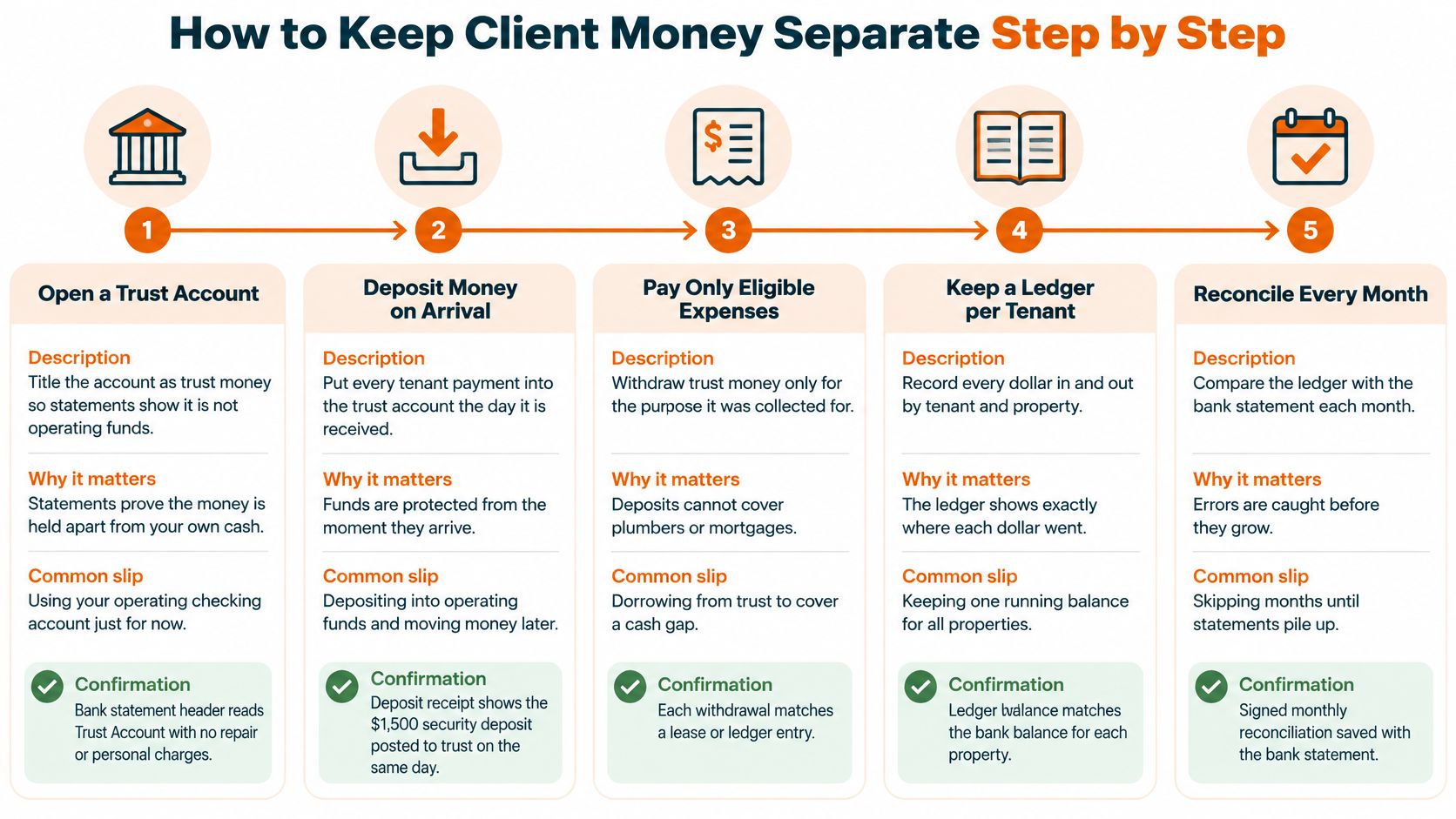
- Open a trust or escrow account titled as trust money. Statements then show the cash isn't operating funds. The slip is using the operating account because it's faster. Confirm the title on the bank statement.
- Deposit every held dollar inside the two-working-day window, unless a written agreement says otherwise. Weekend rent left in a personal account is the usual slip. Confirm that no client money sits in an operating or personal account.
- Post each receipt to a property and tenant ledger the day it clears. Batching a month of deposits into one entry hides a missing name. Confirm every line names a tenant or an owner.
- Withdraw only for a proper disbursement, such as an owner distribution, a documented repair for that property, or a refund. Paying a personal bill and planning to repay it is still a bad withdrawal. Confirm each withdrawal has a receipt.
- Keep a liability ledger for each property and confirm restricted cash equals or exceeds the tenant obligations it covers. Pooling without property coding lets one building's cash cover another's shortfall. Confirm the comparison for every property.
- Reconcile the bank to the ledger monthly, or daily if volume is high, and send owners a monthly accounting that matches. Confirm the totals agree to the penny.
- Move earned management fees out promptly and write down the date. Fees left in the trust account for months blur whose money it is. Confirm the withdrawal date on the ledger.
- Store deposit and withdrawal records for the four-year retention period. Confirm you can pull the file without hunting through email.
A short walk-through of the same custody habit is easier to replay than a checklist on the wall.
When federal housing rules are stricter
For federally assisted multifamily housing, HUD's management handbook looks past the question of whether money shares a bank. The accounting system has to identify each project's ownership and obligations all the time. Security deposits are generally kept apart from operating funds, and the balance has to equal or exceed the outstanding deposit liability. Deposits from different projects may not be combined without specific authorization. Project funds may sometimes share an account only with advance HUD approval, and only if every receipt and disbursement can be coded to the right project and the books can produce project-specific statements.
Pooling without that coding hides a shortfall, lets one property's cash subsidize another, and makes it impossible to prove tenant liabilities are fully funded. If you own or manage assisted housing, get counsel before you rely on the Texas steps alone. The same property-level coding also keeps income support clean for a rental property tax organizer.
Who to Call and Your Next Step
Match the problem to one helper, then stop shopping for a second opinion on the same question.
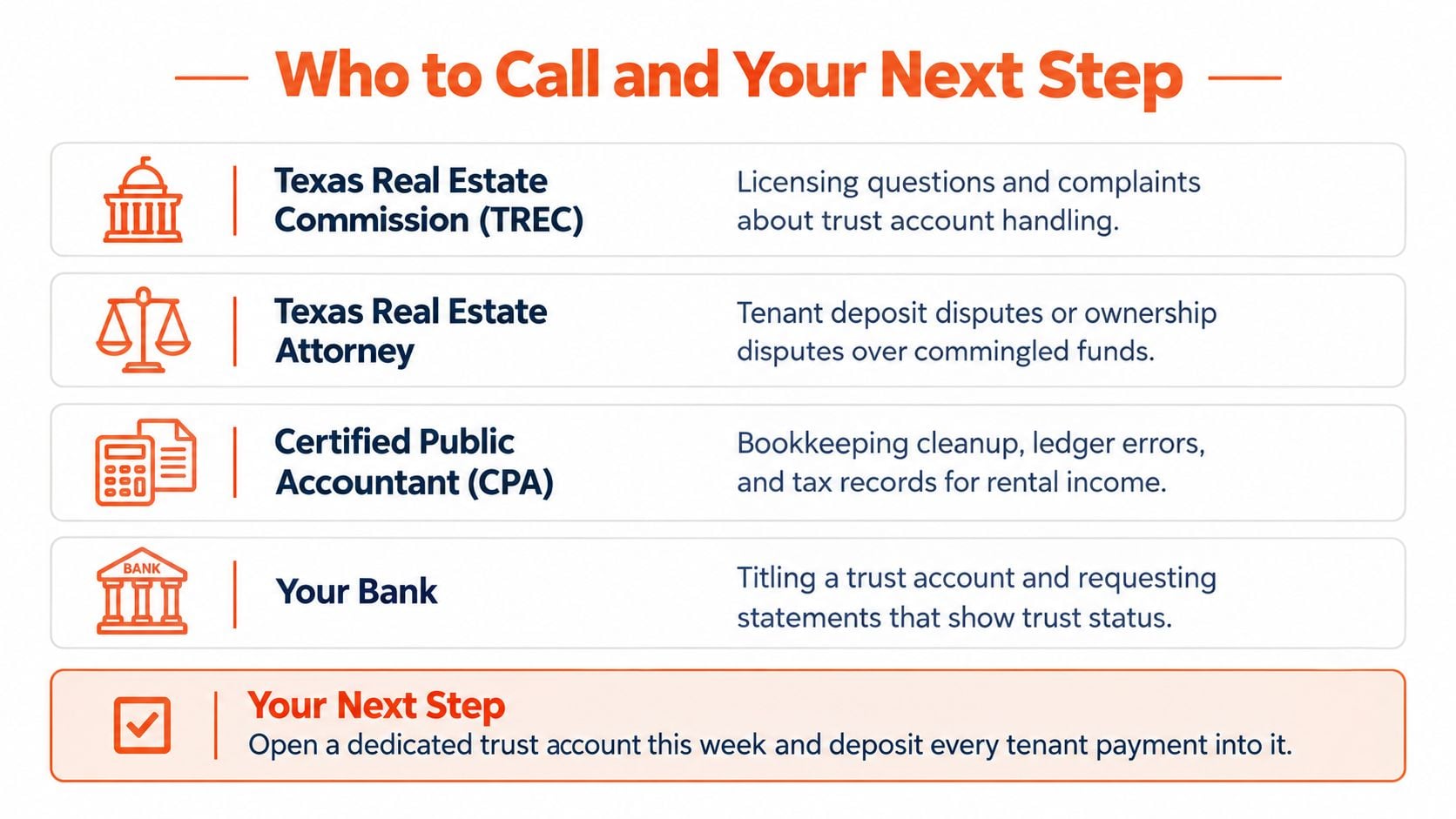
- TREC: Licensing questions and complaints about how trust money was handled.
- A Texas real estate attorney: A tenant deposit dispute, or a sale where the deposit may not have transferred.
- A CPA: Ledger design and the bank reconciliation when the totals don't agree.
- A licensed property manager with trust-account experience: Day-to-day administration once the account is set up.
INTELLI is a Texas property tax reduction service, not a trust-accounting provider. INTELLI uses licensed property tax consultants and employs a data-first approach, using public and private data, to challenge valuations, pursue exemptions, and recover past overcharges. Property tax is often a large recurring outflow, so it belongs in the same cash plan as rent and deposits. A rental property tax accountant conversation fits after the trust ledger is clean, not instead of it.
This week, complete the eight confirmations and fix any row you can't prove before the next rent is due.
INTELLI helps Texas owners and investors lower property tax bills by challenging inflated valuations, pursuing exemptions, and reviewing past overcharges, using licensed consultants and public and private data. Clean trust records and a clear tax file both answer the same question: whose money is this, and can you prove it? Visit INTELLI to see how a results-based review fits the rentals you already manage.