

You probably opened your Clark County notice thinking the number would look manageable, then saw a tax bill that felt higher than it should've been. That reaction is normal in Las Vegas, because the system is built to look simple on the surface and become confusing the moment you compare one neighborhood, one exemption status, or one ownership history against another.
The good news is that Vegas property tax is still structurally low by major U.S. metro standards, with reported effective rates around 0.48% to 0.55% and a 2024 median property-tax bill of about $2,057 in the Las Vegas Valley, up roughly 3.4% from about $1,990 in 2023, according to the Nevada Realty Experts summary of recent reports. Nevada also shows up near the bottom in statewide property-tax comparisons, including a 4th-lowest ranking in one WalletHub-based report and 9th-lowest in an ATTOM-based ranking, which is exactly why people get blindsided. The headline rate is low, but the bill can still be wrong, inflated, or just badly understood.
Why Vegas Property Tax Is Simpler Than It Looks
A homeowner in Henderson opens the notice, sees a number that doesn't match the mortgage estimate, and assumes the county must've made a mistake. Sometimes the county did. More often, the owner is looking at the wrong comparison point, because Nevada taxes aren't based on full market value and the bill is shaped by district, cap status, and whether the home is treated as a primary residence.
The part people miss is structural. Nevada taxes property on 35% of taxable value, not on the full market figure, and the state's annual growth limits are doing real work in the background. For primary residences, annual tax bill increases are generally capped at 3%, while other property types are capped at 8% under Nevada law, which is why the base-year valuation matters so much more than the marketing line about low taxes.
Practical rule: If your bill looks high, don't start by arguing the rate. Start by checking the assessed value, the district rate, and whether your home is actually receiving the correct cap status.
Clark County also doesn't use one uniform metro-wide rate. The consolidated district rates sit in different bands across the valley, and that's why two homes with the same price can live very different tax lives over time. Once you understand that split, the bill stops looking random and starts looking like a math problem you can audit.
If you're trying to understand how the assessment notice affects your mortgage escrow or a future appeal, this breakdown of what a property tax assessment means and how it impacts your bill is worth reading once you've checked your own notice.
How Clark County Calculates Your Tax Bill
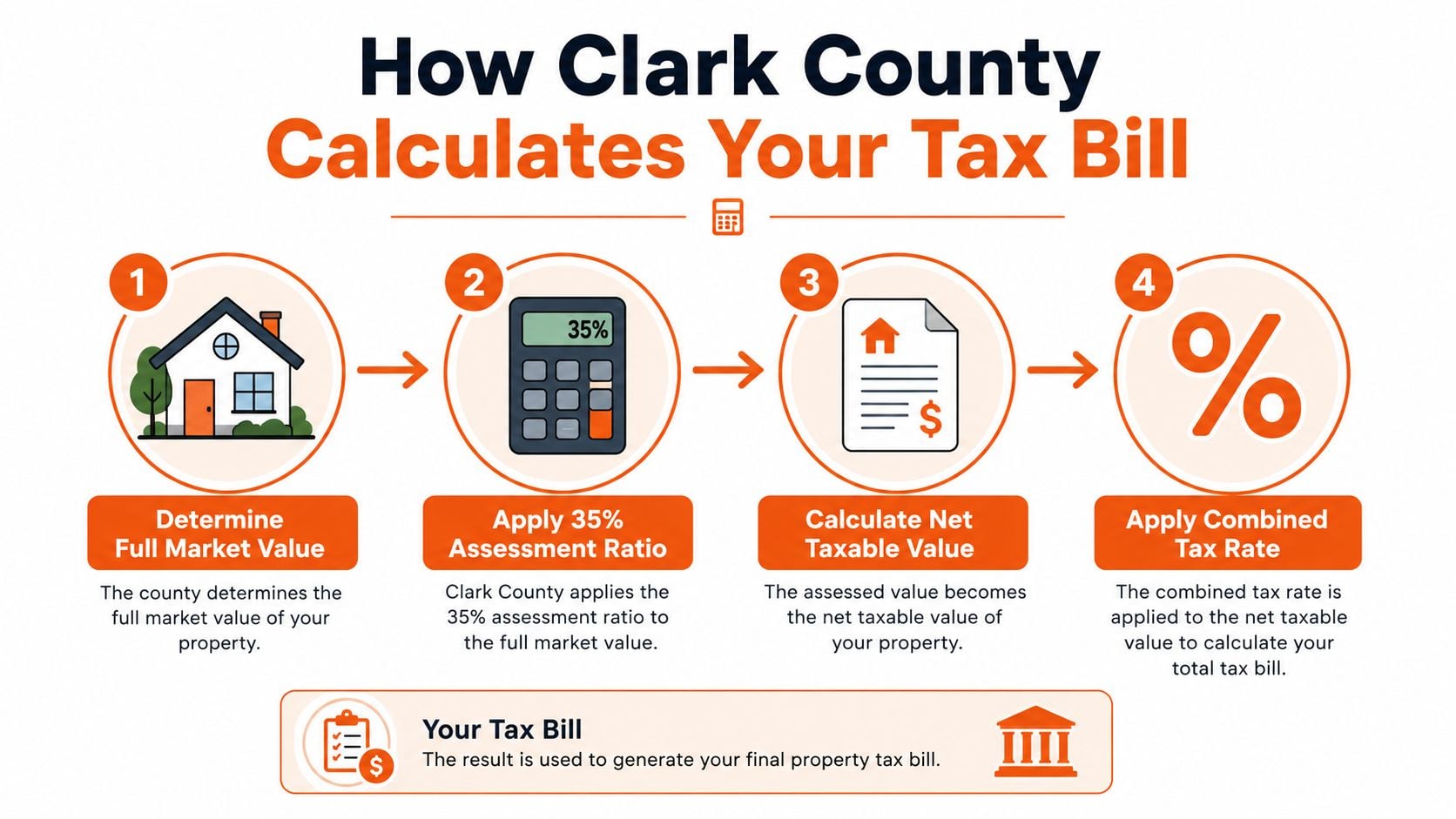
The calculation is straightforward once you stop looking at market value and start looking at the county's taxable formula. Nevada taxes are levied on 35% of taxable value, and Clark County's consolidated rates are typically around $3.20 to $3.50 per $100 of assessed value, with some district guides translating that into roughly 0.55% to 0.65% of market value depending on location and property type. That's the math you should use when you're checking a bill, not a rough online estimate.
The three numbers that matter
First, identify the property's full market value as the assessor sees it. Then apply the 35% assessment ratio to get assessed value. Finally, multiply that assessed value by the rate for your tax district. That sequence is the reason a high sticker price doesn't automatically mean a brutal tax bill.
For a $500,000 home, the math works like this. The assessed value is $175,000 because Nevada taxes at 35% of taxable value. If the combined rate in the district sits near the middle of Clark County's typical range, the annual bill lands in the range reflected by local guides, and the exact figure depends on the jurisdiction, not just the home's price.
| Step | What happens | Why it matters |
|---|---|---|
| Full market value | County starts with the property's value | This is the number most owners focus on first |
| Apply 35% ratio | Only a portion becomes assessed value | This is Nevada's biggest built-in tax protection |
| Use district rate | Rate varies by location | Same house value can produce different bills |
| Annual bill | Assessed value times district rate | This is the number you actually pay |
That's the part to challenge if something looks off. If the home's condition, lot value, or district coding is wrong, the assessed number can be wrong too. If the rate is correct but the base valuation is too high, the appeal should focus on the valuation, not on wishing the county used a different tax system.
The county's math isn't negotiable. The facts it uses to build that math are.
The exact line items on your notice can change, but the core challenge is always the same. Get the county's value, compare it to the property's condition and district context, and decide whether the valuation is defensible.
Why Your Neighbor Pays a Different Rate
Two homes can sit a few streets apart and still produce different bills, not because one owner got lucky, but because the county's tax districts aren't identical. Clark County's published 2025–2026 district rates were about 3.2782 per $100 of assessed value in Las Vegas and about 3.3544 in North Las Vegas, and local guides show district-specific ranges across the county that lead to different outcomes even when the properties look similar on paper. That's the hidden reason comparing your bill to a neighbor across a jurisdiction line is a waste of time.
A better comparison is jurisdiction to jurisdiction. One local guide estimates a $500,000 home in unincorporated Clark County at about $5,161 per year, while the same home in the City of Henderson is about $4,695 because the rate is lower there. That difference isn't about the home's quality. It's about where the property sits in the tax map.
| Clark County Tax Bill Comparison by Jurisdiction | Estimated Annual Tax | Approximate Effective Rate |
|---|---|---|
| Unincorporated Clark County | About $5,161 | Higher than Henderson in the cited example |
| City of Henderson | About $4,695 | Lower than unincorporated Clark County in the cited example |
Why location changes the bill
District boundaries pull in different public service overlays, and those overlays change the rate applied to the assessed value. That's why a property in one part of the metro can carry a different burden than an identical home elsewhere. The county's own published district structure makes that variation unavoidable.
This is also why “Vegas property tax is low” is only half the story. The effective burden can still shift meaningfully by district, property use, and whether the owner filed the correct paperwork for primary-residence treatment. If you're comparing homes, compare the district first and the sticker price second.
What to check before you argue the bill
- Look up the parcel district. Your APN and district determine the rate, not the zip code alone.
- Compare within the same jurisdiction. A Henderson bill is not the same reference point as an unincorporated Clark County bill.
- Verify the rate year. District schedules change by tax year, so use the current published table, not a listing estimate.
- Check property type. Primary residence treatment and investment treatment don't behave the same way over time.
That's the takeaway. The same house value can generate a different annual tax because Clark County doesn't tax the valley as one flat block.
How to Appeal Your Clark County Valuation
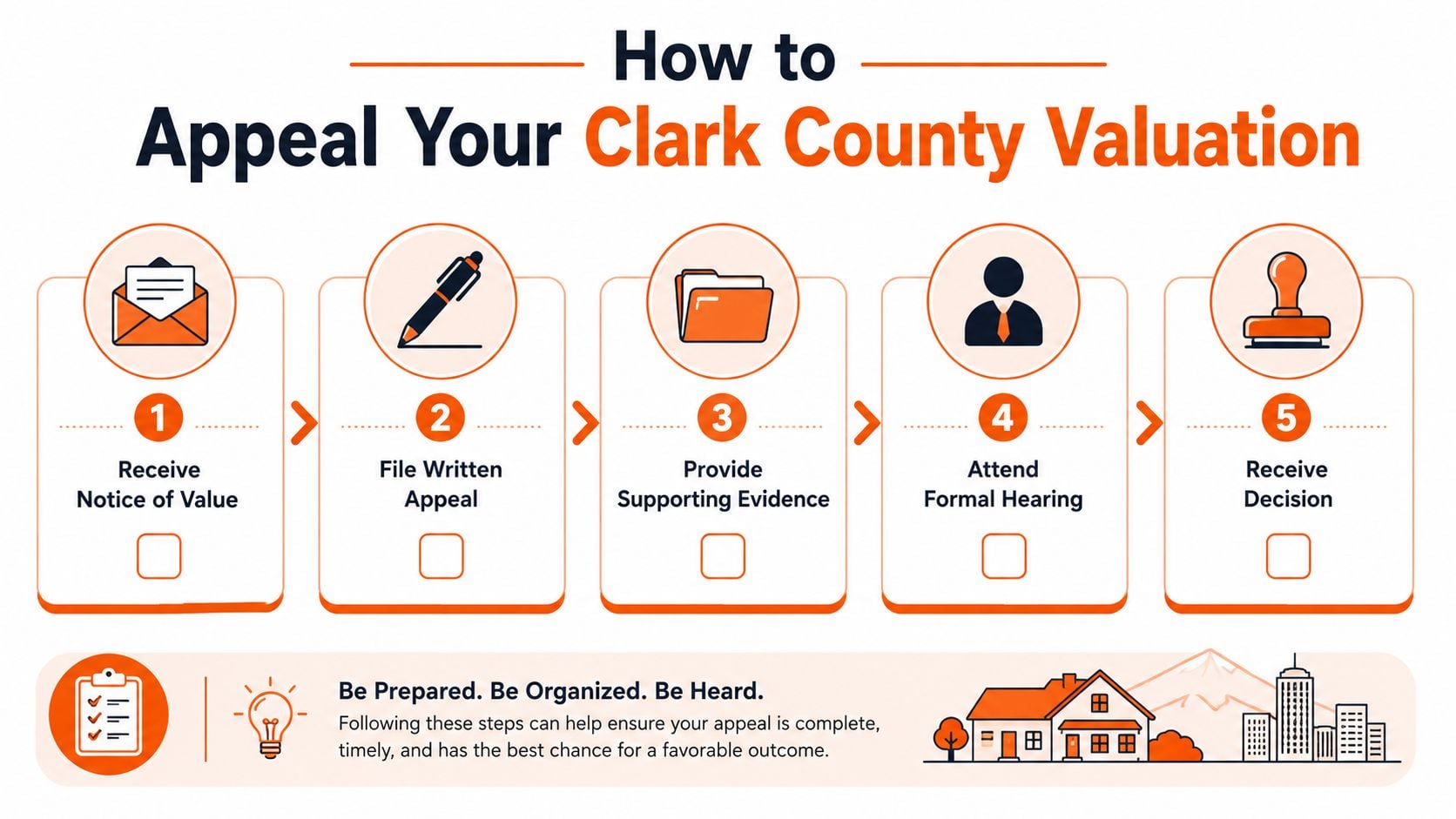
If the county's taxable value is too high, appeal it. Don't wait and hope next year fixes it, because the appeal window is short and the long-term effects of a wrong base value are bigger than most owners realize. Clark County mails assessment notices by December 18, and appeals must be filed by January 15, so the clock starts ticking fast.
Start with evidence, not outrage
The assessor responds to facts. Comparable sales, photos showing condition issues, repair estimates, and a professional appraisal all carry more weight than a complaint that the bill “feels high.” For investment property, income data can also matter if the valuation method should reflect the property's earning profile.
A weak appeal says the taxes are unfair. A strong appeal says the county's value doesn't match the property's real-world condition or market position. That distinction matters more than anything else in the file.
The filing path
- Receive the notice of value. Read the land value, improvement value, and assessed value separately.
- File the written appeal. Use the county's process before the deadline closes.
- Attach supporting evidence. Put your best comparables and condition documentation in the packet.
- Attend the hearing. Be concise and present only the facts that support your position.
- Wait for the decision. If the county agrees, the base value changes and future caps work from that corrected starting point.
For a practical walkthrough of the filing sequence, see the property tax appeal process guide.
Bring the county something it can verify. A clean evidence packet beats a long argument every time.
The video below gives a helpful visual overview of the appeal flow, and it's worth watching if you've never filed before.
What wastes your time
Don't argue that rates should be lower. They won't be. Don't lean on neighborhood emotion or general market complaints. Focus on the property-specific facts the county may have missed, because that's where appeals win.
If you build a serious case, use public records and private support documents together. That's the difference between a file that looks busy and a file that changes the number.
The Compounding Power of Nevada's 3% Cap
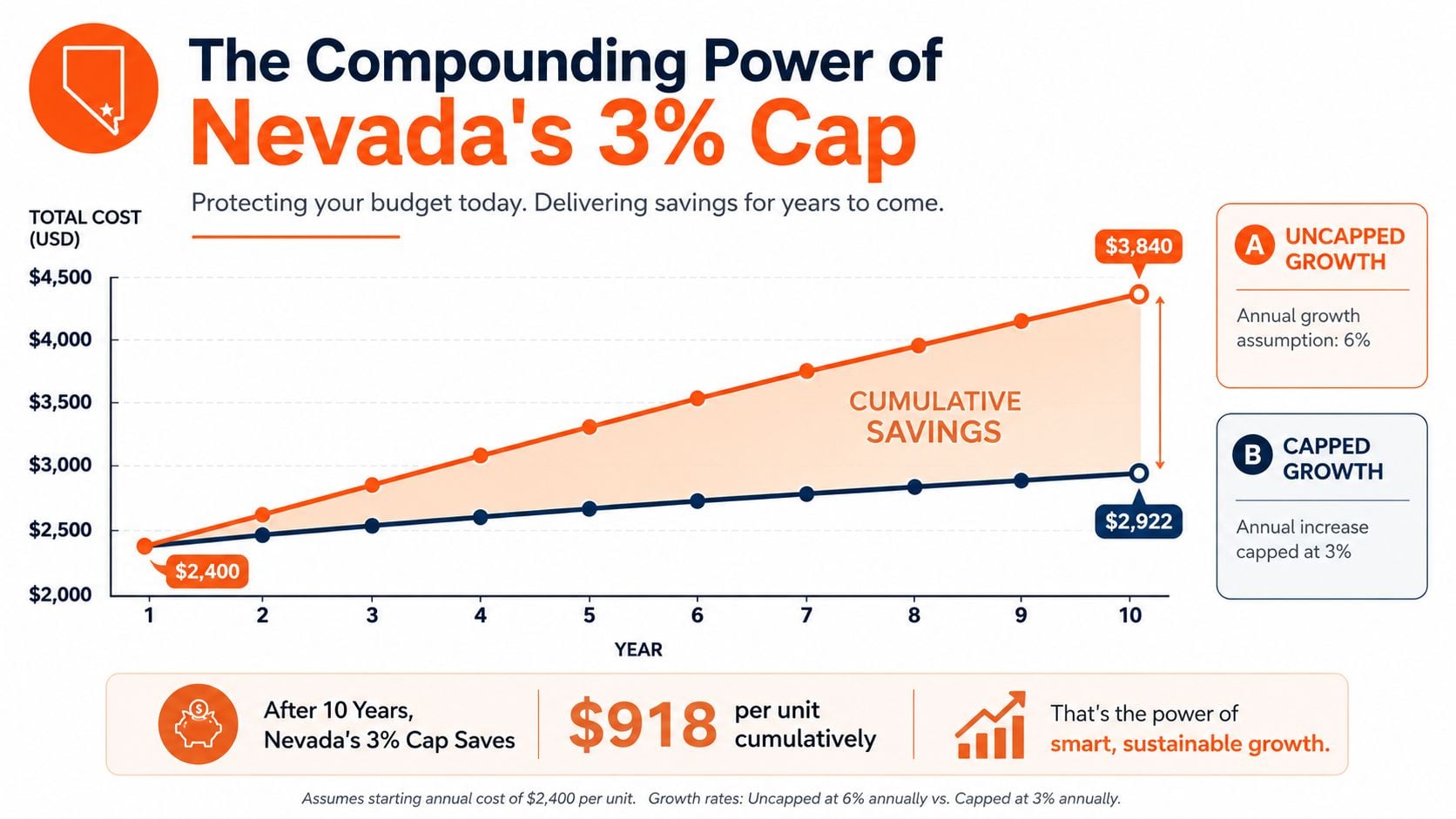
The best reason to appeal in Nevada is not this year's bill. It's the compounding effect of lowering the base that future caps apply to. For primary residences, annual tax bill increases are capped at 3%, and for other properties they're capped at 8%, so an inflated base value keeps costing you every year the home stays in your hands.
A one-time reduction can matter for a long time. If the county starts too high, every capped increase grows from that inflated starting point. If the county starts lower after a successful appeal, the cap protects a smaller number going forward, which is where the savings sit.
Why the base year matters most
Most owners obsess over whether this year's bill is a few hundred dollars too high. That's too narrow. The correct question is whether the assessment that becomes your starting point is accurate, because Nevada's cap only limits future growth from that base.
A fair base value keeps your future increases manageable. An inflated base can stay with you for years, especially if you own the property long enough for the cap to do its slow work. This is why a good appeal is less about the current invoice and more about the tax history you're locking in.
The long view
If you hold the property for several years, the gap between a corrected base and an inflated base doesn't stay small. It widens as the capped increases apply year after year to the same underlying number. That's why a homeowner who wins an appeal in year one can be far better off than a homeowner who waits until the bill has already drifted upward.
The system rewards owners who fix errors early. It punishes owners who assume the assessor will self-correct later. That's the blunt truth.
Reduce the base once, and the cap works in your favor every year after that.
That's the argument for treating an appeal as a long-term move, not just a paperwork chore.
Exemptions and Ownership Changes You Should Not Miss
Some homeowners lose money not because the value is wrong, but because they never filed the exemption they were entitled to or assumed it would follow them after closing. Nevada offers exemptions for qualifying veterans, disabled veterans, surviving spouses, and blind persons, and those exemptions reduce assessed value rather than acting like a one-time rebate. The county requires documentation, and the application has to be current.
The practical part is ownership change. Buyers often assume the seller's exemption or cap treatment carries over automatically, and that's where surprise bills happen. Local Clark County guidance and real-estate explainers both point homeowners back to the same habit, verify the exemption status after closing and refile when needed because the benefit may not transfer on its own.
For a broader checklist on missed relief, the hostAI tax deduction guide is a useful reminder that tax savings usually disappear when owners don't document them properly.
What to verify before and after closing
- Primary-residence status. Check whether the property is being treated as a primary home or something else.
- Existing exemptions. Ask which exemptions are on file and whether a new application is required.
- Escrow handling. Don't assume the lender or title company fixed every tax detail for you.
- Bill timing. Review the first bill after closing instead of waiting for the second one.
- Ownership records. If the county's records are stale, update them fast.
The most common mistake is passive ownership. People buy the house, sign the loan, and assume the tax side is automatically correct. It isn't.
For owners who want to double-check overlooked relief opportunities, this property tax exemptions guide is the kind of reference that helps prevent preventable overpayment.
File the paperwork yourself if you want the benefit to stick. Hope isn't a filing strategy.
If you're buying, selling, or inheriting a property, put the exemption review on the same checklist as title and insurance. That's how you stop a small administrative miss from becoming a recurring bill problem.
How INTELLI's Data-First Approach Delivers Results
INTELLI's model is built around one simple truth, the strongest appeals come from real data, not guesswork. The firm uses licensed property tax consultants and a data-first approach, drawing from public and private data to build a property-specific evidence file instead of relying on generic county printouts. That matters in Clark County, where district variation and ownership status can change the outcome.
The work starts with intake, then moves into valuation review, evidence gathering, filing, and hearing support. The point isn't volume, it's precision. When the base year is wrong or the district details are off, a tightly built case can expose it quickly.
If your notice looks inflated, gather the assessment, photos, repair records, and any comparable data you already have before you send it in. Then have a qualified team review whether the number is worth challenging.
If your Clark County assessment feels off, don't guess. INTELLI helps homeowners challenge inflated valuations with licensed property tax consultants, a data-first review process, and evidence built from public and private data. Visit INTELLI to see whether your Vegas property tax bill deserves a serious appeal and to start the process with a team that knows where owners lose money.