

You're probably looking at a county tax bill, a mailbox full of appraisal notices, or a headline about another Texas property-tax vote and thinking the same thing many homeowners think every year, what does this do to my bill? If you live in Travis County or anywhere else in Texas, Texas Proposition 11 is worth understanding in plain English, because the answer isn't just “it raises the exemption.” It's how that exemption stacks, who it helps, and where the savings really show up on a school-tax bill.
Texas Proposition 11 is a constitutional amendment that would let the Legislature raise the additional school-district homestead exemption for Texans who are 65 or older or who have a disability from $10,000 to as much as $60,000 of homestead market value, under Article VIII, Section 1-b(c) of the Texas Constitution Texas bill text. That sounds technical, but the practical idea is simple, it gives eligible homeowners a bigger shield against school district taxes, not city, county, or special-district taxes Texas Secretary of State ballot materials%20English%20-Spanish-final.pdf).
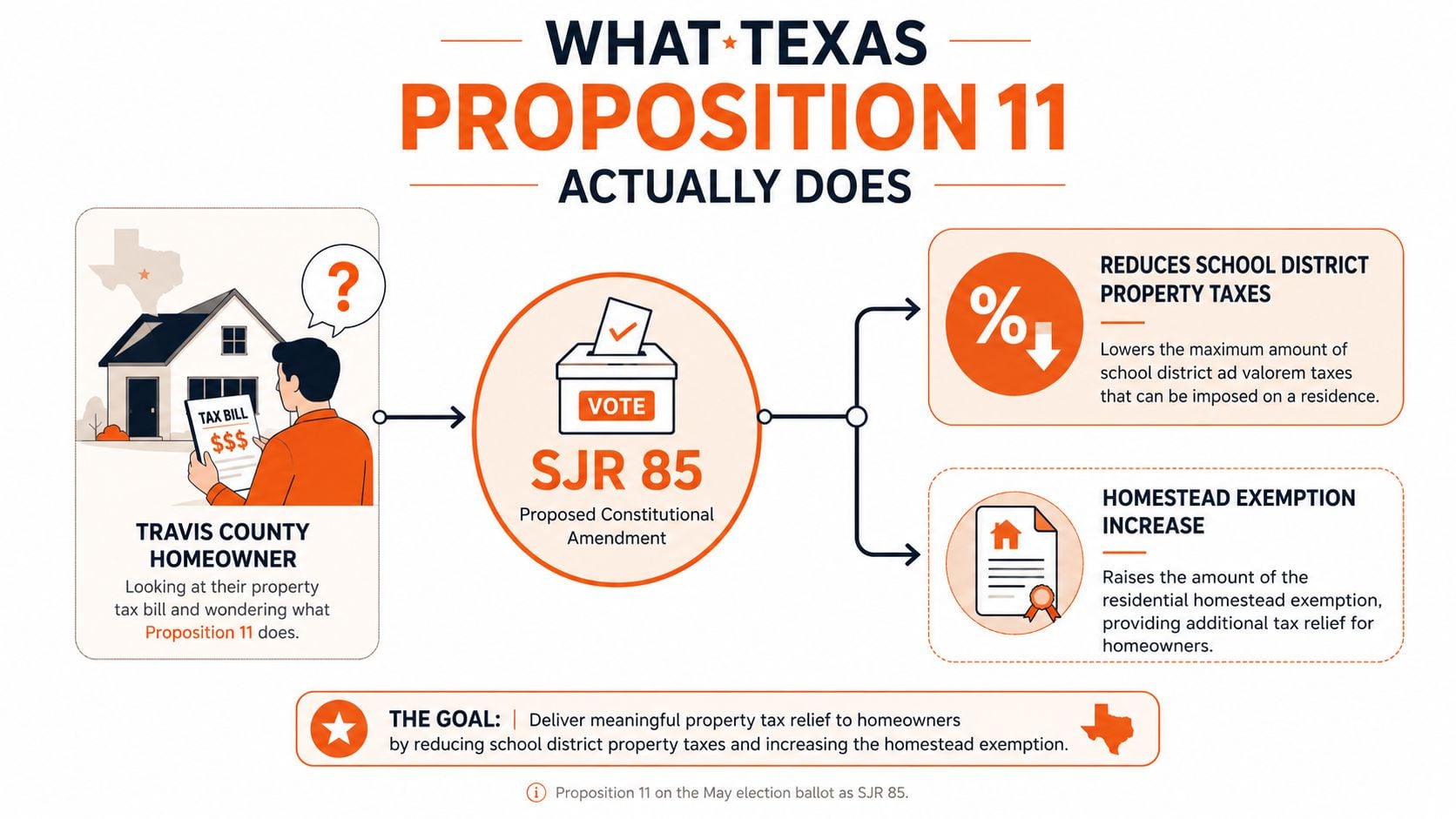
A good way to think about it is this. Your house sits under a stack of tax rules, and Proposition 11 changes just one layer of that stack for a narrow group of owners. If you want a refresher on what local property taxes pay for, Allied Tax Advisors has a useful plain-language overview of what property taxes fund locally.
What Texas Proposition 11 Does
A Travis County homeowner opening an appraisal notice usually wants the same answer first, what changes on the bill. Proposition 11 would let the Legislature raise the school-tax homestead exemption for elderly or disabled homeowners from $10,000 to as much as $60,000, and that change applies only to the school maintenance and operations part of the bill Texas Secretary of State ballot text%20English%20-Spanish-final.pdf).
The part of the bill it touches
That detail matters because a Texas property tax bill is really a stack of separate charges, and Proposition 11 only changes one layer. School taxes are often the biggest single piece of that stack, so a school-only exemption can still make a noticeable difference even though it does not change county, city, or special-district levies Texas House research brief. For a plain-language guide to homestead exemptions, see how homestead exemptions work in Texas.
A homeowner can picture the bill like a row of buckets. Proposition 11 takes water out of the school-district bucket, and the other buckets stay in place.
If you want to see why local bills are split that way, Allied Tax Advisors has a useful overview of what property taxes fund locally.
Why the measure focuses on two groups
The Legislature wrote the amendment for homeowners who are 65 or older or disabled because those households can be hit hardest when property values rise but income does not rise with them Texas bill text. That is also why the measure is narrower than a general homestead cut. It is aimed at households that may have less room to absorb a growing tax bill, not at every property owner in the state.
If a proposal says “school-district homestead exemption,” read it as a school-tax change first. The rest of the tax bill stays on its own track.
Practical rule: A larger school-tax exemption can lower the school portion of the bill, but it does not rewrite the whole property tax bill.
The Ballot Language Translated
A homeowner reading the ballot in a hurry could easily miss the point. Proposition 11 asks whether the Texas Constitution should let the Legislature raise the extra homestead exemption for a qualifying residence owned by someone who is 65+ or disabled, with the exemption tied to the market value of the homestead Texas Secretary of State ballot text.
What “authorize the Legislature” really means
This wording trips people up because the amendment does not change anyone's tax bill by itself. It gives lawmakers constitutional permission to raise the cap, up to $60,000, and then the legal and administrative pieces still have to follow Texas Senate materials. In plain terms, the ballot is opening a door, not mailing out a discount check.
What it does not do
It also does not raise the general homestead exemption. That separate change belongs to Proposition 13, which handled the standard school-tax homestead exemption for all homeowners Teach the Vote explanation.
For a homeowner sorting the ballot at the kitchen table, the split is simple. Proposition 13 changes the base layer for most homeowners. Proposition 11 changes the extra layer for qualifying seniors and disabled homeowners. Same tax system, different slice of the stack.
The confusion makes sense because several tax propositions were on the ballot at once. The cleanest way to read Proposition 11 is this, it is the add-on exemption for a specific group, not the broad homestead cut.
The Layered Math Behind the Exemption
A homeowner who is 65 or older or disabled does not start at zero. The tax break sits on top of the regular homestead exemption, plus the existing $10,000 additional school-tax exemption for elderly or disabled homeowners. Proposition 11 would raise that extra layer to $60,000, so the school-tax shield would stack on top of the general homestead layer instead of replacing it.
That stacking idea is easier to understand if you picture your exemption like layers of padding around the same home value. One layer comes from the standard homestead rules. A second layer comes from the senior or disability exemption. If you want a plain-language refresher on how those layers work together, see understanding how homestead exemptions stack.
Think in layers, not slogans
For a qualifying homestead, the school-tax picture can look like this:
- General school-tax homestead exemption, the baseline exemption available to homeowners, which was increased by the separate 2025 measure.
- Additional exemption for seniors or disabled homeowners, the part Proposition 11 changes from $10,000 to $60,000.
- Combined school-tax protection, which can reach $200,000 when Proposition 11 is combined with Proposition 13, according to Every Texan policy summary.
The headline number is only part of the story. A homeowner does not receive “$60,000” in cash. The exemption removes that amount from the value used to calculate school taxes, so the savings depend on the local tax rate and the home's assessed value.
A simple way to do the math
Start with your home's taxable value for school taxes, then subtract the homestead exemptions that apply to you. What remains is the part the school district still taxes. That is the number that matters if you want to estimate your own bill instead of guessing from the ballot language.
A simple example helps. If your home value rises, the fixed exemption still subtracts the same dollar amount, but it covers a smaller share of the total. That is why the same $60,000 can feel strong on a lower-priced homestead and less protective on a higher-priced one. The exemption does not shrink in dollars, but its relief rate shrinks as home values go up.
If the exemption is not on your appraisal record, the math will not help yet. The filing has to be in place before the tax office can apply it. That is why homeowners should check the appraisal notice, not just the ballot language, since the notice shows whether the exemption is already being counted where it should.
Who Benefits Most and Who Benefits Less
The exemption is fixed in dollars, so its value depends on the size of the home. That's why the same $60,000 can feel generous on a modest home and less powerful on a higher-value one. In a market like Austin, where assessed values can climb quickly, fixed-dollar relief covers a smaller share of total value as prices go up.
What the combined shield means
When Proposition 11 is viewed alongside Proposition 13, the total school-tax shield for qualifying seniors and disabled Texans can reach $200,000 Every Texan policy summary. That's a real help for homeowners who are trying to stay in place as tax bills climb, especially on a fixed income. It also means the measure is far more targeted than a broad tax cut.
Why home value changes the impact
A $60,000 exemption protects a much larger slice of a lower-priced homestead than an expensive one. That's the core reason people in fast-appreciating areas can feel disappointed by headline relief that sounds larger than it functions. The benefit doesn't disappear, but its share of the home's market value shrinks as the value rises.
The policy discussion around this measure also points to a meaningful split in expected savings. Coverage cited in the brief reports that about 5.7 million homeowners could save around $484 annually on average, while over 2 million seniors could save about $907 KXAN coverage referenced in the brief. Those figures show the package is targeted, but they also show that the likely benefit differs by household type.
What that means for your own bill
If you own a smaller home, the exemption can cover a larger share of your taxable base. If you own a high-value property, especially in a rising market, the same dollar exemption leaves more of the bill untouched. That's not a flaw in the math, it's how flat-dollar exemptions work.

The Arguments For and Against the Measure
Supporters and critics are looking at the same exemption from different angles. A homeowner hearing the pitch at the kitchen table might hear one thing. Someone watching the school tax bill line by line may hear another. Supporters focus on targeted relief for older Texans and homeowners with disabilities, especially those on fixed incomes who feel the pressure when appraisals keep climbing. They also see the constitutional exemption as a familiar Texas tool for property-tax relief.
The case for Proposition 11
The pro argument starts with the bill that arrives every year. School taxes are one of the biggest pressures on a homestead, and a larger exemption can keep seniors from feeling every rise in appraisal value all at once. If your home value keeps going up, an exemption works like a larger cushion between that value and the part that gets taxed.
Supporters also like that the measure is aimed at a clearly defined group. That makes it more focused than a broad across-the-board cut, since the relief goes to homeowners who already qualify under the exemption rules. For advocates, that narrow design is a feature, not a flaw.
The case against Proposition 11
Critics focus on what happens behind the scenes. When exemptions rise, school-district revenue falls, even if the state later makes up some of that money through the school finance system. That is the tradeoff built into the policy.
There is also the problem of fixed-dollar relief in a fast-rising market. A set exemption can look generous on paper, then feel smaller as home values climb higher. That is why the same measure can mean very different real-world savings from one neighborhood to the next.
Fairness is the other big objection. Some senior homeowners are comfortable on paper, while some renters face serious housing pressure with no exemption at all. That is why some policy voices argue that a broader approach is simpler to administer, even if it does not target help as tightly Every Texan policy summary.
One more way to read the debate is to ask a plain question. Does the exemption keep the annual bill manageable after appraisal growth and local tax rates do their work? That is the standard many homeowners care about, and it is the standard the measure has to meet in real life.
Timeline, Vote Totals, and How to Verify Results
A homeowner checking the ballot count would see that Proposition 11, SJR 85, was settled in the 2025 Texas constitutional amendment election. It passed with 2,301,919 Yes votes, or 77.71%, against 660,143 No votes, or 22.29%, out of 2,962,062 total votes 2025 Texas constitutional amendment election results. The ballot materials described it as applying for the tax year beginning January 1, 2025, which helps explain why the measure mattered for the next property tax cycle Texas House research brief.
How to verify what happened in your county
Start with the Texas Secretary of State election results portal for the statewide result, then check your county appraisal district to confirm whether the exemption is already on file and whether any county notices affect your property. That is the simplest way to see how the statewide vote is being carried into your local tax records.
If you are sorting through the paperwork, treat the election result and the appraisal record as two separate files. The first tells you the measure passed, and the second tells you whether your home is set up to receive the change.
A naming trap to avoid
Older Texans sometimes search “Proposition 11” and end up on a different measure entirely. In 1991, Texas Proposition 11 was the state lottery amendment, which passed on November 5, 1991 with 1,326,154 votes in favor and 728,994 votes against, and later became the constitutional basis for the lottery system through enabling legislation identified as HB 54 1991 ballot history. If the year is wrong, the answer will be wrong too.

Practical Next Steps for Texas Property Owners
A homeowner in Texas usually gets the clearest answer by checking two files side by side. The first is your county appraisal record, which shows whether your residence homestead exemption and any age or disability exemption are already attached to the property. The second is your own eligibility, because the tax break only works if the county has the right status on file.
If you think you qualify, start by confirming your age 65+ status or disability status, then review whether the homestead exemption is already recorded with your county appraisal district. If it is missing, the usual homestead paperwork, including the filing process described in How to apply for homestead exemption, is the place to begin. A common mistake is waiting for the county to add it automatically, because that usually does not happen on its own.
What to check right away
- Confirm your homestead status. If the property is not coded as a residence homestead, the school-tax exemption math will not line up the way you expect.
- Check the senior or disability exemption. The extra exemption applies only if you qualify under the age or disability rules.
- Review your 2025 assessed value. A protest and a valid exemption can work together, because each one changes a different part of the tax calculation.
- Read your county notice carefully. Appraisal districts often show whether exemptions and protest deadlines are already reflected in the record.
A hands-off option also exists for owners who do not want to sort through county forms and protest paperwork on their own. INTELLI uses licensed property tax consultants and a data first approach, using public and private data, to challenge assessed values, maximize exemptions, and handle tax-recovery audits on a no-recovery, no-fee basis. That is one route among several, and it can help owners who want support with filings, appeals, and county deadlines without managing each step themselves.
Why timing matters
The bill text says the change applies for the tax year beginning January 1, 2025. That makes the timing of your appraisal notice and exemption record matter, because the benefit depends on what your county has already entered for you.
If the exemption is already on file, the county can apply the change more cleanly. If it is missing, the homeowner usually has to fix the record first before the lower taxable value shows up where it should.
The Big Picture for the 2025 Tax Year
For a homeowner in Texas, Texas Proposition 11 is best read as one more line in the school-tax worksheet, not as a full reset of the bill. It adds to the homestead relief already in place, it is aimed at seniors and disabled homeowners, and the size of the benefit still depends on your local appraisal and school tax rate. A bigger exemption can still feel smaller once a higher assessed value enters the math.
The easiest way to sort that out is to compare the exemption stack on your notice with the rules you qualify for. Start with the base homestead amount, then add the extra relief the measure allows, then check whether your county has already recorded it correctly. If you want a broader map of how these changes fit together, an overview of Texas property tax relief bills can help frame the measure in the larger school-tax picture.
For 2025, the practical question is simple. Does the added exemption cut enough taxable value to matter on your school tax line, or does a rising appraisal eat up part of that gain?
That is why the same amendment can feel generous in one neighborhood and modest in another. A homeowner with a lower assessment may see a clearer drop in taxable value, while a homeowner whose appraisal jumped may only see part of the relief show up in the final bill.
If you want to check your own numbers, use the county appraisal record as your starting point, then compare it with the exemption stack you are entitled to use. The Texas House research brief lays out the framework, but your actual savings come from how that framework meets your home value, your school tax rate, and the exemptions already on file.
For homeowners who want a clear read on exemptions, appraisal notices, and protest options, INTELLI can help review the numbers and handle the process through a Texas property tax relief workflow. Visit INTELLI to see how its consultants approach homestead exemptions, appeals, and tax recovery with a data-first review of your property.