

You open your Texas appraisal notice expecting a routine update and find a value that no longer resembles what you believe your home is worth. The deadline is close, the county portal is difficult to use, and you're not sure whether your homestead exemption is active, whether you need to reapply, or whether an appeal is separate from a property tax relief application.
That confusion costs homeowners real money. Relief depends on timely filing, accurate eligibility information, and evidence that supports your position. A missed date or incomplete submission can leave an otherwise eligible owner paying more than necessary for the tax year.
Why Your Property Tax Relief Application Matters Now
A homeowner may discover an inflated appraisal value after the county mails a notice, but the underlying problem often began earlier. The owner may never have confirmed a homestead exemption, may have missed an over-65 filing window, or may have assumed that one application covered every available benefit. By the time the tax bill arrives, the easiest opportunity to correct the record may have passed.
Texas property tax relief isn't a single, permanent transaction. Some benefits require a new filing, some depend on a qualifying event, and an appraisal protest follows a different process from an exemption application. The practical task is to separate those tracks and verify each one with the county appraisal district.
Practical rule: Treat your exemption status and assessed value as separate items to review every year. Approval of one doesn't automatically correct the other.
The financial stakes are substantial across the country. Pennsylvania's 2022 property tax and rent rebate report recorded 405,493 applications approved for payment, with rebates totaling more than $192.0 million for that claim year, and more than $8.2 billion distributed since the program began in 1971, according to the Pennsylvania statistical report. That report also recorded 29,518 denied applications, illustrating how documentation and eligibility rules affect outcomes even in an established relief system.
Tennessee's program provides another indication of scale. The state's Comptroller reports that more than 100,000 individuals receive benefits each year from a program worth more than $41,000,000 annually, as described in the Tennessee property tax relief program information. Texas homeowners face their own county-specific procedures, so waiting for the bill or relying on an assumption about approval is a poor strategy.
INTELLI uses licensed property tax consultants and a data-first approach that combines public and private data. That model is relevant when a homeowner needs more than a basic form submission, particularly when the case involves valuation evidence, multiple properties, or a confusing county process.
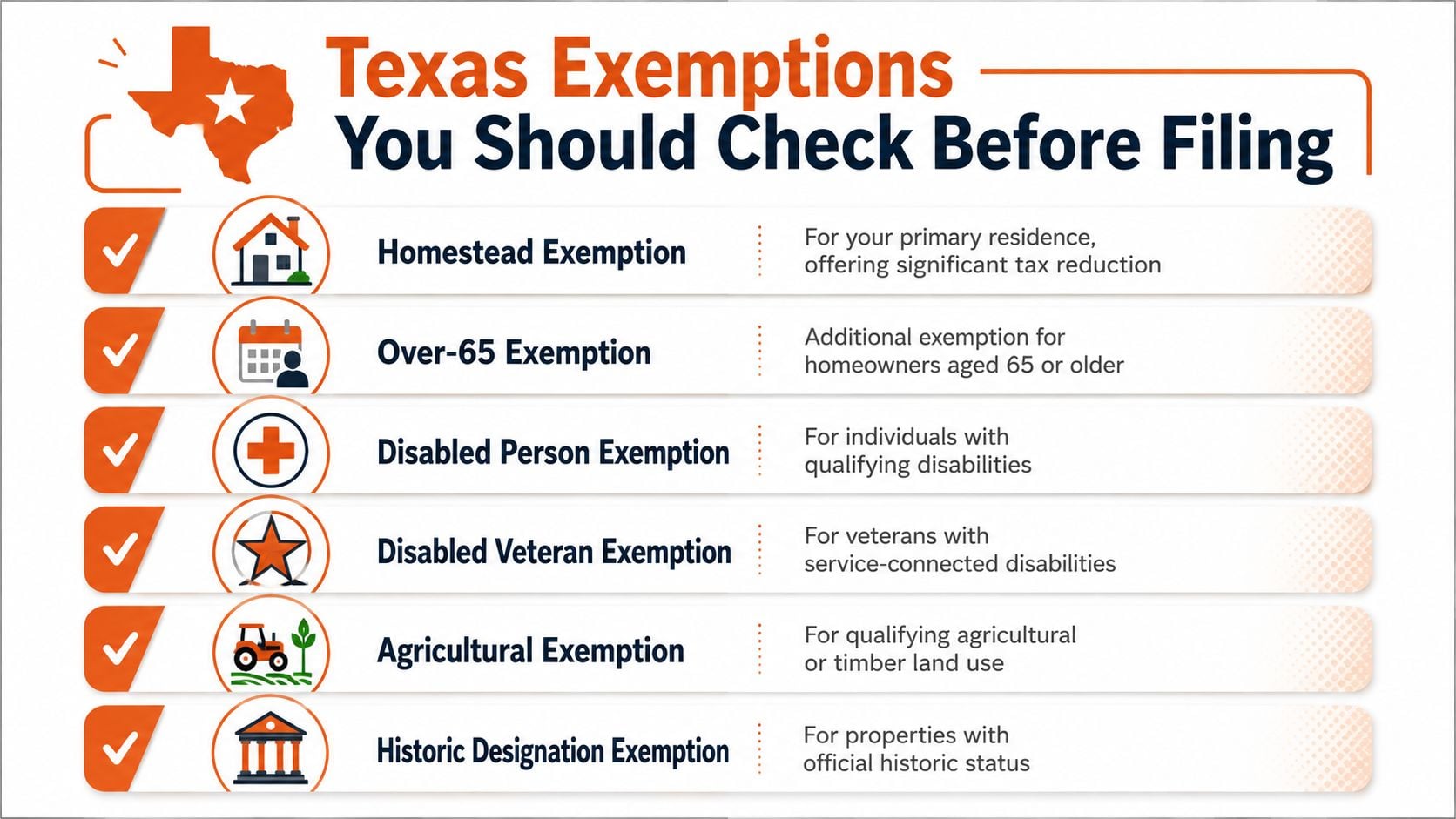
Texas Exemptions You Should Check Before Filing
Start by identifying the relief categories that fit your situation. The county appraisal district, not a generic online checklist, controls the local record and may require supporting material that varies by property or exemption type.
Primary residence and age-based relief
The residence homestead exemption applies to a qualifying primary residence. You'll generally need proof that you own the property and occupy it as your principal residence, such as identification showing the property address or other residency evidence requested by the appraisal district.
Texas homestead exemption applications are generally accepted only from January 1 through April 30, and early applications aren't accepted, according to Harris Central Appraisal District's homeowner exemption guidance. An owner who qualifies for an over-65 exemption or a disabled-person exemption generally has until the first anniversary of the date of qualification to apply, effectively providing one year.
Over-65 relief typically requires age verification and ownership of the residence. A disabled-person exemption requires documentation supporting the qualifying disability. Don't confuse the filing deadline for these categories with the standard homestead window, because the qualifying date can control the deadline.
For a practical overview of Texas categories and application considerations, review INTELLI's guide to property tax exemptions in Texas.
Veteran, agricultural, and historic property categories
A disabled veteran exemption depends on qualifying service-connected disability status and military documentation. The county may require evidence from the Department of Veterans Affairs or other official records. Check the appraisal district's instructions before uploading documents, since a vague statement about military service isn't a substitute for the required certification.
An agricultural exemption is tied to qualifying agricultural or timber use rather than owning land outside a city. Expect the county to examine use, management, and supporting records. The relevant evidence can include leases, production records, photographs, or other material requested by the appraisal district.
A historic designation exemption depends on official historic status and the applicable local rules. A property's age alone doesn't establish eligibility. Keep the designation documentation, restrictions, and preservation records with the application.
Some exemptions can apply together, while others may have distinct requirements or effect on different portions of the tax bill. Confirm the current exemption codes on your county account and request clarification before filing duplicate or conflicting forms.
How to File Your Application and Meet Every Deadline
The cleanest filing process begins before you open the county portal. Create a folder for the property, then separate documents into ownership, residency, qualification, and prior correspondence.

Prepare the file before opening the portal
Use the deed or closing documents for ownership verification, government identification for residency, and qualification records for age, disability, veteran status, agricultural use, or historic designation. Scan documents clearly, make sure names match across records, and check that every page is legible.
Then locate the official county appraisal district website. Search by the property's account number or address, confirm the legal description, and look for the exemption or protest area. A search engine result, third-party form, or old county bookmark can lead to an outdated page.
Submit, save, and verify
Complete the form exactly as the county requests. Don't add a second owner, change an address, or select a category without checking how that change affects eligibility. Upload only the requested documents, retain the original files, and save the completed form before submission.
Confusing portals aren't a minor inconvenience. Texas Law reports that many eligible homeowners still miss the homestead exemption, while Harris County reporting connected to CPAL identified larger exemption gaps in low-income, majority-Black and brown neighborhoods. The reported barriers include limited awareness, difficult appraisal district websites, and language access gaps, as discussed in the University of Texas Law discussion of the exemption gap.
Before you click submit: Take a screenshot of the confirmation number, download the receipt, and write down the submission date. A browser confirmation without a retained record won't help much if the county later says it can't locate the filing.
Some applications are annual, while others may remain in place until circumstances change. Read the county's approval notice rather than assuming permanence. You can also use INTELLI's Texas property tax deadline guide to organize the dates that apply to your situation, but the appraisal district's official deadline controls.
Filing Informal and Formal Appeals for a Lower Valuation
An exemption reduces tax through an eligibility rule. An appeal challenges the value assigned to the property. If the appraisal district's value exceeds market value or includes factual errors, you need an appraisal protest, even if your homestead exemption is already approved.
Texas deadlines are unforgiving. Most protests must be filed by May 15 or within 30 days after the appraisal district mails the notice of appraised value, whichever is later, and the Texas Comptroller explains that the relevant date is the mailing date, not the date the owner receives the notice, according to the Comptroller's protest guidance.
Build the evidence before arguing the number
A strong informal submission usually combines recent comparable sales, corrections to property facts, and condition evidence. If the home has foundation movement, roof damage, outdated systems, flooding, or other defects, provide dated photographs, repair estimates, inspection material, and a clear explanation of how the condition affects market value.
For property condition issues, a homeowner may benefit from a technical explanation of site factors before preparing the valuation argument. Upchurch Inspection's guide to property grading is useful background when drainage, slope, or grading affects the property's condition and marketability.
Weak submissions usually rely on frustration, a neighbor's tax bill, or an unsupported claim that the value “feels too high.” The appraisal district needs evidence tied to the subject property and a defensible alternative value.
Neutral industry summaries report that appeals supported by strong documentation and comparable sales can succeed at roughly 50% to 90%, while weak or unsupported appeals may succeed at roughly 10% to 30%. One cited benchmark reports about 52% overall success, with evidence-based appeals at 86% compared with 12% without evidence, as summarized by AppealDesk's property tax appeal analysis. These figures are benchmarks, not a promise for a specific Texas property.
Escalate when the informal result isn't enough
The practical Texas sequence is to submit an informal request first, then request a formal Appraisal Review Board hearing if the appraisal district doesn't make an adequate adjustment. A formal hearing gives you a structured opportunity to present evidence, challenge the record, and preserve your objections.
Use concise protest language:
“I protest the appraised value of account [number] because the assessment exceeds the property's market value and doesn't reflect its condition. Attached are comparable sales, photographs, repair estimates, and corrections to the property record. I request a review and adjustment based on the enclosed evidence.”
| Factor | Informal Appeal | Formal ARB Hearing |
|---|---|---|
| Purpose | Seek a correction or reduction before a hearing | Present the dispute to the Appraisal Review Board |
| Best evidence | Comps, factual corrections, condition records | The same evidence, organized into a clear hearing presentation |
| Typical trade-off | Less procedural pressure, but less control over the record | More formal process, with greater preparation required |
| When to use it | As the first reduction attempt | When the informal result is inadequate or unavailable |
If you didn't receive the required notice, Texas rules can allow a later protest. The deadline may extend until the day before taxes become delinquent, usually February 1, or in some circumstances up to the 125th day after receiving a tax bill, as described in the published Texas protest procedures. Confirm the precise rule with your appraisal district.
For a step-by-step process, see INTELLI's guide to protesting property taxes in Texas.
When to Handle It Yourself and When to Hire a Professional
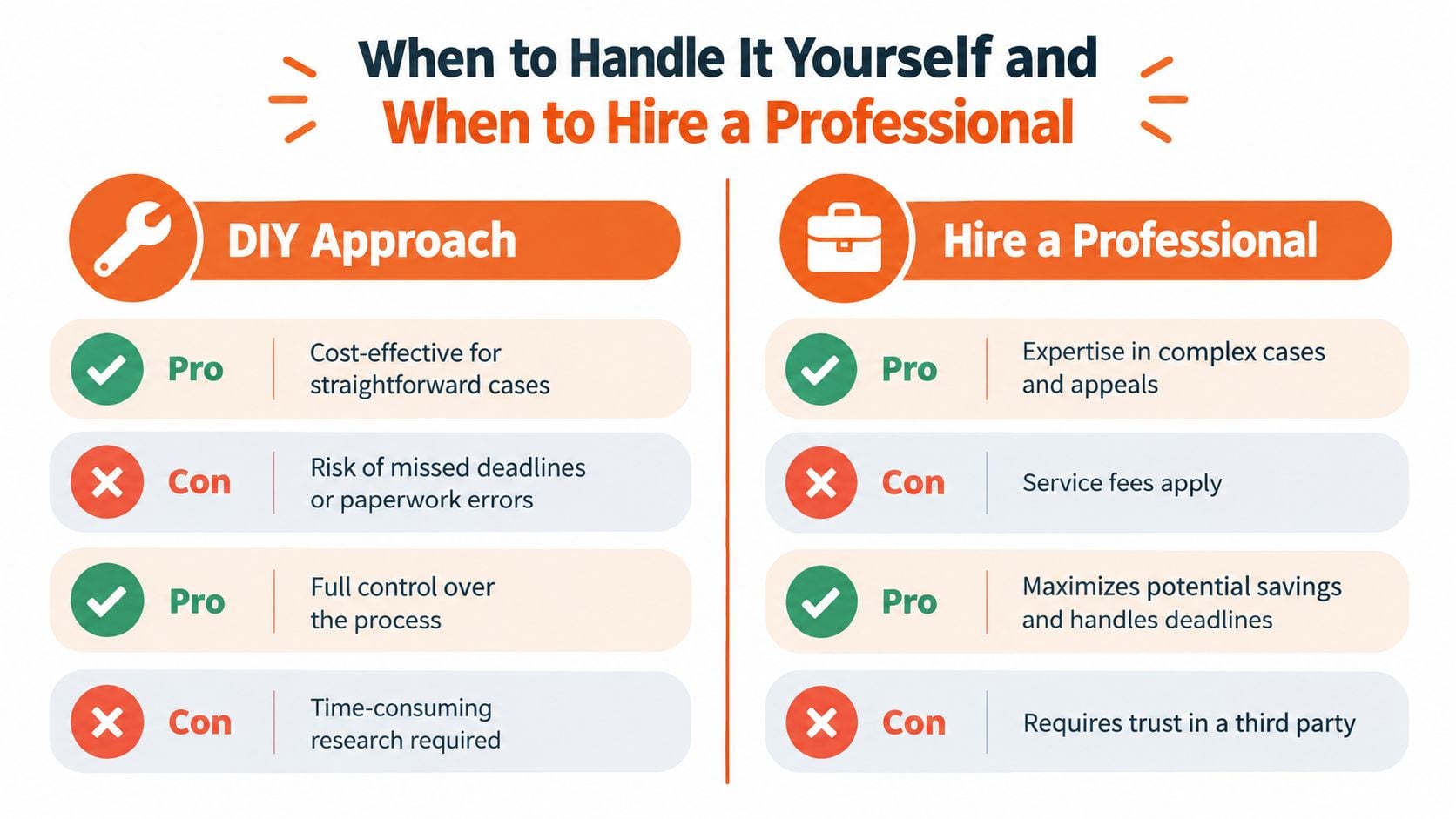
A straightforward homestead filing can be a reasonable DIY task. If the property is your primary residence, your ownership and address records match, the county portal is clear, and you can track the deadline, handling the application yourself may save a service fee.
The calculation changes when the case requires valuation analysis or sustained follow-up. A disputed rental portfolio, multiple commercial parcels, a property with significant defects, or a retroactive filing can demand more time and evidence than a homeowner expects. The same applies when the owner can't reliably use the county portal or attend an Appraisal Review Board hearing.
The DIY option
DIY works best when the question is narrow and the documentation is easy to verify. You control the submission, communicate directly with the appraisal district, and avoid paying someone to complete a form you could accurately file yourself.
It fails when the owner submits a generic argument instead of property-specific evidence, misses a mailing-based deadline, or stops after an informal response that doesn't resolve the valuation. Time is also a cost. Researching comparable sales, organizing repair evidence, and preparing for a hearing can compete with work and family obligations.
Professional support
INTELLI uses licensed property tax consultants, a data-first approach using public and private data, and representation before county appraisal districts. Its results-based model is structured so clients pay only when taxes go down, according to the service description provided for this guide. That arrangement changes the financial trade-off, but homeowners should still review the engagement terms, scope, and fee before authorizing representation.
The service can be more appropriate for owners who need a coordinated property tax relief application, an appeal supported by market analysis, or help tracking county deadlines across several properties. It can also help identify whether a tax recovery audit is worth considering when the owner suspects prior overcharges.
Use the following video as a general visual introduction to the professional-versus-DIY decision, then evaluate your own records and deadlines.
The right choice isn't determined by whether professional help sounds convenient. It depends on the complexity of the property, the strength of the evidence, the time available, and the cost of missing the filing window.
Common Mistakes That Kill Your Relief Application
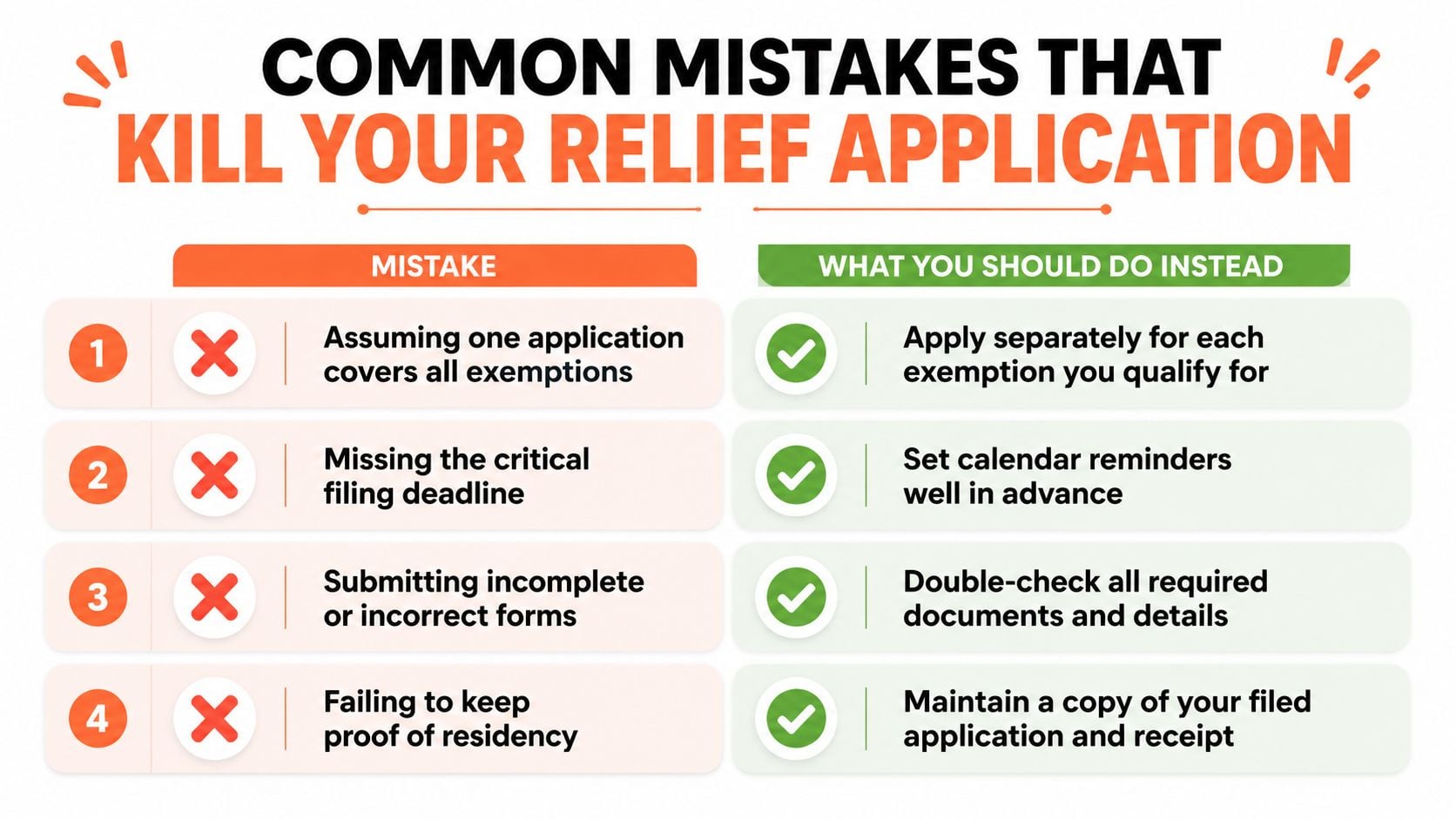
Most failed filings don't collapse because the homeowner is ineligible. They fail because the owner assumes the process is automatic, submits the wrong evidence, or waits until the deadline leaves no room for correction.
Four preventable errors
- Assuming one application covers every benefit: A homestead filing doesn't necessarily enroll you in over-65, disabled-person, veteran, agricultural, or historic relief. Confirm each category separately with the county.
- Waiting for the bill before tracking deadlines: A protest deadline can be tied to the appraisal district's mailing date, not the day the notice reaches your mailbox. Put the expected appraisal cycle and filing windows on your calendar early.
- Uploading incomplete information: A missing signature, mismatched address, illegible certification, or absent supporting record can delay processing or produce a denial. Compare the completed form with the county checklist before submission.
- Failing to retain proof: Keep the application, attachments, confirmation, and correspondence in one property file. If the county can't locate the filing, your receipt is the starting point for resolution.
Don't assume approval lasts forever
Some relief requires annual refiling, and some programs allow applications to address earlier tax years. Government programs outside Texas show why owners shouldn't generalize from one jurisdiction. New Jersey's 2026 guidance says a combined Property Tax Relief application is needed for ANCHOR and related programs, with a deadline of November 2, 2026, while Idaho requires annual applications between January 1 and April 15 for a reduction to appear on the later bill, according to New Jersey's property tax relief guidance.
Those examples don't establish Texas rules, but they demonstrate the administrative risk: a homeowner may lose savings by assuming approval is permanent or that one filing covers every program. Ask your county whether a change in ownership, residence, disability status, veteran qualification, land use, or deed requires a new application.
Your Action Plan for Lower Property Taxes This Year
Start with the account, not the form. Pull the county appraisal record, review the assessed value and exemptions shown, and compare the property description with the actual home. If the record contains an incorrect improvement, omitted condition, ownership issue, or missing exemption, document that problem before contacting the district.
A workable filing calendar
- Act now: Gather the deed, identification, residency proof, qualification documents, prior notices, photographs, inspection records, and repair estimates that apply to your case.
- Before April 30: Submit a standard homestead application during the accepted filing period. Early applications aren't accepted, so use the applicable window rather than sending a form prematurely.
- By the relevant qualification anniversary: If you qualify for over-65 or disabled-person relief, track the first anniversary of the qualification date instead of relying on the standard homestead deadline.
- By May 15 or the later applicable protest date: File a valuation protest when the appraisal appears excessive, using the mailing-based rule described earlier.
- Throughout the year: Save county notices, verify processing, monitor changes to the account, and ask whether the exemption requires annual refiling.
A tax recovery audit may also identify prior overcharges, but it requires a separate review of historical records rather than an assumption that a current exemption will correct the past.
Property tax relief is earned through proactive filing, complete documentation, and a valuation argument supported by evidence. If the case involves several parcels, a difficult portal, a formal hearing, or uncertainty about prior years, professional assistance can reduce the risk of an avoidable mistake.
INTELLI offers licensed property tax consultants who use public and private data to prepare property tax relief applications, exemptions, appeals, and tax recovery audits. Visit INTELLI to review your Texas property record and decide whether its results-based support fits your filing needs.