

In 2025, Texas estimated that 39.23% of about 6.1 million homesteads paid no school district property taxes at all. The mandatory school-district exemption increased from $100,000 to $140,000, and the Texas Comptroller says that exemption saves about $560 a year at the state average school tax rate. Texas Comptroller data
That changes how you should think about homestead exemption benefits. This isn't merely a small discount buried somewhere on your tax statement. For an Austin homeowner, the exemption can reduce the taxable value immediately, help control future appraisal growth, and combine with special protections for seniors, disabled homeowners, and qualifying veterans.
Why Homestead Exemption Benefits Matter More Than You Think
A Texas homestead tax bill can reflect four separate layers of relief: the general residence homestead exemption, local-option exemptions, protections for older or disabled homeowners, and benefits tied to qualifying veterans. Those layers affect cash flow in different ways. Some reduce the taxable value today. Others limit how quickly the taxable value can rise or hold school taxes at a defined level.
Start with the home's role in your household. If it is your principal residence and the residence homestead exemption has been granted, the appraisal district does not treat the entire market value as taxable for every purpose. The school district, county, city, and other taxing units may each apply their own rules. Your bill is therefore a stack of separate calculations, not one simple percentage applied to the price of the house.
The general residence homestead exemption removes part of the home's value from school district taxation. A local taxing unit may also offer a local-option exemption, if it has adopted one. Texas law allows a local-option exemption of up to 20% of appraised value, but the benefit depends on the taxing units serving your address. The Texas Comptroller explanation of residence homestead exemptions describes the residence homestead structure.
Four layers can affect one household
- General residence homestead: The basic exemption for a qualifying principal residence. It reduces the value used for the school district calculation and may apply under rules set by other taxing units.
- Local-option exemption: A county, city, or other taxing unit may grant an additional percentage-based exemption. One address can receive it from one taxing unit but not another.
- Over-65 or disability protection: A qualifying homeowner may receive an additional exemption and a school-tax ceiling. The ceiling can matter as much as the initial reduction because it helps keep school taxes from rising with every appraisal increase.
- Veteran-related exemption: A qualifying veteran may receive partial or full relief, depending on the veteran's eligibility and the applicable rules.
A surviving spouse may also continue a deceased spouse's homestead-related benefits when the property remains the couple's residence. Ownership, residency, and the specific benefit must all fit the applicable requirements.
The second benefit affects future bills
The exemption lowers the taxable base now. The 10% appraisal cap limits the annual increase in the appraised value used for taxation in later years, subject to statutory rules and new improvements. These protections work together, but they are not interchangeable. A lower starting base makes the current bill smaller, while the cap helps control future increases.
Timing can affect both results. The cap does not automatically appear just because you moved into the home. Texas guidance requires the homestead exemption to be granted before the limitation applies. Because of that rule, filing in the first eligible year can protect the current taxable base and the next several years of appraisal growth. That is the cash-flow reason to treat the application as part of buying the home, not as paperwork to postpone.
How the Homestead Exemption Lowers Your Tax Bill
Think of your property tax calculation as a two-step equation. First, the appraisal district determines the value used for taxation. Next, each taxing unit applies its tax rate to the portion of value that remains taxable.
An exemption works by subtracting value before the tax rate is applied. It isn't a percentage discount on the final bill in the ordinary sense. If a school district grants a $140,000 exemption, the district calculates school taxes on less value than the property's full appraised value.
Texas school districts must provide a $140,000 residence homestead exemption. A county, city, or other local taxing unit may also adopt a local-option exemption of up to 20% of appraised value, if that taxing unit has chosen to do so. The availability and effect of a local option depend on the taxing units connected to the property. The Texas Comptroller's exemption guidance describes both the mandatory school exemption and the local-option structure.
A simple subtraction example
Suppose an appraisal district values a home at a certain amount. For school taxes, subtract the $140,000 general homestead exemption first. The school district then applies its rate to the reduced taxable value.
The same property may have a different taxable base for county, city, or special-district taxes because each taxing unit sets its own exemptions and rates. That's why two homeowners with similar properties can see different total savings even when both receive the same school exemption.
Texas A&M's Real Estate Center describes additional standard homestead relief for certain county farm-to-market and flood-control levies, as well as additional school-tax relief for qualified homeowners. Those smaller levy reductions should be treated as separate layers, not folded into the headline school exemption.
The exemption and cap do different jobs
The exemption helps immediately by reducing the amount exposed to taxation. The appraisal cap helps later by limiting annual growth in the appraised value used for a qualifying homestead.
The exemption lowers the taxable base immediately. The separate appraisal cap slows future growth to no more than 10% per year, plus the value of new improvements, once the cap applies.
After the homestead exemption has been granted, the state limits the annual increase in a qualifying homestead's appraised value to no more than 10% per year plus the value of new improvements. The cap applies to the existing homestead value, not automatically to additions such as a new room or other improvement.
The practical lesson is simple. File the exemption instead of assuming the appraisal district will add it automatically. Texas guidance says owners must qualify and submit an application. Until the exemption is granted, the appraisal cap may not be available for the home's future assessment cycle.
| Exemption Layer | Amount Removed | Who Provides It |
|---|---|---|
| General school homestead exemption | $140,000 | School district |
| Local-option homestead exemption | Up to 20% of appraised value | Participating local taxing unit |
| Age-65 exemption | $60,000 layer for qualifying owners | Applicable taxing units |
| Disability exemption | $60,000 layer for qualifying owners | Applicable taxing units |
The table shows the principal layers, but it doesn't replace the appraisal district's calculation. Your statement may show separate taxable values for separate taxing units, so compare each line rather than relying only on the total.
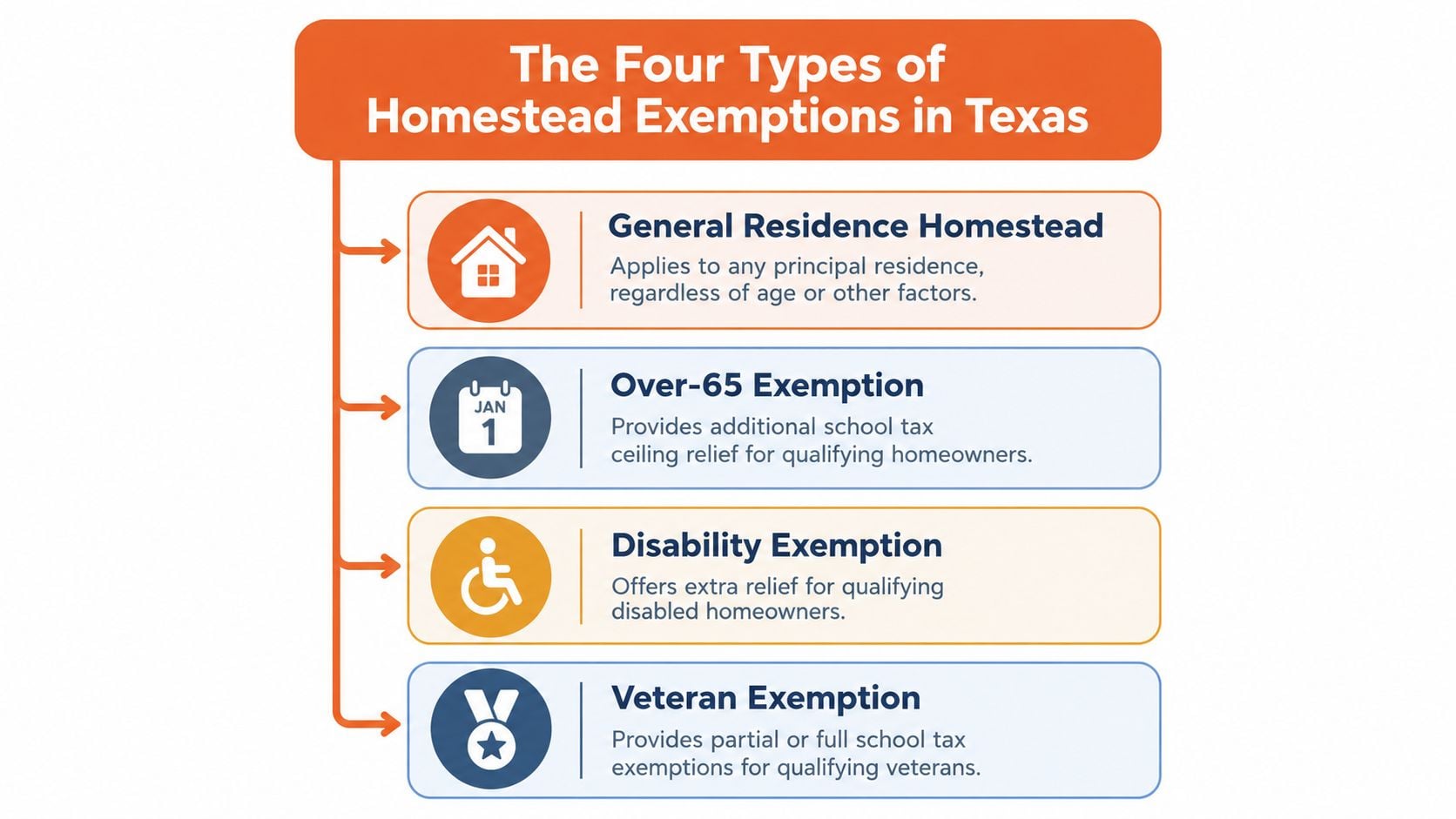
The Four Types of Homestead Exemptions in Texas
Texas homeowners often use “the homestead exemption” as if it were one program. In practice, several provisions can apply to different households. The right way to review them is to start with the general residence exemption, then check whether age, disability, veteran status, or surviving-spouse rules add another layer.
General residence homestead
- Principal residence: The home must be the owner's main residence, not merely a property the owner owns.
- Ownership interest: The applicant must hold an ownership interest in the property.
- Core school benefit: A qualifying residence receives the mandatory school-district exemption described above.
- Appraisal protection: Once granted, the exemption supports the separate homestead appraisal cap for future assessment calculations.
This is the layer most first-time Austin homeowners need to address first. It establishes the property's homestead status for tax purposes and can affect both the current taxable base and later appraisal growth.
Over-65 exemption
- Qualification date: The exemption becomes effective on January 1 of the tax year in which the owner qualifies.
- Larger layer: Texas guidance provides a $60,000 exemption for qualifying homeowners who are age 65 or older.
- School-tax protection: The benefit includes a school-tax ceiling once granted, which can make future budgeting more predictable.
- Household planning: The owner should contact the appraisal district when approaching eligibility rather than waiting for the next bill to explain the change.
The school-tax ceiling is especially important for a homeowner living on a fixed or tightly managed income. It doesn't mean every part of the property tax bill stops changing. Other taxing units, rates, and property changes can still affect the total.
Disability exemption
- Qualifying disability: A homeowner who meets the applicable disability requirements may receive the disability exemption.
- Comparable protection: The disability layer includes the larger $60,000 exemption and school-tax protection described in Texas guidance.
- Effective date: Like the age-65 exemption, it takes effect on January 1 of the tax year in which the owner qualifies.
- Separate review: Disability eligibility and documentation should be confirmed with the local appraisal district.
A homeowner who is both age 65 or older and disabled may receive both exemptions in the same year, but not from the same taxing units. That distinction matters. Seeing two potential exemptions on a checklist doesn't mean the same taxing unit will apply both to the same tax calculation. Texas Comptroller guidance for age-65 and disability exemptions explains the effective date and this limitation.
Veteran and surviving-spouse situations
- Veteran exemption: Qualifying veterans may receive partial or full residence homestead relief depending on their eligibility classification. A 100% disabled veteran may receive a full exemption on a residence homestead.
- Surviving spouse: A qualifying surviving spouse may continue the deceased spouse's homestead-related benefits when the home was the couple's residence.
- Ownership changes: These situations require a review of the current owner, the property's use, and the documentation supporting the claim.
Veteran benefits don't replace the need to establish the property as a residence homestead. A veteran household should identify the applicable classification and submit the required evidence through the appraisal district rather than assuming the benefit transfers automatically.
The best comparison isn't “which exemption is largest?” It's “which layers fit this household, which taxing units apply them, and when did the owner become eligible?” Those answers determine the actual bill.
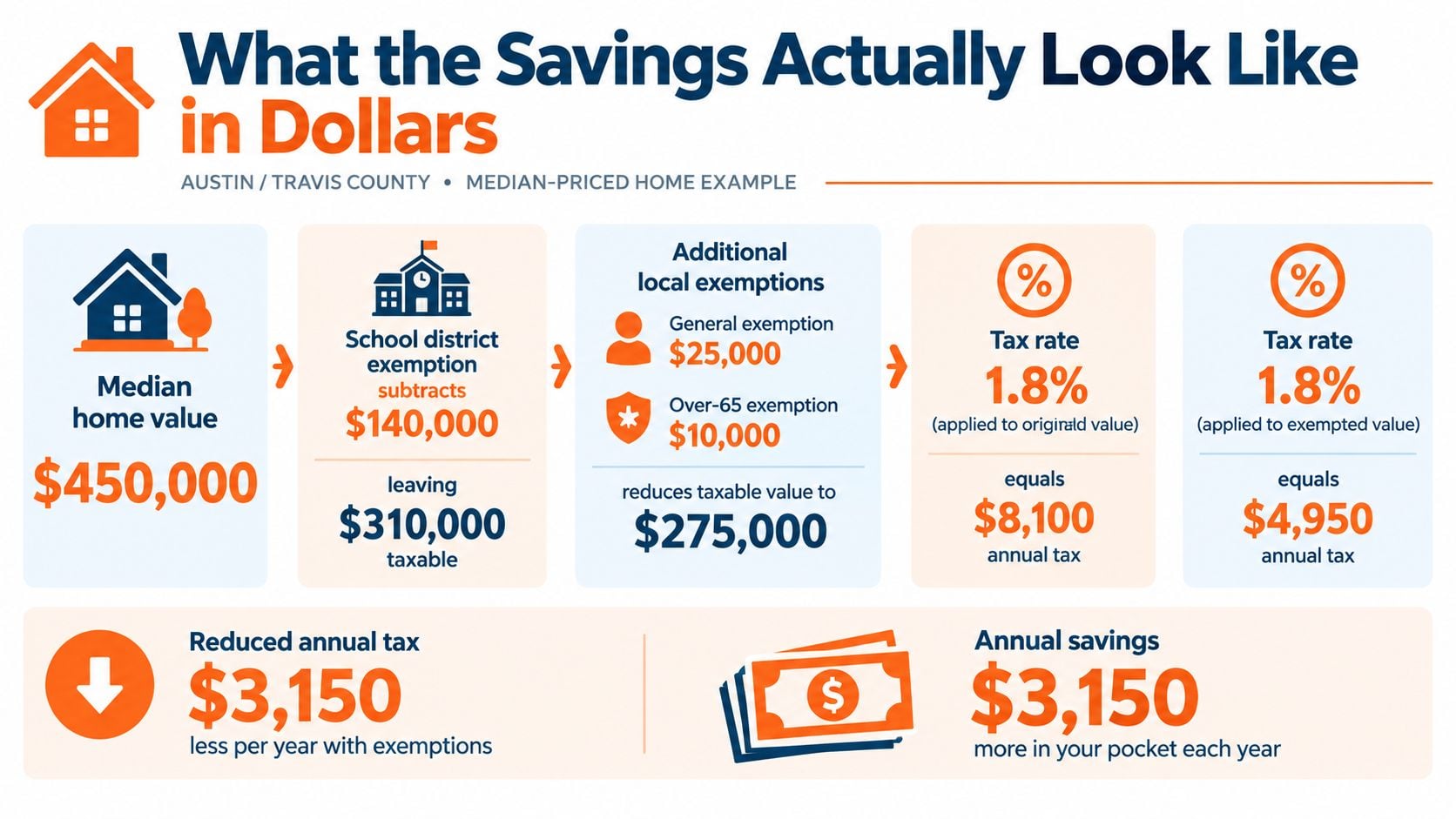
What the Savings Actually Look Like in Dollars
The cash-flow question is more useful than the headline exemption amount. A $140,000 subtraction sounds substantial, but the amount that reaches your bank account depends on the tax rate, the taxing unit, and whether local or special exemptions apply.
A documented Texas Law analysis estimates that, on a median-priced home in Dallas, the general homestead exemption saves at least $2,400 per year, while senior or disability exemptions save at least $5,000 per year. The same analysis says the school-district exemption removes $140,000 from school-tax calculations. The University of Texas Housing Policy Clinic analysis provides those benchmarks.
Read the bill in layers
Use your appraisal notice and tax statement to separate the calculation:
- Start with appraised value. This is the value assigned to the property before exemptions are applied.
- Subtract the school-district homestead amount. The mandatory school exemption removes $140,000 from that district's taxable calculation.
- Check local exemptions. A participating taxing unit may apply a local-option exemption of up to 20% of appraised value.
- Review age or disability benefits. The applicable $60,000 layer and school-tax ceiling can change the result for qualifying owners.
- Compare taxable values by taxing unit. Your school taxable value may not match the county or city taxable value.
For example, the required visual in this article illustrates an Austin and Travis County-style calculation using a $450,000 home value, the $140,000 school subtraction, additional local layers, and an illustrative 1.8% rate. It shows how the taxable value and annual tax can differ when exemptions are applied. Treat that graphic as an example of the arithmetic, not as a promise of your own bill. Your appraisal district, taxing units, exemptions, and rates control the actual result.
Why senior protection changes the budget
A general exemption reduces the taxable base for the current calculation. An age-65 or disability school-tax ceiling addresses a different concern, future predictability. When home values rise, a qualifying owner can have more stability in the school-tax portion than a similarly situated homeowner without that protection.
That doesn't freeze every dollar on the statement. Local tax rates, non-school taxing units, and new improvements can still matter. The point is that a household may receive both an immediate reduction and a longer-term budgeting benefit.
For a personalized calculation, compare the current statement with the appraisal district record and use the Texas homestead exemption savings guide to identify which value reductions may apply. Keep the assumptions visible. If you change the property value, tax rate, or exemption layer, the result changes too.
Eligibility Rules and Deadlines You Cannot Skip
A homestead exemption starts with use and ownership. The property must be the owner's principal residence, and the owner must have an ownership interest. Owning a house in Austin while treating another property as the main home doesn't automatically satisfy the residence requirement.
Texas school districts must provide the $140,000 residence homestead exemption under Texas Tax Code Section 11.13(b). Local taxing units may adopt an additional exemption of up to 20% under Section 11.13(n), but the principal-residence and ownership requirements still apply. The Comptroller's residence homestead exemption page sets out those requirements.
Start with the qualification date
January 1 is the key date for many eligibility questions. If you own and occupy the property as your principal residence on that date, you can generally apply for the tax year's residence homestead treatment, subject to the appraisal district's review and the specific facts.
Age-65 and disability exemptions use the same January 1 framework for the year in which the owner qualifies. Someone moving into a Texas home, aging into the exemption, or becoming eligible under disability rules should preserve documents showing ownership and principal-residence use.
Filing is an action, not a setting
The exemption isn't automatic. Submit the application to the county appraisal district, retain confirmation, and check the next appraisal record to ensure the exemption appears. If you move within Texas, don't assume the exemption and cap follow the property or transfer without review. The new home must be evaluated under its own ownership and residency facts.
A sale or ownership change also removes the existing homestead appraisal limitation. The buyer's future tax calculation can therefore differ sharply from the seller's capped value.

A practical filing checklist
- Confirm the property: Verify that the address is your principal residence.
- Confirm ownership: Gather the deed, closing documents, or other ownership records.
- Check the date: Establish that the relevant ownership and residency facts were in place on January 1.
- Use the county form: Submit the residence homestead application through the local appraisal district.
- Add special status: Include the required information for age, disability, veteran, or surviving-spouse benefits.
- Save proof: Keep the submitted application and confirmation with your property tax records.
- Review the record: Check that the exemption appears before relying on the projected bill.
If you're unsure about the county process or a deadline, use the Texas homestead exemption deadline guide as a starting point, then confirm the current requirements directly with the appraisal district.
How Exemptions Work With Caps, Freezes, and Protests
These protections address different parts of the tax calculation, so they shouldn't be treated as interchangeable.
The exemption removes value from taxation. The homestead appraisal cap limits the annual growth of the appraised value used for taxation after the exemption is in place. The age-65 or disability school-tax ceiling helps control the school-tax portion after qualification. A protest challenges whether the appraisal district's value is higher than the property's legally supportable market value.
One property, several calculations
After the first year, the appraised value used for a qualifying homestead can't exceed the lesser of the current market value or the prior year's appraised value plus 10% plus the value of new improvements. Harris County Appraisal District's explanation of the homestead cap describes that ceiling.
New improvements need separate attention. A new addition or other improvement is assessed at market value first. That value is then incorporated into the capped calculation later, so the cap doesn't make new construction invisible for tax purposes.
The cap also isn't permanent through every ownership change. When the property is sold or ownership changes, the limitation is removed, and the new owner must establish eligibility for the new homestead.
Why a protest still matters
An exemption doesn't prove that the appraisal is correct. It reduces the taxable base after the value is determined. If the appraisal district values the property too high, a protest can challenge that valuation, while the exemption preserves the deductions for which the homeowner qualifies.
That combination requires organized evidence, county-specific deadlines, and a clear record of the property's condition and comparable sales. INTELLI uses licensed property tax consultants and a data-first approach that combines public and private data to review exemptions, valuations, and filing requirements. It can help identify missed exemptions, prepare evidence, and handle property tax matters for eligible clients.
For homeowners focused on senior protections, the Texas property tax freeze resource can help clarify how a freeze fits alongside the other layers. The important distinction is that each tool solves a different problem, and one doesn't substitute for the others.
Making Sure You Capture Every Benefit
Start with the record, not the estimate. Open your county appraisal district account or notice and verify whether the residence homestead exemption appears, which taxing units applied it, and whether the taxable values match the exemptions you expect.
Then check the household facts. An owner who has reached age 65, qualifies under disability rules, or meets veteran or surviving-spouse requirements may need to submit an additional application or supporting documentation. Don't rely on a mortgage servicer's escrow account as proof that the exemption was granted. Escrow pays the bill. It doesn't establish eligibility.
Use this short review list
- Verify homestead status: Confirm that the principal-residence exemption is active.
- Check special eligibility: Review age, disability, veteran, and surviving-spouse possibilities.
- Calendar filing dates: Record the appraisal district's application and protest deadlines.
- Compare values: Check the notice against prior records and your property's actual condition.
- Separate the tools: Use exemptions to reduce the taxable base and protests to challenge an unsupported valuation.
- Keep evidence: Save applications, decisions, notices, photographs, and relevant property records.
The exemption is foundational, but it isn't the only lever. A coordinated review can uncover both a missed exemption and an appraisal problem. INTELLI reports an average reduction of about 15% for its clients, and its results-based model has no upfront costs because the firm is paid only when taxes go down, according to the publisher information provided for this service.
A few hours spent checking the record this year can protect cash flow for every year your family remains in the home. Start by confirming the exemption, then determine whether your appraisal and special eligibility deserve a closer review.
INTELLI helps Texas homeowners identify and file homestead-related exemptions, review appraisal values, and manage county-specific property tax deadlines through licensed consultants and public and private data. Visit INTELLI to request a review of your homestead exemption benefits and find out whether additional savings opportunities may apply.