

A tax bill arrives for your Austin bungalow, and the number is higher than you expected. The house has original windows, a porch that has survived generations of repairs, and a neighborhood character that newer construction can't reproduce. Then a neighbor mentions historic designation and suggests it might reduce the tax burden. The natural question is whether your property qualifies, and whether the financial benefit justifies the rules that come with it.
Historic designation isn't just a reward for owning an old building. It's a formal finding that a property or district has historical significance, retains enough character to communicate that significance, and meets the requirements of the relevant government program. Texas property owners may encounter federal National Register standards, Texas Historical Commission requirements, and city-specific ordinances in places such as Austin and Fort Worth. The practical difference between those systems matters because designation, local review, and tax treatment don't always follow the same path.
Understanding Historic Designation in Texas
Consider a hypothetical Austin homeowner with a 1940s bungalow. The owner has a deed, old family photographs, a few newspaper clippings, and a renovation history showing that the porch and front elevation remain substantially intact. Those materials might support a nomination, but they don't establish eligibility by themselves. The owner still needs to connect the property to a recognized significance theme and show that later work hasn't erased the features that make the house historically legible.

Why the level of designation matters
Federal, state, and local programs don't offer identical outcomes. A National Register listing can document significance at a federal level, while a Texas Historical Commission designation or a local historic designation may be more relevant to a property owner seeking a Texas or municipal tax benefit. Local rules can also affect exterior alterations, so the designation that looks attractive on paper may not fit an owner planning a major addition.
The most useful starting questions are practical:
- What is significant: Is the property associated with an event, person, architectural design, cultural tradition, or archaeological information?
- What remains intact: Can the building still communicate its historic period through its location, setting, design, materials, workmanship, feeling, and association?
- Which authority applies: Is the intended path federal, state, local, or district-based?
- What is the financial outcome: Does the applicable taxing unit offer a benefit, and what conditions control it?
UNESCO's global framework illustrates the underlying logic. A property must demonstrate Outstanding Universal Value, satisfy at least one of ten criteria, and meet integrity, authenticity, and protection or management requirements. Its cultural criteria include tests involving creative achievement, testimony to a cultural tradition, and built or natural environments that illustrate a significant stage in human history. The broader lesson is useful in Texas: age and popularity are not substitutes for documented significance and integrity. UNESCO's explanation of World Heritage criteria shows why formal designation systems rely on evidence rather than reputation.
Start with the property record, not the tax promise
An owner should first assemble the property's legal description, construction history, renovation permits, photographs, maps, and any records connecting it to people or events. A local preservation overlay may add another layer of review, so it's worth checking the applicable historic preservation overlay zone guidance before spending money on a nomination.
Images can be particularly useful when they show the streetscape, neighboring properties, character-defining details, and changes over time. For visual documentation context, property owners and researchers can also browse landmark preservation shoots to see how preservation photography records buildings and their surroundings.
INTELLI uses licensed property tax consultants and employs a data-first approach, using public and private data, to help property owners work through complex designation processes. That approach is relevant because a designation decision requires two separate investigations: whether the property qualifies and what the designation will do to the owner's tax position.
The Three Core Gates of Historic Designation
A technically solid historic designation test has three gates: minimum age, physical integrity, and significance. Texas Historical Commission guidance states that a property is usually at least 50 years old, must retain a relatively high degree of physical integrity, and must have historical significance. Texas Historical Commission guidance on caring for historic property provides the Texas-specific foundation for this screening approach.
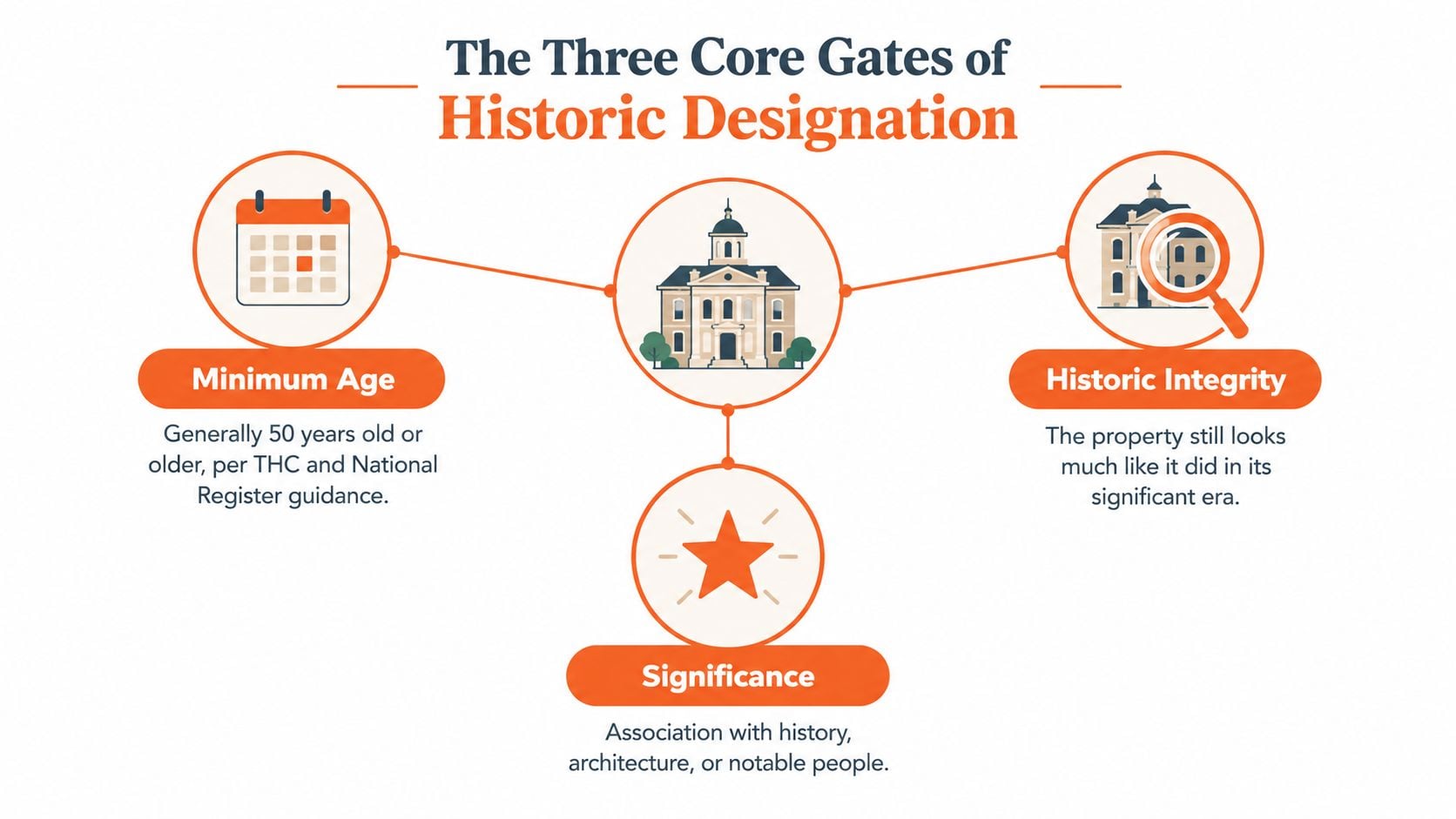
Gate one is age
Age is a threshold, not a conclusion. A property that has reached the commonly used 50-year benchmark may receive further consideration, but the passage of time doesn't prove that it represents an important event, person, design tradition, or source of information. Newer properties aren't automatically excluded, either. Federal guidance treats properties under 50 years old as needing exceptional importance, and Texas applies the same general principle for National Register eligibility.
The age question should be documented with reliable records, such as deeds, building permits, historic maps, directories, archival photographs, or contemporaneous publications. A listing description or real estate estimate may provide a lead, but it usually doesn't carry the same evidentiary weight as a source that establishes when and how the property was built.
Gate two is integrity
Integrity asks whether the property still conveys the qualities that support its significance. The National Register framework evaluates seven aspects:
- Location: The property remains where the important event or development occurred.
- Setting: The surrounding context still helps explain the property.
- Design: The original plan, form, style, and spatial relationships remain readable.
- Materials: Important historic materials have survived.
- Workmanship: Craft techniques and construction details remain visible.
- Feeling: The property still communicates the historic character of its period.
- Association: A visitor can understand the connection to the event, person, or theme.
A 1920s cottage may retain its age but fail this gate if a later remodel removed the porch, replaced the exterior form, altered the roof, and eliminated the original materials. Conversely, a carefully updated property may retain enough character if its significant features remain visible and its alterations don't overwhelm the historic design.
Gate three is significance
Significance explains why the property deserves recognition. The strongest nominations don't merely describe attractive architecture. They establish a defensible relationship to a documented event, notable person, distinctive design or construction, cultural tradition, or archaeological research potential.
Practical rule: Treat the three gates as cumulative. A property that is old but insignificant won't qualify, and a significant property that no longer retains its character may also fail.
Before commissioning a full nomination, test the evidence against all three gates. That early discipline prevents owners from building an application around a compelling story that lacks either physical proof or a qualifying significance argument.
National Register Versus State and Local Designation
The same property can be meaningful at one level of government and less useful at another. A National Register nomination, a Texas landmark designation, and a city designation answer different questions about significance, authority, and practical consequences. Choosing the right path begins with separating recognition from regulation and recognition from tax relief.
Federal recognition
The broader National Register framework uses four historic-significance tests: association with significant events, association with significant persons, distinctive design or construction, and the ability to yield important information through archaeology. The National Historic Landmarks program sets a higher bar. A property must have national significance, retain a high degree of integrity, and be evaluated under six criteria. National Park Service eligibility guidance distinguishes those federal standards from ordinary age-based claims.
A National Register listing can be valuable for documentation, public recognition, and preservation planning. It doesn't automatically answer whether a Texas taxing unit will provide an exemption, and it shouldn't be treated as a universal shield against every local alteration or development decision. Owners must examine the local ordinance and the specific program tied to any financial benefit.
State recognition
The Texas Historical Commission administers state-level landmark pathways, including the Recorded Texas Historic Landmark program. State recognition can provide an official record and marker, but the tax question remains separate. Texas property tax law identifies particular designation categories and requires an exemption structure adopted by the taxing unit before a historic-site exemption applies.
That distinction prevents a common mistake: assuming that any historic recognition automatically changes the appraisal account. The owner needs the designation, the relevant local action, and the records required by the taxing authority.
Local designation
Local designation usually has the most direct effect on exterior work because cities can apply design review standards to properties and districts. It may also be the pathway most closely connected to a municipal tax exemption or preservation incentive. Local criteria can be more specific than federal criteria, particularly for district boundaries, contributing properties, building alterations, and neighborhood context.
A property owner should therefore compare programs using four questions:
| Question | Why it matters |
|---|---|
| What significance level is required? | Local, state, and federal programs may value different forms of importance. |
| What integrity must remain? | A property may qualify at one level but not another. |
| What changes require review? | Local designation can affect exterior renovation planning. |
| What benefit is actually available? | Recognition doesn't guarantee a tax exemption. |
The practical choice isn't always the highest-profile designation. It's the designation whose criteria, obligations, and tax consequences fit the property and the owner's plans.
How Austin and Fort Worth Historic District Criteria Differ
A property owner can receive historic recognition in Texas and still see no automatic change on the next tax bill. Austin and Fort Worth illustrate why the city's criteria, designation category, property use, and filing process matter more than the broad label “historic.”
Austin evaluates district intactness through the relationship between contributing structures and the area's historic character. A local historic district must not have been substantially changed since most buildings were constructed, and at least 51% of principal structures must be contributing, according to Austin's historic district criteria. The city's Austin historic district guidance helps place that threshold in the context of district character, boundaries, and contributing properties. The decision therefore depends on documented neighborhood condition, not on whether the area appears old.
Austin's structure and land treatment
Austin applies its exemption according to property use. Under the local ordinance, an owner-occupied historic residential property or nonprofit-owned property can receive a 100% exemption on the assessed value of the historic structure and a 50% exemption on the land needed for access and use. Other historic property, including commercial property, receives 50% of the historic structure and 25% of the necessary land. Austin's historic tax exemption ordinance sets out these distinctions.
That division affects the taxable portions of the appraisal account. The owner must identify whether the property qualifies as a homestead, nonprofit property, or another use, then determine which structure and land values the exemption covers.
Filing timing also affects the result. Austin requires the application to be filed with the Travis Central Appraisal District between January 1 and April 30 of the requested tax year. The city caps the exemption for a homestead designated after 2004, or a homestead that changed ownership since 2004, at $8,500 annually. Austin's historic preservation resources provides filing and maintenance information.
Fort Worth's criteria and freezes
Fort Worth uses a different designation structure. A property designated as HC must satisfy at least two criteria for significance and integrity. Qualifying Historic and Cultural Landmarks can receive a 10-year tax freeze on the assessed value of land and improvements. Highly Significant and Endangered properties can receive a 15-year tax freeze. Fort Worth historic preservation information explains the categories and durations.
| Austin | Fort Worth |
|---|---|
| District eligibility includes a 51% contributing-structure threshold. | HC designation requires at least two criteria for significance and integrity. |
| Benefits vary by residential, nonprofit, and other use. | Benefits use tax freezes tied to designation category. |
| Applications go through Travis Central Appraisal District between January 1 and April 30. | Freeze duration depends on the local historic category. |
| A qualifying homestead may face an $8,500 annual cap in the stated circumstances. | Highly Significant and Endangered properties receive a 15-year freeze. |
Owners should compare the property's appraisal account, intended use, planned work, and filing obligations before relying on a projected benefit. “Historic tax benefit” describes several local outcomes, not one uniform Texas program.
Documentation Requirements for Historic Nomination
A persuasive nomination turns a property's story into a documented argument. The reviewer needs to understand what happened at the site, why it matters, which features convey that importance, and how confidently the owner can support each conclusion.
Build an evidence file
Start with a property chronology. Record construction, ownership, uses, additions, removals, major repairs, and changes in surrounding context. Then match each event to a source instead of relying on an unsourced family story or a real estate listing.
Useful evidence can include:
- Current photographs: Capture every exterior elevation, important interior spaces, character-defining details, site features, and visible alterations.
- Historic images: Label the date, source, location, and features that can be compared with the current condition.
- Ownership records: Use deeds, directories, census materials where appropriate, and archival records to establish associations with people or events.
- Maps and plans: Compare historic maps, plats, surveys, architectural drawings, and site plans to explain changes in location and setting.
- Written history: Organize the narrative around a significance criterion rather than a general biography of the building.
- District surveys: Document contributing and non-contributing properties, boundaries, streetscape character, and the reason the proposed area functions as a coherent historic resource.
A photographer should document context, not just attractive details. A close-up of an original window proves that the window exists, but a complete elevation shows how that window contributes to the building's design. Interior images can help, although the relevant program may place greater weight on features visible from public areas or on the elements that directly support the significance argument.
Make the argument auditable
The strongest files let a reviewer trace each important claim to a source. If an owner says a prominent architect designed the property, the file should identify the record supporting that connection. If a district survey calls a house contributing, the survey should explain which historic features and associations justify that classification.
A nomination should make the reviewer's job easier. Clear labels, consistent dates, a property map, and a direct connection between evidence and criteria often matter more than a large pile of disconnected material.
Common weak approaches include submitting photographs without captions, presenting a long history without identifying significance, and treating every original feature as equally important. A nomination becomes more credible when it distinguishes character-defining elements from ordinary repairs and explains why the property remains able to convey its historic meaning.
Property Tax Benefits and Limitations of Historic Designation
Historic designation can affect a tax bill, but the benefit begins with a legal designation and ends with the rules of the relevant taxing unit. Texas law doesn't create an automatic exemption for every old or architecturally interesting property.
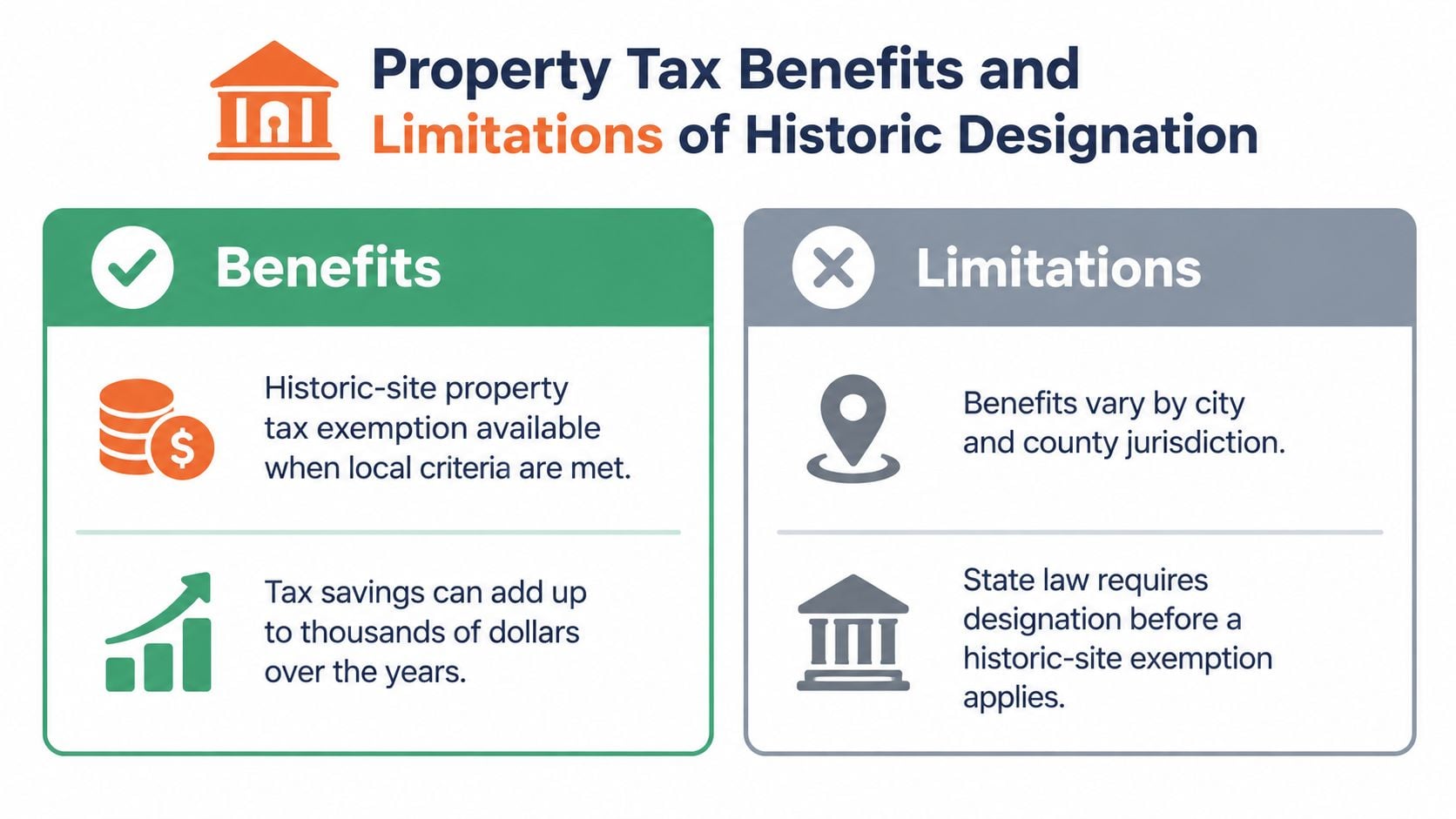
The Texas Comptroller states that a historic-site exemption is available only when the structure is designated as a Recorded Texas Historic Landmark or state archeological landmark by the Texas Historical Commission, or as a historically or archeologically significant site in need of tax relief under a local ordinance. The taxing unit must adopt the exemption through official action, and that taxing unit decides the exemption amount. Texas Comptroller guidance on historic-site exemptions is the key reference for separating legal eligibility from assumptions about savings.
Translate designation into an appraisal question
The relevant calculation isn't “Does the property have historic character?” It's “Which assessed value is covered, which land is included, what percentage or amount applies, and what filing or maintenance conditions must be met?” Austin's use-based structure demonstrates why two properties with similar architecture can receive different treatment when one is owner-occupied residential property and the other is commercial property.
For an owner, the analysis should include:
- Designation status: Confirm that the property holds the designation required by the exemption program.
- Taxing-unit action: Verify that the relevant taxing unit adopted the exemption.
- Covered property: Identify whether the benefit applies to the historic structure, necessary land, or both.
- Filing calendar: Confirm the application deadline and supporting records.
- Maintenance standard: Determine what condition the property must maintain to keep the benefit.
A tax estimate should replace a slogan. Compare the potential exemption with the cost of eligible repairs, professional documentation, design review, and any delay to planned work. A benefit can be meaningful over time, but the owner shouldn't assume that the entire parcel or every improvement receives identical treatment.
A short visual overview may help explain why designation and tax treatment must be considered together:
Account for the restrictions
Local designation can require review of exterior modifications. Replacing windows, changing a roof form, adding an addition, removing architectural details, or altering a visible façade may require plans and approval, depending on the local ordinance. Maintenance standards can also create an ongoing obligation, rather than a one-time application task.
The trade-off is clearest for an owner planning a major renovation. If the project depends on substantial exterior changes, the review process may reduce design flexibility and add professional costs. If the owner intends to preserve the building and can work within the standards, the same process may protect the character that made the property valuable in the first place.
Owners who want to evaluate the tax side can review INTELLI's Texas property tax services alongside the applicable city and county rules. The decision should rest on the actual account, the applicable designation, and the owner's renovation plans, not on a generalized claim that all historic properties receive the same relief.
When Historic Designation Makes Sense for Texas Property Owners
Historic designation isn't automatically a burden, and it isn't automatically a tax strategy. It makes sense when the owner values preservation, the property has a well-supported significance argument, and the available benefit justifies the restrictions and administration.
A designation may fit when:
- The evidence is strong: The property has a documented connection to a qualifying event, person, design, tradition, or research theme.
- The character remains visible: Original form, materials, setting, and workmanship still communicate the period of significance.
- The owner plans compatible work: Repairs and improvements can respect the features that support the designation.
- The district benefit matters: Neighborhood designation can help protect a coherent streetscape from incompatible alterations.
- The tax result is concrete: The applicable taxing unit has adopted a benefit, and the owner can estimate its effect on the actual account.
It may be a poor fit when the owner expects to remove significant exterior features, add a highly visible incompatible addition, or change the property without review. The same is true when the available tax relief is modest relative to professional fees, maintenance requirements, and the administrative effort of compliance.
Before applying, verify the designation level, test the property against age, integrity, and significance, and build a record that connects every major claim to evidence. Then compare the expected tax treatment with planned renovation costs and the time required for local review. A licensed property tax consultant familiar with Texas designation processes can help evaluate that decision, but the owner still needs to understand the preservation obligations attached to the designation.
Historic designation works best as a coordinated preservation and tax decision. Treating it only as a way to lower an assessment leaves out the restrictions. Treating it only as a restriction leaves out the recognition, neighborhood protection, and possible tax relief that local programs can provide.
INTELLI helps Texas homeowners, investors, and businesses evaluate property tax reduction opportunities, prepare evidence, and manage exemption applications and deadlines, including historic-property questions. Visit INTELLI to review your options and determine whether historic designation fits your property, tax account, and renovation plans.