
If you opened your Caldwell County notice and your first thought was, “Why did this go up again?”, you're in good company. A lot of homeowners in Lockhart, Luling, and the rural edges of the county are seeing a new appraised value, a new bill, or both, and trying to figure out which number matters.
The short answer is that Caldwell County property taxes aren't one bill from one office. They're the result of an appraisal, then several tax rates layered on top of that value, then exemptions, deadlines, and sometimes a protest or refund claim. Once you understand the parts, the bill stops looking mysterious and starts looking manageable.
Where the Caldwell County Property Tax Bill Comes From
A Lockhart homeowner opens the mail and sees a bigger number than expected after the 2025 revaluation. The first reaction is usually to blame the county tax office, but that is only one piece of the picture. The bill starts with a value set by the appraisal district, then the county and other taxing units add their own rates on top of it.

The value comes first
The Caldwell County Appraisal District assigns the assessed value. In Texas, the key starting point is market value, then taxable value after exemptions or special treatment. If the value is too high, every rate that follows gets applied to a bigger base.
That is why homeowners often compare a property-tax notice to other household bills and get frustrated. Property taxes work more like a chain than a single fee. If the first link is off, the final number is off too.
More than one taxing unit adds its own rate
The county rate is only one part of the total. Cities, school districts, and special districts each set their own levy, then those rates are added together on the statement the owner pays. A homeowner in a city limits area can therefore pay a very different total than a rural owner with the same market value.
A useful mental model is this, value first, rates second, exemptions in the middle, then the final bill. That pipeline helps you decide what to challenge. If the value is wrong, protest it. If the exemption is missing, fix it. If the rate changed, check the budget documents.
For a plain-language comparison of how tax forms are assembled, the federal AGI calculation shows the same basic pattern, one number built from several inputs, see how the IRS figures your AGI. A property tax bill is not income tax, but the organizing idea is similar, you have to understand each piece before you can tell which piece is wrong.
The county tax rate itself comes from budget work done by the taxing units and the appraisal district's value base. If you want to estimate what a rate change means for your home, use INTELLI's property tax rate calculation guide to turn the posted rate into a dollar figure you can check against your notice.
Practical rule: don't argue about the bill until you know which part is wrong.
How Caldwell County Property Tax Rates Are Set
The math is simple, even if the paperwork isn't. Assessed value multiplied by the combined tax rate equals the tax bill. In Texas, taxable property is assessed at 100% of appraised value according to the state DOR, so if the appraisal goes up, the bill can rise even when the rate stays flat. For North Carolina Caldwell County, the 2025 county rate is $0.4975 per $100 of appraised value, which means every $100,000 of taxable value generates about $497.50 in county tax before other levies are added. NC DOR county tax rates
Caldwell County, Texas rate movement
Caldwell County, Texas shows how much rates can change over time. The adopted property tax rate fell from $0.7053 per $100 in 2020 to $0.4390 in 2024, a drop of about 37.8% over four tax years. The same county table shows the maintenance and operation rate declined from $0.6683 to $0.4035, while the debt rate stayed constant at $0.0355 in 2021 through 2024. Caldwell County tax-related information
That matters because the rate line on a notice can look stable while the bill still changes. The county's no-new-revenue tax rate also moved from $0.6968 in 2020 to $0.4391 in 2024, which shows how the tax structure shifted over time. A homeowner who reads only the final bill misses the reason behind it.
Budget rate decisions drive the next year
For 2023-2024, Caldwell County, Texas said its budget would raise $287,618.86 more in property taxes than the prior year, a 1.24% increase. The county's budget documents also list a total combined tax rate of $0.5532 per $100 valuation for that fiscal year. In later 2025-2026 budget materials, the current fiscal year tax rate is shown as $0.4391 per $100 and the voter-approval tax rate as $0.5326. P. O'Connor Caldwell County 2024 property tax page
The county's adopted FY 2025-2026 budget shows a no-new-revenue tax rate of $0.4299 and a voter-approval tax rate of $0.5326, while the adopted current rate remains $0.4391 per $100. It also projects collection on an estimated 97% collection rate from $11.12 billion in taxable valuation, which is why a flat nominal rate can still generate more revenue if the tax base grows. FY 2025-2026 adopted budget
A reappraisal changes the base, a budget changes the rate, and both can move the bill at the same time.
For a deeper walk-through of the rate formula, INTELLI's property tax rate guide lays out the mechanics in plain English.
Texas Exemptions Available to Caldwell County Property Owners
Most owners think of exemptions as paperwork. They're really taxable-value reducers, and that's a big difference. If the county values your home correctly but the exemption is missing, you can still overpay because the taxable base is too high.
The main exemptions that matter most
A homestead exemption lowers taxable value on a primary residence. An Over-65 exemption can freeze the school portion of the bill at the level it stood when the owner turned 65, which is one of the few protections that feels immediate in day-to-day budgeting. A Disabled Veteran exemption depends on disability rating, and it can reduce or eliminate taxes on qualifying property.
Agricultural valuation and historic designations work differently. They protect properties that are being used in a qualifying way, not just owned in a qualifying way. That matters for small ranch tracts, family land, and designated historic properties that would otherwise be taxed like ordinary market-value real estate.
Filing timing matters as much as eligibility
The missed exemption is the silent problem. An owner can qualify and still pay more than necessary for a full year if the application doesn't reach the appraisal district on time. That's why filing status should be checked before the bill becomes a payment habit.
Here's a quick comparison you can use with the Caldwell County appraisal district.
| Exemption | Who Qualifies | What It Does | Typical Filing Window |
|---|---|---|---|
| Homestead | Primary residence owner | Lowers taxable value | File as soon as the home is your main residence |
| Over-65 | Eligible senior homeowner | Freezes the school tax portion at the qualifying level | File after reaching qualifying age |
| Disabled Veteran | Qualifying veteran with disability rating | Reduces taxable value based on rating | File once federal or state disability documentation is available |
| Agricultural valuation | Property used for qualifying ag use | Taxes land by use, not full market treatment | File when use qualifies and records support it |
| Historic designation | Designated historic property | May reduce taxable burden under local rules | File when the designation and supporting records are in place |
Caldwell County's own rate materials show why these filings matter. The county's 2024 adopted rate of $0.4390 and the later 2025 adopted rate of $0.4391 are close on paper, but the taxable value underneath them can be very different. When the base is too high, even a small rate shift leaves the owner with a bigger bill than expected. Caldwell County tax-related information
For a detailed filing overview, INTELLI's Texas exemption guide is a useful reference for homeowners comparing eligibility, documents, and deadlines.
Filing a Property Tax Protest in Caldwell County
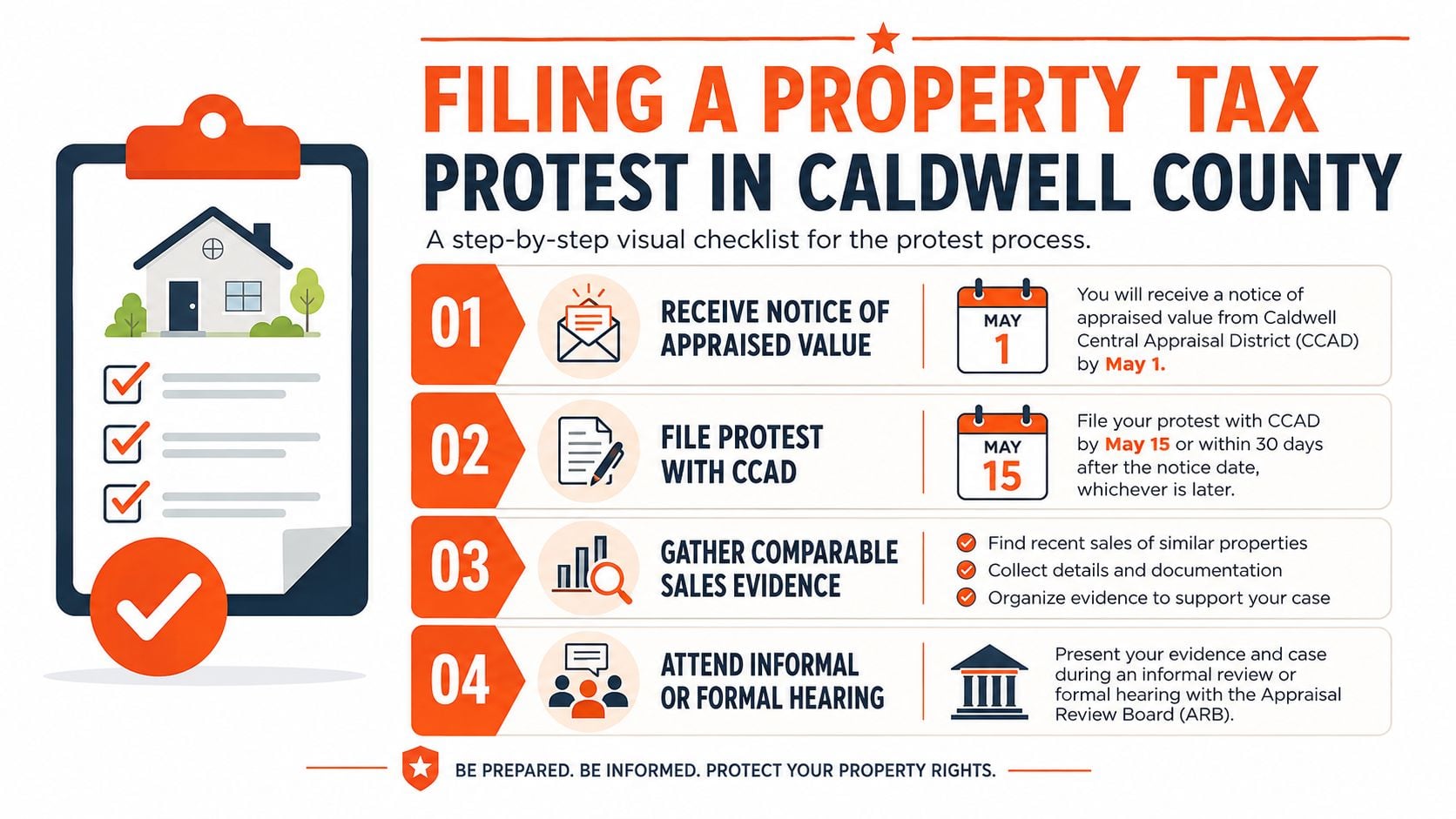
A property tax protest is a records check with evidence, not a fight. If the appraisal district's number is too high, the goal is to show why the value does not match the property's condition, the local market, or the income profile.
Start with the notice, not your frustration
The notice of appraised value is the starting point. Read the property description, the land size, any improvements, and the appraised amount before deciding what to do next. If something is clearly off, an informal review can resolve the issue before a formal hearing becomes necessary.
The evidence that usually matters is plain and specific. Comparable sales, condition problems, and income data for rentals tend to carry more weight than broad complaints. A form letter that says the bill is too high usually does not move the file very far.
Informal review first, formal hearing second
Many owners get a better result by starting with the appraisal district. If the data is solid, the district may agree to a correction without a formal hearing. If it does not, the Appraisal Review Board hearing gives the owner a more structured chance to present the case.
Deadlines are where people lose ground. The protest has to be filed by the deadline on the notice, and that deadline can be short. Waiting until the end of the season to gather evidence can leave you with a complete file and no open window to use it.
If you want a broader procedural map, INTELLI's protest guide walks through the Texas protest process in plain terms. For owners who also watch delinquent-property outcomes or tax-sale timing, 2026 Harris County tax sales from PropLab can be a useful comparison point, even though the rules and market dynamics are different.
For a visual walkthrough of the protest hearing process, watch this short guide:
Best evidence wins: a clean comp set and solid condition photos beat a generic complaint every time.
Disaster and Damage Adjustments After the 2025 Revaluation
The 2025 revaluation left some Caldwell County owners dealing with a second problem, damage that never got properly reflected in the new value. County appraisal materials and the 2025 revaluation update said owners received new appraised values by mail and could request review if values seemed unfair or didn't reflect damage. The update specifically called out properties structurally damaged by Hurricane Helene and not repaired by January 1, 2025 as candidates for review. Caldwell County revaluation update
Damage review is not the same as a routine protest
A routine protest argues that the market value is too high. A damage adjustment argues that the property wasn't in normal condition when the value was set. That distinction matters because the evidence changes too.
Insurance documentation, contractor estimates, repair invoices, and dated photos are the records that usually tell the story best. A homeowner with wall damage, roof loss, or structural repair work should make the file tell the same story the property tells in person. If the county can see the condition clearly, it's harder to defend a number that assumes everything was intact.
Use the disaster evidence in the right order
The cleanest path is to gather the damage file first, then decide whether to pursue an informal review or a formal protest. If the value was set without fully accounting for the damage, the same evidence can support both a district review and an ARB hearing. The mistake is waiting for a generic tax-faq page to explain a disaster-specific valuation issue that needs property-specific proof.
That's why many broad Texas tax guides fall short here. They talk about protests in general, but they don't address the timing of repair, the effect of storm damage on appraised value, or the way a post-disaster review can sit alongside a normal appraisal challenge. Owners who were impacted by Helene should treat documentation as the first step, not the last one.
Requesting Refunds and Recovering Past Overcharges
A homeowner in Lenoir or a nearby rural tract owner may do everything right this year and still have paid too much in a prior year. That's where a property-tax recovery audit comes in. It looks backward, not forward, and asks whether the prior bill was larger than it should have been.
A prior overcharge is not lost money
The practical value of a recovery audit is simple. If a past valuation was inflated, the owner may still be able to seek a correction within the allowable window. Texas commonly uses a two-year window for corrections, so the timeline matters just as much as the evidence.
The best support usually includes closing statements, past appraisal notices, and any prior-year tax documents the owner kept. Historical valuation data also matters because a refund claim isn't just about saying “this looked too high.” It's about showing how the earlier number compared with market evidence at the time.
A real-world pattern owners recognize
A storm-impacted owner often starts with the current year. The roof is damaged, the appraised value doesn't reflect the condition, and the protest file is built around photos and repair records. Later, the same owner realizes the prior year was also overstated because the damage began before the new notice arrived. That's when the recovery audit becomes useful.
INTELLI conducts these audits on a no-recovery, no-fee basis, then folds the findings into the current-year protest work so the owner isn't trying to manage two separate calendars. That approach matters because the refund claim and the live protest often use some of the same files, just pointed at different tax years.
If the paper trail is strong, the refund claim can be a correction, not a guess.
Common Caldwell County Tax Pitfalls and How to Avoid Them
The most expensive mistakes are usually quiet. A homeowner doesn't miss a giant deadline because the system failed. They miss it because the notice looked routine, the exemption seemed automatic, or the appraisal number got treated like a final judgment instead of a reviewable estimate.
The mistakes that come up most often
- Missing exemption filings: The owner qualifies but never submits the form, so the tax base stays too high.
- Treating the notice as the final bill: The notice is the starting point for review, not the end of the process.
- Mixing up county rate and total rate: The county rate is only one layer of the full tax burden.
- Ignoring agricultural valuation rules: Small tracts and working land need separate review, not guesswork.
- Assuming a flat rate means a flat bill: If the appraisal base rises, the bill can rise too even when the rate barely moves.
These errors show up in real files because property tax forms aren't written for casual readers. A licensed consultant brings local judgment to the file, which matters when the same valuation issue can look different on a homestead, rental, or acreage parcel.
What to gather before the next bill lands
A simple pre-bill folder can save a lot of stress later. Keep your latest appraisal notice, exemption confirmations, closing statement if you bought recently, and any photos or repair records if the property changed condition. If you own a rental, keep lease and income records too, since income can matter in valuation review.
INTELLI uses licensed property tax consultants and employs a data-first approach, using public and private data to build the evidence file. It also handles tax recovery audits on a no-recovery, no-fee basis, so the owner isn't paying for a search that never produces a result.
Your Caldwell County Tax Action Plan and Key Contacts
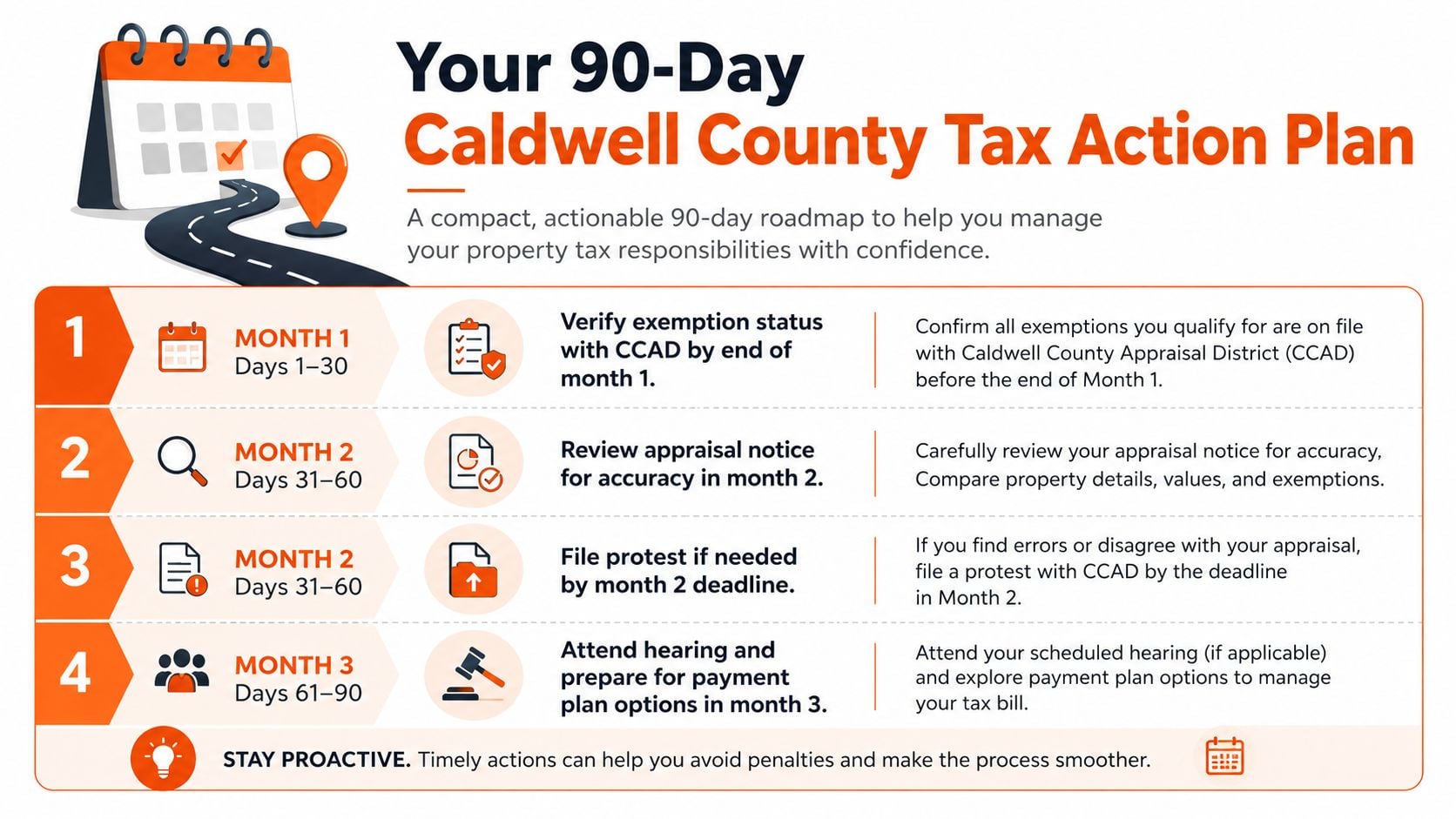
The smartest move is to treat property taxes like a short annual project, not a once-a-decade headache. A good next 90 days starts with checking your exemption status, then reviewing the appraisal notice, then deciding whether the evidence supports a protest or a refund claim. If you own more than one property, use the same checklist on each parcel, because one missing exemption can hide inside a larger portfolio.
The offices to keep on your radar
The main places to check are the Caldwell County Appraisal District, the Caldwell County Tax Office, and county budget resources that publish the adopted rate and levy information. Those are the offices that tell you what was valued, what was billed, and what the county budgeted to collect.
If you're deciding whether to go alone or hire help, think about the complexity of the file. A straightforward homestead with a clean comp set may be manageable on your own. A mixed file with exemptions, damage, or prior-year overcharges usually benefits from consultant review.
A simple 90-day checklist
- Month 1: verify exemption status with CCAD.
- Month 2: review the appraisal notice for accuracy and gather evidence.
- Month 2 deadline: file a protest if the value looks wrong.
- Month 3: attend the hearing and prepare for payment-plan questions if needed.
The practical goal is not to fight every bill. It's to make sure you're only paying what the property really supports. That's where INTELLI fits naturally, because its licensed consultants use public and private data to build a property-specific case for current-year protests and past-year recovery work.
If you want a second set of eyes on your Caldwell County notice, exemption status, or past overpayments, visit INTELLI and start with a property review. Their licensed consultants work from a data-first file, so you're not guessing at value, deadlines, or refund opportunities.