
Your protest deadline depends on when the appraisal district mailed your Notice of Appraised Value, not when the envelope reached your mailbox. The standard deadline is May 15. If the notice was mailed after April 15, count 30 days from its mailing date. If that gives you a later date, the later date controls.
Notices go to more than 488,000 Travis County property owners, and they may be mailed on different days. That means your deadline can differ from a neighbor's, even if your homes are on the same block. Check the mailing date printed on your notice rather than relying on when it arrived.
Keep the protest deadline in view alongside the rest of your tax-year calendar. Filing a protest addresses the appraised value, while a missing homestead or other exemption can still affect what you owe. Exemption applications are due April 30, so handle that filing separately; winning a valuation dispute does not replace an exemption application.
Your Protest Deadline at a Glance
For most Travis County owners, the standard protest deadline is May 15, 2026. The Travis County Tax Office property tax calendar lists May 15 as the last day to file property tax protests with TCAD.
The exception is the 30-day rule. If the district mailed your Notice of Appraised Value after April 15, count 30 days from that mailing date. When that count lands after May 15, the later date controls.
| Situation | Deadline | Rule that controls |
|---|---|---|
| Notice mailed on or before April 15, 2026 | May 15, 2026 | May 15 controls; the 30-day date is no later |
| Notice mailed April 20, 2026 | May 20, 2026 | 30-day date controls |
| Notice mailed April 25, 2026 | May 25, 2026 | 30-day date controls |
| Notice mailed May 1, 2026 | May 31, 2026 | 30-day date controls |
| Deadline falls on a Saturday, Sunday or legal holiday | Next regular business day | Texas Tax Code Section 1.06 |
| Exemption application (not a protest) | April 30, 2026 | Separate deadline; a protest does not replace it |
Three actions before you circle a date
Find the mailing date. It is printed on the notice. Don't use the day the letter showed up in the mailbox.
Count 30 days forward. April 20 becomes May 20. April 25 becomes May 25. May 1 becomes May 31.
Circle the later date. Keep whichever date gives you more time, then set a reminder two weeks earlier so filing isn't a midnight task.
The table is a starting point until you confirm the date printed on your own notice. The calendar runs from the mailing date, not from a guess about when the carrier arrived.
Why the Mailing Date Starts Your Protest Clock
The mailing date is the starting gun, not the moment the envelope hits the counter. A slow route doesn't stretch the course. You still finish on the statutory clock.
Texas law generally requires a notice of protest with the county Appraisal Review Board by midnight on May 15, unless a later deadline applies. The Texas Comptroller protest guide states the alternative: 30 days after the appraisal district mails the notice of appraised value, with the later date controlling. The count uses the mailing date, not the day you receive the notice. Travis Central Appraisal District uses the same local rule. If May 15 falls on a Saturday, Sunday, or legal state or national holiday, Texas Tax Code Section 1.06 moves that deadline to the next regular business day.
Match the protest to the notice
The notice supplies filing instructions and identifies the value, exemption, or other district action being challenged. Read what a Notice of Appraised Value shows before you complete the form. A market-value dispute, an unequal-appraisal argument, and a denied exemption each need their own accurate reference. Checking only the dollar figure, and skipping a removed homestead, is how owners win the wrong fight.
A missing or late notice doesn't pause the clock. Call TCAD the day you spot the gap, write down the date and the name of the person you spoke with, and keep any proof of delivery.
- Mailing date confirmed on the notice, with the postmark kept if you still have the envelope.
- 30 days counted from that date, then the later date marked.
- Reminder set two weeks before the filing day.
Exceptions and Worked Examples That Move the Date
Owners often assume one countywide day covers every account. These short cases show when it doesn't.
A weekend deadline. Say May 15, 2027 falls on a Saturday. Under Texas Tax Code Section 1.06, the protest date moves to Monday, May 17, 2027. Use that only as a picture of the rule. The 2027 calendar isn't set for owners yet, and your notice still has to be checked when it arrives.
A late-mailed notice. A notice mailed April 25, 2026 produces a May 25 deadline, ten days past the standard date. Filing on May 15 is safe. Waiting until May 16 because you thought the standard day had passed is not, if you never counted.
Several parcels. A home plus two rental lots can arrive as three notices with three mailing dates. Each account gets its own count. The earliest of those dates is the one that should drive your reminder.
An authorized agent. An agent may file for you, but the authorization has to be in place before the deadline, not scribbled on the deadline itself.
An exemption-only dispute. If the notice shows a denied or reduced exemption, the protest has to address that exemption, not only market value.
What is not an exception: slow mail, a missed email, or a pending exemption application. None of those extend the date. Write down which case matches your property, and set the reminder to the earliest date that applies.
Your Annual Calendar From Exemptions to Hearings
The annual property tax calendar has separate deadlines that work like relay handoffs. Filing a value protest does not replace an exemption application due in April.
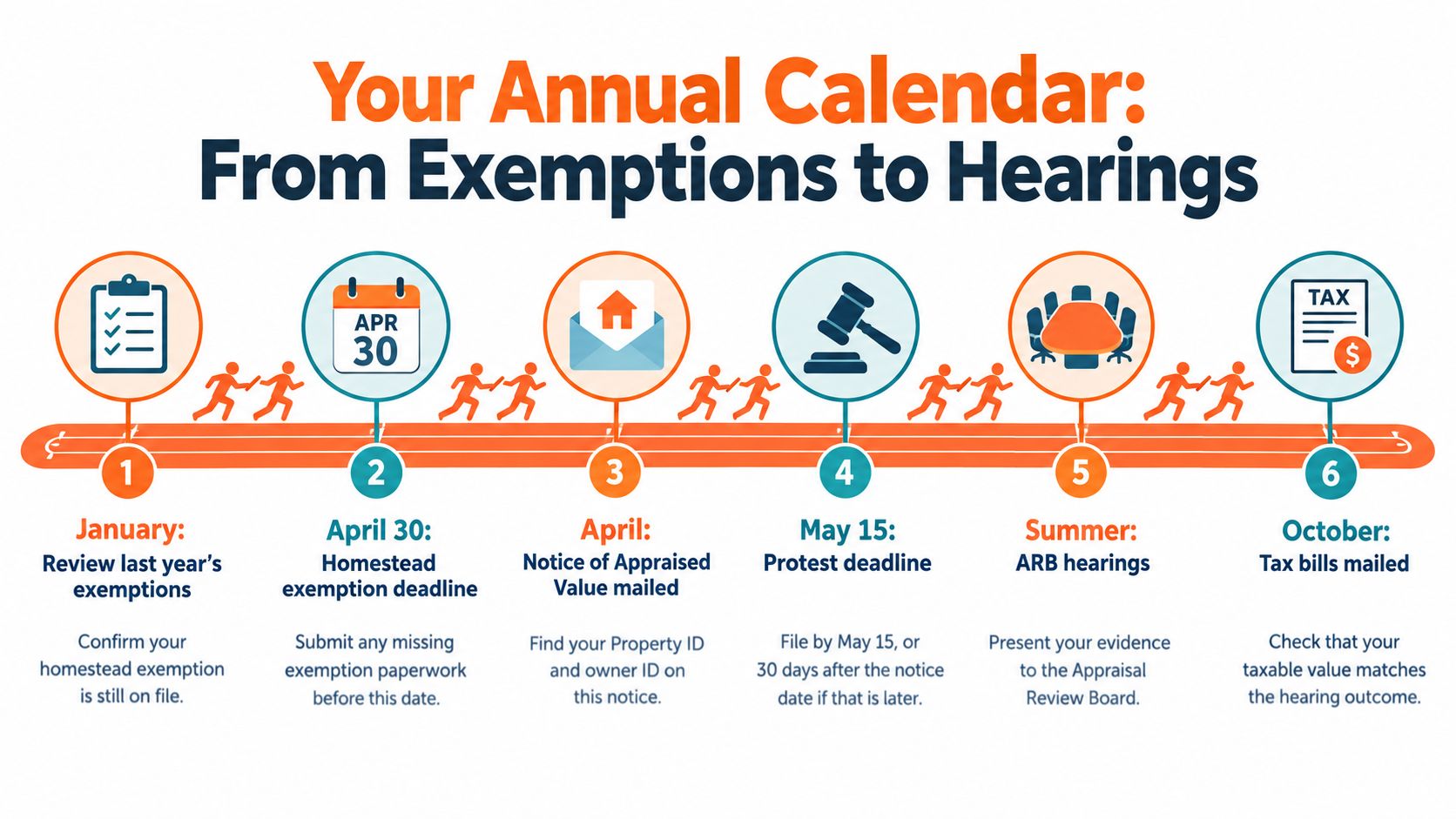
Start early in the year by comparing last year's notice with current sales, rents, and notes about the property's condition. The dates then fall into sequence: Texas Comptroller guidance identifies April 30 as the usual deadline for most exemption and special-appraisal applications. Most value protests are due May 15 or 30 days after the appraisal notice is mailed, whichever is later. TCAD publishes its informal process and ARB hearing schedule for each protest season on its protests page, so check there for the current schedule.
Where owners still overpay after a win
Homestead, over-65, disabled-person, disabled-veteran, and agricultural applications follow the April 30 timeline. A lower market value does not make up for an eligible exemption that is missing or misapplied. An ownership change may also affect the taxable value shown on the notice while a protest is pending.
Check exemption status before April 30, even if you plan to protest. Keep separate reminders for the exemption application and the protest deadline. Owners can customize calendar alerts in Google to track both handoffs. Travis County exemption rules are distinct from the value dispute, so include both on your annual calendar.
How to File a Protest Before the Deadline
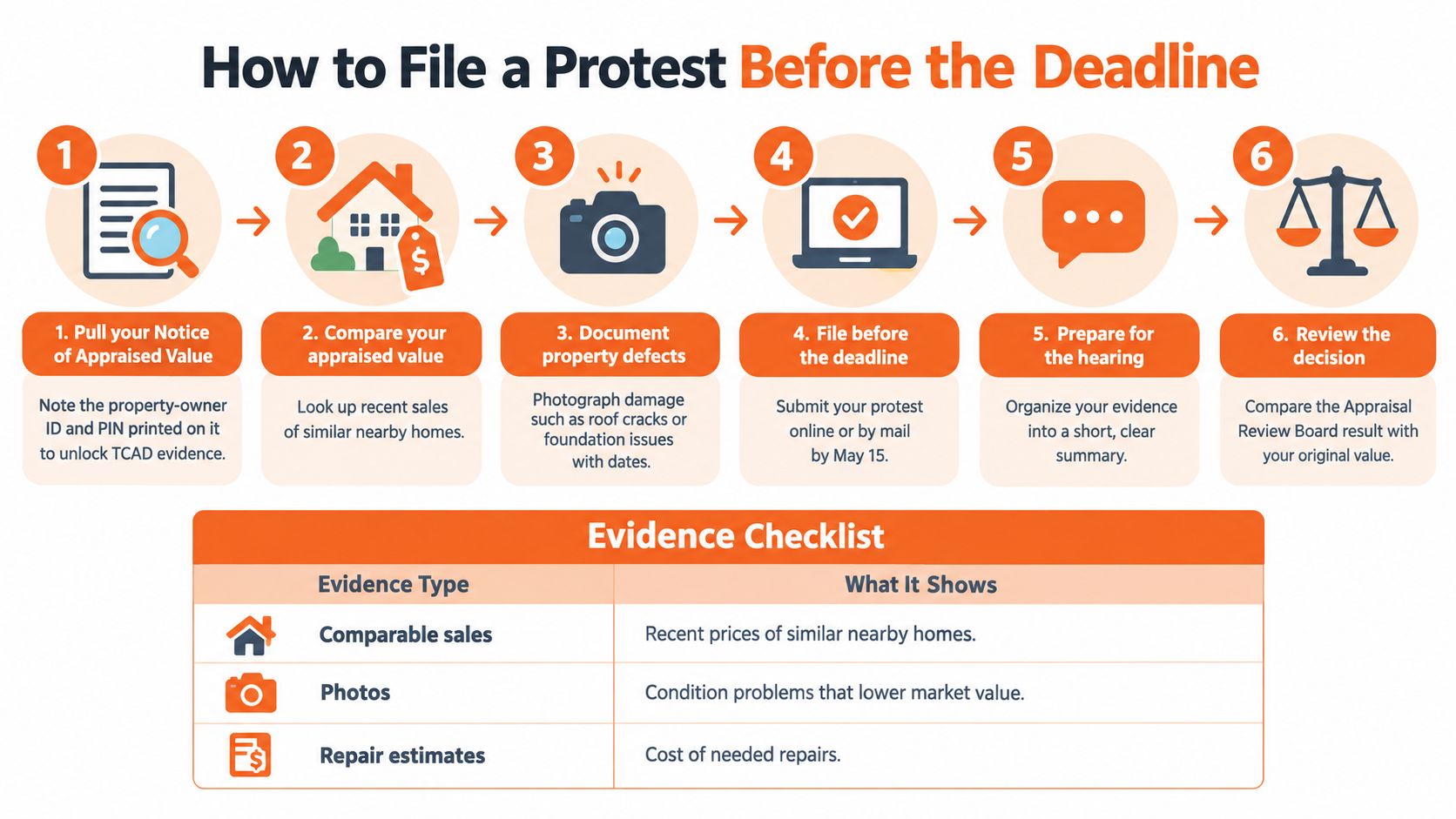
Start with the notice. Travis Central Appraisal District allows owners to file online, receive immediate confirmation, upload comments and evidence, review the district's evidence, and accept or reject a settlement offer in an online account. The property-owner ID and PIN printed on the Notice of Appraised Value give you access to the evidence packet.
The filing sequence
- Find your notice and record the owner ID and PIN. You need these codes to open TCAD's evidence packet and review the district's comparable properties.
- Check the value, exemptions, and property details. Compare the notice with your deed, survey, and prior-year account. Flag errors such as incorrect square footage or a missing homestead exemption before focusing on price.
- Gather evidence that fits your property. Recent sales, condition photos, repair invoices, rent rolls, and exemption paperwork support different parts of your case.
- File online and save the confirmation. It records that TCAD received your protest. For a closer explanation of the reasons and forms, see this guide to protesting Texas property taxes.
- Upload your comments and evidence, then review the district's packet. Keep an eye on the account for settlement offers as your case proceeds.
- Meet informally with a TCAD appraiser. Review any offer and decide whether to accept it. If you reject it, your case can proceed to an Appraisal Review Board hearing.
- Prepare a one-page value summary and your strongest comparable properties. At the hearing, lead with evidence about value rather than the tax rate.
- Keep track of the written decision. Check the next tax bill to confirm that the settled value is reflected.
| Property type | Core evidence | Supporting documents and gaps |
|---|---|---|
| Homestead | Recent sales of similar nearby homes | Condition photos, repair invoices, exemption confirmation; check whether the exemption is on file |
| Rental portfolio | Comparable sales and rent comparables per unit | Rent rolls, operating expenses, vacancy records; check for missing unit-level data |
| Commercial property | Income approach data and comparable sales | Leases, operating statements, capital repair records; check for gaps in lease history |
The video below follows the same progression, from reviewing the notice to preparing for a hearing.
What Happens If You Miss the Protest Deadline
A missed protest deadline generally means you lose the right to challenge that year's appraised value before the Appraisal Review Board. The value on the appraisal roll stands, and the tax bill is calculated on it.
Say a home is on the roll at $500,000 and a supported market value was $420,000. That is an $80,000 gap in taxable value for the year. At an illustrative combined rate of 2.0 percent, not a Travis County rate, the gap costs about $1,600 for each year that value stands. The point isn't the rate. It's that the gap doesn't shrink on its own once the roll is certified.
A late filing isn't a second chance at the same year. The next year brings a new notice, a new mailing date, and a new clock.
Property tax bills are generally due by January 31 of the following year, so the cost of a missed protest arrives on a fixed schedule. Some clerical errors can go through a separate correction process, and past overcharges can be pursued through other routes. Each route has its own rules and timelines. Verify any of them with TCAD or a licensed professional before you rely on it.
Confirm Your Date and Choose Your Filing Route
Once you confirm the notice's mailing date, choose a filing route that fits your property and the time you have. A homeowner with a straightforward homestead and clear documentation may be able to file through TCAD. A rental portfolio, commercial property, or a notice showing a substantial value gap may call for professional representation. Either way, keep the protest deadline and exemption calendar separate: qualifying exemptions generally must be claimed by April 30.

| Factor | Self-filing | Property tax service |
|---|---|---|
| Filing cost | No TCAD filing fee; your time is the cost | INTELLI uses a results-based model and is paid only when taxes go down |
| Deadline tracking | You count 30 days from the mailing date yourself | A service can help track protest and exemption dates |
| Evidence building | You gather comparable sales and property photos yourself | INTELLI uses a proprietary, data-driven system to prepare valuation evidence |
| Hearing support | You present your own case at the hearing | INTELLI represents clients before county appraisal districts |
| Best fit | A straightforward homestead with documented errors | Rental portfolios, commercial property, or a substantial valuation gap |
INTELLI helps homeowners, investors, and businesses challenge property valuations and pursue eligible exemptions. Its proprietary, data-driven system prepares valuation evidence, and the firm represents clients before county appraisal districts. INTELLI also handles exemption applications and deadlines. Fee arrangements can differ by provider, so confirm the terms with the service before signing.
Use this checklist to keep both calendars in view:
- Confirm the mailing date printed on your notice, then calculate the protest deadline.
- Check eligible exemptions and submit applications by April 30.
- Gather evidence that fits your property, such as comparable sales or photos.
- File before the protest deadline and save your confirmation.
- Review the written decision and compare it with your tax bill.
INTELLI can help Travis County owners manage the value challenge and exemption process. It uses its data-driven system to prepare evidence and represents clients before appraisal districts. To ask about its process and fees, visit INTELLI.